Top Accounting Courses After 12th Grade: Pathways & Eligibility 2026
After completing 12th, accounting students can pursue UG, PG and Professional level education. Take a detailed look at accounting courses after 12th with all the key details in this article.
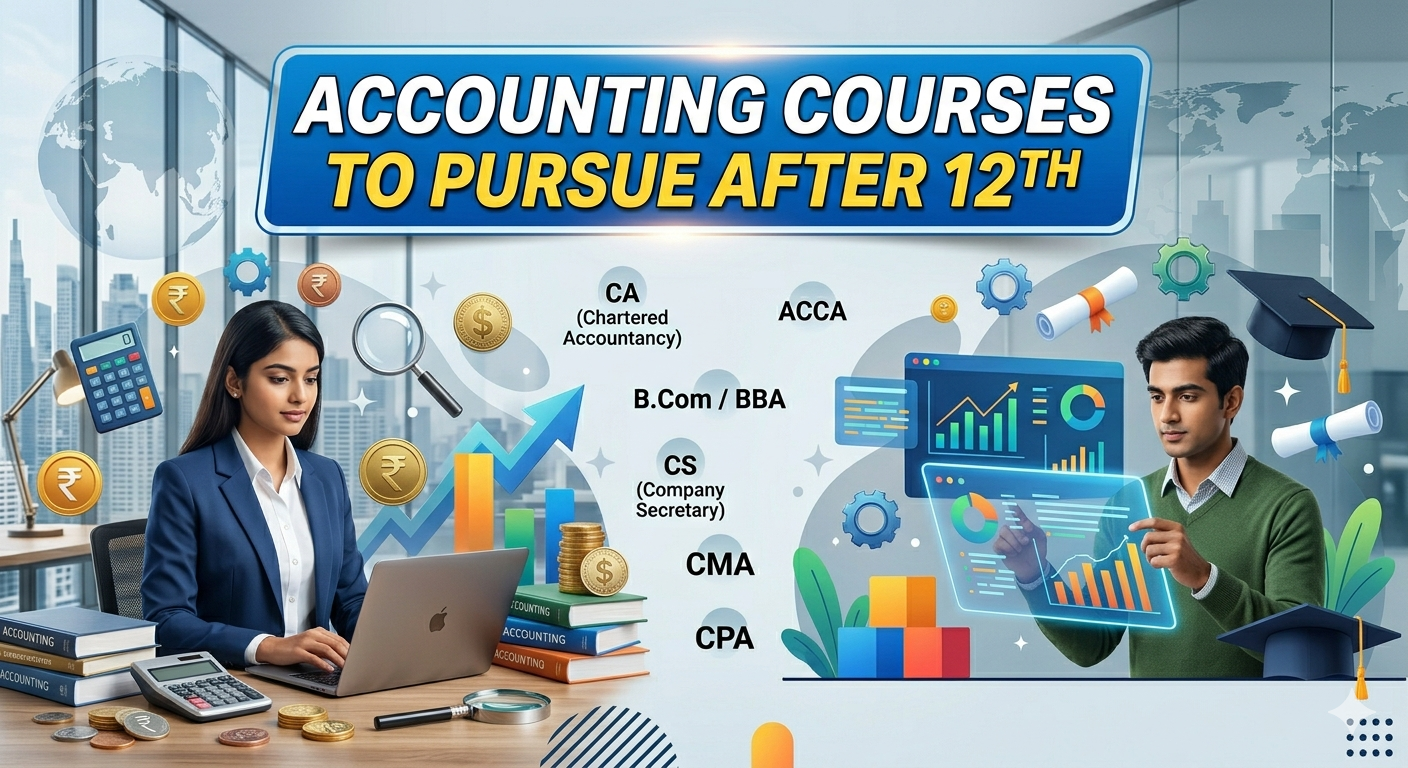
Embarking on Accounting Courses After 12th is a strategic move, given the constant demand for financial expertise across all industries. Whether you aspire to be a Chartered Accountant, a financial analyst, or a tax consultant, a plethora of professional and degree pathways are available to shape your career. This article details the key options, eligibility criteria, and future opportunities to guide your academic journey in 2026.
Accounting Courses After 12th: Quick Glance
After completing 12th grade, students have diverse options ranging from undergraduate degrees like BCom to professional certifications such as CA and CMA. These courses are offered at various levels including UG, PG, PhD, and Diploma, providing pathways for different career aspirations in accounting and finance.
| Particulars | Details |
| Course Level | UG, PG, Diploma, Certifications |
| Course Duration | Varies according to courses |
| Accounting Course Fees | INR 2 – 6 Lakhs |
| Eligibility | UG – 10+2 PG – After a bachelor’s degree |
| Admission Criteria | UG – Merit-based/Entrance Exams PG – Entrance Exam-based |
| Entrance Exams | UG – CUET PG – MAH CET, CAT, MAT, CPGET, XAT |
| Job Roles | Accountants, Chief Revenue Officers, Financial Analysts, etc. |
| Top Recruiters | KPMG, Deloitte, ICICI, HDFC, Reliance |
| Average Salary | INR 5 – 25 LPA |
Eligibility for Accounting Courses: Commerce, Arts, Science Students 2026
For students considering Accounting Courses After 12th, eligibility criteria demonstrate significant flexibility across academic streams. Both ACCA and CA courses welcome candidates from Commerce, Science, or Arts backgrounds, broadening access to professional accounting qualifications. General undergraduate accounting programs also require a 12th-pass qualification.
| Course Type | Course Name / Area | Eligibility (12th Stream) | Qualification |
| Degree Courses | B.Com (Accounting / Finance / General) | Commerce preferred, Arts & Science eligible in many colleges | Minimum 12th pass (often 45–50%+) |
| BBA in Accounting / Finance | All streams (Commerce, Arts, Science) | Merit-based or entrance exam | |
| B.Sc Accounting & Finance | Commerce & Science preferred | Math/Statistics helpful in some universities | |
| Professional Courses | CA (Chartered Accountancy) | All streams eligible | Must clear CA Foundation (after 12th) |
| ACCA (UK-based Accounting Qualification) | All streams eligible | English & Maths basics recommended | |
| CMA (Cost Management Accounting – India) | All streams eligible | CMA Foundation after 12th | |
| CS (Company Secretary) | All streams eligible | CS Executive after Foundation route | |
| Diploma Courses | Diploma in Accounting & Finance | Commerce, Arts, Science | 10+2 pass required |
| Diploma in Financial Accounting | All streams eligible | Basic computer/accounting knowledge helpful | |
| Diploma in Taxation & GST | All streams eligible | Useful for tax practice careers | |
| Certificate Courses | Certificate in Tally / Tally Prime | All streams eligible | No strict eligibility |
| Certificate in Accounting Software | All streams eligible | Basic computer skills preferred | |
| Certificate in Banking & Accounting | All streams eligible | Short-term job-oriented course | |
| Online / Distance Courses | Accounting & Finance Certificates (IGNOU / Online platforms) | All streams eligible | 12th pass required |
| MOOCs (SWAYAM / NPTEL Finance courses) | All streams eligible | Free/low-cost learning options |
Degree and Professional Accounting Courses After 12th
After completing 12th, students who want to build a long-term career in accounting and finance can choose from structured degree programs as well as globally recognised professional qualifications.
| Course Level | Course Name | Duration | Eligibility | Popular Colleges / Institutions |
| Undergraduate Degrees (UG) | B.Com (Accounting / Finance / General) | 3 years | 12th pass (Commerce preferred, others eligible) | University of Delhi, University of Mumbai, Christ University, St. Xavier’s College Kolkata |
| B.Com (Hons.) | 3 years | 12th pass (minimum % may apply) | University of Delhi, Shri Ram College of Commerce, Lady Shri Ram College | |
| BBA in Finance / Accounting | 3 years | All streams eligible | Christ University, Symbiosis Centre for Management Studies, NMIMS University | |
| B.Sc Accounting & Finance | 3 years | Commerce/Math preferred | University of Madras, Mumbai University, Amity University | |
| Postgraduate Degrees (PG) | M.Com (Accounting / Finance) | 2 years | UG degree (B.Com or equivalent) | University of Calcutta, University of Delhi, University of Madras |
| MBA in Finance | 2 years | Any UG degree | Indian Institute of Management Ahmedabad, XLRI Jamshedpur, Symbiosis Institute of Business Management | |
| M.Sc Finance / Accounting | 2 years | UG in Commerce/Science | University of Mumbai, Christ University, Amity University | |
| MA Economics (Finance-focused) | 2 years | Any UG degree | Jawaharlal Nehru University, University of Delhi | |
| Professional Courses (India & Global) | Chartered Accountancy (CA) | 4.5–5 years | 12th pass (any stream) | The Institute of Chartered Accountants of India |
| ACCA (UK Qualification) | 2–3 years | 12th pass (any stream) | ACCA | |
| CMA (Cost & Management Accounting – India) | 3–4 years | 12th pass (any stream) | Institute of Cost Accountants of India | |
| Company Secretary (CS) | 3–4 years | 12th pass (any stream) | Institute of Company Secretaries of India | |
| Integrated / Advanced Programs | B.Com + ACCA Integrated Program | 3–4 years | 12th pass | Christ University, Amity University |
| BBA + Professional Certification (CA/ACCA Foundation) | 3 years | 12th pass | NMIMS University, Symbiosis Centre for Management Studies |
Best Short-Term Accounting Courses After 12th Commerce 2026
Short-term Accounting Courses After 12th offer a practical pathway to quick employment and skill development in the finance sector. These programs, available in various modes, cover essential areas like accounting software, taxation, and financial management, making them ideal for immediate career entry.
| Course Category | Course Name | Duration | Mode | Career Opportunities |
| Accounting Software Courses | Tally Prime / Tally ERP Course | 1–3 months | Online / Offline | Accountant, Tally operator, billing executive |
| Advanced Excel for Accounting | 1–2 months | Online / Offline | MIS executive, finance assistant | |
| SAP FICO Basics | 2–4 months | Online / Institute | SAP trainee, finance support | |
| Taxation Courses | GST Practitioner Course | 1–3 months | Online / Offline | GST assistant, tax support |
| Income Tax Filing Course | 1–2 months | Online | Tax assistant, freelance filer | |
| Certificate Courses (Short-Term) | Certificate in Financial Accounting | 2–6 months | Online / Offline | Junior accountant, accounts assistant |
| Bookkeeping & Accounting Fundamentals | 1–3 months | Online | Bookkeeper, data entry operator | |
| Banking & Finance Courses | Banking & Financial Services Certificate | 2–4 months | Online / Offline | Banking assistant, operations staff |
| Financial Management Basics | 1–3 months | Online | Finance trainee | |
| Diploma Courses (Short-Term) | Diploma in Accounting & Finance | 6–12 months | Offline / Online | Accountant, finance executive |
| Diploma in Financial Accounting | 6–12 months | Offline / Online | Accounts officer, junior accountant | |
| Diploma in Taxation & GST | 6–12 months | Offline / Online | Tax consultant assistant | |
| Diploma in Banking & Finance | 6–12 months | Offline / Online | Banking executive, clerk-level roles | |
| Job-Oriented Combo Courses | Accounting + GST + Tally Combo Course | 3–6 months | Offline / Online | Accountant, finance executive |
| Office Accounting & Administration Course | 2–4 months | Offline | Admin/accounts executive |
CMA vs CS After 12th: Detailed Overview
Choosing among top Accounting Courses After 12th like CA, CS, and CMA requires understanding their distinct focuses and career paths. The comparison below highlights the key differences between these options:
| Criteria | CA (Chartered Accountant) | CS (Company Secretary) | CMA (Cost & Management Accountant) |
| Governing Body | ICAI | ICSI | ICMAI |
| Duration | 4.5 – 5 years | 3 – 4 years | 3.5 – 4 years |
| Main Focus | Accounting, Audit, Taxation | Corporate Law, Governance | Costing, Management Accounting |
| Course Levels | Foundation, Inter, Final | Foundation, Executive, Professional | Foundation, Inter, Final |
| Difficulty Level | High | Moderate | Moderate |
| Average Salary (India) | ₹6 – ₹12 LPA | ₹4 – ₹7 LPA | ₹5 – ₹10 LPA |
| Top Recruiters | Big 4, Banks, MNCs | Law Firms, PSUs, Corporates | Manufacturing, Finance Companies |
| Global Recognition | High | Medium | Growing |
How to Enroll in Accounting Courses After 12th: Admission Process 2026
Admission process for various accounting courses after 12th typically includes meeting the eligibility criteria and applying via the online portal. Here is a quick overview of the admission process:
| Course Type | Admission / Entry Requirement | Eligibility Criteria | Selection Method |
| Undergraduate Courses (B.Com, BBA, B.Sc Finance) | Must have passed 12th (10+2) from a recognized board | 12th pass (any stream in most colleges; Commerce preferred for some courses) | Merit-based or entrance exam (CUET for many universities) |
| Postgraduate Courses (M.Com, MBA Finance, etc.) | Graduation in relevant field required | UG degree (B.Com/BBA or equivalent) | Entrance exams (CAT, MAT, university-level tests) or merit |
| ACCA (Global Accounting Qualification) | 12th pass + minimum subject criteria | 12th pass with 65% in English, Maths, Accountancy; 50% in others | Direct registration (no entrance exam) |
| CA (Chartered Accountancy) | 12th pass required | Any stream eligible | CA Foundation exam route |
| CMA (Cost & Management Accounting) | 12th pass required | Any stream eligible | CMA Foundation exam |
| CS (Company Secretary) | 12th pass required | Any stream eligible | CS Foundation route (or direct entry to Executive for graduates) |
| Short-Term Certificate Courses (Tally, GST, Excel, etc.) | 12th pass | No stream restriction | Direct admission (no entrance exam) |
| Diploma Courses (Accounting, Taxation, Finance) | 12th pass required | Any stream eligible | Merit-based admission in institutes |
| Global Certifications (CPA, FRM, etc.) | 12th pass + further progression required | 12th pass (basic eligibility) | Direct enrollment + stage-wise exams |
| Online Accounting Courses (Udemy, edX, SWAYAM, etc.) | 12th pass or no strict requirement | Open eligibility | Direct registration |
Career Opportunities & Salary After Accounting Courses Post-12th 2026
After completing Accounting Courses After 12th, graduates can expect diverse career opportunities and competitive salaries. The overall average salary ranges from INR 5 – 25 LPA, with significant growth potential across various specializations and professional qualifications.
| Job Role | Starting Salary (Approx.) | Role Overview |
| Accounts Assistant | ₹15,000 – ₹25,000 per month | Handles basic bookkeeping, data entry, billing, and day-to-day accounting support in firms and businesses. |
| Junior Accountant | ₹20,000 – ₹35,000 per month | Manages ledgers, financial records, GST entries, and assists senior accountants in reporting work. |
| Tax Assistant | ₹25,000 – ₹40,000 per month | Assists in income tax filing, GST returns, compliance work, and taxation documentation. |
| Accounts Executive | ₹25,000 – ₹45,000 per month | Responsible for managing accounts, invoices, reconciliations, and financial reporting tasks. |
| Financial Analyst (Entry-Level) | ₹30,000 – ₹60,000 per month | Works on budgeting, financial planning, data analysis, and business performance tracking. |
| Chartered Accountant (CA) | ₹6 – ₹10 LPA (entry-level average) | Handles auditing, taxation, corporate finance, and compliance for businesses and clients. |
Frequently Asked Questions
Is CMA a good course after 12th with commerce? What is its scope?
Yes, CMA is a strong career option after 12th Commerce, focusing on costing and management accounting. It offers roles in finance companies, manufacturing firms, and corporate financial management.
How can I enroll in accounting courses after 12th for 2026 admissions?
To enroll, students must select a course, apply through official portals, appear for entrance exams if required, submit documents, and complete fee payment to confirm admission.
What are the top institutes for accounting courses after 12th in India in 2026?
Top institutes include University of Delhi, University of Mumbai, Christ University, SRCC, IIMs for MBA Finance, ICAI, ICSI, and ICMAI for professional accounting qualifications.
What are accounting courses options after 12th?
Options include B.Com, BBA Finance, B.Sc Accounting, CA, ACCA, CMA, CS, diplomas, certificate courses, and online programs in accounting, taxation, banking, and financial management.
What are the eligibility requirements for Accounting Courses After 12th?
Students must complete 10+2 from a recognized board. Most courses accept all streams, while some require commerce background or minimum percentage criteria depending on the program.
How do I apply for Accounting Courses After 12th?
Students apply online or offline through colleges or institutes, appear for entrance exams if needed, complete merit selection, submit documents, and pay fees for final admission confirmation.