Top Cyber Law Courses in India 2026: Diplomas, Certificates & PG Programs
Aayush is a writer and content strategist who turns personal stories into brand narratives. With an experience spanning diverse industries, rely on his writing for simplifying complex subjects…
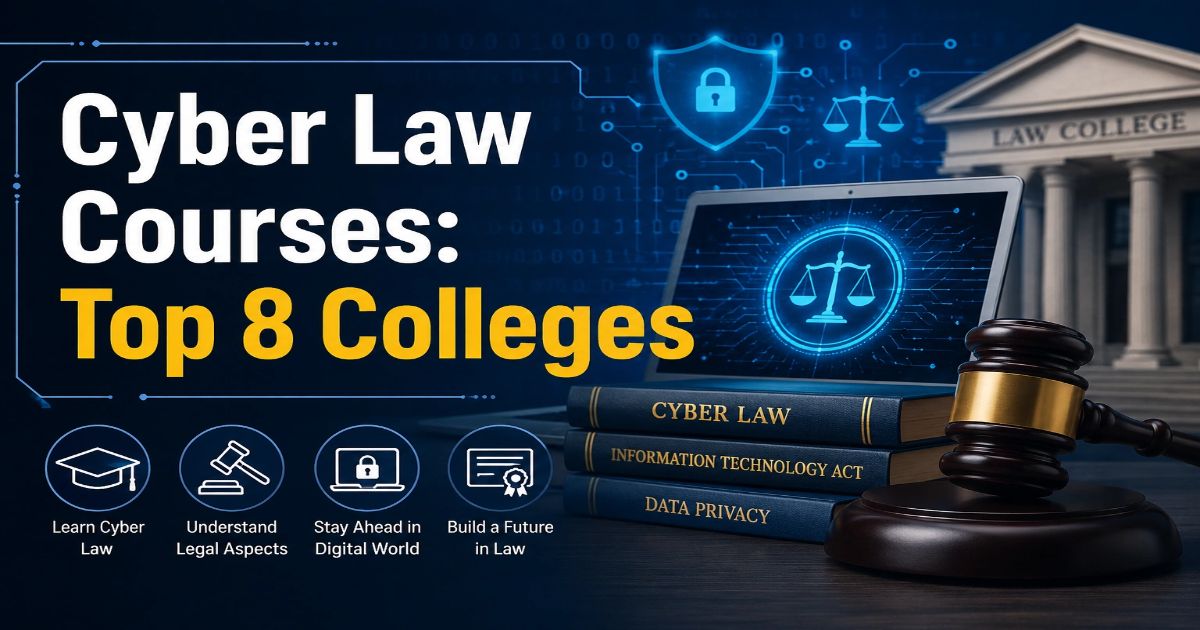
Cyber Law courses typically range from 6 months to 1 year and are available in Diploma, Online, Distance or Hybrid modes. Top colleges include NLSIU, NALSAR University of Law, Chanakya National Law University and Asian School of Cyber Laws.
Navigating the complex digital landscape requires specialized legal expertise, and choosing the right cyber law course in India for 2026 is crucial for aspiring professionals. The rapid evolution of technology and increasing cyber threats have created a high demand for skilled cyber law practitioners. Renowned institutes like NLSIU Bangalore, NALSAR University of Law Hyderabad and Asian School of Cyber Laws offer cyber law courses in Diploma, Online, Distance Learning and Hybrid formats. This guide will help you explore eligibility, compare online and distance learning options, and select the best course for your career.
Types of Cyber Law Courses in India 2026: Diploma, PG, Certificate
India offers diverse cyber law course options for 2026, ranging from diplomas to postgraduate certificates, catering to various academic backgrounds and career aspirations. These programs typically span 6 months to 1 year, providing specialized knowledge in digital legal frameworks.
| Type/Category of Diploma | Details & Focus | Key Components / Features |
| General Diploma in Cyber Law (Regular) | Typically 6-12 months, covering the Information Technology Act, cybercrime, data protection, and intellectual property in the digital. | Classroom lectures, case studies, practical exercises; often offered by traditional law colleges.
Example: Government Law College, Mumbai (6-month duration, ₹8,850 total fee, jointly with Asian School of Cyber Laws). |
| Postgraduate Diploma in Cyber Law (PGDCL) | A 1-year program for graduates, deeper into legal frameworks, digital evidence, and regulatory compliance. | Advanced modules, research projects, suitable for legal and non-legal graduates.
Example: Rabindranath Tagore University offers a PG Diploma in Cyber Law. |
| PG Diploma in Cyber Law & Cyber Forensics | Focuses on the intersection of legal aspects with forensic investigation techniques for cybercrimes. | Covers digital evidence collection, analysis, and presentation in court; helpful for law enforcement and IT professionals.
Example: National Law School of India University, Bengaluru (PGDCLCF, classes start September 2026). |
| PG Diploma in Cyber Security and Law | Integrates legal principles with cybersecurity practices, addressing data breaches, network security, and legal compliance. | Combines technical security knowledge with legal frameworks; ideal for IT and legal professionals.
Example: Shaheed Sukhdev College of Business Studies, Delhi (PGDCSL, admissions open for 2026). |
| Postgraduate Certificate in Cyber Law | Shorter duration (typically 6 months) than a Diploma, providing foundational knowledge or a specialized overview of cyber law. | Focused modules, often offered by open universities for working professionals.
Example: Indira Gandhi National Open University (IGNOU) offers a PG Certificate in Cyber Law (January 2026 admission cycle). |
| Online/Distance Learning Diploma | Offers flexible learning, accessible from anywhere, covering core cyber law concepts and regulations. | Self-paced modules, online assessments, digital learning platforms, often with rolling admissions.
Example: University of Madras (PG Diploma in Information Security and Cyber Law via Distance Education). |
| Hybrid Learning Diploma | Blends online learning with occasional in-person sessions or workshops, offering flexibility with structured interaction. | Weekend classes, recorded lectures, online assessments, career planning support, industry internships.
Example: MERI PLI (PG Diploma in Cyber Law, admissions open for 2026-27). |
| Specialized Certificate Course (Complementary) | Short-term programs focusing on specific technical aspects relevant to cyber law, like forensic science or advanced technology. | Practical skills development, hands-on training, complements a cyber law Diploma by adding technical expertise. |
Cyber Law Course Eligibility Criteria 2026: Non-Law & 10+2 Options
Eligibility criteria for a cyber law course are diverse, primarily depending on the specific program level and institution. Prospective students will find varying academic requirements, from undergraduate diplomas to postgraduate specializations, each tailored to different educational backgrounds.
| Course Level | Eligibility Criteria |
| Diploma | You must be passed the 10+2 from a recognized board. Some may accept students in the final year |
| Undergraduate Certificate | Passed 10+2 from a recognized board |
| Postgraduate Diploma (PG Diploma) | Bachelor’s degree from a recognized university |
| Master’s Degree (LLM in Cyber Law) | LLB degree or equivalent from a recognized college |
| Doctoral Degree (PhD in Cyber Law) | LLM degree or equivalent from a recognized college |
People Also Read


Online vs Distance Learning Cyber Law Diplomas: Key Differences 2026
For those considering a cyber law course, understanding the differences between distance learning and live online classroom diplomas is crucial. This section details key parameters for both options in 2026, including fees, duration, and learning formats, as offered by ASCL.
| Parameter | Distance Learning Cyber Law Diploma | Online Cyber Law Diploma |
| Mode of Learning | Self-paced study through recorded content and digital material | Live online classes with faculty-led teaching |
| Schedule | Flexible; learn anytime within the course period | Fixed class schedule set by the institute |
| Interaction Level | Limited live interaction | Higher real-time interaction with faculty |
| Learning Style | Independent, self-directed learning | Structured, guided classroom-style learning |
| Best Suited For | Working professionals and self-motivated learners | Students who prefer regular teaching support |
| Pace | Learner decides the pace | Institute decides the pace |
| Faculty Support | Usually through email, portal, or scheduled doubt sessions | Available during live classes and follow-up sessions |
| Peer Interaction | Minimal in most cases | Better through live classes and discussions |
| Assessment | Online exams, quizzes, or assignments | Similar assessments with fixed timelines |
| Flexibility | High | Moderate |
| Discipline Needed | High self-discipline required | More structured accountability |
| Technical Requirement | Internet access for course material and recorded lectures | Stable internet for attending live sessions |
| Duration | Usually varies by institute | Usually varies by institute |
| Fees | Vary by institute and course features | Often slightly higher due to live teaching |
| Certificate | Certificate awarded after successful completion | Certificate awarded after successful completion |
Top Colleges Offering Cyber Law Courses
Top colleges offering cyber law courses in India include NLUs, specialist law institutes, and a few private law colleges, with fees varying widely by course type—certificate, diploma, PG diploma, or LL.M.
| College/University | Cyber Law Course | Course Level | Approx. Course Fee |
| National Law School of India University (NLSIU), Bengaluru | PG Diploma in Cyber Law & Cyber Forensics | PG Diploma | ₹55,000 |
| NALSAR University of Law, Hyderabad | Cyber Law Certificate course / cyber law offering | Certificate | ₹7,500 |
| National University of Advanced Legal Studies (NUALS), Kochi | PG Diploma in Cyber Law | PG Diploma | ₹31,000 |
| Chanakya National Law University (CNLU), Patna | PG Diploma in Cyber Law | PG Diploma | ₹15,000 |
| Indian Law Institute (ILI), New Delhi | PG Diploma in Cyber Law | PG Diploma | ₹35,000 |
| Government Law College (GLC), Mumbai | Diploma / cyber law-related diploma offering | Diploma | ₹8,850 |
| Pravin Gandhi College of Law, Mumbai | PG Diploma in Cyber Law & Information Technology | PG Diploma | ₹15,000 |
| HLM Law College, Ghaziabad | PG Diploma in Cyber Crime & Laws | PG Diploma | As per UP Government / CCS University norms (Approx. ₹15,000 – ₹20,000) |
Asian School of Cyber Laws: Online Diploma Course Highlights 2026
The Diploma in Cyber Law (Online Classroom) offered by Asian School of Cyber Laws (ASCL) in collaboration with Government Law College, Mumbai is a beginner-friendly six-month programme designed to build practical knowledge of cyber law, cybercrime, and digital evidence.
| Feature | Details |
| Course Name | Diploma in Cyber Law (Online Classroom) |
| Institute | Asian School of Cyber Laws (ASCL) |
| Collaboration | Government Law College, Mumbai |
| Course Level | Basic / Beginner-friendly |
| Duration | 6 months |
| Course Fee | ₹7,500 + 18% GST |
| Next Batch Starts | 16 June 2026 |
| Application Deadline | 15 June 2026 |
| Eligibility | Higher Secondary Pass (Class 12) |
| Mode of Delivery | Online |
| Study Format | Self-study with live online support |
| Live Online Lectures | 16 hours |
| On-Demand Video Content | 5 hours |
| Language | English |
| Assessment | 100-mark open-book online exam |
| Passing Criteria | Minimum 40% marks |
| Certificate | Joint certificate from Government Law College, Mumbai and ASCL |
| Collaboration Start Year | 2004 |
| Included Tool | Digital Evidence Certificate Generator |
| Alumni Base | 10,000+ successful alumni |
| Graduate Outcome Claim | 80% of graduates reportedly secure jobs, promotions, or freelance opportunities within 6 months |
| Course Designer | Rohas Nagpal |
| Lead Faculty | Gokul Narayan |
| Key Learning Areas | Cyber law fundamentals; e-commerce law basics; intellectual property in cyberspace; cybercrime laws; cybercrime investigation laws; data privacy law; presenting digital evidence in court |
How to Choose the Best Cyber Law Course in India for 2026
Choosing the right cyber law course in India for 2026 involves understanding key parameters like eligibility, fees, and core curriculum. The table below provides a comprehensive overview of the essential factors for selecting a cyber law course, highlighting the diverse eligibility criteria, fee structures, and critical subject matter across various program types.
| Parameter | Details |
| Course Type | Diploma, Postgraduate Diploma, or PG Certificate in Cyber Law |
| Typical Duration | 6 months to 1 year (full-time or part-time) |
| General Eligibility (Diploma/Certificate) | Open to students who have completed 10+2 or hold a bachelor’s degree; ideal for beginners or professionals wanting to upskill. |
| General Eligibility (Undergraduate) | Requires 10+2 with at least 45–50% marks; admissions are often through CLAT, LSAT, or state-level law entrance exams. |
| General Eligibility (Postgraduate) | Applicants must hold an LLB or equivalent degree; entrance tests like CLAT-PG or AILET-PG may be required depending on the institution. |
| Minimum Marks Required | Typically 45-50% aggregate in the qualifying examination (varies by institution) |
| Admission Process | Primarily merit-based, some institutions may conduct an entrance exam |
| General Course Fees (Diploma/Certificate) | Range from ₹3,500 to ₹70,000, depending on course length and institution reputation. |
| General Course Fees (Undergraduate) | Approximately ₹30,000 to ₹2,00,000 per year, with top NLUs and private law schools charging at the higher end. |
| General Course Fees (Postgraduate) | Typically cost between ₹18,500 to ₹2,50,000 for the entire course. |
| Core Focus Areas | Cybercrime, data privacy, intellectual property in cyberspace, IT Act |
| Core Subjects: Cybercrime Laws | Hacking, identity theft, online fraud |
| Core Subjects: IT Act, 2000 | Key provisions and offences |
| Core Subjects: Data Protection | Privacy, data security |
| Key Learning Outcomes | Understanding digital forensics, e-commerce laws, and cybersecurity regulations |
| Target Audience | Law graduates, IT professionals, legal practitioners, government officials |
| Program Objective | To develop expertise in cyber jurisprudence and digital security compliance |
| Relevance in 2026 | Addresses the growing demand for specialized cyber law experts in India’s digital economy |
| Industry Impact | Supports policy-making, law enforcement, and corporate legal compliance in digital domains |
Frequently Asked Questions
1. What is the duration of the ASCL Online Diploma in Cyber Law?
The ASCL Online Diploma in Cyber Law runs for 6 months and combines self-study resources with live online support, making it suitable for beginners and working professionals.
2. Who is eligible to apply for the ASCL cyber law diploma?
Candidates who have passed Class 12 / Higher Secondary are eligible to apply for this cyber law diploma, making it accessible even to students at an early academic stage. Pasted text.txt
3. What is the fee for the ASCL Online Diploma in Cyber Law?
The course fee is ₹7,500 plus 18% GST, making the total cost higher than the base fee while still remaining relatively affordable for a six-month cyber law programme. Pasted text.txt
4. What certificate do students receive after completing the course?
Students receive a joint certificate from Government Law College, Mumbai and Asian School of Cyber Laws after successfully completing the programme and meeting the minimum passing criteria. Pasted text.txt
5. What topics are covered in the ASCL cyber law diploma curriculum?
The curriculum covers cyber law fundamentals, e-commerce law, cybercrime laws, cybercrime investigation, data privacy, intellectual property in cyberspace, and digital evidence presentation in court. Pasted text.txt
6. How is the ASCL Online Diploma in Cyber Law assessed?
The programme uses a 100-mark open-book online exam, and students must secure at least 40% marks to pass and qualify for the joint completion certificate.