Types of B.Sc Courses: List of Honours and General Options
Nishit Kumar is a senior EdTech industry leader with over a decade of experience in building and scaling education platforms, shaping their product, content, and growth strategy. At…
- 1 Oct 2026LPUNEST 2027 Registration Commenced
LPUNEST 2027 registration for B.Sc admissions is ongoing and open until January 15, 2027.
Bachelor of Science (B.Sc) programs in India offer over 114 specialisations across core sciences, technology, agriculture, and healthcare. Most standard B.Sc courses are 3 years long, while specialized programs like B.Sc Agriculture and B.Sc Paramedical run for 4 years, requiring 50–60% marks in 10+2 PCM or PCB.
Students can choose between core B.Sc groups and professional applied streams depending on their Class 12 subject combinations. Below is an overview covering course options, syllabus details, university entrance exams like CUET UG, fee structures, top colleges, placement trends, and step-by-step admission procedures.
| Parameter | Details |
|---|---|
| Program Degree Level | Undergraduate (UG) |
| Course Duration | 3 to 4 Years (Paramedical & Agriculture: 4 Years; Standard B.Sc: 3 Years) |
| Basic Eligibility | 10+2 with 50-60% in PCM or PCB stream from a recognized board |
| Available Specialisations | Over 114 B.Sc courses/specialisations |
| Primary Entrance Exam | CUET UG (Common University Entrance Test) |
| Major Stream Groups | Core Sciences (Physics/Chemistry/Maths/Biology), Computer Science & IT, Agriculture, Paramedical |
List of B.Sc (General) and Specialised Groups
Selecting the right degree B.Sc group depends on whether a candidate studied Mathematics or Biology in Class 12. Students from the PCM stream typically enter theoretical and technical B.Sc groups such as Computer Science, Information Technology, Statistics, Electronics, or Physics. Students from the PCB stream enter life science groups including Biology, Zoology, Botany, Microbiology, and Biotechnology.
Core degree groups provide comprehensive domain coverage. B.Sc Biology is a 3-year program focusing on life processes, covering Biophysics, Cell Biology, Molecular Biology, Ecology, Genetics, Recombinant DNA Technology, Medical Botany, and Biochemical Techniques. Similarly, B.Sc Zoology examines biological systems across animal anatomy, physiology, genetics, evolution, biodiversity conservation, wildlife forensics, marine ecology, and immunology.
Detailed Syllabus Breakdown for CS, IT, Biology, and Agriculture
Applied B.Sc degrees incorporate practical programming, field training, and laboratory work directly aligned with job requirements. B.Sc Computer Science features technical subjects such as Digital Electronics, Object-Oriented Programming using C++, Data Structures, Database Management Systems (DBMS), Operating Systems, Computer Networks, System Programming, and Python Programming.
B.Sc Information Technology emphasizes software engineering and system architecture, focusing on Web Programming, C/C++, RDBMS/Oracle Database Systems, Telecommunications, System Analysis, and Software Testing. For agrarian careers, B.Sc Agriculture covers Agronomy, Soil Science, Plant Genetics, Entomology, Plant Pathology, Food Processing, Dairy Science, and Farm Machinery over its 4-year curriculum.
| B.Sc Specialisation | Key Subjects Covered in Curriculum |
|---|---|
| B.Sc Computer Science | Digital Electronics, C++, Data Structures, DBMS, Operating Systems, Computer Networks, Python Programming |
| B.Sc Agriculture | Agronomy, Soil Science, Plant Genetics, Entomology, Plant Pathology, Food Processing, Dairy Science, Farm Machinery |
| B.Sc Information Technology | Web Programming, C/C++, Database Systems (RDBMS/Oracle), Telecommunications, System Analysis, Software Testing |
| B.Sc Biology | Biophysics, Cell Biology, Molecular Biology, Genetics, Recombinant DNA Technology, Ecology, Biochemical Techniques |
| B.Sc Zoology | Cell Biology, Animal Physiology, Evolution, Wildlife Forensics, Marine Ecology, Biodiversity Conservation, Immunology |
CUET Courses List for UG Science Admissions
Central and state universities across India mandate national entrance tests for B.Sc admissions. The Common University Entrance Test (CUET UG), administered by the National Testing Agency (NTA), regulates admissions across 50 Central, 36 State, 154 Private, and 30 Deemed universities.
Through CUET UG, candidates apply for B.Sc Hons and General degrees in core sciences alongside specialized programs. University of Allahabad offers admissions into B.Sc Bio Group and B.Sc Maths Group. University of Hyderabad provides 5-year integrated M.Sc courses in Mathematical Sciences, Physics, Chemistry, Biology, and Applied Geology.
| University Name | B.Sc & Science Programs Offered | Admission Pathway |
|---|---|---|
| University of Delhi (DU) | B.Sc (Hons.), B.Sc (Pass / General) across Science subjects | CUET UG |
| University of Allahabad | B.Sc (Bio Group), B.Sc (Maths Group) | CUET UG |
| Jamia Millia Islamia | B.Sc (Hons) Applied Mathematics, B.Sc (Multidisciplinary) | CUET UG |
| University of Hyderabad | 5-Year Integrated M.Sc (Maths, Physics, Chemistry, Biology) | CUET UG |
| Babasaheb Bhimrao Ambedkar University | B.Sc, Integrated B.Sc-M.Sc | CUET UG |
Eligibility and Duration
Admission to standard B.Sc programs requires passing Class 12 board examinations with an aggregate score of 50% to 60% in relevant science subjects.
Course duration varies between general academic and professional offerings. General B.Sc degrees are completed over 3 years (6 semesters). Institutional entrance tests operate alongside national exams; for example, LPUNEST 2027 registration for B.Sc programs opened on October 01, 2026, with applications accepted through January 15, 2027.
Entrance Exams for B.Sc Admissions: CUET UG Marking Scheme and Structure
National entrance evaluation for undergraduate science degrees follows standardized computer-based test formats. In the CUET UG exam, candidates select up to 5 subject papers based on domain prerequisites specified by target universities. Each subject paper contains 50 questions for a total of 250 marks per subject, awarding 5 marks for every correct answer.
| Parameter | Exam Rules / Details |
|---|---|
| Exam Mode | Computer Based Test (CBT) |
| Maximum Selectable Subjects | Up to 5 subjects |
| Questions per Subject | 50 Questions |
| Marks per Subject | 250 Marks (5 Marks for every correct answer) |
| Benchmark Good Score for Top Unis | 700+ Marks out of combined domain total (95+ Percentile) |
Fees
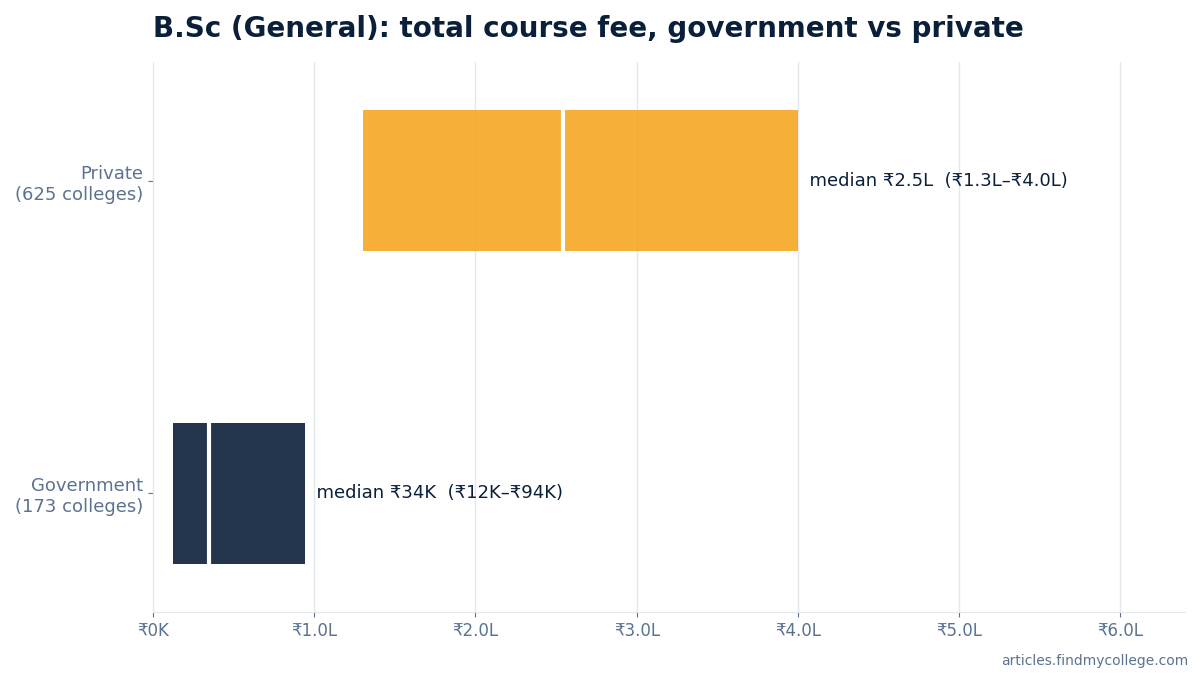
At least 2,139 colleges offer B.Sc (General) degrees in India across public and private sectors. Government colleges maintain highly affordable fee structures: the median total course fee among government institutions is ₹34,440, with the middle half ranging between ₹12,237 and ₹94,445 based on data from 173 reporting government colleges. Private colleges present higher fee scales, reflecting a median total course fee of ₹2.54 lakh, with the middle half falling between ₹1.30 lakh and ₹4.00 lakh across 625 private colleges with fee data.
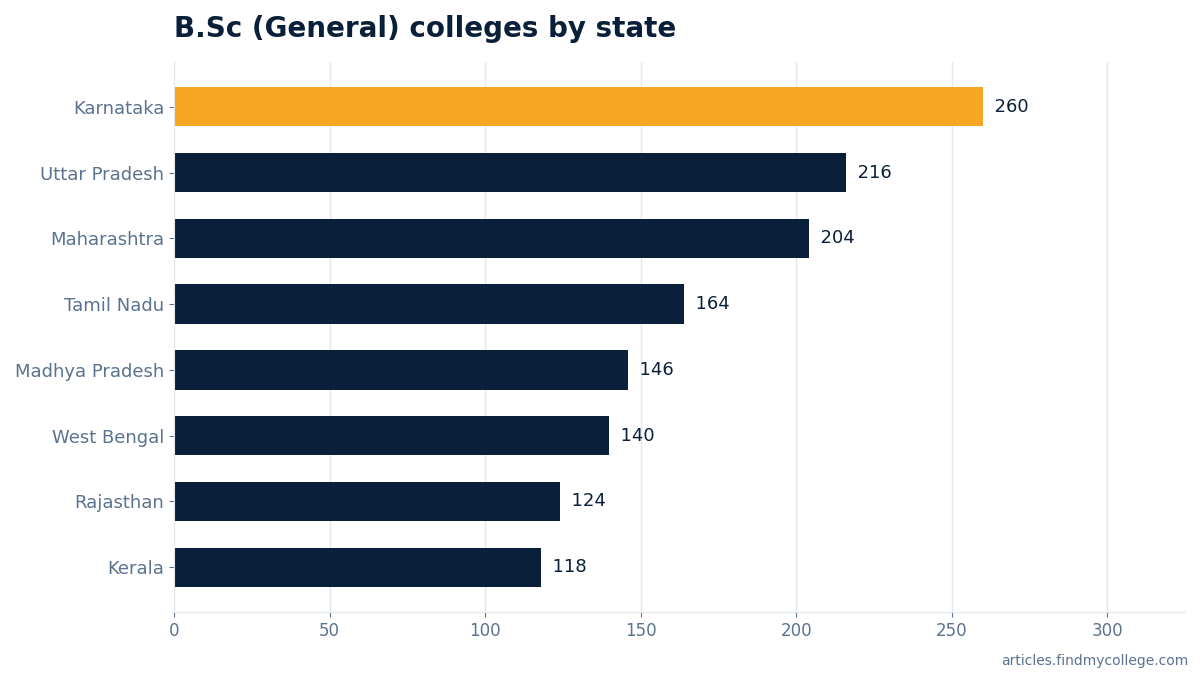
Statewise distribution shows substantial college density in South and Central India. Karnataka features at least 260 B.Sc colleges, Uttar Pradesh has 216, Maharashtra has 204, Tamil Nadu has 164, Madhya Pradesh has 146, and West Bengal has 140 colleges offering undergraduate science degrees.
| College | City | Ownership | Total course fee | NIRF rank |
|---|---|---|---|---|
| Indian Institute of Science | Bangalore | — | ₹78,200 | 1 (Overall, 2025) |
| Jamia Millia Islamia University | Delhi | Government | ₹1.61 lakh | 4 (Overall, 2025) |
| Banaras Hindu University | Varanasi | Government | ₹9,324 | 6 (Overall, 2025) |
| Indian Institute of Technology Kharagpur | Kharagpur | Government | ₹86,700 | 6 (Overall, 2025) |
| All India Institute of Medical Sciences New Delhi | Delhi | Government | — | 8 (Overall, 2025) |
| Aligarh Muslim University | Aligarh | — | ₹1.20 lakh | 10 (Overall, 2025) |
| Chaudhary Charan Singh Haryana Agricultural University | Hisar | — | ₹84,870 | 10 (Overall, 2025) |
| SRM Institute of Technology | Kanchipuram | Private | ₹8.10 lakh | 11 (Overall, 2025) |
| Kerala Agricultural University | Thrissur | — | ₹2.48 lakh | 12 (Overall, 2025) |
| Saveetha Institute of Medical and Technical Sciences | Chennai | — | ₹4.00 lakh | 13 (Overall, 2025) |
| College | City | Ownership | Total course fee |
|---|---|---|---|
| Maharana Pratap Government Post Graduate College Chittorgarh | Chittorgarh | Government | ₹5,400 |
| Ram Lakhan Singh Yadav College Ranchi | Ranchi | Government | ₹5,612 |
| Sovarani Memorial College | Howrah | Government | ₹5,715 |
| Nabadwip Vidyasagar College | Nadia | Government | ₹5,965 |
| Fakir Chand College | South 24 Parganas | Government | ₹6,171 |
| Ram Krishna Dwarika College | Patna | Government | ₹6,182 |
| Sahyadri Science College | Shimoga | Government | ₹6,250 |
| Swami Vivekanand Government College | Bilaspur | Government | ₹6,502 |
| Chandidas Mahavidyalaya | Birbhum | Government | ₹6,615 |
| Bidhan Chandra College Rishra | Hooghly | Government | ₹6,630 |
| City | Colleges | Fee range | Well-known options |
|---|---|---|---|
| Bangalore | 128 | ₹40,000 – ₹13.22 lakh | Alliance University, National Institute of Mental Health and Neuro Sciences |
| Kolkata | 55 | ₹9,085 – ₹17.46 lakh | The West Bengal National University of Juridical Sciences, West Bengal University of Health Sciences |
| Bhopal | 48 | ₹12,450 – ₹7.62 lakh | VIT Bhopal University, All India Institute of Medical Sciences Bhopal |
| Jaipur | 44 | ₹54,000 – ₹28.75 lakh | Banasthali Vidyapith, Suresh Gyan Vihar University |
| Lucknow | 41 | ₹72,000 – ₹6.60 lakh | King George’s Medical University, Sanjay Gandhi Postgraduate Institute of Medical Sciences |
| Chennai | 41 | ₹12,000 – ₹14.50 lakh | Madras Medical College, Saveetha Institute of Medical and Technical Sciences |
| Pune | 37 | ₹57,000 – ₹36.65 lakh | Armed Forces Medical College, Dr. DY Patil Vidyapeeth |
| Mumbai | 34 | ₹7,086 – ₹20.00 lakh | Tata Institute of Social Sciences Mumbai, Mumbai University |
| College | City | Ownership | Total course fee |
|---|---|---|---|
| Indira Gandhi National Open University | Delhi | Government | ₹17,700 |
| BJB Autonomous College | Bhubaneswar | Government | ₹1.80 lakh |
| Uttarakhand Open University | Nainital | — | ₹62,200 |
| Pacific Institute of Engineering and Management | Delhi | — | ₹61,500 |
| College | City | Ownership | Total course fee | Average package |
|---|---|---|---|---|
| Ramnarain Ruia Autonomous College | Mumbai | Private (aided) | — | 5.43 LPA |
| Kishinchand Chellaram College | Mumbai | Private (aided) | — | 3.64 LPA |
| Hislop College | Nagpur | Private (aided) | — | 3.42 LPA |
| Gossner College | Ranchi | Private (aided) | ₹76,710 | 2.95 LPA |
| Thakur College of Science and Commerce | Mumbai | Private (aided) | ₹84,063 | 2.94 LPA |
| BFIT Group of Institutions | Dehradun | Private | ₹9.00 lakh | 2.76 LPA |
| Khudiram Bose Central College | Kolkata | Private (aided) | — | 2.48 LPA |
| Deogiri College | Aurangabad | Private (aided) | — | 1.77 LPA |
How to Choose
Deciding which B.Sc course is best requires aligning personal academic strengths with specific career objectives. Students seeking immediate industry roles in software engineering, web development, or data analytics should opt for B.Sc Computer Science or B.Sc IT. Students aiming for careers in farming technology, crop science, or rural development benefit from 4-year B.Sc Agriculture degrees.
For candidates interested in medicine, research, or laboratory diagnostics, PCB-based streams such as B.Sc Biology, B.Sc Zoology, or B.Sc Paramedical provide strong foundation pathways. Always review target university domain subject requirements on CUET UG before submitting entrance application choices to ensure complete eligibility.
How to Apply for B.Sc (General) Admission in 2026: Step by Step
- Check Eligibility Requirements: Verify completion of Class 12th board exams with 50-60% aggregate marks in PCM (Physics/Chemistry/Maths) or PCB (Physics/Chemistry/Biology) streams.
- Choose B.Sc Specialisation & Course Type: Select between 3-year core science/tech programs (e.g., B.Sc Physics, B.Sc CS, B.Sc IT) or 4-year professional degrees (e.g., B.Sc Agriculture, B.Sc Paramedical).
- Register for Entrance Exams: Apply for national entrance exams like CUET UG on cuet.nta.nic.in, or university entrance tests like LPUNEST (registration open from Oct 1, 2026 to Jan 15, 2027).
- Appear for Computer Based Entrance Test (CBT): Take the NTA CUET UG examination consisting of 50 questions per subject paper (250 marks per paper).
- Participate in University Seat Allotment & Counselling: Apply to central/state universities (DU, BHU, JNU, Allahabad University) using CUET scores (aiming for 700+ marks for top percentile cutoff seats) and lock preferences.
| What to do | Where | Link |
|---|---|---|
| application | NTA CUET UG Official Website | cuet.nta.nic.in |
| Compare colleges, fees and cutoffs | B.Sc (General) colleges in India | findmycollege.com |
FAQs
Which B.Sc course is best after Class 12 Science?
The best course depends on your stream: B.Sc Computer Science and B.Sc IT lead to software and technology careers, while 4-year B.Sc Agriculture and B.Sc Biology/Zoology suit research and agrarian sectors.
Is B.Sc a 3 year degree in India?
Most standard B.Sc programs (Physics, Chemistry, CS, Biology) are 3 years long. However, professional programs like B.Sc Agriculture and B.Sc Paramedical are 4-year degrees.
What is the primary entrance exam for B.Sc admissions?
The Common University Entrance Test (CUET UG) conducted by NTA is the major entrance exam for B.Sc admissions across 50 central and 154 private universities.
What is the CUET UG exam pattern for B.Sc science courses?
Candidates can choose up to 5 subjects. Each subject paper contains 50 questions worth 250 marks (5 marks per correct answer). A score above 700 is considered very good.
Which subjects are included in B.Sc Computer Science?
Key subjects in B.Sc CS include Digital Electronics, C++ Object-Oriented Programming, Data Structures, DBMS, Operating Systems, Computer Networks, and Python Programming.
What subjects are taught in B.Sc Biology for PCB students?
B.Sc Biology covers Biophysics, Cell Biology, Molecular Biology, Genetics, Recombinant DNA Technology, Ecology, Medical Botany, and Biochemical Techniques.