Videography Courses: Duration, Admission Process & Career Scope
Course fees vary from ₹4,000 to ₹1.7 Lakhs, leading to starting job roles with salaries ranging between ₹1 LPA and ₹12 LPA.
Students can explore details regarding eligibility criteria, course syllabus, fee structures, top institutes, career prospects, and admission steps for videography training across India.
| Parameter | Details |
|---|---|
| Course Duration | 5 days to 2 years (Certificates: 5 days–6 months; Diplomas: 1–2 years; Doctorate: 4–6 years) |
| Eligibility Criteria | Class 10 or Class 12 pass (min 45%–50% aggregate) for Certificate/Diploma; Graduation in any stream for PG Diploma |
| Average Course Fees | ₹4,000 to ₹1.7 Lakhs (Certificate: ₹4,000–₹1.2 Lakhs; PG Diploma: ₹80,000–₹1.7 Lakhs) |
| Popular Entrance Exams | FTII-ET, IIMC Entrance Exam, ACJ Entrance Exam, IPU CET BJMC, CUCET Mass Communication |
| Starting Salary Range | ₹1 LPA to ₹12 LPA depending on specialisation, experience, and role |
What is Videography
Videography refers to the technique of capturing moving images using digital cameras or electronic devices for events like weddings, sports matches, training sessions, and corporate videos. Media production rely on trained videographers to manage composition, lighting, sound capture, and post-production workflows.
| Course Level | Duration | Eligibility Criteria | Average Course Fee | Average Starting Salary |
|---|---|---|---|---|
| Certificate | 5 days to 6 months | Class 10 or Class 12 Pass | ₹4,000 – ₹1.2 Lakhs | ₹2 – ₹3 LPA |
| Diploma | 6 months to 1 year | Class 12 Pass (45%-50% marks) | ₹35,099 – ₹1.25 Lakhs | ₹3 – ₹4 LPA |
| Doctorate (Ph.D.) | 4 to 6 years | Postgraduate Degree / PG Diploma | ₹50,000 – ₹2.75 Lakhs | ₹5 – ₹10 LPA |
Videography Eligibility
Postgraduate Diploma courses require a Bachelor’s degree in any discipline from a recognized university. Advanced doctoral options require a postgraduate degree or PG Diploma. Institutions like Dr Annasaheb GD Bendale Mahila Mahavidyalaya in Jalgaon offer specialized B.Voc in Photography and Videography, while Symbiosis School of Photography in Pune offers a BA in Visual Arts and Photography.
Videography Syllabus and Subjects
Practical videography training covers camera handling, studio illumination, sound acquisition, and non-linear editing. Students learn standard 3-point lighting setups comprising key light, fill light, and back light alongside audio capture techniques using lapel and shotgun microphones.
Software instruction focuses heavily on Adobe Premiere Pro for timeline arrangement, color correction, and master exports. Training modules incorporate hands-on practice with stabilizers, tripods, gimbals, sliders, and Ninja recorders.
| Week | Module Topic | Core Skills & Tools Covered |
|---|---|---|
| Week 1 | Camera Fundamentals & Composition | Aspect ratios (16:9, 9:16, 1:1), camera settings, prime vs zoom lenses, framing rules |
| Week 2 | Lighting & Audio Setup | TV anchoring/news lighting, lapel & shotgun mics setup, manual & auto focus |
| Week 3 | Creative Shooting & Gear Utility | Green screen keying, double role filming, tripods, gimbals, sliders, Ninja recorder |
| Week 4 | Footage Organisation & Shot Framing | Establishing shots, close-ups, two-shots, high/low angles, Adobe Premiere Pro timeline |
| Week 5 | Editing Techniques & Final Output | Match cut, jump cut, J & L cuts, transitions, L-Bands, color correction, master export |
Top Videography Colleges
Media academies and government institutes across India offer professional certifications and diplomas in videography, camera operation, and video editing. Students seeking local training centers can compare course durations, specialized curricula, and total tuition fees across top colleges.
| Institute Name | Course Offered | Duration | Course Fee |
|---|---|---|---|
| Film and Television Institute of India (FTII), Pune | PG Course in TV (Video Editing Specialisation) | 1 Year | ₹1,56,457 |
| AAFT Noida | Certificate in Video Editing & Sound Recording | 3 Months | ₹97,000 |
| Centre for Development of Imaging Technology (C-DIT) | Diploma in Digital Videography | 6 Months | ₹38,695 |
| C-DIT Kerala | Certificate in Videography | 3 Months | ₹19,995 |
| Gulshan Kumar Film & Television Institute | Video Editing & Sound Recording | 3 Months | ₹80,000 |
| Visualite Photography Academy | Basic Videography Course | 16 Days | ₹15,000 |
| Creative Hut Institute of Photography | Certified Course in Videography | 5 Days | ₹10,000 + GST |
| Indian Institute of Skill Development Training | Diploma in Photography & Video Shooting | 6 Months | ₹4,000 |
Videography vs Cinematography
Videography focuses on capturing events, corporate functions, sports matches, training sessions, and wedding ceremonies using portable digital cameras or electronic devices. Videographers often operate independently or in small crews to record real-time unscripted or semi-scripted live action.
Cinematography involves large-scale motion picture production with narrative storytelling, cinematic lighting design, high-end cinema camera systems, and large production crews working under a director’s vision.
How to Choose the Right Videography College and Course Near You
Selecting a videography course nearby requires evaluating camera inventory, studio accessibility, and hands-on practical hours. Prospective students should review whether institutes provide essential equipment such as DSLR or mirrorless cameras, prime and zoom lenses, gimbals, tripods, Ninja recorders, and lighting setups like 3-point key, fill, and back lights.
Location considerations, editing lab software such as Adobe Premiere Pro, green screen compositing facilities, and sound recording gear (lapel and shotgun mics) help determine the best training institute in your city.
Videography Career Scope and Salary
Career scope after completing a videography course includes roles in event coverage, digital media houses, advertising agencies, news channels, and corporate video production. Specialized professionals work as documentary filmmakers, commercial videographers, product videographers, camera operators, and freelance media creators.
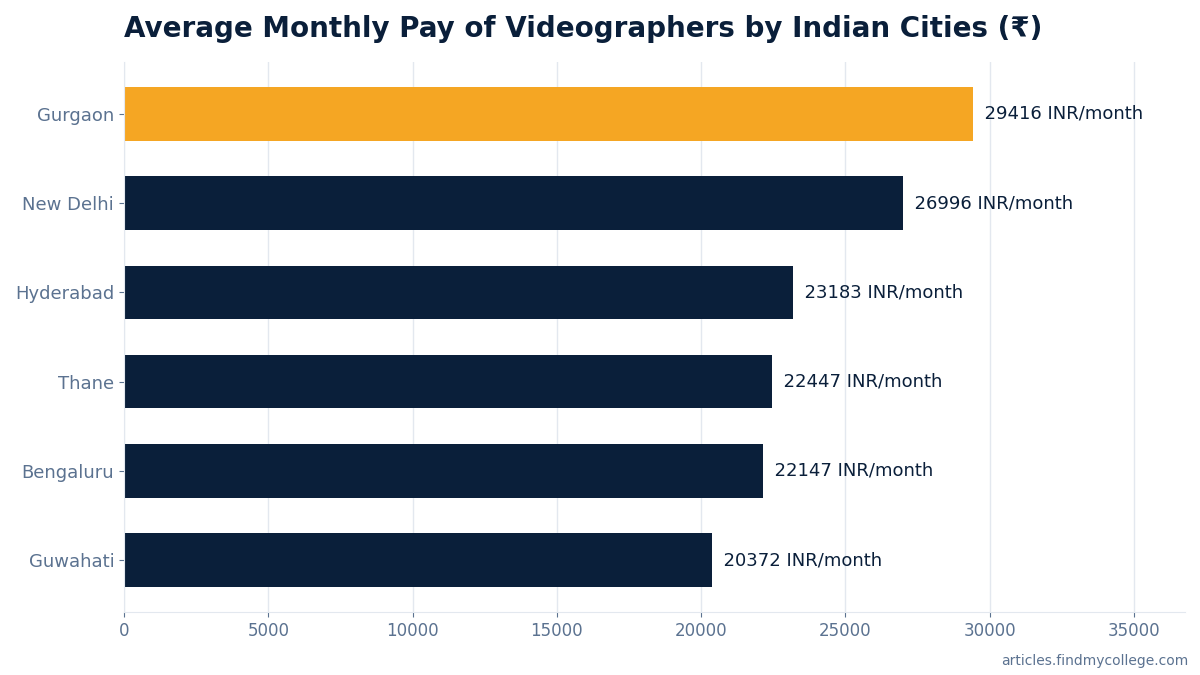
Salary potential varies by specialization and geographic region. Documentary filmmakers earn between ₹1.5 LPA and ₹12 LPA, while commercial videographers earn between ₹1.7 LPA and ₹7.2 LPA. Product Videographers earn up to ₹8.6 LPA, Freelance Videographers reach up to ₹7.7 LPA, and Camera Operators earn up to ₹7.1 LPA.
| City | State | Average Monthly Pay |
|---|---|---|
| Gurgaon | Haryana | ₹29,416 per month |
| New Delhi | Delhi NCR | ₹26,996 per month |
| Hyderabad | Telangana | ₹23,183 per month |
| Thane | Maharashtra | ₹22,447 per month |
| Bengaluru | Karnataka | ₹22,147 per month |
| Guwahati | Assam | ₹20,372 per month |
How to Apply for Videography Admission: Step by Step
- Check Eligibility Criteria: Verify qualifications: Class 10/12 pass with at least 45%-50% aggregate for certificate/diploma courses, or a Bachelor’s degree for PG Diploma programs.
- Choose Course Format & Level: Select between online short-term certifications (3-6 months), intensive offline short courses (5 days to 5 weeks), or 1-2 year full-time Diplomas and PG Diplomas.
- Apply on Institute Portal: Submit online or offline application forms directly on institute websites (e.g., FTII, C-DIT, AAFT, Pixel Academy).
- Appear for Entrance Exam / Interview: Take national media entrance exams like FTII-ET, CUCET, or attend institute-level online tests and personal interviews where applicable.
- Verify Equipment Requirements: Ensure access to required gear like a working DSLR or Mirrorless camera if required by the institute for practical assignments.
- Submit Documents and Pay Course Fee: Submit Class 10/12 mark sheets, ID proof (Aadhaar/DL), and pay prescribed tuition fees (ranging from ₹4,000 to ₹1,56,457).
| What to do | Where | Link |
|---|---|---|
| Compare colleges, fees and cutoffs | Videography colleges in India | findmycollege.com |
FAQs
What is the average salary of a videographer in India?
Videographer salaries in India range between ₹1 LPA and ₹12 LPA depending on the job role. Top monthly averages include ₹29,416 in Gurgaon, ₹26,996 in New Delhi, and ₹22,147 in Bengaluru.
What are the job roles available after videography courses?
Graduates can work as Documentary Filmmakers (up to ₹12 LPA), Product Videographers (up to ₹8.6 LPA), Freelance Videographers (up to ₹7.7 LPA), Commercial Videographers (up to ₹7.2 LPA), and Camera Operators (up to ₹7.1 LPA).
What is the duration and fee structure of videography courses?
Course duration ranges from 5 days to 2 years.
What is the difference between videography and cinematography?
Videography focuses on capturing events, corporate videos, sports, and weddings using portable digital cameras. Cinematography deals with large-scale commercial motion picture production with high-end cinema equipment and large production crews.
What is the eligibility criteria for videography courses?
Certifications require Class 10 or 12 pass. Diplomas generally require Class 12 with 45%-50% aggregate score. PG Diplomas require a Bachelor’s degree in any discipline from a recognized university.
Which entrance exams are conducted for media and video production courses?
Key entrance tests include the FTII Entrance Test (FTII-ET), IIMC Entrance Examination, ACJ Entrance Exam, IPU CET BJMC, and CUCET Mass Communication.