Electronics and Telecommunication Engineering Syllabus and Subjects
At least 217 colleges in India offer this stream, with private college median total fees standing at ₹2.37 lakh and core specialization salaries reaching up to ₹25 LPA. Below is a complete guide to semester-wise subjects, core electives, practical requirements, top colleges, fee structures, and career opportunities.
| Parameter | Details |
|---|---|
| Course Duration | 4 Years (8 Semesters) |
| Total Credits (NIT Hamirpur) | 180 Credits |
| Total Contact Hours | 270 Hours |
| Eligibility Criteria | 10+2 with PCM or 3-year Engineering Diploma with minimum 50% aggregate marks |
| Entrance Exams | JEE Main, AIE CET |
B.Tech Electronics and Telecommunication Engineering Electives and Specialisations
The B.Tech E&TC program provides specialized elective options in the seventh and eighth semesters, enabling students to align their learning with industry requirements or research interests. Students choose departmental electives across domains such as VLSI design, wireless networking, satellite technology, and embedded systems, alongside multidisciplinary open electives.
Elective subjects are categorized into technical streams including high-speed communication systems, microelectronics, signal processing, and operational management. Open electives provide opportunities to explore subjects outside the core department, such as Operations Research, Data Structures, and Professional Ethics.
| Elective Category | Subject Options |
|---|---|
| Elective-I (Sem 7) | Satellite Communication, T.V. and Display Technology, Biomedical Electronics, Signal and Systems, Mobile Communication, Telecommunication Management |
| Elective-II (Sem 7) | MEMS & Sensor Design, FPGA & SoC Design, RF IC Design, Advanced IC Design, HDL Based Design |
| Elective-III (Sem 8) | Optical Networks, Wireless Sensor Networks, Signal Processing for Image and Video, Error Control & Coding, Radar & Navigational Aids |
| Elective-IV (Sem 8) | Low Power VLSI Design Techniques, VLSI Interconnects & Packaging, NanoElectronics, CAD of Integrated Circuits |
| Open Electives | Data Structure, Optimisation Techniques, Operation Research, Professional Ethics and Human Values, Numerical Analysis, MEMS and Sensor Design, Telecommunication Systems |
B.Tech Electronics and Telecommunication Engineering Practicals and Projects
Practical laboratory work and project-based learning constitute an essential part of the B.Tech Electronics and Telecommunication Engineering curriculum. Laboratory courses run parallel to theory subjects in every semester, starting from basic physics, chemistry, and workshop practice in the first year to specialized simulation and hardware labs in subsequent semesters.
Students gain hands-on experience in CAD circuit design tools, Hardware Description Languages (HDL), embedded systems programming, and optical/microwave testing. In the final year, practical requirements include industrial training viva evaluations, technical term papers, and a major capstone project divided into Project Phase-I and Project Phase-II across Semesters 7 and 8.
| Practical Component | Semester Allocated | Credit Weightage / Purpose |
|---|---|---|
| Workshop & Basic Labs | Semester 1 & 2 | 1-2 Credits per lab; fundamental hands-on experience in basic sciences and electrical circuits. |
| Circuit Design & Simulation Lab | Semester 3 | 1 Credit; practical learning of CAD simulation tools for electronic circuits. |
| HDL Based Design & Specialized Labs | Semester 6 | 2 Credits each; training in Hardware Description Languages, VLSI tools, and embedded platforms. |
| Project-I & Project-II | Semester 7 & 8 | 4 Credits & 6 Credits; major capstone hardware/software project execution across the final year. |
Top Colleges Offering B.Tech Electronics and Telecommunication Engineering
At least 217 colleges offer B.Tech Electronics and Telecommunication Engineering across India, including 12 government institutions and 119 private institutes. Government colleges: median total course fee ₹1.49 lakh, middle half between ₹92,200 and ₹2.53 lakh (12 colleges with fee data). Private colleges: median total course fee ₹2.37 lakh, middle half between ₹1.65 lakh and ₹3.62 lakh (107 colleges with fee data).
Colleges by state: Maharashtra 120, Odisha 39, Chhattisgarh 25, Madhya Pradesh 7, Uttar Pradesh 5, Haryana 3. Median average placement package across 16 colleges: 4.15 LPA.
| College | City | Ownership | Total course fee | NIRF rank |
|---|---|---|---|---|
| Kalinga Institute of Industrial Technology | Bhubaneswar | — | ₹10.50 lakh | 17 (Overall, 2025) |
| Symbiosis International University Pune | Pune | University | ₹9.95 lakh | 24 (Overall, 2025) |
| SVKM’s Narsee Monjee Institute of Management Studies Navi Mumbai | Navi Mumbai | Private | ₹10.05 lakh | 52 (Overall, 2025) |
| Bharati Vidyapeeth Deemed University | Pune | — | ₹10.06 lakh | 59 (Overall, 2025) |
| DY Patil University Navi Mumbai | Navi Mumbai | — | ₹18.30 lakh | 91 (Overall, 2025) |
| Dr. M.G.R. Educational and Research Institute | Chennai | — | ₹2.10 lakh | 92 (Overall, 2023) |
| Veer Surendra Sai University of Technology | Burla | — | ₹1.52 lakh | 101 (Overall, 2023) |
| DY Patil Education Society | Kolhapur | — | ₹3.20 lakh | 101 (Overall, 2023) |
| Rashtrasant Tukadoji Maharaj Nagpur University | Nagpur | — | ₹7.13 lakh | 151 (Overall, 2023) |
| College | City | Ownership | Total course fee |
|---|---|---|---|
| Government College of Engineering and Research | Pune | Government | ₹72,434 |
| Government College of Engineering Yavatmal | Yavatmal | Government | ₹73,362 |
| Parala Maharaja Engineering College | Berhampur | Government | ₹92,200 |
| Indira Gandhi Institute of Technology | Dhenkanal | Government | ₹92,200 |
| Jorhat Institute of Science and Technology | Jorhat | Government | ₹1.23 lakh |
| Shri Guru Gobind Singhji Institute of Engineering and Technology | Nanded | Government | ₹1.33 lakh |
| Dr. A.P.J. Abdul Kalam Technical University | Lucknow | Government | ₹1.65 lakh |
| Government College of Engineering Jalgaon | Jalgaon | Government | ₹2.49 lakh |
| Government College of Engineering Satara | Satara | Government | ₹2.52 lakh |
| Government College of Engineering Amravati | Amravati | Government | ₹2.53 lakh |
Electronics and Telecommunication Engineering Salary in India
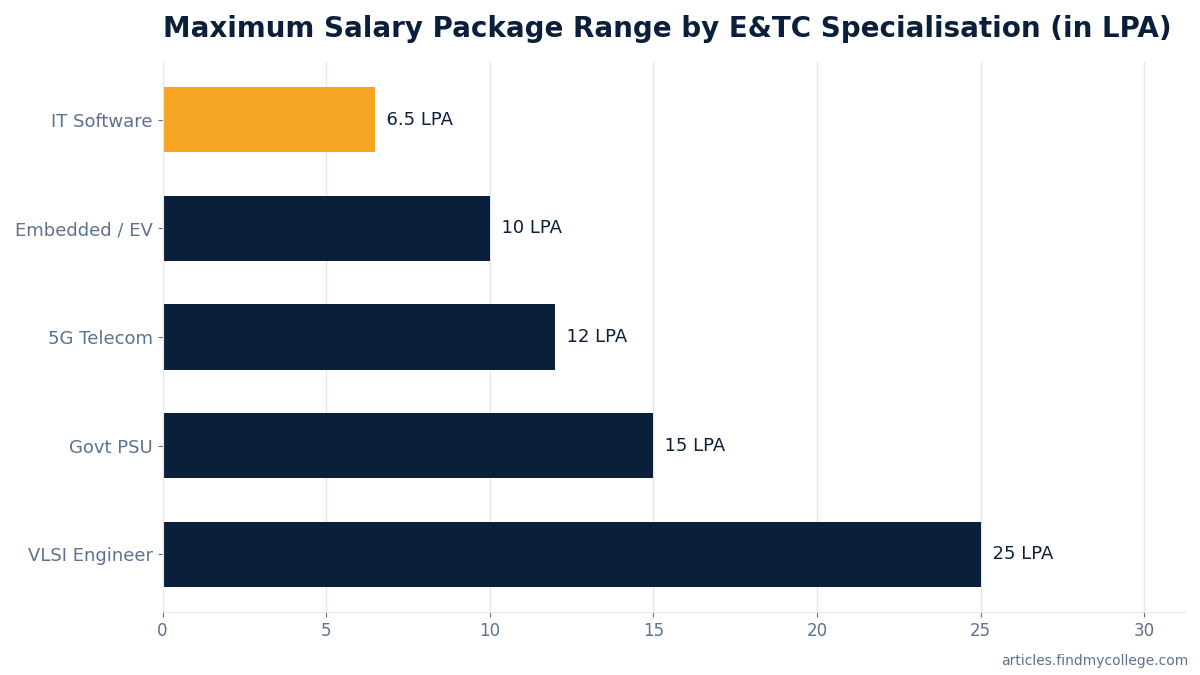
Graduates in Electronics and Telecommunication Engineering enjoy varied career opportunities across semiconductor design, telecommunications, embedded systems, software engineering, and public sector undertakings. Fresh E&TC graduates working as VLSI Engineers in top firms like Intel, Qualcomm, NVIDIA, and AMD can earn salaries ranging from ₹8 to ₹25 LPA.
Government PSUs such as ISRO, DRDO, BEL, and BHEL recruit E&TC freshers at pay scales ranging between ₹7 and ₹15 LPA.
| Career Specialisation | Top Hiring Companies | Average Salary Package (LPA) |
|---|---|---|
| VLSI Engineer | Intel, Qualcomm, NVIDIA, AMD | ₹8 – ₹25 LPA |
| Govt PSU Engineer | ISRO, DRDO, BEL, BHEL | ₹7 – ₹15 LPA |
| 5G Telecom Engineer | Ericsson, Nokia, Samsung, Reliance Jio | ₹5 – ₹12 LPA |
| Embedded Systems / EV Engineer | Bosch, Tata Elxsi, Ola Electric | ₹5 – ₹10 LPA |
| IT / Software Engineer | TCS, Wipro, Infosys, Cognizant | ₹3.5 – ₹6.5 LPA |
How to Apply for B.Tech Electronics and Telecommunication Engineering Admission in 2026: Step by Step
- Check Eligibility: Candidates must have qualified 10+2 with Physics, Chemistry, and Mathematics securing a minimum of 50% marks in PCM, or an equivalent AICTE-approved 3-year Engineering Diploma, with an age between 16 to 28 years at the time of admission.
- Register for Entrance Examination: Fill out the AIE CET application form online on the official website www.aiecet.com.
- Attend Admission Counseling: Participate in admission counseling to confirm admission according to the All India Rank (AIR) secured in the entrance exam.
- Scholarship Allocation: All entrance-qualified students can get up to a 100% scholarship for admission in Puran Murti Group of Institutions.
| What to do | Where | Link |
|---|---|---|
| Compare colleges, fees and cutoffs | B.Tech Electronics and Telecommunication Engineering colleges in India | findmycollege.com |
Candidates must fulfill academic and age requirements before registering for entrance examinations online. Admission is confirmed through rank-based counseling, where qualified students can also receive up to 100% scholarships.
FAQs
What is the salary of electronics and telecommunication engineering?
Domain specialisations like VLSI Engineering offer packages up to ₹8–25 LPA, while 5G Telecom roles pay ₹5–12 LPA.
What subjects are there in ENTc?
Key ENTC subjects include Engineering Mathematics, Basic Electrical & Electronics, Digital Logic Design, Signals & Systems, Analog & Digital Communication, Microprocessors & Microcontrollers, VLSI Design, Control Systems, and Optical Communication.
How many credits are in BTech ECE?
Standard B.Tech ECE programmes (such as NIT Hamirpur’s curriculum) consist of 180 total credits distributed across 8 semesters, requiring roughly 270 total contact hours.
Is electronics and telecommunication engineering in demand?
Yes, E&TC engineering is highly in demand across fast-growing sectors like VLSI design, 5G telecommunications, EV/embedded systems, and government defense PSUs like ISRO and DRDO.