Vocational Courses After 12th: Top Career Options and Skill List
Nishit Kumar is a senior EdTech industry leader with over a decade of experience in building and scaling education platforms, shaping their product, content, and growth strategy. At…
With fee structures starting at INR 5,000 for short-term certificates up to INR 1,80,100 for degree programs, vocational qualifications lead directly into technical job roles earning entry-level monthly salaries between Rs. 10,000 and Rs. 20,000. This complete guide outlines stream-wise vocational lists, eligibility requirements, course fees, top offering colleges, and step-by-step admission procedures.
| Parameter | Details |
|---|---|
| Course Types & Duration | BVoc (3 Years with 1/2 year exit diploma options), Diploma (1-2 Years), Certificates (6 Months) |
| Average Course Fee | INR 6,000 to INR 1,80,100 (Most courses average under INR 1 Lakh) |
| Starting Monthly Salary | Rs. 10,000 – Rs. 20,000 (Entry level); Rs. 40,000 – Rs. 50,000 (Senior level) |
| Key Regulatory Body / Scheme | UGC Deen Dayal Upadhyay Kaushal Kendra scheme & AICTE approved institutes |
| Admission Process | Merit-based on Class 12 marks or college-specific entrance examinations |
List of Vocational Courses after 12th by Stream
Students completing Class 12 across Science, Commerce, and Arts streams can choose specialized vocational pathways aligned with their academic background and core skill interests.
Eligibility and Duration for Top BVoc and Diploma Courses
BVoc degree specialisations run across 3 years with annual exit milestones, whereas short-term diplomas and certificate courses range from 6 months to 1 year. Admission requirements vary depending on the practical focus of each domain.
| BVoc Specialisation | Eligibility Criteria | Top Offering Colleges / Institutes |
|---|---|---|
| BVoc Data Science & Analytics | Min 50-60% in 10+2 with Mathematics / Statistics | Mount Carmel College Bangalore, DSEU, CUSAT, St. Thomas College Kerala |
| BVoc Software Development | Min 50-60% in 10+2 from any stream | University of Delhi, GGSIPU, St. Xavier’s Mumbai, DSEU, Jai Hind Mumbai, Banasthali Vidyapeeth |
| BVoc Food Processing & Quality Management | Min 45-55% in 10+2 with Science / Home Science | PIMS Bangalore University, Stella Maris Chennai, Assam University, University of Allahabad |
| BVoc Automobile Technology | Min 45-50% in 10+2 from any stream | DSEU, GGSIPU, University of Allahabad |
| BVoc Retail Management | Min 45-50% in 10+2 from any stream | University of Delhi, MCC Bangalore, DSEU, St. Aloysius College, St. Albert’s College |
| BVoc Banking & Financial Services (BFSI) | Min 45-50% in 10+2 from any stream | University of Delhi, DSEU, GNDU Amritsar, MAKAUT West Bengal |
| BVoc Printing Technology | Min 45-50% in 10+2 from any stream | University of Delhi, DSEU, St. Thomas College Kerala |
| BVoc Hospitality & Tourism | Min 45-50% in 10+2 from any stream | University of Delhi, MCC Bangalore, Manipur University |
For candidates seeking faster workplace entry, 1-year diplomas and 6-month skill certificates offer concentrated vocational modules in specific administrative, technical, or creative tracks.
| Course Name | Duration | Eligibility Criteria | Course Fee (INR) |
|---|---|---|---|
| Diploma in Modern Office Practice (IGNOU) | 1 Year | Pass in 10+2 | INR 6,000 |
| Diploma in BPO Finance and Accounting (IGNOU) | 1 Year | Min 50% in 10+2 with English | INR 19,200 |
| Certificate in Fashion Designing (IGNOU) | 6 Months | Pass in 10+2 | INR 5,000 |
| Certificate in Communication and IT Skills (IGNOU) | 6 Months | Pass in 10+2 with English | INR 5,200 |
Vocational Courses Fee Structure Across Top Indian Colleges
The cost of pursuing vocational training in India depends on the institution type and course equipment requirements. Government colleges and open universities maintain minimal tuition fees, while private technology institutes charge higher operational fees.
| College / Institution Name | Vocational Course Offered | Fee Structure (INR) |
|---|---|---|
| College of Vocational Studies (DU) | BA (VS) Human Resource / Marketing / Tourism / Office Management | INR 10,150 |
| Ramniranjan Jhunjhunwala College | BVoc Courses | INR 6,265 |
| Khalsa College, Amritsar | BVoc Retail Management | INR 10,500 |
| Mahishadal Raj College, Medinipur | BVoc Retail Management | INR 30,000 |
| Akra Jain University, Jamshedpur | BVoc Courses | INR 43,000 |
| Kalindi College for Women (DU) | BVoc Web Designing | INR 47,241 |
| St. Aloysius College, Mangalore | BVoc Retail Management | INR 47,250 |
| University of Technology, Jaipur | BVoc Courses | INR 50,000 |
| Ramanujan College (DU) | BVoc Banking Operations | INR 75,000 |
| Ganga Technical Campus, Bahadurgarh | BVoc Courses | INR 1,80,100 |
Career Options and Expected Salary After Vocational Courses
| Industry Sector | Key Career Options / Job Roles | Expected Monthly Salary Structure |
|---|---|---|
| Information Technology (IT) | Web Developer, Computer Network Specialist, Data Analyst | Entry: Rs. 10,000 – 20,000 | Senior: Rs. 40,000 – 50,000 |
| Healthcare & Paramedical | Medical Laboratory Technician, Nursing Assistant, Radiology Technician | Entry: Rs. 10,000 – 20,000 | Senior: Rs. 40,000 – 50,000 |
| Business, BFSI & Commerce | Office Manager, Sales Executive, Accountant, Marketing Executive | Entry: Rs. 10,000 – 20,000 | Senior: Rs. 40,000 – 50,000 |
| Hospitality & Tourism | Chef, Hotel Manager, Travel Consultant | Entry: Rs. 10,000 – 20,000 | Senior: Rs. 40,000 – 50,000 |
| Art, Design & Fashion | Fashion Designer, Graphic Designer, Interior Designer | Entry: Rs. 10,000 – 20,000 | Senior: Rs. 40,000 – 50,000 |
| Beauty & Wellness | Beautician, Spa Manager, Fitness Trainer | Entry: Rs. 10,000 – 20,000 | Senior: Rs. 40,000 – 50,000 |
| Event Management | Event Planner, Wedding Coordinator, Corporate Event Manager | Entry: Rs. 10,000 – 20,000 | Senior: Rs. 40,000 – 50,000 |
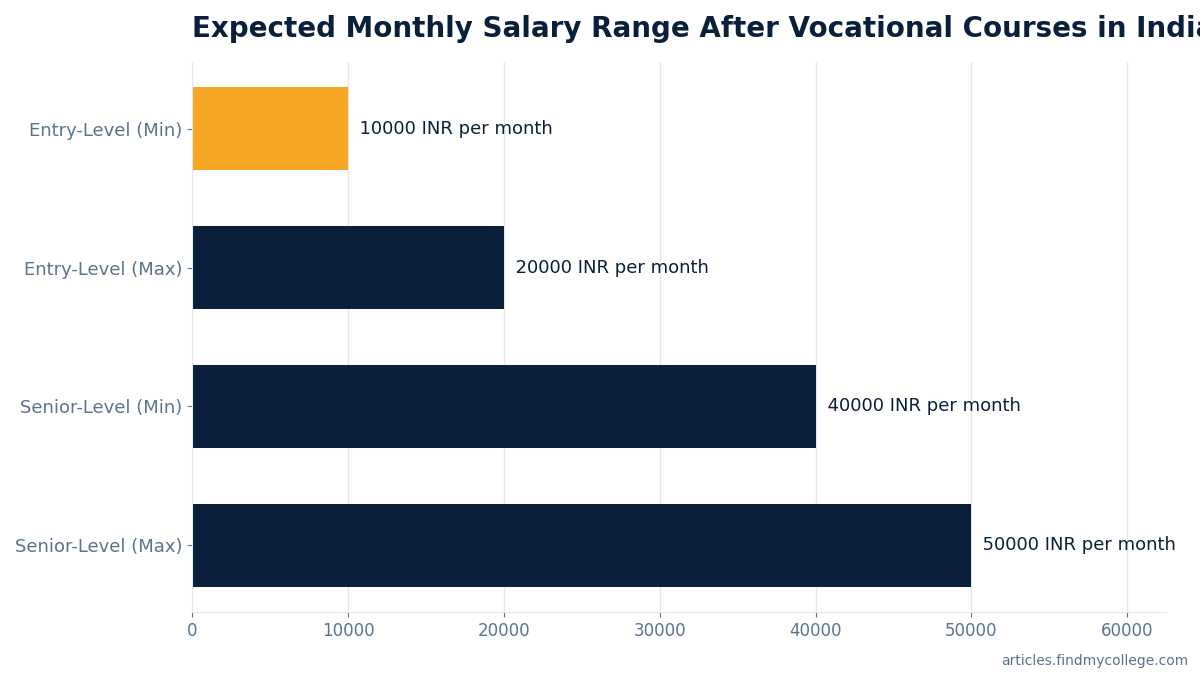
Graduates of vocational programs secure targeted job roles across multiple high-growth industries. Technical trade roles include Engineer, Technician, and Quality Control Inspector.
How to Select the Right Vocational Course After Class 12
Choosing the right vocational course requires matching individual stream background with domain-specific eligibility rules and targeted industry career goals. Students should evaluate whether a 3-year BVoc degree with exit options fits their long-term plans or if a short-term certificate is sufficient for fast entry into employment.
Assess fee affordability and practical workshop infrastructure before committing to an institution. Starting monthly earnings typically range from Rs. 10,000 to Rs. 20,000 for entry-level positions, advancing to Rs. 40,000 to Rs. 50,000 as practical experience and technical competencies grow.
How to Apply for Vocational Courses after 12th Admission in 2026: Step by Step
- Check Course Eligibility: Verify 10+2 stream and aggregate requirements (e.g. 50-60% with Math/Stats for Data Science; 45-55% with Science/Home Science for Food Processing; 45-50% for BVoc Retail/BFSI).
- Select Vocational Specialisation: Choose between 3-year BVoc degrees (with 1-year Diploma exit options) or 6-12 month skill certificates (IGNOU / NIOS / ITI).
- Apply to Target Universities: Submit applications to offering institutes like DU colleges (CVS, Ramanujan, Kalindi), DSEU, IGNOU, MCC Bangalore, GGSIPU, or St. Xavier’s Mumbai.
- Complete Entrance Test / Merit Screening: Admissions are granted primarily based on Class 12 merit marks, while specific institutes conduct institutional entrance tests.
- Verify Academic Documents: Submit Class 12 mark sheets, pass certificates, identity documents, and category certificates if applicable during seat allotment.
| What to do | Where | Link |
|---|---|---|
| Compare colleges, fees and cutoffs | Vocational Courses after 12th colleges in India | findmycollege.com |
FAQs
What are vocational courses after 12th and what are their benefits?
Vocational courses offer application-based practical training in specific career fields like IT, retail, healthcare, and design. Key benefits include hands-on training, industry readiness, and flexible exit options like exiting BVoc after 1 year with a diploma.
What are vocational courses in DU (Delhi University)?
Delhi University offers BA (VS) programs at College of Vocational Studies in HR, Marketing, Material Management, and Tourism, along with BVoc degrees such as Banking Operations (Ramanujan College) and Web Designing (Kalindi College).
Is there any 1 year diploma course after 12th?
Yes, institutes like IGNOU offer 1-year diploma programs including Diploma in Modern Office Practice (INR 6,000) and Diploma in BPO Finance and Accounting (INR 19,200). BVoc degrees also award a diploma upon completing 1 year.
Which vocational course after 12th science has the best opportunities?
Popular vocational courses for science students include BVoc Data Science & Analytics, BVoc Food Processing & Quality Management, and Diploma in Medical Laboratory Technology (DMLT).
Which course after 12 commerce has high salary and job scope?
Commerce students can pursue BVoc Banking & Financial Services (BFSI), BVoc Retail Management, Diploma in BPO Finance and Accounting, or BA (VS) Marketing Management, leading to roles like Accountant, Store Manager, and Office Manager.
What is the expected starting salary after a vocational course?
Graduates of vocational courses generally earn entry-level monthly salaries ranging from Rs. 10,000 to Rs. 20,000, which can increase to Rs. 40,000 – Rs. 50,000 at senior levels with experience.