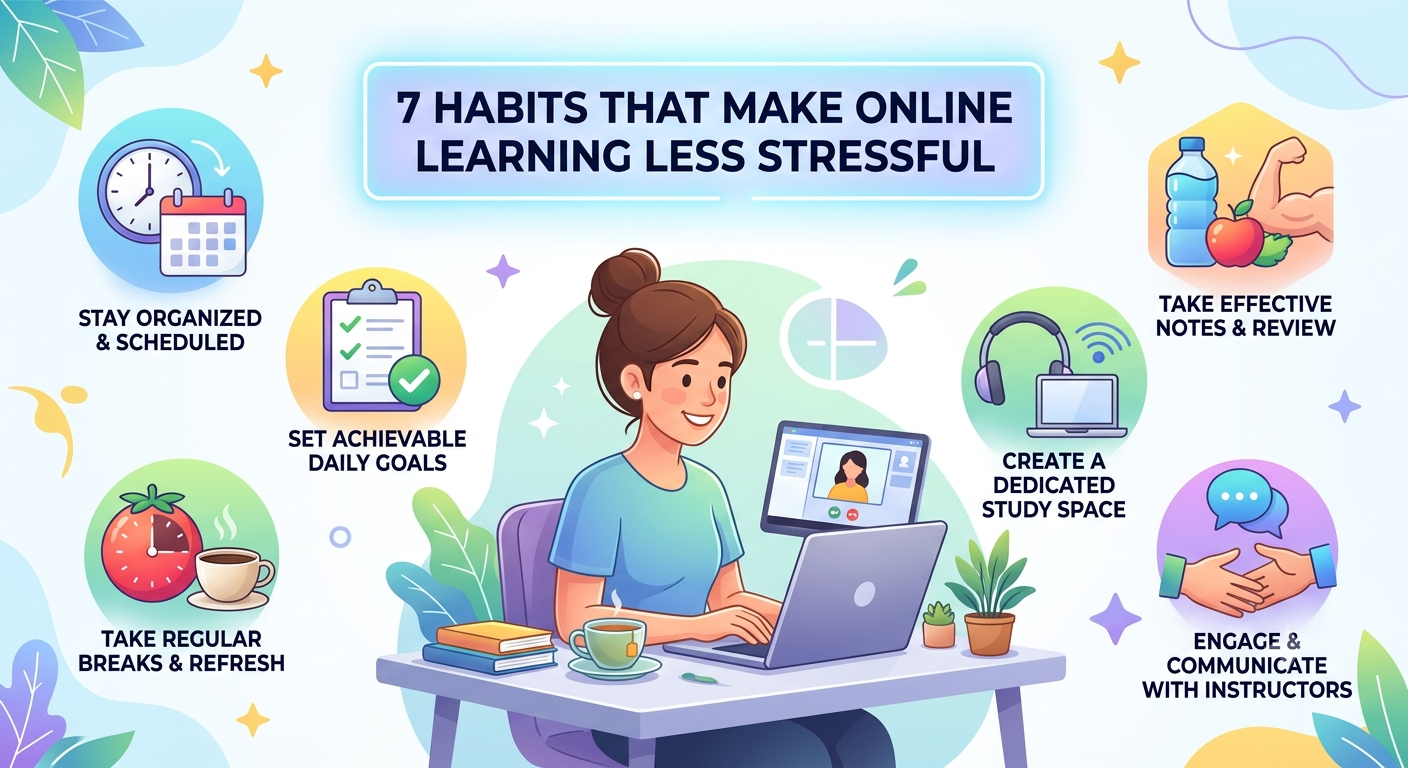
7 Habits That Make Online Learning Less Stressful
Online learning gives students the freedom to study from home, attend classes from different locations, and manage their education alongside work or other responsibilities. However, this flexibility can sometimes make studying harder than expected.
Without a fixed classroom schedule, students may delay assignments, miss important classes, or struggle to find time for revision. Some students also find it difficult to stay focused during long online lectures, especially when they have to manage household responsibilities, college work, or a full-time job.
The good news is that online learning does not have to feel overwhelming. A few simple habits can make it easier to manage classes, complete assignments on time, and maintain a healthy balance between studies and personal life.
Here are seven habits that can make online learning less stressful and help students get more out of their courses.
1. Set a Fixed Time for Studying Every Day
One of the biggest advantages of online education is that students often have more control over their schedules. However, this freedom can become a problem when there is no clear study routine.
For example, a student may plan to watch a recorded lecture in the morning but keep postponing it until the evening. The same thing happens the next day, and soon several lectures are waiting to be completed.
Setting a fixed study time can help prevent this situation. Students do not need to study for long hours every day. Even one or two hours of focused study can make a difference when done regularly.
Start by choosing a time that fits your daily routine. Students who work full-time may prefer studying after dinner, while college students may find mornings more convenient.
Try to follow these simple steps:
- Choose a regular time for attending classes or watching recorded lectures.
- Keep a separate time slot for assignments and revision.
- Avoid changing your schedule every day unless necessary.
- Leave some extra time for unexpected tasks or difficult topics.
For example, a working professional pursuing an online MBA could spend one hour on lectures from Monday to Friday and use the weekend to complete assignments and revise important topics.
A fixed routine reduces the need to decide when to study every day. Once studying becomes part of your schedule, it becomes easier to manage.
2. Break Large Tasks Into Smaller Goals
Looking at an entire semester’s syllabus or a long assignment can make anyone feel stressed. Students may know what they need to do but struggle to decide where to begin.
The easiest way to handle a large task is to divide it into smaller steps.
Suppose you have a 3,000-word assignment due in ten days. Instead of worrying about the complete assignment, divide the work into manageable tasks.
You could spend the first day understanding the topic, the second day collecting information, the next few days writing different sections, and the final days reviewing your work.
The same approach works for online lectures. Instead of planning to complete five hours of recorded classes in one sitting, aim to finish one or two lectures at a time.
Here is an example of how to divide a study task:
| Day | Task |
|---|---|
| Monday | Watch two lectures |
| Tuesday | Make notes on the main concepts |
| Wednesday | Read the relevant study material |
| Thursday | Practise questions or solve examples |
| Friday | Revise the topic |
| Saturday | Complete pending work |
| Sunday | Review progress and plan the next week |
This schedule is only an example. Students can adjust it according to their course requirements and available time.
The main idea is to make the next step clear. When a task feels manageable, students are less likely to delay it because of stress or confusion.
3. Plan Your Week Before It Starts
Online students often have to manage several things at once. There may be live classes, recorded lectures, assignment deadlines, examinations, office work, and family responsibilities.
Trying to remember everything can quickly become tiring. A weekly study plan can help students understand what needs attention and avoid last-minute pressure.
Take 15 to 20 minutes at the beginning of each week to check your academic calendar. Note the classes you need to attend, assignments that are due, and topics you want to revise.
You can use a notebook, a phone calendar, or a simple digital planner. There is no need to use complicated productivity tools if a basic list works for you.
While planning your week, keep these points in mind:
- Write down assignment deadlines and examination dates.
- Mark live classes and important academic sessions.
- Give difficult subjects more time than familiar topics.
- Keep some free time for unfinished tasks.
- Avoid filling every hour with study-related activities.
It is also helpful to identify your three most important academic tasks for the week. These should be the tasks that need the most attention or have the closest deadlines.
For instance, if you have an assignment due on Friday and a live class on Wednesday, complete at least part of the assignment before the class. This prevents several important tasks from piling up together.
A weekly plan does not have to be followed perfectly. Its purpose is to give you a clear idea of what lies ahead, so you can adjust your schedule before things become difficult to manage.
4. Take Short Breaks Between Study Sessions
Studying continuously for several hours may seem productive, but it can make it harder to concentrate. After a while, students may start rereading the same paragraph, miss important points in a lecture, or feel tired without making much progress.
Short breaks give your mind and body a chance to rest.
One simple method is to study for 25 to 30 minutes and then take a five-minute break. After three or four sessions, you can take a longer break of around 15 to 20 minutes.
You do not have to follow this exact schedule. Some subjects may require longer periods of concentration, while others may be easier to study in shorter sessions.
During breaks, try to move away from your study screen. You can:
- Walk around the room.
- Stretch your neck, shoulders, and back.
- Drink water.
- Look away from the screen and rest your eyes.
- Get some fresh air if possible.
Avoid spending every break scrolling through social media. A quick look at your phone can easily turn into 20 minutes, leaving you with less time for studying.
Breaks are particularly useful for students who attend online classes for several hours or work on a laptop throughout the day.
Remember, taking a break is not a waste of time. It can help you return to your work with better concentration and less fatigue.
5. Keep Your Study Space Simple and Distraction-Free
Not every online student has a separate room or a large desk for studying. Many students attend classes from their bedroom, dining table, or a shared space at home.
However, having a regular study spot can make it easier to concentrate.
Your study area does not need to look perfect. It should simply be comfortable enough for you to attend classes, read study material, and complete assignments without unnecessary distractions.
Start with a few basic changes:
- Keep your laptop, notebooks, pens, and other study materials within reach.
- Put your phone on silent or keep it away during focused study sessions.
- Close unnecessary browser tabs.
- Turn off non-essential notifications.
- Use headphones if the surroundings are noisy.
If you share your space with family members or roommates, let them know when you have an important live class or examination. Agreeing on quiet periods can reduce interruptions.
It is also useful to keep your digital study space organised. Create separate folders for different subjects and save lecture notes, assignments, and reference material in clearly named files.
For example, a student studying an online BCA programme could create separate folders for programming, mathematics, database management, and project work.
This saves time when examination preparation begins. Instead of searching through dozens of files, students can quickly find the material they need.
A clean and organised study space will not solve every problem, but it can remove several small distractions that make online learning more tiring.
6. Ask for Help Before You Fall Behind
Online learning can sometimes feel isolating. In a traditional classroom, students can ask a classmate a quick question or speak to a teacher after a lecture. Online learners may not always have the same opportunities.
As a result, some students keep studying even when they do not understand a topic. They hope that the concept will become clearer later, but the confusion often continues into the next lesson.
Asking for help early can prevent this problem.
If you do not understand a lecture, first review your notes and revisit the relevant section of the recording. If the topic is still unclear, contact your instructor, ask a question during a doubt-clearing session, or discuss it with classmates.
You can also use student discussion forums or official course groups, if your university provides them.
Here are a few habits that can make asking for help easier:
- Write down questions while attending lectures.
- Ask specific questions instead of saying that you do not understand the entire subject.
- Contact your instructor before an assignment deadline becomes urgent.
- Join group discussions when you need help understanding difficult concepts.
- Check official course announcements for information about academic support.
For example, instead of spending several hours struggling with one programming concept, an online BCA student could identify the exact step that is causing confusion and ask the instructor to explain it.
The same applies to working professionals pursuing online degrees. If office responsibilities make it difficult to complete coursework, speaking to the academic support team early may help them understand the available options.
There is no need to wait until you have missed several classes or deadlines. Getting help at the right time can save effort and make studying less stressful.
7. Make Time for Life Outside Your Course
When students fall behind on their coursework, they often try to solve the problem by studying late into the night or giving up their free time.
Doing this occasionally may be unavoidable, especially during examinations. However, making it a regular habit can leave students tired and frustrated.
Online education is meant to offer flexibility, but that does not mean every free hour should be spent studying.
Maintaining a balance between education and personal life is important for long-term progress. Students need time for sleep, meals, physical activity, family, friends, and hobbies.
A few practical changes can help:
- Set a reasonable time to stop studying each day.
- Avoid regularly sacrificing sleep to finish routine academic tasks.
- Take time away from screens after classes.
- Make room for exercise, walking, or another activity you enjoy.
- Keep at least some free time during the weekend.
Students who work full-time and study online may find it particularly difficult to maintain this balance. Their workday may already involve several hours of screen time, followed by online lectures or assignments.
In such cases, it helps to set realistic weekly study goals rather than expecting yourself to study for several hours every night.
For example, you could study for an hour on most weekdays and reserve a longer session for Saturday. Sunday could include a short revision session along with time for rest and personal activities.
Your schedule may look different depending on your responsibilities. What matters is that it remains manageable over several weeks, rather than feeling exhausting after just a few days.
Also, avoid comparing your progress with that of other students. Someone who studies full-time may have more available hours than a student who works eight or nine hours a day. Focus on your own schedule and the progress you can make consistently.
Final Thoughts
Online learning becomes easier to manage when students develop habits that support regular study, better planning, and a healthy daily routine.
Setting a fixed study time, breaking large assignments into smaller tasks, planning the week, taking short breaks, keeping your study space organised, asking for help, and making time for personal life can reduce much of the pressure associated with online education.
You do not need to change your entire routine overnight. Start with one or two habits that address your biggest challenges. Once they become easier to follow, gradually introduce the others.
The aim is not to study every available minute or maintain a perfect schedule. It is to build a routine that helps you learn at a steady pace without feeling overwhelmed.
With a little planning and consistency, online learning can fit more comfortably into your everyday life.