Journalism Courses Duration: Program Lengths and Course Types
Nishit Kumar is a senior EdTech industry leader with over a decade of experience in building and scaling education platforms, shaping their product, content, and growth strategy. At…
- 15 May 2026JEECUP 2026 Exam Window
JEECUP 2026 diploma entrance exam conducted between 15 May 2026 and 22 May 2026. - 11 May 2026CUET UG 2026 Exam Window Opens
CUET UG 2026 exam conducted between 11 May 2026 and 31 May 2026 for undergraduate journalism admissions. - 25 Apr 2026IPU CET 2026 Exam Schedule
IPU CET 2026 exams conducted between 25 April 2026 and 17 May 2026. - 6 Mar 2026CUET PG 2026 Exam Window Conducted
CUET PG 2026 examination held from 06 March 2026 to 27 March 2026 for master level journalism courses. - 12 Nov 2025SUAT 2026 Application Form Release Date
SUAT 2026 application form release date announced for media and journalism course admissions.
Journalism course duration in India ranges from 6 months to 1 year for Certificate courses, 1 year for PG Diploma programs, 3 years for Undergraduate degrees (such as BJMC or BA), and 2 years for Postgraduate degrees (such as MA or MJMC).
Academic options span multiple entry points after Class 12 or graduation, offering distinct specialization paths in media. Students can evaluate course structures, eligibility criteria, admission schedules, tuition fee patterns across government and private institutions, and career outcomes below.
| Parameter | Details |
|---|---|
| UG Course Duration | 3 Years |
| PG Course Duration | 2 Years |
| PG Diploma Duration | 1 Year |
| Certificate Course Duration | 6 Months – 1 Year |
| UG Eligibility | Class 12 from recognized board with 50% aggregate score |
| PG Eligibility | UG degree in BJ, BJMC, BMM or relevant discipline with 50% aggregate |
| Course Fee Range | INR 1,080 to INR 25 Lakh |
| Average Starting Salary | INR 4.2 LPA (Fresher range INR 2-3 LPA up to INR 8-12 LPA with experience) |
Journalism Courses Duration and Level Wise Breakdown
Journalism courses in India are structured across five primary academic levels: Undergraduate (UG), Postgraduate (PG), Post Graduate Diploma (PGD), Certificate, and Doctoral (Ph.D.) programs. The table below outlines the standard program lengths, entry requirements, and primary entrance examinations for each level.
| Course Level | Duration | Eligibility Criteria | Common Entrance Exams |
|---|---|---|---|
| Undergraduate (UG) | 3 Years | Class 12 from recognized board with 50% aggregate | CUET, IPU CET, JEECUP |
| Postgraduate (PG) | 2 Years | UG degree in B.J., BJMC, BMM or relevant discipline with 50% aggregate | CUET-PG |
| PG Diploma | 1 Year | Bachelor’s degree in any discipline with 50% aggregate | Merit / College Entrance Exam |
| Certificate | 6 Months – 1 Year | Class 12 from recognized board with 50% aggregate | Merit-based admission |
Postgraduate Degree and PG Diploma Journalism Course Lengths
Postgraduate study in media is divided between 1-year Post Graduate Diploma (PGD) programs and 2-year Master’s degree programs. The minimum academic requirement for PG journalism courses is a 3, 4, or 5-year bachelor degree in any discipline with a 50% aggregate score. PGD options focus on targeted skill-building in areas like TV, Radio, Print, Broadcast, Screenplay Writing, Acting, and Sound Design, while MA and MSc degrees provide broader academic and technical training.
| Course Name | Program Type | Duration |
|---|---|---|
| PGD in Journalism | PG Diploma | 1 Year |
| PG Diploma in TV Journalism and Radio | PG Diploma | 1 Year |
| PG Diploma in Print & Broadcast Journalism | PG Diploma | 1 Year |
| Post Graduation Diploma in Acting | PG Diploma | 1 Year |
| Diploma in Screenplay Writing and Direction | PG Diploma | 1 Year |
| Post Graduation Diploma in Sound Recording, and Design | PG Diploma | 1 Year |
| MA in Communication and Journalism | Master’s Degree | 2 Years |
| MA in Advertisement, Entertainment and Media | Master’s Degree | 2 Years |
| Master’s Degree in Multimedia | Master’s Degree | 2 Years |
| Master’s Degree in Communication | Master’s Degree | 2 Years |
| Masters in Mass Communication and Journalism | Master’s Degree | 2 Years |
| MSc in Film Production and Television | Master’s Degree | 2 Years |
Journalism Eligibility
Eligibility criteria vary by academic level across Indian institutions:
- Undergraduate, Diploma, and Certificate Courses: Completion of Class 12 from a recognized educational board with a minimum of 50% aggregate score.
- Postgraduate and PG Diploma Courses: A 3, 4, or 5-year bachelor degree in B.J., BJMC, BMM, or any discipline with at least 50% aggregate marks from a recognized university.
- Doctoral (Ph.D.) Programs: A postgraduate degree in Journalism or Mass Communication & Media with at least 50% aggregate score.
Journalism Syllabus and Subjects
Key subjects covered during post-graduation journalism programs include:
- Reporting Methods
- Editing Techniques
- Media Laws & Indian Constitution
- Basic Audio-Visual Media
- Radio Broadcasting
- TV Broadcasting
- Internet & New Media
Journalism Career Scope and Salary
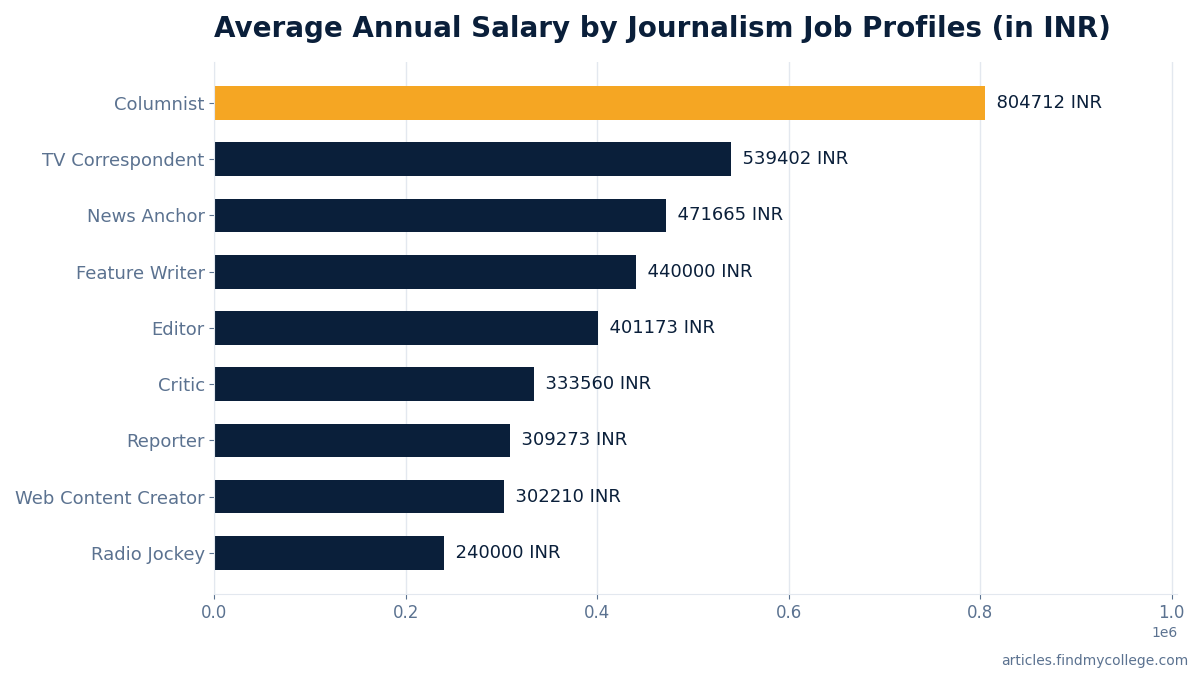
Graduating from a journalism program leads to opportunities in print newsrooms, broadcast television channels, news agencies, digital portals, and media production houses. Across 22 reporting colleges, the median average placement package is 3.0 LPA. Freshers in the journalism industry earn between INR 2 Lakh and INR 3 Lakh per annum, while professionals with 3 to 4 years of experience earn between INR 8 and 12 LPA. Major recruiters include Aaj Tak, NDTV, The Times of India, Hindustan Times, and Nav Bharat.
| Job Profile | Average Annual Salary (INR) |
|---|---|
| Columnist | 8,04,712 |
| TV Correspondent | 5,39,402 |
| News Anchor | 4,71,665 |
| Feature Writer | 4,40,000 |
| Editor | 4,01,173 |
| Critic | 3,33,560 |
| Reporter | 3,09,273 |
| Web Content Creator | 3,02,210 |
| Radio Jockey | 2,40,000 |
| Journalist | 1,50,000 |
How to Apply for Journalism Admission in 2026: Step by Step
- Check eligibility criteria: Verify academic eligibility: Class 12 with 50% aggregate score for UG/Diploma courses, or a 3-5 year undergraduate degree in any stream with 50% aggregate score for PG/PG Diploma courses.
- Register for entrance exams: Apply online for national/university entrance tests such as CUET (11-31 May 2026), CUET-PG (06-27 Mar 2026), IPU CET (25 Apr-17 May 2026), or JEECUP (15-22 May 2026).
- Submit application form: Fill out the online or offline application form on the institute portal, upload required mark sheets, academic certificates, and letters of recommendation, and pay the registration fee.
- Participate in Group Discussion & Personal Interview: Shortlisted candidates based on entrance exam scores or merit cutoffs attend Group Discussion (GD) and Personal Interview (PI) rounds conducted by the institution.
| What to do | Where | Link |
|---|---|---|
| Compare colleges, fees and cutoffs | Journalism colleges in India | findmycollege.com |
FAQs
What is the duration of journalism courses in India?
UG journalism programs (like BJMC or BA) last 3 years, PG degrees (MA/MJMC) take 2 years, PG Diploma courses take 1 year, and Certificate courses range from 6 months to 1 year.
Is BA journalism a recognized course?
Yes, BA in Journalism is a 3-year undergraduate degree course offered by recognized Indian universities for students completing Class 12 with a minimum 50% aggregate score.
What is the eligibility for postgraduate journalism courses?
Candidates require a valid 3-year, 4-year, or 5-year undergraduate degree in B.J., BJMC, BMM, or any stream with at least 50% aggregate marks from a recognized university.
What is the average salary after completing a journalism course?
Freshers earn between INR 2-3 LPA, while experienced professionals (3-4 years) earn INR 8-12 LPA.
What are the fees for journalism courses in government vs private colleges?
Which entrance exams are conducted for journalism admissions?