
BA in Journalism Salary in India 2026: A Comprehensive Guide
Nishit Kumar is a senior EdTech industry leader with over a decade of experience in building and scaling education platforms, shaping their product, content, and growth strategy. At…
Latest update: BA in Journalism 2026 admissions & dates updated. Read more ›
For students and parents considering a BA in Journalism in India for the 2026 academic year, understanding potential career outcomes and salary expectations is crucial. This comprehensive guide provides an in-depth look at the salary landscape for journalism graduates, covering various roles, influencing factors, and future prospects in the dynamic media industry.
What is the average starting salary for a BA in Journalism graduate in India?
The average starting salary for a BA in Journalism graduate in India typically ranges from INR 2.5 LPA to INR 4.5 LPA. This figure can vary significantly based on the specific role, the employing organization (e.g., print, digital, broadcast), location, and the individual’s skills and internship experience.
Graduates often begin their careers in entry-level positions such as Junior Reporter, Content Writer, Sub-Editor, or Production Assistant. While initial salaries might seem modest, the journalism field offers substantial growth potential with experience and specialization.
Which job roles offer the highest salaries after a BA in Journalism?
While entry-level roles have a defined salary bracket, positions like Investigative Journalist, Senior Editor, Digital Marketing Manager (with a media focus), Public Relations Manager, and Media Consultant tend to offer the highest salaries for experienced professionals with a BA in Journalism background. Specialization in niche areas like data journalism, political reporting, or international affairs can also lead to higher earning potential.
What factors influence BA in Journalism salaries in India?
Several critical factors influence the salary of a BA in Journalism graduate in India:
- Type of Media House: Large national and international media organizations (e.g., Times Group, NDTV, Reuters) generally offer better compensation packages compared to smaller regional or local outlets.
- Location: Metropolitan cities like Mumbai, Delhi-NCR, Bengaluru, and Hyderabad, which are media hubs, typically offer higher salaries due to higher living costs and more opportunities.
- Specialization: Graduates specializing in high-demand areas like digital content creation, multimedia journalism, data analytics for media, or specific beats (e.g., finance, technology) often command better salaries.
- Skills and Portfolio: A strong portfolio showcasing diverse work (articles, videos, podcasts), excellent writing, editing, research, and digital media skills significantly boosts earning potential. Proficiency in multiple languages is also a major advantage.
- Experience and Internships: Relevant internships during the degree program are invaluable. They provide practical experience, networking opportunities, and often lead to pre-placement offers or better starting salaries.
- Further Education: Pursuing a Master’s degree (MA in Journalism, PG Diploma in Mass Communication) or specialized certifications can open doors to higher-paying roles and leadership positions.
Is a BA in Journalism worth it for jobs and salary in India?
Yes, a BA in Journalism can be a worthwhile degree for jobs and salary in India, especially for individuals passionate about media, communication, and storytelling. While initial salaries may not be as high as some technical fields, the degree provides a strong foundation for a diverse range of careers in a constantly evolving industry. The value lies in the versatility of skills acquired, which are applicable across traditional media, digital platforms, corporate communications, and even entrepreneurship.
The media landscape is rapidly expanding, particularly in digital content, social media, and multimedia production, creating new avenues for journalism graduates. The key is to continuously upskill and adapt to new technologies and trends.
What are the top recruiting sectors and companies for BA in Journalism graduates?
BA in Journalism graduates find opportunities across a broad spectrum of sectors. The top recruiting sectors include:
- Print Media: Newspapers, magazines (both national and regional).
- Broadcast Media: News channels (TV and Radio), production houses.
- Digital Media: Online news portals, content websites, social media platforms, OTT platforms.
- Public Relations (PR) & Advertising: PR agencies, corporate communication departments, ad agencies.
- Content Marketing: Brands and agencies requiring content writers, strategists, and editors.
- Event Management: Media relations and content creation for events.
- NGOs & Government: Communication roles, public information officers.
Some prominent recruiting companies and organizations include:
- News Organizations: The Times Group, Hindustan Times, India Today Group, NDTV, Zee Media, Network18, Reuters, PTI.
- Digital Platforms: ScoopWhoop, The Quint, Scroll.in, various content marketing agencies.
- PR Agencies: Adfactors PR, Genesis BCW, Edelman, Weber Shandwick.
- Corporate Houses: Communication departments of large corporations across various industries.
BA in Journalism Salary by Job Role in India (2026 Estimates)
Here’s an estimated salary range for various job roles for BA in Journalism graduates in India, considering 0-5 years of experience. These figures are indicative and can vary.
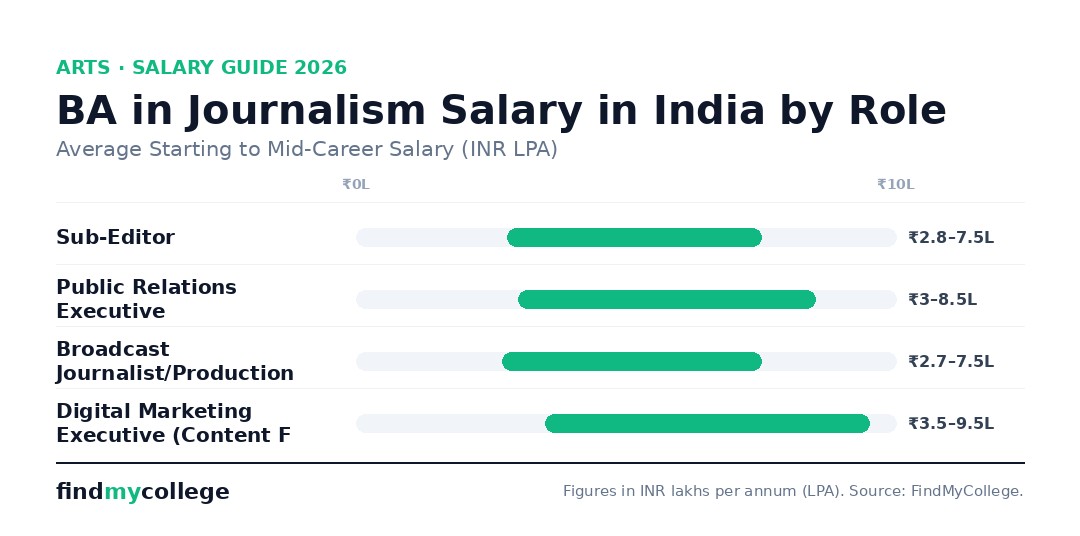
| Job Role | Average Starting Salary (INR LPA) | Mid-Career Salary (INR LPA, 3-5 Yrs Exp) |
|---|---|---|
| Junior Reporter/Trainee Journalist | 2.5 – 4.0 | 4.0 – 7.0 |
| Content Writer/Editor | 3.0 – 4.5 | 5.0 – 8.0 |
| Sub-Editor | 2.8 – 4.2 | 4.5 – 7.5 |
| Copywriter | 3.5 – 5.0 | 6.0 – 9.0 |
| Public Relations Executive | 3.0 – 4.8 | 5.0 – 8.5 |
| Social Media Manager (Entry-Level) | 3.2 – 4.7 | 5.5 – 9.0 |
| Broadcast Journalist/Production Assistant | 2.7 – 4.2 | 4.5 – 7.5 |
| Digital Marketing Executive (Content Focus) | 3.5 – 5.0 | 6.0 – 9.5 |
How does a BA in Journalism compare to other Arts stream degrees in terms of salary?
Compared to many other general Arts stream degrees (e.g., BA in History, Sociology, Philosophy), a BA in Journalism often offers a more direct and structured career path with clearer entry-level job roles and salary expectations. While degrees like Economics or Psychology might lead to higher salaries in specific corporate or research roles, Journalism provides practical skills immediately applicable to a large industry. The salary potential for a BA in Journalism graduate can be competitive, especially when combined with strong practical skills and a good portfolio, often surpassing that of general arts graduates in their initial years.
What is the career growth and long-term salary potential after a BA in Journalism?
The career growth and long-term salary potential after a BA in Journalism are significant for dedicated professionals. With 5-10 years of experience, individuals can move into senior roles such as Senior Reporter, Bureau Chief, Editor, Content Head, PR Manager, or Communications Director. Salaries for these positions can range from INR 8 LPA to INR 20 LPA or even higher, depending on the organization, impact, and leadership responsibilities.
Specialized roles like investigative journalists, foreign correspondents, or media consultants can command premium salaries. Entrepreneurial ventures, such as starting independent media platforms or content agencies, also offer unlimited earning potential.
Explore more on FindMyCollege
Related pages for BA in Journalism aspirants on findmycollege.com:
Frequently Asked Questions
What is the eligibility for BA in Journalism in India?
The basic eligibility for a BA in Journalism in India is typically passing 10+2 (or equivalent) from a recognized board, often with a minimum aggregate percentage (e.g., 45-50%). Some universities may conduct entrance exams or interviews.
Are there entrance exams for BA in Journalism admissions?
Yes, many prominent universities and colleges conduct entrance exams for BA in Journalism admissions. Examples include IPU CET, DUET (for Delhi University colleges), Symbiosis Entrance Test (SET), and various university-specific tests. These usually assess general awareness, English language proficiency, media aptitude, and logical reasoning.
What are the top colleges for BA in Journalism in India?
Some of the top colleges for BA in Journalism in India include Indian Institute of Mass Communication (IIMC), Symbiosis Institute of Media and Communication (SIMC), Delhi University colleges (e.g., Lady Shri Ram College, Delhi College of Arts & Commerce), Christ University, and Manipal Institute of Communication (MIC).
Can I pursue a BA in Journalism after any stream (Science, Commerce, Arts)?
Yes, a BA in Journalism is typically open to students from any stream (Science, Commerce, or Arts) who have completed their 10+2. The focus is more on communication skills, general knowledge, and aptitude rather than specific subject prerequisites.
What are the common specializations within BA in Journalism?
While a BA is often a foundational degree, some programs offer specializations or electives in areas like Print Journalism, Broadcast Journalism, Digital Journalism, Photojournalism, Public Relations, Advertising, and Corporate Communications.
What are the career prospects beyond traditional journalism?
Beyond traditional journalism, graduates can pursue careers in content writing, content marketing, digital marketing, social media management, public relations, corporate communications, technical writing, instructional design, media research, film/TV production, and even entrepreneurship in the media and communication space.
How important are internships for BA in Journalism graduates?
Internships are extremely important for BA in Journalism graduates. They provide practical exposure, help build a portfolio, offer networking opportunities, and significantly enhance employability and starting salary prospects. Most programs mandate internships as part of the curriculum.
What is the fee range for a BA in Journalism in India?
The fee range for a BA in Journalism in India varies widely. For government colleges or state universities, it can be anywhere from INR 10,000 to INR 50,000 per annum. For private universities and institutes, fees can range from INR 80,000 to INR 3,00,000 per annum, depending on the institution’s reputation and facilities.