Best Journalism Courses After 12th in India — Eligibility, Fees, Career Path (2026)
Nishit Kumar is a senior EdTech industry leader with over a decade of experience in building and scaling education platforms, shaping their product, content, and growth strategy. At…
Is a BA in Journalism enough, or do you need a Master’s to land a real reporting job after 12th? Many aspiring journalists in
TL;DR — Who This Guide Is For
Students from any stream (Arts, Commerce, Science) who have passed 12th grade with at least 50% marks and are passionate about storytelling and seeking facts.
- Streams needed: Any
- Shortest path: Under 1 year (certificate)
- Longest path: 5 years (UG + PG)
- Salary band: 2.5-25 LPA
Eligibility — Can You Apply?
| Requirement | What it means |
|---|---|
| Streams allowed | Arts, Commerce, Science |
| Minimum 12th marks | 50% aggregate in 12th |
| Subjects required | English |
Course Options at a Glance
Here are the routes you can take after 12th, ranked by how long they take and what they cost:
| Type | Duration | Fees Range | Entry Route | Best For |
|---|---|---|---|---|
| Certificate | 0.5-2 years | ₹25,000-₹200,000 total | merit-based | students who want to test the waters before committing to a full degree program |
| Diploma | 0.5-2 years | ₹50,000-₹300,000 total | merit-based | students who want to enter the field quickly or prefer shorter programs with hands-on training |
| UG Degree | 3 years | ₹75,000-₹6,000,000 total | merit-based or entrance exams | students seeking comprehensive education in journalism and mass communication |
| Integrated | 5 years | ₹125,000-₹10,000,000 total | merit-based or entrance exams | students who want to combine journalism with other disciplines for a well-rounded education |
Top 5 Specific Courses to Consider
Each course below has a distinct career outcome. Pick by the kind of job you want at the end, not by the name.
Bachelor of Journalism & Mass Communication (BJMC)
Bachelor
3 years
- Eligibility: Minimum 50% marks in 12th grade from any stream
- Fees: ₹75,000-₹6,000,000 total
- Career focus: media, reporting, digital journalism, content writing, social media management, podcast production, video journalism
- Top institutes: IIMT University
BA in Mass Communication
Bachelor
3 years
- Eligibility: Minimum 50% marks in 12th grade from any stream
- Fees: ₹75,000-₹6,000,000 total
- Career focus: advertising, public relations, corporate communication, digital marketing alongside core journalism subjects
- Top institutes:
BA in Journalism
Bachelor
3 years
- Eligibility: Minimum 50% marks in 12th grade from any stream
- Fees: ₹75,000-₹6,000,000 total
- Career focus: traditional print media, television journalism, radio broadcasting, public relations & advertising
- Top institutes:
Diploma in Journalism
Diploma
0.5-2 years
- Eligibility: Completion of 10+2 from any stream
- Fees: ₹50,000-₹300,000 total
- Career focus: practical skills, hands-on training, internships with media organizations
- Top institutes:
Certificate in Journalism
Certificate
0.5-2 years
- Eligibility: Completion of 10+2 from any stream
- Fees: ₹25,000-₹200,000 total
- Career focus: test the waters before committing to a full degree program, learn ropes of the profession quickly
- Top institutes:
Entrance Exams You Should Know
| Exam | Authority | Frequency | Next Window | Eligibility |
|---|---|---|---|---|
| CUET UG | NTA | once yearly | May 2026 | For admission to undergraduate journalism programs after 12th grade |
| SET | Symbiosis International University | once yearly | — | For admission to SCMC Pune |
| XIC OET | Xavier Institute of Communications | once yearly | — | For admission to XIC Mumbai |
Top Journalism Colleges in India — State-Wise List with Admission & Fees
Below are 30 Journalism colleges in India grouped by state, so you can shortlist options close to home. Each entry shows the exact admission route (entrance exam + cutoff signal or merit-based), complete fees breakdown (tuition + hostel where available), and the specific Journalism course offered:
📍 Delhi NCR (5 colleges)
| College | Course Offered | Admission Process | Complete Fees | NIRF / Notable |
|---|---|---|---|---|
| Aditi Mahavidyalaya, Delhi New Delhi · State University |
BA in Journalism | CUET UG | ₹45.64K/yr | None |
| Bharati College, New Delhi New Delhi · State University |
BA in Journalism | CUET UG | ₹96.33K total course fees | None |
| Bhim Rao Ambedkar College, Delhi New Delhi · State University |
BA in Journalism | CUET UG | ₹44.95K total course fees | None |
| Jamia Millia Islamia New Delhi · Central University |
BA Hons. in Journalism | JMI Entrance Exam | ₹10K-₹30K/yr | Listed as a ‘Top College (Govt.)’ |
| Maharaja Agrasen College, University of Delhi New Delhi · State University |
BA Hons. in Journalism | CUET UG | ₹10K-₹30K/yr | Listed as a ‘Top College (Govt.)’ |
📍 Karnataka (5 colleges)
| College | Course Offered | Admission Process | Complete Fees | NIRF / Notable |
|---|---|---|---|---|
| Garden City University Bengaluru · Private University |
BA in Media and Mass Communication (Journalism specialization) | Merit-based (CBSE 12th / Karnataka 2nd PUC scores) | ₹1.02L – ₹5L/yr | 4.6 (35 Reviews) |
| St. Joseph’s College of Commerce, Bangalore Bengaluru · Private Aided |
BA in Media and Mass Communication (Journalism specialization) | Merit-based (CBSE 12th / Karnataka 2nd PUC scores) | ₹49K – ₹2.4L/yr | 4.4 (70 Reviews) |
| Manipal Institute of Communication (MIC), Manipal Academy of Higher Education (MAHE) Manipal · Deemed University |
BA (Media & Communication) | MET (Manipal Entrance Test) or direct merit-based (12th marks) | ₹80K-₹2.5L/yr | Listed as a ‘Top College (Private)’ |
| IADC bangalore Bengaluru · Private |
Media and Mass Communication | Direct merit-based (12th marks) | ₹61.7K/yr | 4.5 (6 Reviews) |
| Commits Institute of Journalism and Mass Communication Bengaluru · Private |
Media and Mass Communication | Direct merit-based (12th marks) | ₹1.8L – ₹2.3L total course fees | Shortlisted by 20+ students |
📍 Uttar Pradesh (16 colleges)
| College | Course Offered | Admission Process | Complete Fees | NIRF / Notable |
|---|---|---|---|---|
| Amity University, Noida Noida · Private University |
BA Hons. in Journalism | Private entrance test (e.g. Amity JEE) or direct merit-based (12th marks) | ₹80K-₹2.5L/yr | Listed as a ‘Top College (Private)’ |
| Mangalayatan University (MU) Aligarh · Private University |
BA in Journalism | Private entrance test or direct merit-based (12th marks) | ₹80K-₹2.5L/yr | None |
| Babu Banarasi Das University (BBDU) Lucknow · Private University |
BA in Journalism | Private entrance test or direct merit-based (12th marks) | ₹80K-₹2.5L/yr | None |
| IIMT University Meerut · Private University |
BA in Journalism | Private entrance test or direct merit-based (12th marks) | ₹80K-₹2.5L/yr | None |
| United University Prayagraj · Private University |
BA in Journalism | Private entrance test or direct merit-based (12th marks) | ₹80K-₹2.5L/yr | None |
| Noida International University (NIU) Noida · Private University |
BA in Journalism | Private entrance test or direct merit-based (12th marks) | ₹80K-₹2.5L/yr | None |
| Sharda University (SU) Greater Noida · Private University |
BA in Journalism | Private entrance test (SUAT) or direct merit-based (12th marks) | ₹80K-₹2.5L/yr | None |
| Galgotias University (GU) Greater Noida · Private University |
BA in Journalism | Private entrance test (GU-SET) or direct merit-based (12th marks) | ₹80K-₹2.5L/yr | None |
| Rama University Kanpur · Private University |
BA in Journalism | Private entrance test or direct merit-based (12th marks) | ₹80K-₹2.5L/yr | None |
| Amity University, Lucknow Campus Lucknow · Private University |
BA in Journalism | Private entrance test or direct merit-based (12th marks) | ₹80K-₹2.5L/yr | None |
| Teerthanker Mahaveer University (TMU) Moradabad · Private University |
BA in Journalism | Private entrance test or direct merit-based (12th marks) | ₹80K-₹2.5L/yr | None |
| Bennett University (BU) Greater Noida · Private University |
BA in Journalism | Private entrance test (BET) or direct merit-based (12th marks) | ₹80K-₹2.5L/yr | None |
| IFTM University Moradabad · Private University |
BA in Journalism | Private entrance test or direct merit-based (12th marks) | ₹80K-₹2.5L/yr | None |
| Khwaja Moinuddin Chishti Urdu, Arabi-Farsi University Lucknow · State University |
BA in Journalism | University entrance exam or merit-based (12th marks) | ₹10K-₹30K/yr | None |
| Sam Higginbottom Institute of Agriculture Technology and Science (SHUATS) Prayagraj · Deemed University |
BA in Journalism | University entrance exam or merit-based (12th marks) | ₹10K-₹30K/yr | None |
| Nehru Gram Bharati Prayagraj · Deemed University |
BA in Journalism | University entrance exam or merit-based (12th marks) | ₹10K-₹30K/yr | None |
📍 Other States (4 colleges)
| College | Course Offered | Admission Process | Complete Fees | NIRF / Notable |
|---|---|---|---|---|
| Symbiosis Centre for Media and Communication (SCMC), Symbiosis International (Deemed University) Pune · Deemed University |
BA (Mass Communication) | SET (Symbiosis Entrance Test) | ₹80K-₹2.5L/yr | Listed as a ‘Top College (Private)’ |
| St. Xavier’s College, Kolkata Kolkata · Autonomous Institute |
BA in Journalism & Mass Communication | College-specific entrance test and merit-based (12th marks) | ₹80K-₹2.5L/yr | Listed as a ‘Top College (Private)’ |
| Haridev Joshi University of Journalism and Mass Communication (HJU) Jaipur · State University |
BA in Journalism and Mass Communication | University entrance exam or merit-based (12th marks) | ₹10K-₹30K/yr | Listed as a ‘Top College (Govt.)’ |
| Makhanlal Chaturvedi National University of Journalism and Communication (MCNUJC) Bhopal · State University |
BA (Journalism and Mass Communication) | University entrance exam or merit-based (12th marks) | ₹10K-₹30K/yr | Listed as a ‘Top College (Govt.)’ |
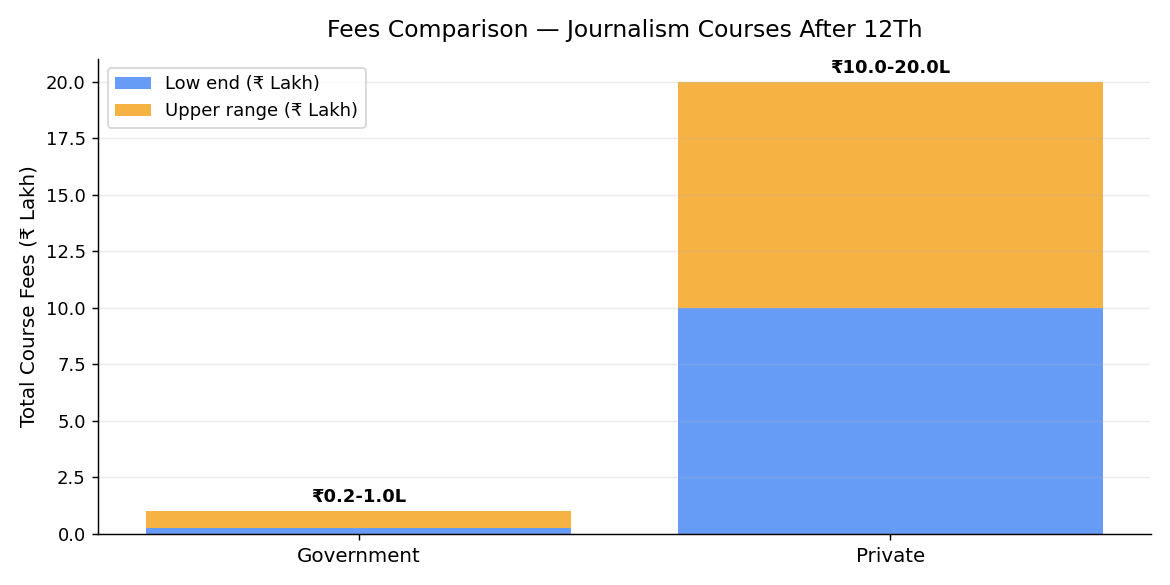
Fees Breakdown — What You’ll Actually Pay
| College Type | Total Course Fees |
|---|---|
| Government colleges | ₹25,000-₹100,000 per year |
| Private colleges | ₹1,000,000-₹2,000,000 per year |
Career Progression — Where You’ll Be in 10 Years
This is the realistic trajectory for graduates who stay in the field. Salary bands reflect Indian market data; relocate to a Tier-1 metro and the upper band moves up 20-40%.
- Entry (0-2 yrs) — 2.5-4.5 LPA · Roles: Junior Reporter, Trainee Journalist, Content Writer, Fresher Copywriter. Building credibility and skills, gathering leads, researching and pitching story ideas.
- Mid (3-7 yrs) — 3-12 LPA · Roles: Reporter, News Anchor, Digital Journalist, Content Strategist, PR Manager. Progressing to senior correspondent, news anchor, or editor roles, specializing in areas like investigative storytelling.
- Senior (8+ yrs) — 10-25 LPA · Roles: Senior Correspondent, Editor, Columnist, Senior Creative (Advertising), Senior PR Professional. Leading teams, shaping editorial direction, and managing high-profile projects in media houses or corporate communication.
Skills to Build (and How to Build Them)
A degree gets you to the interview; these skills get you the offer. Start in your first semester:
- Research & Fact-checking — Through practical assignments, internships, and investigative projects
- Content Creation & Storytelling — Developing writing, reporting, and multimedia content for various platforms
- Digital Media Proficiency — Learning tools for online publishing, social media, and digital content management
- Interviewing & Reporting — Hands-on training in live reporting assignments and field work
- Presentation & Communication — Practicing news anchoring, public speaking, and effective message delivery
- Multimedia Storytelling — Creating content across text, audio, video, and interactive formats
Top Recruiters Hiring Graduates
These companies actively hire from this field in India:
Higher Studies — Where You Can Go After UG
If you want to specialize further or move into research, these are the PG routes that pay off:
| PG Course | Duration | Entry Exam | Career Uplift |
|---|---|---|---|
| MA in Mass Communication | 2 years | CUET-PG | Qualify for promotions and increase income potential in senior roles |
| Master of Journalism and Mass Communication (MAJMC) | 2 years | — | Enhance specialized knowledge and leadership skills in media |
| Postgraduate Diploma in Journalism | 1 year | IIMC Entrance Exam | Specialized training for specific journalism fields like English, Hindi, Radio & TV, Digital Media |
Common Mistakes Students Make
These are the decision-level errors that cost a year (or a career switch):
- ❌ Mistake: Choosing an unaccredited or unrecognized journalism program.
✅ Do this instead: Always select programs recognized by the government of India to ensure your qualification holds value. - ❌ Mistake: Not aligning your course choice with your long-term career aspirations.
✅ Do this instead: Identify your interest (print, broadcast, digital, investigative) and choose a specialization that matches. - ❌ Mistake: Opting for programs that lack practical training and internships.
✅ Do this instead: Prioritize courses offering internships, realistic assignments, and real-world experience for hands-on learning. - ❌ Mistake: Underestimating the impact of the media house or employer on salary and career growth.
✅ Do this instead: Aim for reputable national media houses and digital platforms for better earning potential and opportunities. - ❌ Mistake: Overlooking salary differences between traditional and digital media roles.
✅ Do this instead: Be aware that broadcast and digital media often offer higher salaries compared to conventional print journalism.
Frequently Asked Questions
What is the eligibility for journalism courses after 12th?
Completion of 10+2 from any stream (Arts, Commerce, Science) with a minimum of 50% marks in 12th grade is typically required by most institutions.
What are the different types of journalism courses available after 12th?
Students can pursue undergraduate degrees (BA in Journalism, BJMC, BA in Mass Communication), diploma programs, and certificate courses, varying in duration from six months to three years.
What is the average fee for Journalism courses in India?
Fees range from around ₹25,000 per year in government universities to ₹10 lakh or more per year in private universities, depending on the institution and program.
Which entrance exams are required for admission to journalism courses?
Some colleges admit based on Class 12 scores, while others require entrance exams like CUET UG, SET (for SCMC Pune), and XIC OET (for XIC Mumbai).
What is the average salary after Mass Communication courses?
Average salaries usually range between ₹3 LPA to ₹9 LPA, depending on the college, role, and experience, with entry-level roles starting from ₹2.5 LPA.
What career opportunities are available after completing journalism courses?
Graduates can work as reporters, editors, news anchors, content writers, social media managers, podcast producers, video journalists, or in public relations and advertising.
Is journalism a good career choice after 12th?
Yes, India’s media industry is booming, offering diverse and dynamic career paths in print, broadcast, digital media, and related fields like PR and advertising, with potential for significant growth.
Do I need a specific stream in 12th to pursue journalism?
No, journalism courses are open to students from any stream – Arts, Commerce, or Science – as long as they meet the minimum marks requirement, making it a versatile career path.
What to Do Next
Now that you’ve mapped the Journalism landscape, your next 2 steps are concrete:
- Shortlist 5 colleges using the Top Colleges table above — apply to a mix of govt and private to hedge fees.
- Register for the relevant entrance exam(s) from the Exams table — most close registration 2-3 months before the test date.