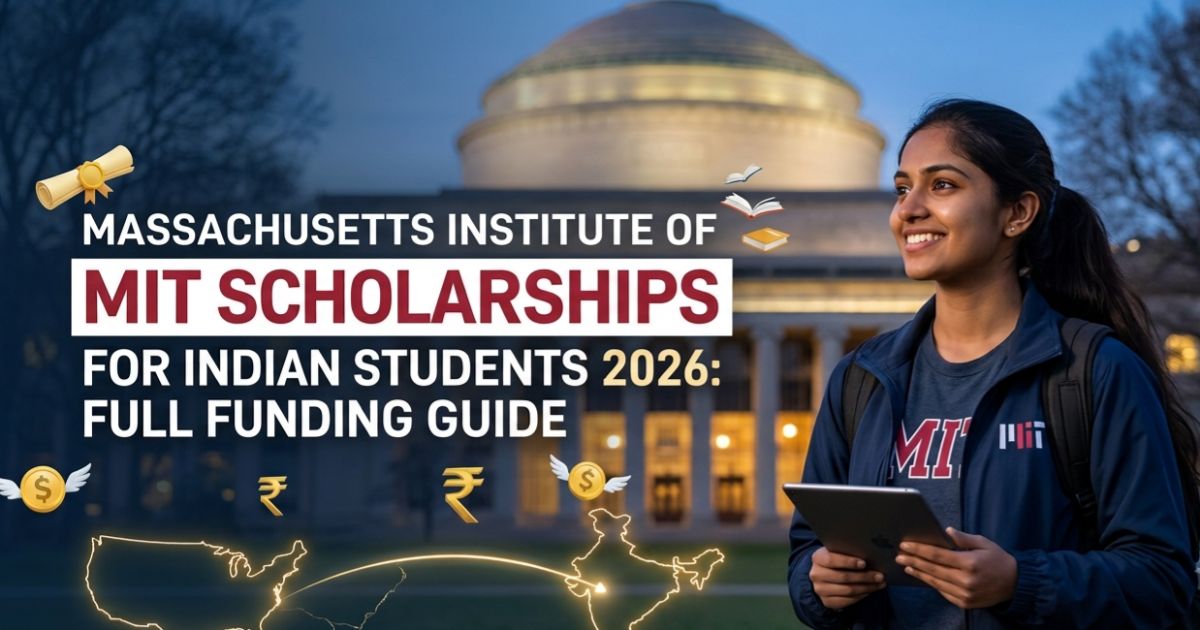
Massachusetts Institute of Technology Scholarships for Indian Students 2026: Full Funding Guide
Abhijeet Chatterjee is a professional Content and Copy specialist with over five years of experience in crafting compelling content around the Edtech domain. His portfolio includes notable work…
Massachusetts Institute of Technology scholarships for Indian students are a cornerstone of MIT’s commitment to global talent, ensuring that financial constraints never hinder an admitted student’s ability to attend. MIT proudly meets the full demonstrated financial need of all admitted international undergraduates, and significant funding opportunities exist for graduate students as well. This comprehensive guide details eligibility, application processes, various scholarship types, and external funding options to help you secure your place at MIT.
MIT Need-Based Financial Aid for Indian Students 2026: An Overview
MIT offers comprehensive need-based financial aid for all undergraduate students, including those from India, through its need-blind and full-need policy. Beginning 2025–2026, students from families earning under $200,000 can typically attend tuition-free, with zero parent contribution for incomes below $100,000.
| Income range | Median MIT Scholarship | Percent of tuition covered | Median net price |
| $0–$100,000 | $85,236 | 100% | $0 |
| $100,000–$200,000 | $67,848 | 100% | $19,734 |
| Over $200,000 | $37,750 | 59% | $49,083 |
Eligibility Requirements for MIT Scholarships: Indian Applicants 2026
Massachusetts Institute of Technology scholarships for Indian students are entirely need-based, ensuring financial situation plays no role in undergraduate admissions. Once admitted, MIT pledges to meet 100% of demonstrated financial need through grants and scholarships that never need repayment, making education accessible for eligible applicants.
- Financial Aid Model: MIT uses a need-based model for all applicants, including Indian students.
- Admissions Policy (Undergraduate): MIT practices need-blind admissions for all undergraduates, including international students.
- Commitment to Need: Once admitted, MIT meets 100% of demonstrated financial need via grants/scholarships.
- Scholarship Application: No separate application; CSS Profile applicants are automatically considered.
- Primary Document: Applicants must submit the CSS Profile from the College Board for eligibility.
- MIT’s CSS Code: 3514
Massachusetts Institute of Technology scholarships for Indian students demonstrate a strong commitment to financial accessibility. In 2025–26, MIT plans to award $176 million in need-based scholarships. For families earning under $200,000 annually, MIT covers at least the full cost of tuition through grants, with the median scholarship reaching $69,777 in 2024–2025.
| Category | Detail |
| Postgraduate Academic Requirement | Minimum 65% in an undergraduate degree. |
| First Year Grant | $2,000 for highest-need students. |
| Health Insurance Grant | Covers MIT SHIP for the highest-need undergraduates. |
| Early Action Deadline | November 30 |
| Regular Action Deadline | February 15 |
| Continuing Students Deadline | April 15 |
Also Read: USA Scholarships for Indian Students: Top Funding Opportunities 2026-27
Types of MIT Scholarships for Indian Students: Undergraduate & Graduate 2026
MIT offers some of the strongest financial aid in the world, and Indian students are included in that support. For undergraduate applicants, MIT is need-blind and meets 100 percent of demonstrated financial need, while graduate funding is usually handled by individual departments through scholarships, fellowships, assistantships, and research support.
| Scholarship / Aid Type | Description / Details | Key Figures / Eligibility |
| Undergraduate MIT Scholarship | Need-based grant, not a loan, and does not need to be repaid. This is the main form of aid for MIT undergraduates. | Median aid: USD 69,777 for 2024 to 2025. Planned aid budget: USD 176 million for 2025 to 2026. About 57 percent of undergraduates receive aid. |
| Undergraduate Tuition Coverage | Students from families with annual incomes under USD 200,000 often attend tuition-free. Families with lower incomes may also receive support for housing, dining, books, and other costs. | For 50 percent of American families with income below USD 100,000, parents pay nothing toward tuition, housing, dining, fees, books, or personal expenses. |
| First-Year Grant | Extra support for transition costs in the first year of study. | USD 2,000 for highest-need first-year undergraduates and low-income first-year graduate students. |
| Health Insurance Grant | Helps cover the MIT Student Health Insurance Plan. | Available to the highest-need undergraduates who do not already have adequate health insurance. |
| Graduate Program Scholarships | Graduate aid is usually decentralized and managed by each department. Support may include tuition help or partial fee waivers. | Depends on the department, programme, and admission profile. |
| Graduate Fellowships | Supports tuition and living expenses for graduate students. | Partial or full tuition support, plus stipend support that may go up to USD 4,000 for living expenses in some cases. |
| Research and Teaching Support | Many graduate students receive funding through assistantships rather than only scholarships. | Common in research-heavy programmes and usually tied to academic performance and departmental need. |
Undergraduate aid at MIT
For Indian students applying to undergraduate programmes, the most important point is that MIT does not award merit scholarships. Instead, it uses a need-based model, which means your family’s financial situation determines the aid package. This often makes MIT one of the most generous options for international students who need substantial financial support.
MIT also gives extra help beyond tuition in many cases, including housing, dining, books, and personal expenses. That is why students from lower- and middle-income families may end up with a much lower out-of-pocket cost than they expect.
Also Read: Google Scholarships for Indian Students 2026: Eligibility, Benefits & Application
Top UK Scholarships for Indian Students 2026: Eligibility, Amount & Application
Top EU Scholarships for Indian Students in 2026: Fully Funded Opportunities
Graduate aid at MIT
Graduate funding at MIT works differently because it is usually organised by the academic department rather than by a single central scholarship. Students may receive tuition support, fellowships, research assistantships, or teaching assistantships, depending on the programme and admission decision. In practice, this means funding for graduate students is more variable and depends on the department’s resources and the strength of the applicant’s profile.
Indian students applying for master’s or PhD programmes should treat graduate funding as programme-specific rather than guaranteed. A strong academic record, research background, and early application are important because departments often make funding decisions alongside admission decisions.
Application process
For undergraduate aid, students are generally considered automatically when they submit the required financial aid documents, including the CSS Profile and supporting income information. MIT uses those documents to assess the demonstrated need and create the aid package.
Graduate applicants usually need to follow the funding process of the specific department or programme. Since deadlines differ widely, students should check each department’s timeline carefully and apply early wherever possible.
These comprehensive Massachusetts Institute of Technology scholarships for Indian students demonstrate MIT’s strong commitment to making its education accessible, covering tuition, living, and health costs for eligible undergraduate and graduate students through various grants and fellowships.
People Also Read




Step-by-Step: Applying for MIT Scholarships as an Indian Student 2026
Applying for Massachusetts Institute of Technology scholarships for Indian students involves a clear process, starting with MIT’s commitment to meeting 100% of demonstrated financial need for all undergraduate international students. Indian students are classified as international for financial aid purposes, benefiting from MIT’s need-blind policy.
- Eligibility: MIT is need-blind and full-need for all undergraduate international students.
- Financial Need: MIT commits to meeting 100% of demonstrated financial need.
- Indian Students: Classified as ‘international’ for financial aid purposes.
- Step 1 (CSS Profile): Submit online using CSS Code 3514 for scholarship determination.
- Step 2 (IDOC): Submit parental tax returns/income documentation to the College Board’s secure IDOC.
- Step 3 (Tracking): Monitor financial aid documents and offer via the MIT Application Portal.
The application process for the Massachusetts Institute of Technology scholarships for Indian students requires careful submission of financial documents. This includes providing detailed income records and tax returns, with specific instructions for international applicants and those with separated parents.
| Category | Detail |
| CSS Profile Requirements | Parents’ tax returns (2 years ago), wage statements, bank balances, investments, and untaxed income. |
| IDOC Submission Note | Do not send documents directly to MIT; allow up to two weeks for processing. |
| International Tax Docs | Provide the country’s tax return (e.g., India), translated to English (self-translation allowed). |
| Document Tracking Delay | Allow 10 business days for documents to appear in the MIT Online Financial Aid System. |
| Early Action Deadline (2026-27) | November 30 |
| Regular Action Deadline (2026-27) | February 15 |
| Continuing Students Deadline (2026-27) | April 15 |
Adhering to these specific deadlines and documentation guidelines is crucial for a successful scholarship application, ensuring all financial details are accurately processed by MIT.
External Scholarships for Indian Students at MIT: Inlaks, Fulbright 2026
The Inlaks Shivdasani Foundation Scholarship and the Fulbright Program are key external scholarships for Indian students at the Massachusetts Institute of Technology. While applications for the Inlaks Scholarship are now closed for 2026, it offers significant support for overseas study at top global institutions like MIT.
- Purpose: To enable overseas study at a top-rated university for young Indian graduates.
- Value: Up to USD 120,000, covering tuition, living, travel, visa, and health.
- Duration: Nine months to four years.
- Eligibility (Nationality & Residency): Indian passport holder, resident in India at the time.
- Eligibility (Age): Born on or after January 1, 1996 (maximum 30 years old).
- Eligibility (Admission): Prior admission to the chosen institution and course is required.
These criteria underscore the scholarship’s focus on supporting talented Indian students pursuing advanced degrees abroad.
| Category | Details |
| Academic Qualification | Hold a degree from a recognised university in India (final year students eligible). Specific conditions apply for undergraduate degrees from abroad. |
| Minimum Academic Grades | 65% (CGPA 6.8/10, GPA 2.6/4) for Social Sciences, Humanities, Law, Fine Arts, Architecture; 70% (CGPA 7.2/10, GPA 3/4) for Mathematics, Sciences, Environment. |
| Prior Study Abroad Exclusions | Applicants with a postgraduate qualification from an institution abroad or those already studying postgraduate education abroad are not eligible. |
| Subject Exclusions | Includes Business, Finance, most Engineering, Fashion Design, most Film, Hospitality, Management (MBA), Medicine, most Music. |
| Selection Process (2026) | Review of eligible applications (April 2026), online preliminary interviews (around May 2026), and final in-person interview in Mumbai (around the 3rd or 4th weekend of May 2026). |
IIM Internal vs. External OBC Scholarships: PM Yasasvi & ONGC 2026
IIMs usually do not offer a separate scholarship only for OBC students, but OBC candidates can still access need-based institute aid and several external scholarships. For 2026, the most relevant options to compare are the government scholarships under PM Yasasvi and the Post Matric Scholarship for OBC students, along with corporate support such as ONGC and internal financial aid at IIM Bangalore.
| Scholarship Name | Type | Category Focus | Administering Body | Key Eligibility | Benefits / Scholarship Amount |
| PM Yasasvi Scheme for OBC, EBC & DNT Students | External, Government | OBC, EBC, DNT | Government of India | Students belonging to OBC, EBC, or DNT categories, subject to the scheme rules and income criteria | Financial support under the central scholarship framework, the amount varies by component and course level |
| ONGC Scholarship | External, Corporate | General, SC, ST, OBC | ONGC | Meritorious students from the General, SC, ST, and OBC categories | Scholarship support for eligible students, the amount depends on the specific award cycle |
| Post Matric Scholarship for OBC Students | External, Government | OBC-specific | Ministry of Social Justice and Empowerment | OBC category students, parental income below INR 1.5 lakh per annum, pursuing a recognised course | Full tuition fee support, maintenance allowance, and reimbursement of admissible non-refundable fees |
| IIM Bangalore General Financial Aid | Internal | Need-based, open to OBC students who qualify | IIM Bangalore | PGP students with an annual household income below INR 8 lakh, and other students facing severe financial difficulty | 20 percent, 40 percent, 60 percent, 80 percent, or 100 percent of PGP fees, depending on assessed need |
MIT Scholarship Value vs. Total Cost of Attendance for Indian Students 2026
The Massachusetts Institute of Technology (MIT) offers need-blind admissions for all undergraduate applicants, including international students from India. This policy ensures that the university meets 100% of demonstrated financial need through grants and scholarships that never need to be repaid, making a world-class education accessible.
| Expense | Estimated Annual Cost (USD) |
| Tuition | ~$53,450 |
| Housing & Meals | ~$19,850 |
| Books & Supplies | ~$820 |
| Personal Expenses | ~$2,160 |
| Health Insurance | ~$2,300 |
| Total | ~$85,960 (~81 lakh) |
Frequently Asked Questions
How can any Indian get into MIT with a scholarship?
Achieve 90%+ consistently in 10+2 for admission. If awarded an MIT Scholarship, complete the Student Information Review Form annually between May 1 and July 1.
What is Massachusetts Institute of Technology scholarships for Indian students?
MIT Scholarships are need-based grants for admitted students, determined via the CSS Profile. Master’s applicants require a minimum 65% in UG for eligibility.
What are the eligibility requirements for the Massachusetts Institute of Technology scholarships for Indian students?
Massachusetts Institute of Technology scholarships are awarded solely based on financial need. Approximately 57% of undergraduates receive these funds.
How do I apply for the Massachusetts Institute of Technology scholarships for Indian students?
MIT scholarships for Indian students are solely need-based. Apply using the CSS Profile to determine eligibility for these scholarships, which about 57% of undergraduates receive.
What is the application timeline for the Massachusetts Institute of Technology scholarships for Indian students?
MIT scholarship applications align with admission deadlines: November 30 for Early Action and February 15 for Regular Action. The CSS Profile is used to determine need-based scholarships.
What is the expected cutoff for Massachusetts Institute of Technology scholarships for Indian students?
Massachusetts Institute of Technology does not specify a scholarship cutoff for Indian students. Eligibility details are available, with the average scholarship being $63,146 USD.