Re-NEET UG 2026 OMR Sheet Released at neet.nta.nic.in; Result Date Also Out
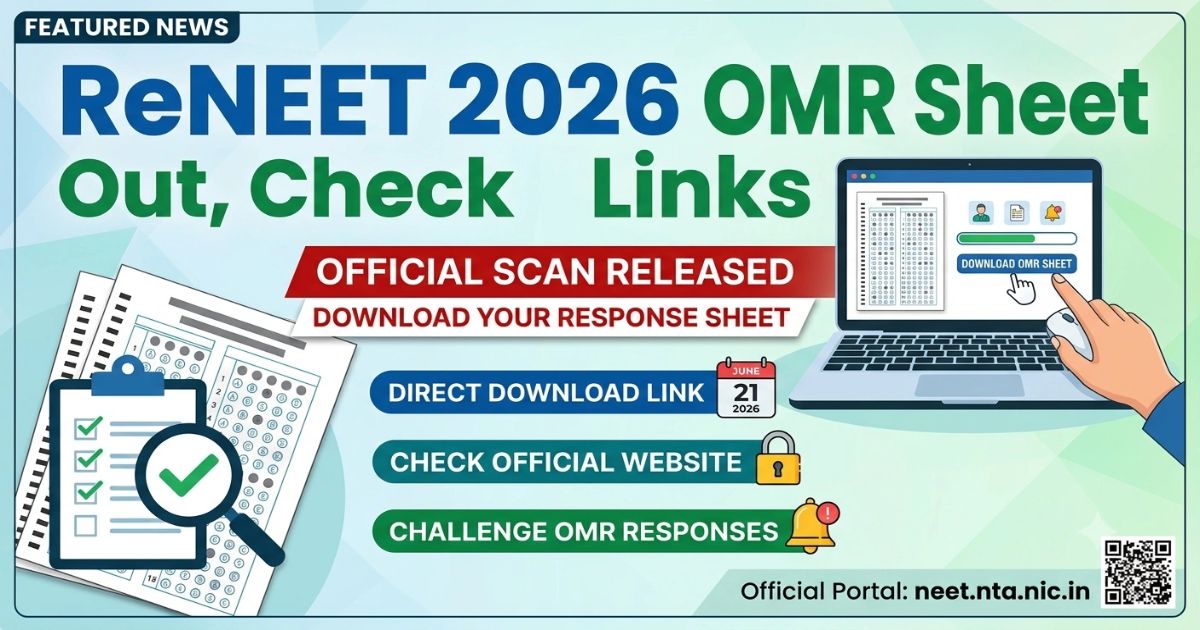
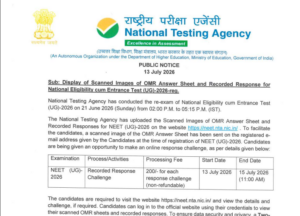
The National Testing Agency (NTA) has officially released the scanned images of the OMR answer sheets and recorded responses for the ReNEET 2026 exam on 13 July at the official NEET NTA . The notification appears as – ‘Display of Scanned Images of OMR Answer Sheet and Recorded Response’. The ReNEET 2026 exam was conducted on 21 June, 2026. Students should keep their Application Number and Password ready to view their ReNEET 2026 OMR sheets.
Further, any discrepancies in the OMR sheet can be challenged till 15 July 2026 11 AM. A non-refundable fee of Rs. 200 per challenged response is applicable. After the release of the OMR sheet, experts expect the NTA ReNEET 2026 final answer key and result release on or before 20th July 2026.
Re-NEET UG 2026 OMR Sheet: Direct Download Link
The direct login portal for the OMR sheets and recorded responses is hosted exclusively on the NTA’s official NEET website:
| Official Portal Link | https://neet.nta.nic.in/ |
How to Download Re-NEET UG 2026 OMR Sheet?
Candidates can follow these official steps to view and save their scanned OMR answer sheets:
- Go to the official NTA NEET homepage at neet.nta.nic.in.
- Click on Display of Scanned Images of OMR Answer Sheet and Recorded Response link on the website.
- Enter Application No. , Password, Captcha and Login.
- Enter the One-Time Password (OTP) sent to your registered mobile number and email address.
- Once logged in, click on the display link to view your scanned OMR sheet and download the PDF copy for future reference.
How to Challenge Re-NEET UG 2026 OMR Responses?
If there is a mismatch between what you marked on the physical sheet and what the NTA’s machine has recorded, you can file an objection till July 15, 11 AM with a non-refundable fee of Rs. 200 per question.
- Log in to the candidate dashboard using the download steps outlined above.
- Select the “Challenge OMR Sheet & Recorded Responses” option.
- You will see a table displaying the question numbers alongside the machine-captured options.
- Select the check box for the specific question number(s) you wish to dispute and tick your claimed correct option.
- Click “Save and Claim” to finalize your selection.
- Complete the process by paying the non-refundable processing fee. Keep a copy of your challenge receipt for reference.
Re-NEET UG 2026 OMR Challenge Fee and Last Date
- Processing Fee: ₹200 per response challenged. This fee is strictly non-refundable and must be paid online via Credit Card, Debit Card, Net Banking, or UPI.
- Submission Deadline: The challenge window is active from July 13, 2026, and will close on July 15, 2026, at 11:00 AM IST.
Note: No offline challenges or submissions after the 11:00 AM deadline on July 15 will be entertained by the NTA.
Details Mentioned on Re-NEET UG 2026 OMR Sheet
Candidates should verify the following essential administrative details printed on the downloaded OMR PDF:
- Candidate Name
- Roll Number and Application Number
- Test Booklet Code (e.g., Code 50, 60, 70, or 80)
- Exam Date and Centre Details
- OMR Barcode
- Recorded Machine Responses (corresponding to each question number)
How to Calculate Your Marks Through Your Re-NEET UG OMR Sheet?
Candidates can estimate their probable Re-NEET UG 2026 score by comparing the responses marked on their OMR sheet with the official answer key and applying the NEET UG marking scheme.
- Download your scanned OMR sheet from the official Re-NEET UG 2026 candidate portal.
- Download the official answer key released by the National Testing Agency (NTA).
- Compare each recorded response on your OMR sheet with the corresponding correct answer in the answer key.
- Count the number of correct, incorrect, and unattempted questions.
- Apply the Re-NEET UG 2026 marking scheme:
- Correct Answer: +4 marks
- Incorrect Answer: –1 mark
- Unattempted Question: 0 marks
- Calculate your estimated score using the formula:
Estimated Score = (Number of Correct Answers × 4) – (Number of Incorrect Answers × 1)
Example:
If a candidate has 150 correct answers, 20 incorrect answers, and 10 unattempted questions, the estimated score will be:
(150 × 4) – (20 × 1) = 600 – 20 = 580 marks
Candidates should note that this is only a provisional score estimate. The final Re-NEET UG 2026 result will be prepared using the official evaluation after considering all valid OMR challenges and the final answer key released by the NTA.
Re-NEET UG 2026 Result Date (Expected)
Following the completion of the challenge evaluation process, the NTA is expected to announce the final Re-NEET UG 2026 results on or before July 20, 2026. The final answer key will also be published around this time. Candidates will be able to download their formal scorecards directly from the login portal.

Further reading
📰 More Education News
- INI-CET Jan 2027: Download admit card today, Oct 26Oct 26, 2026 • Nishit Kumar
- TN BSc Nursing 2026 round 3 seat allotment result on October 27: report by October 31Oct 26, 2026 • Nishit Kumar
- AP OAMDC Phase 3 counselling web option entry begins: exercise choices by October 27Oct 26, 2026 • Nishit Kumar
- BPSC TRE 4.0 application deadline extended: apply for 33,320 vacancies by November 3Oct 26, 2026 • Nishit Kumar