Bachelor of Optometry Degree: Course Details, Eligibility and Scope
Below is detailed information regarding eligibility criteria, entrance examinations, semester-wise syllabus, fee structures, top-ranked institutions across India, and career prospects for optometrists.
| Parameter | Details |
|---|---|
| Course Level & Duration | Undergraduate, 4 Years (3 Academic Years + 1 Year Internship) |
| Academic Eligibility | 10+2 with Physics, Chemistry, and Biology/Mathematics (Minimum 35% to 50% aggregate marks) |
| Age Limit | Minimum 17 years completed as on 31st December of the admission year |
| Regulatory Body | National Commission for Allied and Healthcare Professions (NCAHP), Ministry of Health & Family Welfare |
| Government College Fees | ₹10,000 to ₹50,000 per year |
| Private College Fees | ₹50,000 to ₹2,00,000 per year |
| Starting Salary Range | ₹2.5 LPA to ₹5 LPA (₹15,000 to ₹25,000 per month for freshers) |
| Key Entrance Exams | NEET-UG, AIIMS Entrance Test, JNUEE, INI CET |
What is Bachelor of Optometry (B.Optom)
The curriculum is standardized nationally under the National Commission for Allied and Healthcare Professions (NCAHP) Act 2021, establishing uniform competency standards across medical institutions in India. To qualify for degree award, candidates must secure at least 50% aggregate marks across University Theory, Practical, Internal Assessment, and Oral examinations, while maintaining a mandatory 90% attendance record in theory and practical modules separately.
Bachelor of Optometry (B.Optom) Eligibility
Candidates applying for a Bachelor of Optometry program must fulfill specific academic and age requirements. For B.Sc Optometry and B.Optom, candidates must pass their 10+2 higher secondary examinations with Physics, Chemistry, and Biology or Mathematics, securing a minimum aggregate score of 35% to 50% depending on university rules. Candidates must also complete at least 17 years of age by December 31 of the entry year.
Candidates from non-science streams can opt for a B.Voc in Optometry, which accepts applicants passing 10+2 in any stream, including Science, Commerce, and Arts.
Bachelor of Optometry (B.Optom) Syllabus and Subjects
The 4-year B.Optom curriculum transitions from foundational vision sciences to specialized ocular diagnostics and clinical patient handling. The first four semesters build competence in geometrical optics, ocular anatomy, ocular physiology, biochemical processes, visual optics, and optical instrumentation. Semesters 5 and 6 advance into binocular vision, contact lens fitting, posterior ocular diseases, public health optometry, and low vision aids.
The final two semesters (Semesters 7 and 8) comprise 1 full year of compulsory clinical rotations across specialty clinics, ending with case log book submissions and an independent research project.
| Year / Semester | Core Theoretical Subjects | Practical / Clinical Modules |
|---|---|---|
| Semester 1 | Geometrical Optics I, General Physiology, General Anatomy, General & Ocular Biochemistry, Professional English | Physiology Practical, Geometrical Optics I Practical, Anatomy Practical |
| Semester 2 | Physical Optics II, Ocular Physiology, Ocular Anatomy, Environment & Ecology, Computer Programming | Physical Optics II Practical, Ocular Anatomy Practical, Computer Lab |
| Semester 3 | Visual Optics III, Lighting & the Eye, Medical Pathology & Microbiology, Pharmacology, Optical Instrumentation I | Microbiology & Pathology Lab, Optical Instrumentation Practical, Lighting Lab |
| Semester 4 | Visual Optics IV, Optical Instrumentation II, Clinical Refraction I, Ocular Disease I (Anterior Segment), Dispensing Optics | Instrumentation II Practical, Clinical Refraction Practical, Dispensing Optics Lab |
| Semester 5 | Binocular Vision & Ocular Motility, Contact Lens I, Clinical Refraction II, Ocular Disease II (Posterior/Neuro), Low Vision Aids | Contact Lens I Lab, Clinical Refraction II Lab, Low Vision Aids Practical |
| Semester 6 | Systemic Condition & Eye, Public Health Optometry, Biostatistics, Contact Lens II, Practice Management, Orthoptics | Contact Lens II Lab, Applied Optometry & Orthoptics Practical |
| Semesters 7 & 8 | 1-Year Compulsory Clinical Rotations & Specialty Clinics | Clinical Internship, Research Project & Case Log Book Submission |
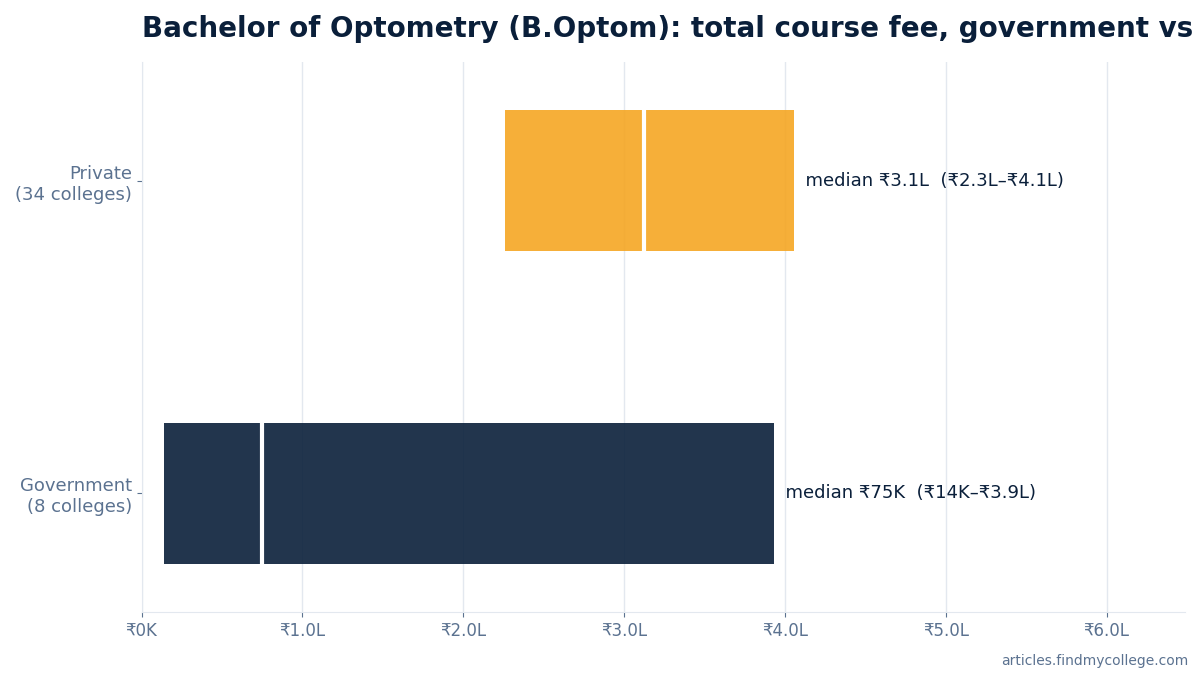
Bachelor of Optometry (B.Optom) Fees
| College | City | Ownership | Total course fee |
|---|---|---|---|
| Government Villupuram Medical College and Hospital | Villupuram | Government | ₹9,000 |
| Post Graduate Institute of Medical Education & Research | Chandigarh | Government | ₹10,500 |
| Jawaharlal Institute of Post Graduate Medical Education and Research | Pondicherry | Government | ₹23,040 |
| Government Medical College and Hospital | Chandigarh | Government | ₹39,132 |
| All India Institute of Medical Sciences Rishikesh | Rishikesh | Government | ₹1.11 lakh |
| Paramedical College | Durgapur | Government | ₹3.10 lakh |
| Goa Medical College and Hospital | Tiswadi | Government | ₹4.21 lakh |
| Goa Dental College and Hospital | North Goa | Government | ₹4.21 lakh |
| College | City | Ownership | Total course fee | NIRF rank |
|---|---|---|---|---|
| All India Institute of Medical Sciences New Delhi | Delhi | Government | — | 8 (Overall, 2025) |
| SRM Institute of Technology | Kanchipuram | Private | ₹5.10 lakh | 11 (Overall, 2025) |
| Chandigarh University | Chandigarh | Private | ₹3.57 lakh | 19 (Overall, 2025) |
| SASTRA University | Thanjavur | — | ₹4.40 lakh | 29 (Overall, 2025) |
| Post Graduate Institute of Medical Education & Research | Chandigarh | Government | ₹10,500 | 33 (Overall, 2025) |
| Dr. DY Patil Vidyapeeth | Pune | — | ₹4.40 lakh | 41 (Overall, 2025) |
| Jawaharlal Institute of Post Graduate Medical Education and Research | Pondicherry | Government | ₹23,040 | 43 (Overall, 2025) |
| Jamia Hamdard University | Delhi | — | ₹5.87 lakh | 47 (Overall, 2025) |
| Datta Meghe Institute of Medical Sciences | Wardha | — | ₹3.48 lakh | 49 (Overall, 2025) |
| College | City | Ownership | Total course fee | ||||||||||||||||||||||
|---|---|---|---|---|---|---|---|---|---|---|---|---|---|---|---|---|---|---|---|---|---|---|---|---|---|
| Christian Medical College Vellore | Vellore | Private | ₹1.40 lakh | ||||||||||||||||||||||
| Chandigarh University | Chandigarh | Private | ₹3.57 lakh | ||||||||||||||||||||||
| Chitkara University | Patiala | Private | ₹2.28 lakh | ||||||||||||||||||||||
| IIMT University | Meerut | Private | ₹2.13 lakh | ||||||||||||||||||||||
| Guru Nanak College of Engineering & Management | Dehradun | Private | ₹3.28 lakh | ||||||||||||||||||||||
| Dayanand Medical College and Hospital | Ludhiana | Private | ₹1.70 lakh | ||||||||||||||||||||||
| NSHM Knowledge Campus Kolkata | Kolkata | Private | ₹4.70 lakh | ||||||||||||||||||||||
Course Comparison: B.Optom vs B.Voc Optometry DegreesUnderstanding the distinction between B.Optom / B.Sc Optometry and B.Voc Optometry helps students select the appropriate academic pathway based on their educational background and career goals. Bachelor of Optometry (B.Optom) Career Scope and SalaryGraduates holding a Bachelor of Optometry degree enter an expanding vision care sector comprising eye hospitals, optical chains, refractive surgery centers, and lens manufacturing corporations. Fresh B.Optom graduates typically start with earnings ranging from ₹15,000 to ₹25,000 per month (₹2.5 LPA to ₹5 LPA). After 5+ years of clinical experience, salaries increase to between ₹50,000 and ₹80,000 per month. Experienced private clinic owners or self-employed optometrists running independent practices can generate monthly earnings exceeding ₹1,00,000. Additionally, Indian optometrists can practice overseas in countries like the UK, USA, Canada, and Australia after passing local jurisdiction licensing examinations. Higher Studies and Post-Graduate Specializations After B.OptomGraduates aiming for specialized clinical practice, research, or faculty appointments can pursue advanced postgraduate qualifications after completing their B.Optom degree.
How to Apply for Bachelor of Optometry (B.Optom) Admission in 2026: Step by Step
 FAQsIs Bachelor of Optometry and BSc Optometry the same?B.Sc Optometry requires 10+2 in Science with Physics, Chemistry, and PCB/PCM. The B.Optom degree duration consists of 3 academic years followed by 1 full year of compulsory clinical internship, with a competency-based curriculum standardized across India by the NCAHP. Do we need NEET for BSc Optometry?NEET-UG is among the accepted entrance exams for B.Sc Optometry, alongside the AIIMS Entrance Test, JNUEE, and INI CET. Entry can also be direct, merit-based, or through university counseling depending on the program stream. Can an Indian optometrist work in the UK or abroad?Yes. Indian optometrists can practice overseas in countries like the UK, USA, Canada, and Australia after passing local jurisdiction licensing exams. What is the average salary of an optometrist in India?Fresh B.Optom graduates typically start with earnings ranging from ₹15,000 to ₹25,000 per month. With 5+ years of clinical experience, earnings rise to ₹50,000 to ₹80,000 per month, while experienced private clinic owners can exceed ₹1,00,000 per month. What are the attendance and passing criteria for B.Optom?Candidates must maintain at least 90% attendance in theory and practical modules separately to qualify for university examinations. To pass, students must achieve a minimum of 50% aggregate marks across University Theory, Practical, Internal Assessment, and Oral examinations. What are the core subjects taught in B.Optom?Core subjects include Geometrical and Physical Optics, General and Ocular Anatomy, Ocular Physiology, Visual Optics, Medical Pathology and Microbiology, Pharmacology, Optical Instrumentation, Clinical Refraction, Ocular Disease, Dispensing Optics, Binocular Vision, Contact Lens, and Low Vision Aids. |