ACCA Syllabus 2026: Levels, Papers, and Exam Pattern Explained
The Association of Chartered Certified Accountants (ACCA) syllabus for 2026 is the definitive roadmap for aspiring finance professionals, detailing the knowledge and skills required to excel in a global career. This updated curriculum ensures candidates are well-prepared for the evolving demands of the finance industry, from foundational accounting principles to strategic business leadership. This guide breaks down the ACCA Syllabus 2026, explaining its levels, papers, exam patterns, and offering strategic preparation advice.
ACCA Syllabus 2026 Overview: Levels, Papers, and Structure
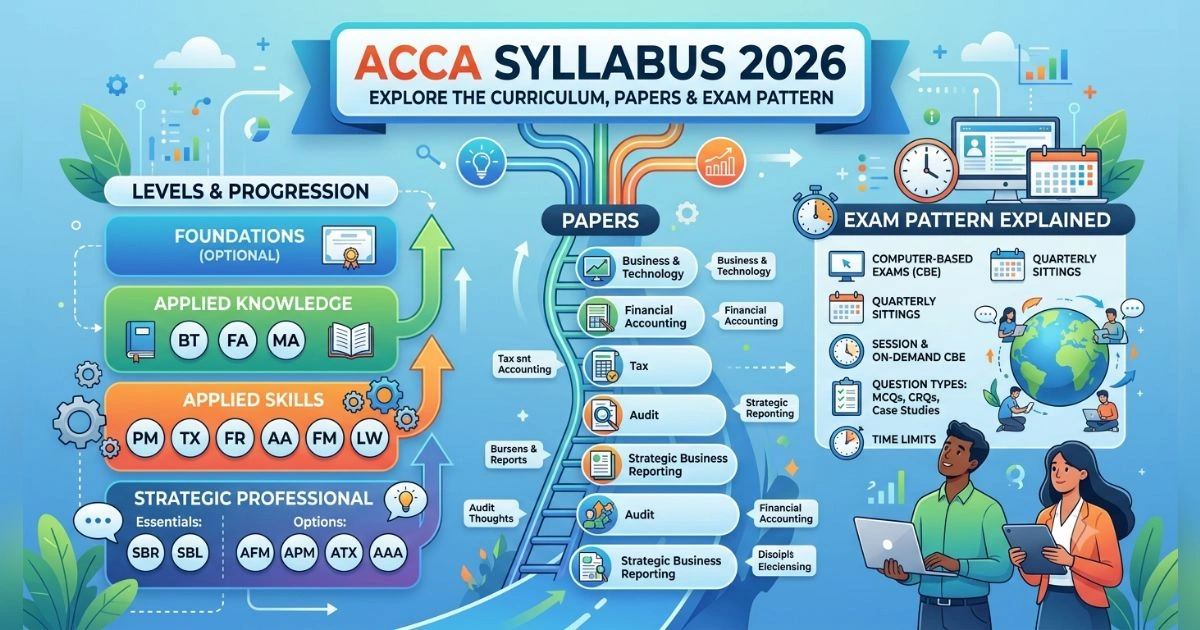
The Association of Chartered Certified Accountants syllabus is structured across three qualification levels, encompassing a total of 13 essential papers. This section details the ACCA exam pattern, outlining the papers, exam durations, and formats for each level to provide a clear overview.
| Level | Number of Papers | Subjects | Exam Duration | Format |
| Applied Knowledge | 3 | Business and Technology (BT), Management Accounting (MA), and Financial Accounting (FA) | 2 hours | Objective (MCQ-based) |
| Applied Skills | 6 | Corporate and Business Law (LW), Performance Management (PM), Taxation (TX), Financial Reporting (FR), Audit and Assurance (AA) and Financial Management (FM) | 3 hours | Objective + Written (Mix of MCQs and essays) |
| Strategic Professional | 4 (2 Essentials, 2 Options) | Strategic Business Leader (SBL), Strategic Business Reporting (SBR) Optional: Advanced Financial Management (AFM), Advanced Performance Management (APM), Advanced Taxation (ATX), and Advanced Audit and Assurance (AAA) | 3-4 hours | Written (Case studies, essays, professional reports) |
ACCA Syllabus 2026: Detailed Analysis
The Association of Chartered Certified Accountants (ACCA) is one of the world’s most recognised global accounting qualifications, with over 252,000 members and 526,000 students across 180+ countries. The ACCA qualification equips candidates with skills in financial reporting, taxation, audit, business strategy, and corporate governance — making graduates eligible for senior finance roles across industries worldwide.
📌 Important 2026 Update: The current ACCA syllabus (13 papers) remains valid for all exams up to June 2027. A major restructured qualification (11 papers, new level names) launches from September 2027. Students starting ACCA in 2026 will follow the current structure for the majority of their journey.
ACCA Qualification Structure 2026
The ACCA qualification is divided into 3 progressive levels comprising 13 exam papers in total, plus the Ethics and Professional Skills Module (EPSM) and Practical Experience Requirement (PER) of 3 years.
| Paper Code | Paper Name | Key Topics Covered |
| BT | Business and Technology | Business organisations, leadership, IT systems, governance, and professional ethics |
| MA | Management Accounting | Costing techniques, budgeting, variance analysis, and performance measurement |
| FA | Financial Accounting | Double-entry bookkeeping, trial balance, financial statements preparation, and basic accounting standards |
Level 1: Applied Knowledge
The foundation level introduces core concepts in accounting, business, and management. All 3 papers are computer-based and can be taken on demand at ACCA-approved centres year-round.
| Paper Code | Paper Name | Key Topics Covered |
| BT | Business and Technology | Business organisations, leadership, IT systems, governance, and professional ethics |
| MA | Management Accounting | Costing techniques, budgeting, variance analysis, and performance measurement |
| FA | Financial Accounting | Double-entry bookkeeping, trial balance, financial statements preparation, and basic accounting standards |
- Exam Mode: Computer-Based Test (CBT), on-demand
- Duration: 2 hours per paper
- Pass Mark: 50%
- Award on Completion: ACCA Diploma in Accounting and Business
Also Read: Scope of Accounting in India (2026): Jobs, Salary, Top Recruiters & Future
Level 2: Applied Skills
The skills level builds deep technical competence across six papers covering financial reporting, taxation, law, audit, and financial management. These are session-based exams held four times a year (March, June, September, December).
| Paper Code | Paper Name | Key Topics Covered |
| LW | Corporate and Business Law | Contract law, company law, employment law, governance (Global or UK/SGP variant) |
| PM | Performance Management | Budgeting, pricing, performance measurement, divisional performance, risk analysis |
| TX | Taxation | Income tax, corporation tax, VAT, capital gains tax (UK variant or global adaption) |
| FR | Financial Reporting | IFRS standards, consolidated accounts, interpretation of financial statements |
| AA | Audit and Assurance | Audit process, internal controls, evidence gathering, professional ethics |
| FM | Financial Management | Investment appraisal, working capital, cost of capital, business valuations, risk management |
- Exam Mode: Computer-Based Test (CBT), session-based (4 sessions/year)
- Duration: 3 hours per paper
- Pass Mark: 50%
- Award on Completion: ACCA Advanced Diploma in Accounting and Business + BSc (Hons) in Applied Accounting (via Oxford Brookes University, if eligible)
Level 3: Strategic Professional
The highest level develops strategic thinking, leadership, and specialist expertise. It comprises 2 mandatory (Essential) papers and 2 optional papers chosen from 4 options.
Essential Papers (Both Mandatory)
| Paper Code | Paper Name | Key Topics Covered |
| SBL | Strategic Business Leader | Corporate governance, risk, strategy, leadership, ethics, digital technology, change management |
| SBR | Strategic Business Reporting | Advanced IFRS, group reporting, complex financial instruments, sustainability reporting, current issues |
- Exam Format: Case study-based; SBL is a 4-hour integrated case study; SBR is 3.5 hours
- Pass Mark: 50%
Optional Papers (Choose Any 2 of 4)
| Paper Code | Paper Name | Best For | Key Topics |
| AFM | Advanced Financial Management | Corporate finance, investment banking | Complex valuations, M&A, treasury management, international finance |
| APM | Advanced Performance Management | Management consulting, strategy roles | Strategic performance systems, EVA, balanced scorecard, big data analytics |
| ATX | Advanced Taxation | Tax advisory, Big 4 tax practice | Complex tax planning, inheritance tax, stamp duty, trusts, international tax |
| AAA | Advanced Audit and Assurance | Audit firms, risk advisory | Group audits, forensic accounting, professional judgement, assurance engagements |
Ethics and Professional Skills Module (EPSM)
The Ethics and Professional Skills Module is mandatory and must be completed before attempting any Strategic Professional paper. It is an online, interactive module covering:
- Professional scepticism and judgement
- Ethical frameworks and dilemmas
- Communication and commercial skills
- Digital mindset and data analytics basics
- Leadership and teamwork in professional contexts
Duration: Self-paced online; typically 10–15 hours | Mode: Online only | Fee: Included in ACCA subscription
Practical Experience Requirement (PER)
In addition to passing all 13 exams and the EPSM, candidates must complete 3 years of relevant practical work experience in a finance or accounting role, documented through the ACCA Experience Toolkit. Key performance objectives include financial accounting, management accounting, audit, tax, and advisory competencies.
ACCA Exam Sessions 2026
| Session | Exam Months | Registration Deadline |
| Session 1 | March 2026 | January 2026 |
| Session 2 | June 2026 | April 2026 |
| Session 3 | September 2026 | July 2026 |
| Session 4 | December 2026 | October 2026 |
Also Read: Scope of Doing MBA Finance in India (2026): Jobs, Salary, Top Recruiters & Future
Upcoming ACCA Qualification Changes from September 2027
Students starting ACCA in 2026 should be aware of the major restructure launching in September 2027. While current exams remain valid through June 2027, the new structure reduces papers from 13 to 11, integrates AI, data analytics, and sustainability more deeply, and introduces a new Data Science Professional optional paper at the Strategic level.
| Feature | Current Syllabus (2026) | New Syllabus (from Sep 2027) |
| Total Papers | 13 | 11 |
| Level Names | Applied Knowledge / Applied Skills / Strategic Professional | Knowledge / Expertise / Strategic Professional |
| Optional Papers (Strategic) | 4 (choose 2) | 5 (choose 1) |
| New Additions | — | Data Science Professional (SDS), stronger AI & sustainability integration |
| BSc Pathway | Oxford Brookes University (BSc Applied Accounting) | University of London (BSc Professional Accountancy) |
| Effective From | Now – June 2027 | September 2027 onwards |
Exemptions from ACCA Papers (2026)
Candidates with prior qualifications may be eligible for paper-level exemptions, reducing the number of exams required:
- CA / CPA / CMA holders: Up to 9 paper exemptions
- Commerce Graduates (BCom/MCom): Up to 4–6 exemptions (varies by university)
- MBA (Finance): Up to 4 exemptions (Applied Knowledge + select Applied Skills)
- ICAI CA (India): Up to 9 exemptions, including all Applied Knowledge and most Applied Skills papers
Exemptions are assessed by ACCA on a case-by-case basis via the official Exemptions Calculator on accaglobal.com. Exemption fees apply per paper waived.
ACCA Applied Knowledge Level Papers and Exam Format 2026
The Applied Knowledge level is the entry point of the ACCA qualification — designed to build a solid foundation in core accounting, business technology, and management concepts. It comprises 3 papers: BT, MA, and FA, all of which are computer-based and available on demand year-round, making this the most flexible level of the entire qualification.
📌 You must complete all 3 Applied Knowledge papers before attempting any Applied Skills paper. Within this level, however, papers can be attempted in any order or simultaneously.
| Feature | Details |
| Number of Papers | 3 (BT, MA, FA) |
| Exam Mode | Computer-Based Exam (CBE) — On-Demand |
| Availability | Year-round at ACCA-approved CBE centres |
| Duration | 2 hours per paper |
| Question Types | Multiple Choice Questions (MCQs) & Objective Test Questions (OTQs) |
| Pass Mark | 50% |
| Negative Marking | — |
| Result | Instant — displayed on screen after exam |
| Resit Policy | Can resit at the next available sitting if failed |
| Maximum Papers Per Sitting | Up to 4 (across all levels combined) |
Paper BT – Business and Technology
Full Name: Business and Technology
Previous Code: F1 / AB (Accountant in Business)
This is typically the first paper most ACCA students attempt. It provides a broad understanding of the business environment in which accountants operate, covering organisational structures, leadership styles, and the role of technology and ethics in business.
Syllabus Breakdown:
| Syllabus Area | Weighting | Key Topics |
| Business organisational structure | 10% | Types of organisations, stakeholders, governance, structure models |
| Business environment | 10% | External environment (PESTLE), competitive forces, market types |
| History and role of accounting | 5% | Role of accountant, professional bodies, financial vs management accounting |
| Specific functions of accounting & internal controls | 10% | Control objectives, internal audit, fraud prevention |
| Leading and managing individuals & teams | 15% | Leadership styles, motivation theories (Maslow, Herzberg, McGregor), team dynamics |
| Recruiting & developing effective employees | 10% | Recruitment process, training, performance appraisal, HR management |
| Professional ethics in accounting | 10% | ACCA Code of Ethics, IFAC framework, threats and safeguards, professional behaviour |
| Governance and social responsibility | 10% | Corporate governance, CSR, sustainability |
| Technology and data analytics | 20% | Digital transformation, cloud computing, data analytics, cybersecurity, AI in finance |
2026 Update: The weighting for Technology and Data Analytics has been increased to 20% to reflect growing demand for digitally capable accountants. Topics now include AI-assisted decision-making, RPA (Robotic Process Automation), and data visualisation tools.
Recommended Study Hours: 60–80 hours
Difficulty Level: ⭐⭐ (Beginner-friendly; conceptual rather than numerical)
Best For: Students with a non-commerce background entering ACCA for the first time
Paper MA – Management Accounting
Full Name: Management Accounting
Previous Code: F2
MA introduces the internal financial management of an organisation — how businesses use cost information and budgets to plan, control, and make decisions. This paper forms the direct foundation for PM (Performance Management) at the Applied Skills level.
Syllabus Breakdown:
| Syllabus Area | Weighting | Key Topics |
| The nature, source and purpose of management information | 5% | Role of management accounting, comparison with financial accounting |
| Cost classification and behaviour | 15% | Fixed, variable, semi-variable costs; absorption vs marginal costing |
| Business mathematics and computer spreadsheets | 10% | Statistical methods, index numbers, time series, regression analysis |
| Cost accounting techniques | 30% | Job costing, process costing, batch costing, service costing, activity-based costing (ABC) |
| Budgeting | 15% | Preparation of master budgets, cash budgets, flexed budgets, zero-based budgeting |
| Standard costing and variance analysis | 15% | Material, labour, overhead variances; operating statements |
| Performance measurement | 10% | Profitability, liquidity, efficiency ratios; balanced scorecard introduction |
Key Formulas You Must Know:
- Contribution = Selling Price – Variable Cost
- Break-Even Point = Fixed Costs ÷ Contribution per Unit
- Overhead Absorption Rate = Budgeted Overheads ÷ Budgeted Activity Level
- All variance formulae (Price, Usage, Efficiency, Capacity, Volume)
Recommended Study Hours: 80–100 hours
Difficulty Level: ⭐⭐⭐ (Numerical; requires practice)
Best For: Students planning to specialise in management consulting, FP&A, or corporate finance roles
Paper FA – Financial Accounting
Full Name: Financial Accounting
Previous Code: F3
FA is the most technically rigorous of the three Applied Knowledge papers. It covers the preparation of financial statements for sole traders, partnerships, and companies, forming the direct foundation for FR (Financial Reporting) at the Applied Skills level.
Syllabus Breakdown:
| Syllabus Area | Weighting | Key Topics |
| The context and purpose of financial reporting | 10% | Regulatory framework, IASB, conceptual framework, qualitative characteristics |
| The qualitative characteristics of financial information | 5% | Relevance, faithful representation, comparability, understandability |
| The use of double-entry and accounting systems | 20% | Double-entry bookkeeping, ledger accounts, trial balance, journal entries |
| Recording transactions and events | 20% | Accruals, prepayments, depreciation, provisions, bad debts, inventory valuation (IAS 2) |
| Preparing a trial balance | 10% | Extended trial balance, identifying and correcting errors |
| Preparing basic financial statements | 25% | Statement of Profit or Loss, Statement of Financial Position, Statement of Cash Flows (IAS 7) |
| Preparing simple consolidated financial statements | 5% | Basic group accounts, goodwill calculation, NCI (IFRS 3 introduction) |
| Interpretation of financial statements | 5% | Ratio analysis: liquidity, profitability, gearing, investor ratios |
Key Accounting Standards Examinable in FA 2026:
| Standard | Topic |
| IAS 1 | Presentation of Financial Statements |
| IAS 2 | Inventories |
| IAS 7 | Statement of Cash Flows |
| IAS 8 | Accounting Policies, Estimates and Errors |
| IAS 10 | Events After the Reporting Period |
| IAS 16 | Property, Plant and Equipment |
| IAS 37 | Provisions, Contingent Liabilities and Assets |
| IFRS 3 | Business Combinations (basic introduction) |
| IFRS 15 | Revenue from Contracts with Customers (basic) |
Recommended Study Hours: 100–120 hours
Difficulty Level: ⭐⭐⭐⭐ (Most demanding at Knowledge level; requires strong numerical and conceptual understanding)
Best For: Students aiming for audit, financial reporting, or Big 4 roles
Recommended Study Order & Tips
Best Sequence: BT → MA → FA
| Step | Recommendation |
| Start with BT | Most accessible; builds conceptual understanding and professional ethics awareness needed throughout ACCA |
| Follow with MA | Introduces numerical skills (costing, budgeting) in a structured, manageable way |
| Finish with FA | The most demanding Knowledge paper — tackle last once you are comfortable with numbers |
| Sit multiple papers together | At this level, sitting 2–3 papers per sitting is feasible and recommended to progress quickly |
| Use ACCA Practice Platform | Free on accaglobal.com — includes mock CBE questions replicating the actual exam interface |
| Target 70%+ in mocks | Pass mark is 50%, but aiming for 70%+ in practice gives a safety buffer on exam day |
Applied Knowledge Level: Award and Progression
On passing all 3 papers, students are eligible to claim the ACCA Diploma in Accounting and Business (DAB) — a standalone qualification recognised by employers for entry-level finance roles. More importantly, completion unlocks progression to the Applied Skills level, where the technical depth of the qualification increases significantly across six papers covering law, taxation, audit, financial reporting, performance management, and financial management.
ACCA Applied Skills Level Subjects and Assessment 2026
The ACCA Applied Skills Level is the second stage of the Association of Chartered Certified Accountants syllabus, building on foundational knowledge. This level comprises six papers, deepening competency across key financial disciplines and is academically equivalent to a UK bachelor’s degree.
- Level Name: Applied Skills Level
- Stage in Qualification: The second stage of the ACCA exams, building on foundational knowledge.
- Number of Papers: 6
- Academic Equivalence: Equivalent to a UK bachelor’s degree.
- Exam Duration: 3 hours per paper.
- Exam Format: Objective + Written (Mix of MCQs and essays).
This level deepens competency across law, taxation, financial reporting, auditing, and financial management, advancing core ideas with more focus on applied concepts within the Association of Chartered Certified Accountants syllabus.
| Aspect | Details |
| Subjects (with codes) | F4 – Corporate and Business Law (LW), F5 – Performance Management (PM), F6 – Taxation (TX), F7 – Financial Reporting (FR), F8 – Assurance and Audit (AA), F9 – Financial Management (FM) |
| Exam Availability | Available in March, June, September, and December each year. |
This table outlines the specific subjects covered and the quarterly availability of exams for the Applied Skills Level.
ACCA Strategic Professional Level Papers and Options 2026
The Strategic Professional Level, ACCA Level 3, is the most advanced stage of the association of Chartered Certified Accountants syllabus, comprising four papers. This section details the structure, essential and optional papers, and key examination information for this crucial level, designed to develop a strategic mindset.
- Level Name: Strategic Professional Level (ACCA Level 3)
- Total Papers: 4 papers
- Paper Structure: 2 Essential and 2 Optional papers from 4.
- Essential Papers: Strategic Business Leader (SBL), Strategic Business Reporting (SBR).
- Essential Paper Codes: P1 (SBL), P2 (SBR).
- Optional Papers to Choose: 2 papers.
This level of the Association of Chartered Certified Accountants syllabus is designed to transition candidates from technical skills to a strategic, consultative mindset. The examination process involves specific durations and formats, detailed further below.
| Detail | Value |
| Optional Papers Available | Advanced Financial Management (AFM), Advanced Performance Management (APM), Advanced Taxation (ATX), Advanced Audit and Assurance (AAA) |
| Optional Paper Codes | P4 (Advanced Financial Management), P5 (Advanced Performance Management), P6 (Advanced Taxation) |
| Exam Duration | 3-4 hours |
| Exam Format | Written (Case studies, essays, professional reports) |
| Level Description | The most advanced level of ACCA, designed to transition from technical skills to a strategic, consultative mindset. |
ACCA Papers Difficulty Guide and Study Planning 2026
This guide details the Association of Chartered Certified Accountants syllabus for 2026, outlining the 13 papers across three qualification levels. It covers the structure, duration, and key requirements for achieving the ACCA qualification.
| Level | Papers |
| Applied Knowledge Level | F1 – Business and Technology (BT) F2 – Management Accounting (MA) F3 – Financial Accounting (FA) |
| Applied Skills Level | F4 – Corporate and Business Law (LW) F5 – Performance Management (PM) F6 – Taxation (TX) F7 – Financial Reporting (FR) F8 – Assurance and Audit (AA) F9 – Financial Management (FM) |
| Strategic Professional Level | P1 – Strategic Business Leader (SBL) P2 – Strategic Business Reporting (SBR) P4 – Advanced Financial Management (AFM) P5 – Advanced Performance Management (APM) P6 – Advanced Taxation (ATX) |
- Total ACCA Papers: 13
- ACCA Qualification Levels: 3 (Applied Knowledge, Applied Skills, Strategic Professional)
- Estimated Duration to Clear ACCA: 2 to 4 years
- Employer Demand for ACCA-qualified Professionals: 85%
- Most Challenging ACCA Level: Strategic Professional Level
- Exemptions for Indian Chartered Accountants (ICAI members): Up to 9 papers
Beyond the core structure, specific requirements and exam schedules define the ACCA journey, ensuring comprehensive professional development.
| Aspect | Details |
| Mandatory Requirements for Full ACCA Membership | 13 papers, Professional Ethics Module, 36 months (3 years) of Practical Experience Requirement (PER) |
| Strategic Professional Level Paper Structure | 2 compulsory papers (Strategic Business Leader (SBL), Strategic Business Reporting (SBR)) and 2 optional papers chosen from 4 (Advanced Financial Management (AFM), Advanced Performance Management (APM), Advanced Taxation (ATX), Advanced Audit and Assurance (AAA)) |
| Applied Knowledge Exam Availability | Computer-based exams on demand |
| Applied Skills Exam Availability | March, June, September, and December each year |
How to Prepare for ACCA Exams 2026: Syllabus-Based Strategy
Preparing for the ACCA exams 2026 demands a smart strategy and consistent effort, with proper planning crucial due to the vast association of chartered certified accountants syllabus. This section outlines key steps and considerations to effectively navigate your preparation.
- Step 1: Study Plan: Create a study plan based on the ACCA syllabus 2026.
- Step 2: Learning Approach: Focus on concept clarity instead of rote learning.
- Step 3: Practice: Practice mock tests regularly.
- Step 4: Revision: Revise frequently, especially key formulas and concepts.
- Step 5: Resources: Use approved study materials and online resources.
- Syllabus Alignment: Align preparation with the ACCA subjects list 2026 to ensure complete coverage.
These steps emphasize a structured and conceptual approach, ensuring thorough understanding and readiness for the exams.
| Requirement | Details |
| Overall preparation | Requires a smart strategy and consistent effort, with proper planning being essential due to the vast syllabus. |
This highlights the foundational need for strategic planning and sustained effort throughout the ACCA exam preparation journey.
Frequently Asked Questions
What is the Association of Chartered Certified Accountants syllabus?
The Association of Chartered Certified Accountants (ACCA) syllabus is a globally recognised, structured program of study covering finance, accounting, and business, leading to a professional qualification.
What are the eligibility requirements for the Association of Chartered Certified Accountants syllabus?
To be eligible for the ACCA syllabus, candidates must have passed Class 10th.
How do I apply for the Association of Chartered Certified Accountants syllabus?
To apply for the ACCA syllabus, you register directly with the Association of Chartered Certified Accountants, meeting their eligibility criteria for this globally recognised qualification.
What is the application timeline for the Association of Chartered Certified Accountants syllabus?
Application to become an ACCA student, providing access to the syllabus, is generally open year-round. Specific exam entry deadlines apply for each exam sitting.
What is the expected cutoff for the Association of Chartered Certified Accountants syllabus?
ACCA exams typically have a fixed pass mark of 50% for each paper, rather than a variable cutoff score. This standard applies globally across all ACCA modules.
ACCA Syllabus 2026 – Frequently Asked Questions
What is the ACCA Syllabus 2026 and what does it cover?
The ACCA Syllabus 2026 provides a detailed explanation of all levels, subjects, and the exam pattern to help students plan their ACCA journey better. It includes a clear subject-wise syllabus, exam structure, and paper-level breakdown as per the latest guidelines.
Where can students find detailed information about the ACCA Syllabus 2026 and its changes?
Students can explore the ACCA Syllabus 2026 in detail and download a free ACCA 2026 syllabus PDF. For those transitioning from the 2025/26 syllabus to the 2026/27 syllabus, an interactive PDF is available on ACCA Global to check specific changes.
When are the ACCA 2026 exam sessions scheduled?
The ACCA June 2026 exam session is set for 1-5 June. Additionally, results for the March session were released on April 11, 2026.
What are the main levels covered in the ACCA Syllabus 2026?
The ACCA Syllabus 2026 covers the Applied Knowledge, Applied Skills, and Strategic Professional levels. It provides a detailed topic-wise syllabus for each of these levels.
What are some of the key updates introduced in the ACCA Syllabus 2026?
The ACCA Syllabus 2026 includes major updates and changes for the June and September attempts, specifically mentioning Tax, ATX, and APM updates. It also incorporates syllabus updates related to the impact of IFRS 18 and exam delivery changes.
How can students prepare for the ACCA 2026 exams?
Students can prepare for the exams using ACCA X or through one of ACCA's Approved Learning Partners. A study plan and preparation strategy are also available for the June and September attempts.