BSc Life Science Syllabus 2026: Comprehensive Subjects, Structure, and University Curriculum
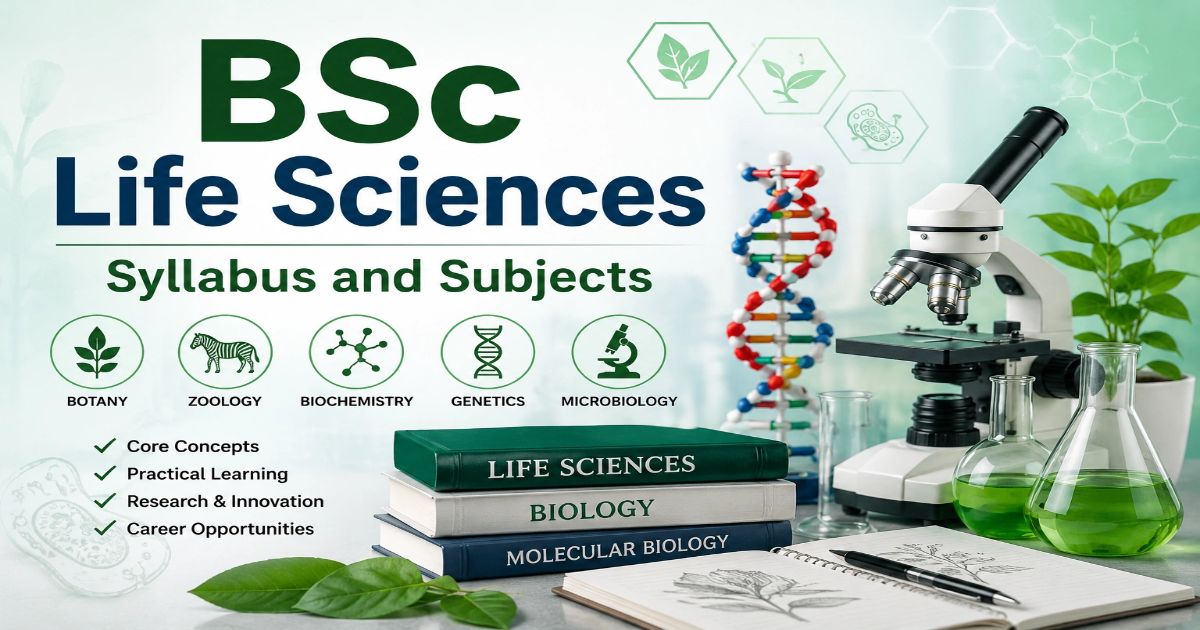
BSc Life Sciences syllabus is divided into 8 semesters across 4 years under the New Education Policy. Core BSc Life Sciences subjects include Botany, Zoology, Biochemistry, Cell Biology, Microbiology and others.
Understanding the BSc Life Science syllabus for 2026 is essential for aspiring students aiming to delve into the intricate world of biology, chemistry, and allied sciences. Most universities today follow a curriculum prescribed by the New Education Policy, divided into 4 years and eight semesters. Core subjects include Botany, Zoology, Biochemistry, Cell Biology, Microbiology and others. Students also get to choose from several value added and Ability Enhancement Courses. This article provides a detailed breakdown of the syllabus, including core subjects, NEP curriculum, old CBCS structure, and specific university curricula.
BSc Life Science Syllabus 2026: Core Subjects and Program Structure
The BSc Life Science syllabus in 2026 is increasingly aligned with the National Education Policy (NEP) 2020 and the Undergraduate Curriculum Framework (UGCF) adopted by many Indian universities. The programme is generally offered as a 3-year undergraduate degree with 6 semesters, while several universities also provide a 4-year Honours/Honours with Research option comprising 8 semesters.
| Year | BSc Life Science Subjects / Course Components |
| First Year | Cell Biology, Biodiversity (Plants and Animals), Biostatistics, Bioinformatics, Applied Biology, Development Biology, introductory practical labs, AEC/SEC/VAC courses |
| Second Year | Ecology, Evolution, Environmental Science, Genetic Engineering, Plant Tissue Culture, Animal Tissue Culture, Food Nutrition and Health, Diversity of Cryptogams, discipline-specific practicals and skill courses |
| Third Year | Molecular Biology, Genetics and Genomics, Taxonomy and Anatomy, Medical Diagnostics, Mathematics for Life Sciences, interdisciplinary electives, research-oriented practical work, project/dissertation in some universities |
| Fourth Year (if applicable under NEP) | Advanced specialisation papers, research methodology, dissertation/project work, internship/apprenticeship, and Honours/Honours with Research coursework |
First-Year BSc Life Science Syllabus: Semesters 1 & 2 Overview 2026
This section provides an overview of the first-year bsc life science syllabus, detailing the subjects covered across Semesters 1 and 2. The curriculum combines theoretical learning with practical exercises, particularly in areas like molecular biology, through lab experiments and hands-on activities.
| Semester 1 | Semester 2 |
| Environmental Science | Microbiology |
| Cell Biology | Practical Microbiology Lab |
| Cell Biology Lab | Genetics |
| Essentials of Chemistry for Biosciences | Physics V |
| Chemistry Lab for Biosciences | Practical Physics Lab |
| Biomolecules / Diversity of Animals | Bioanalytical Techniques / Environmental Biotechnology |
| University Elective | Communicative English |
Second Year BSc Life Sciences Syllabus: Semester 3 & 4 Overview
The second-year BSc Life Science syllabus builds on first-year fundamentals by introducing advanced concepts in genetics, biochemistry, ecology, physiology, and biotechnology, along with practical laboratory training and interdisciplinary skill-based learning.
| Semester 3 | Semester 4 |
| Biochemistry | Molecular Biology |
| Genetics | Ecology |
| Plant Physiology | Animal Physiology |
| Biochemistry Lab | Molecular Biology Lab |
| Genetics Lab | Ecology / Physiology Lab |
| Immunology | Development Biology |
| Analytical Techniques in Biology | Bioinformatics / Biostatistics |
| Skill Enhancement Course (SEC) | Ability Enhancement / Value-Added Course |
| Multidisciplinary / University Elective | Multidisciplinary / University Elective |
Third Year BSc Life Sciences Syllabus: Semester 5 & 6 Overview
In the third year, the BSc Life Sciences syllabus becomes more advanced and specialization-oriented, with core discipline-specific papers, electives, practical/lab work, and NEP-aligned components such as SEC, VAC, AEC, or multidisciplinary courses depending on the university.
| Semester 5 | Semester 6 |
| Plant Physiology and Metabolism / Evolutionary Ecology | Economic Botany and Biotechnology / Basics of Immunology |
| Discipline Specific Elective (DSE) – e.g., Biostatistics, Bioinformatics, Food Nutrition & Health | Discipline Specific Elective (DSE) – e.g., Medical Diagnostics, Microbial Technology, Advanced Life Science topics |
| Multidisciplinary Course (MDC) / University Elective | Multidisciplinary Course (MDC) / University Elective |
| Ability Enhancement Course (AEC) | Ability Enhancement Course (AEC) |
| Skill Enhancement Course (SEC) / Internship component | Skill Enhancement Course (SEC) / Internship component |
| Value Added Course (VAC) / Indian Knowledge System (IKS), where applicable | Value Added Course (VAC) / Indian Knowledge System (IKS), where applicable |
| Discipline-specific practical / lab work | Discipline-specific practical / lab work |
Fourth Year BSc Life Sciences Syllabus: Semester 7 & 8 Overview
Under NEP 2020/UGCF, the fourth year of BSc Life Sciences is designed for students who continue after Semester 6 and typically focuses on advanced discipline-specific courses, higher-level electives, research methodology, and dissertation/project or internship work, especially in the Honours/Honours with Research track.
| Semester 7 | Semester 8 |
| Discipline Specific Core (DSC): Advanced paper from the chosen Life Sciences discipline, such as Genomics, Proteomics and Bioinformatics | Discipline Specific Core (DSC): Advanced paper from the chosen Life Sciences discipline, such as Integrative Plant Biology |
| Discipline Specific Electives (DSEs): Students usually choose advanced electives from one chosen discipline from Research Methodology, Biodiversity Informatics, Plant Tissue Culture, Reproductive Ecology, or Environmental Biotechnology & Management | Discipline Specific Electives (DSEs): Advanced options may include Plant Stress Biology, Immunological Concepts and Applications in Plant Science, Advances in Genetics, Genomics and Plant Breeding, or Genomics, Proteomics and Bioinformatics |
| Research Methodology (if not taken earlier in Semester 6, depending on university rules) | Dissertation / Research Project / Academic Project continuation and completion |
| Dissertation / Academic Project / Entrepreneurship / Internship component begins | Dissertation / Academic Project / Internship / Apprenticeship submission and evaluation |
| Advanced practical / lab work related to the chosen specialization | Advanced practical / lab work / project viva based on the specialization |
CBCS Structure: BSc Life Science Syllabus under Choice Based Credit System 2026
While most institutes have shifted to the NEP structure, some also follow the older 3-year CBCS structure. Here is the syllabus overview:
| Semester | Core Subjects | Elective Options |
| I | Biological Sciences, Fundamentals of Nutrition, Biodiversity (Microbes, Algae, Fungi, Archegoniate) (Theory & Practical), Biodiversity-Animals (Theory & Practical), Conceptual Organic Chemistry (Theory & Practical), English Communications/Environmental Science (AECC-I) | N/A |
| II | Plant Ecology and Taxonomy (Theory & Practical), Comparative Anatomy and Developmental Biology of Vertebrates (Theory & Practical), Molecules of Life (Theory & Practical) | N/A |
| III | Anatomy and Embryology of Angiosperms (Theory & Practical), Physiology and Biochemistry (Theory & Practical), Chemical Bonding (Theory & Practical) | SEC-I (e.g., Biofertilizers, Herbal Technology, IT Skills for Chemists, Green Methods in Chemistry) |
| IV | Plant Physiology and Metabolism (Theory & Practical), Genetics and Evolutionary Biology (Theory & Practical), Physical Chemistry for the Biosciences (Theory & Practical) | SEC-II (e.g., Medicinal Botany, Ethnobotany, Pharmaceutical Chemistry, Fuel Chemistry) |
| V | DSE Botany I (e.g., Cell and Molecular Biology, Economic Botany and Biotechnology), DSE Zoology I (e.g., Applied Zoology, Animal Biotechnology), DSE Chemistry I (e.g., Analytical Methods in Chemistry, Molecular Modelling & Drug Design) | SEC-III (e.g., Nursery and Gardening, Floriculture, Business Skills for Chemists, Pesticide Chemistry) |
| VI | DSE Botany II (e.g., Analytical Techniques in Plant Sciences, Bioinformatics), DSE Zoology II (e.g., Aquatic Biology, Immunology), DSE Chemistry II (e.g., Research Methodology for Chemistry, Green Chemistry) | SEC-IV (e.g., Mushroom Culture Technology, Intellectual Property Rights, Chemistry of Cosmetics & Perfumes) |
Key Subjects in BSc Life Science Curriculum: Botany, Zoology, Biochemistry 2026
The BSc Life Science curriculum in 2026 typically integrates Botany, Zoology, Biochemistry, and allied bioscience subjects across semesters, with NEP-aligned programmes also including practicals, electives, and skill-based courses alongside core papers.
| Subject | Description |
| Botany | Studies plant structure, diversity, physiology, development, and ecological significance. |
| Zoology | Focuses on animal diversity, anatomy, physiology, development, and evolution. |
| Biochemistry | Explains the chemical processes of life, including biomolecules, enzymes, and metabolism. |
| Cell Biology | Covers cell structure, function, division, and the organization of living systems. |
| Genetics | Examines heredity, genes, genetic variation, and patterns of inheritance. |
| Molecular Biology | Studies DNA, RNA, protein synthesis, and molecular mechanisms within cells. |
| Microbiology | Introduces microorganisms, their structure, functions, and role in health and environment. |
| Ecology | Explores relationships between organisms and their environment, including ecosystems and biodiversity. |
| Biotechnology | Applies biological systems and organisms to develop useful products and technologies. |
| Bioinformatics / Biostatistics | Uses computational and statistical tools to analyze biological data and research findings. |
BSc Life Science (Hons) vs Program Syllabus: Key Differences 2026
The BSc Life Science (Hons) syllabus is usually more specialized and research-focused, while the BSc Life Science programme offers a broader, general life sciences curriculum.
| Difference | BSc Life Science (Hons) | BSc Life Science Program |
| Duration | Usually 4 years under NEP/UGCF | Usually 3 years |
| Curriculum Depth | More detailed and specialization-focused | Broader and more general |
| Core Subjects | Stronger emphasis on advanced life science papers | Focus on foundational life science subjects |
| Research Component | Includes research project/dissertation in later semesters | Limited research exposure |
| Electives | More discipline-specific electives | More general or multidisciplinary electives |
| Fourth Year Option | Available in many NEP-aligned universities | Usually not available |
| Practical Training | More advanced lab work and project-based learning | Regular practical and lab training |
| Best Suited For | Higher studies, research, specialization | General bioscience careers and PG options |
Delhi University BSc Life Sciences Syllabus
The B.Sc. Programme in Life Sciences at the University of Delhi operates under the Undergraduate Curriculum Framework (UGCF) in sync with the National Education Policy (NEP), structuring three core subject pillars—Botany, Zoology, and Chemistry—across its semesters.
| Semester | Core Pillar: Chemistry (DSC) | Core Pillar: Botany (DSC) | Core Pillar: Zoology (DSC) |
| Semester I | Atomic Structure, Bonding, General Organic Chemistry & Aliphatic Hydrocarbons | Biodiversity (Microbes, Algae, Fungi, and Archegoniatae) | Non-Chordates: Coelomates to Aschelminthes / Introduction to Life Sciences |
| Semester II | Chemical Energetics, Equilibria & Functional Organic Chemistry | Plant Anatomy and Embryology | Cell Biology, Molecular Biology & Basic Genetics |
| Semester III | Solutions, Phase Equilibrium, Conductance, Electrochemistry & Functional Group Organic Chemistry | Plant Ecology and Taxonomy | Diversity of Chordates & Comparative Anatomy |
| Semester IV | Chemistry of s & p-block Elements, States of Matter & Chemical Kinetics | Plant Physiology and Metabolism | Principles of Ecology & Evolutionary Biology |
| Semester V | Discipline Specific Elective (DSE-1):
(Choose 1: e.g., Green Chemistry, Analytical Chemistry) |
Discipline Specific Elective (DSE-2):
(Choose 1: e.g., Cell & Molecular Biology, Economic Botany) |
Discipline Specific Elective (DSE-3):
(Choose 1: e.g., Reproductive Biology, Applied Zoology) |
| Semester VI | Discipline Specific Elective (DSE-4):
(Choose 1: e.g., Organometallics, Polymer Chemistry) |
Discipline Specific Elective (DSE-5):
(Choose 1: e.g., Bioinformatics, Analytical Techniques) |
Discipline Specific Elective (DSE-6):
(Choose 1: e.g., Insect Vectors, Immunology & Biotechnology) |
BSc Life Sciences Exam Pattern
The BSc Life Sciences exam pattern is usually semester-based and combines theory exams, internal/continuous assessment, and practical evaluation under NEP/UGCF-style frameworks.
| Component | BSc Life Sciences Exam Pattern |
| Exam System | Semester-wise examination pattern |
| Theory Assessment | End-semester university theory exam for each paper |
| Internal Assessment | Includes class tests, assignments, presentations, quizzes, and attendance-based evaluation |
| Practical Assessment | Lab practicals, records/files, viva-voce, and end-term practical exam |
| Tutorial Assessment | In courses with tutorial credits, evaluation may include reviews, presentations, discussions, and project work |
| Weightage Pattern | Varies by university and course credit structure; internal + end-semester marks are combined |
| Practical Weightage | Often split between continuous practical assessment, end-term practical exam, and viva |
| Passing Requirement | Students generally need to pass theory and practical components separately, as per university rules |
Frequently Asked Questions
1) What subjects are included in the BSc Life Science syllabus?
The BSc Life Science syllabus usually includes Botany, Zoology, Biochemistry, Cell Biology, Genetics, Molecular Biology, Ecology, Microbiology, Biotechnology, and practical labs, along with electives and skill-based courses.
2) Is BSc Life Science a 3-year or 4-year course in 2026?
In 2026, most universities offer BSc Life Science as a 3-year programme, while NEP-aligned institutions may also provide a 4-year Honours/Honours with Research option with Semesters 7 and 8.
3) Does the BSc Life Science syllabus follow CBCS or NEP?
Most universities are now shifting to the NEP 2020/UGCF framework, though some colleges may still show older CBCS-style structures for reference or during the transition period.
4) Are practicals included in the BSc Life Science syllabus?
Yes, the syllabus includes practical and lab components in subjects such as Cell Biology, Microbiology, Biochemistry, Molecular Biology, Ecology, and Genetics, along with viva, records, and project-based assessment.
5) What is the exam pattern for BSc Life Science?
The BSc Life Science exam pattern is generally semester-based and includes theory exams, internal assessment, practical exams, viva, assignments, and continuous evaluation, depending on the university’s academic regulations.
6) What is the difference between BSc Life Science (Hons) and BSc Life Science Programme?
BSc Life Science (Hons) is usually more specialized, research-oriented, and may extend to a fourth year under NEP, while the programme version is broader and typically completed in three years.
BSc Life Science Syllabus 2026 – Frequently Asked Questions
Where can I find information about the eligibility criteria for BSc Life Science 2026?
Students preparing for BSc entrance exams in 2026 can find an updated guide to eligibility and popular exams. This information helps aspirants understand the requirements for BSc Life Sciences.
Where can I check the BSc Life Science 2026 syllabus and subjects?
You can check the latest Bachelor of Science (B.Sc.) Life Science 2026 syllabus, subjects list, and semester-wise syllabus at Universitykart.com. Additionally, the complete CUET BSc Life Science Syllabus 2026 is provided on CollegeDekho.
When is JoSAA Counselling expected to start for BSc Life Science admissions in 2026?
JoSAA Counselling for BSc Life Science admissions is expected to start in June 2026. Students can also find tentative dates for popular entrance exams in an updated guide.
Do top colleges accept CUET scores for BSc Life Science admissions in 2026?
Yes, many top BSc colleges accept CUET scores for 2026 admissions. Students can look over the complete CUET BSc Life Science Syllabus 2026 to understand the main subjects included.
What is the career scope after completing BSc Life Science?
The course offers various career opportunities and industry opportunities in life sciences. Students can explore top job roles and career scope after completing BSc Life Sciences.