B.Com LLB Subjects and Syllabus 2026: Comprehensive 5-Year Course Overview
B.Com LLB syllabus is divided into 5 years and ten semesters. Core B.Com LLB subjects include Accounting, Economics, Business Environment, Taxation, Constitutional Law, Family Law, Corporate Law, and procedural law subjects. Find year-wise and semester-wise breakdown.
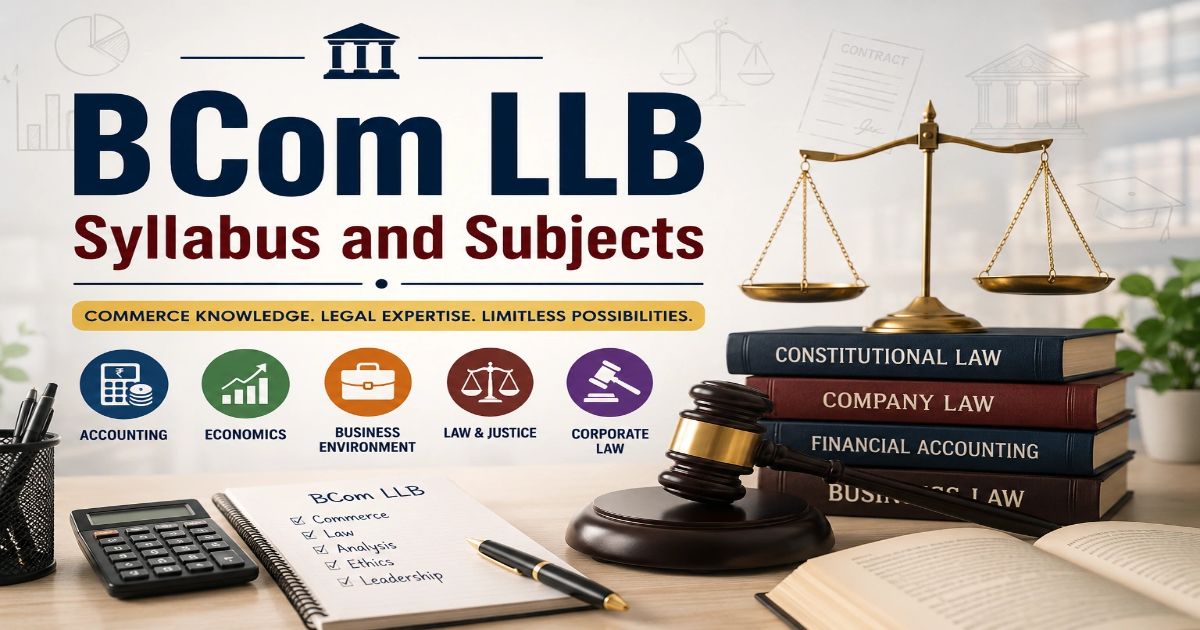
The B.Com LLB subjects offer a unique interdisciplinary curriculum, integrating core principles of commerce like accounting and economics with essential legal studies such as constitutional and corporate law over a five-year period. B.Com LLB syllabus is divided into 5 years and 10 semesters. Core subjects of B.Com LLB course include Accounting, Economics, Business Environment, Taxation, Constitutional Law, Contract Law, Criminal Law, Family Law, Corporate Law, and procedural law subjects. This comprehensive blend is specifically designed to equip students with a strong foundation for careers at the intersection of business and law. This article details the complete syllabus, covering core commerce and law topics, semester-wise breakdowns, and comparisons with other integrated law programs.
B.Com LLB Integrated Course Semester-wise Syllabus
The B.Com LLB is an integrated five-year dual undergraduate degree program designed to merge law and commerce. This overview details the comprehensive BCom LLB subjects covered across its ten semesters, providing a clear understanding of its structure and core focus.
| Semester | Subjects |
| Semester 1 | 1. Legal Methods 2. Law of Torts 3. Law of Contracts 4. Principles of Accounting |
| Semester 2 | 1. Law of Contracts I 2. Management Accounting 3. Foundation of Social Sciences 4. Business Psychology and Organisational Behaviour |
| Semester 3 | 1. Law of Contracts II 2. Law of Crimes 3. Economics 4. Financial Institutions, Markets and Services |
| Semester 4 | 1. Constitutional Law I 2. Criminal Procedure Code 3. Property Law 4. Family Law I |
| Semester 5 | 1. Constitutional Law II 2. Family Law II 3. Civil Procedure Code and Law of Limitation 4. Gender & Society |
| Semester 6 | 1. Public International Law 2. Jurisprudence 3. Administrative Law 4. Law of Evidence |
| Semester 7 | 1. Law of Banking 2. Law of Taxation 3. Environmental Law 4. Intellectual Property Rights 5. Alternative Dispute Resolution |
| Semester 8 | 1. Labour Law I 2. International Trade Law 3. Interpretation of Statutes |
| Semester 9 | 1. Labour Law II 2. Drafting, Pleading and Conveyancing 3. Investment Law |
| Semester 10 | 1. Professional Ethics and Bar-Bench Relations 2. Human Rights Law & Theory 3. Dissertation |
Specialized and Elective Subjects in B.Com LLB (Hons) Programs 2026
The B.Com LLB program offers a comprehensive curriculum, integrating both commerce and law subjects across five years. Specialization Electives are introduced in the fifth year, allowing students to tailor their academic path within the bcom llb subjects.
| Year | Subjects |
| First Year | Business Accounting, Microeconomics, Legal Methods, Constitutional Law, English Communication Skills |
| Second Year | Corporate Accounting, Macroeconomics, Law of Contracts, Family Law, Business Communication |
| Third Year | Business Law, Auditing, Property Law, Taxation Laws, Administrative Law |
| Fourth Year | Corporate Law, Banking and Finance, Criminal Law, Intellectual Property Rights, Environmental Law |
| Fifth Year | Labour Law, International Trade Law, Arbitration and Conciliation, Specialization Electives, Moot Courts, Internship |
People Also Read



Core Commerce Subjects in B.Com LLB: Accounting, Economics, Business Environment
The B.Com LLB integrates core commerce subjects with legal principles. This unique blend equips students with essential skills for understanding the legal and financial aspects of business, covering key areas like accounting, economics, and the broader business environment.
| Core Commerce Subject | What It Covers |
| Financial Accounting | Basics of journal entries, ledgers, trial balance, final accounts, and financial statement preparation for business entities. |
| Corporate Accounting | Company accounts, share capital, debentures, amalgamation, and preparation of corporate financial statements. |
| Cost & Management Accounting | Costing methods, budgeting, cost control, variance analysis, and managerial decision-making tools. |
| Business Economics | Micro and macroeconomic concepts, demand-supply analysis, market structures, national income, and business decision-making. |
| Business Environment | Economic, legal, political, social, and regulatory factors that affect business operations and commercial decisions. |
| Business Communication | Professional communication, report writing, business correspondence, presentations, and workplace communication skills. |
| Business Statistics / Quantitative Techniques | Statistical tools, data analysis, probability, averages, correlation, and business-related numerical problem-solving. |
| Income Tax / Taxation | Basic direct taxation concepts, heads of income, deductions, tax computation, and tax compliance principles. |
| Banking & Insurance / Financial Management | Fundamentals of banking, insurance, financial planning, capital management, and financial decision-making in business. |
Essential Law Subjects in B.Com LLB: Constitutional, Criminal, Corporate, Family Law
The B.Com LLB program encompasses a wide array of essential law subjects, providing students with a comprehensive understanding of the legal framework. This section details key BCom llb subjects, including core and additional offerings, and highlights their purpose in preparing students for the legal industry.
| Law Subject | What It Covers |
| Constitutional Law | Fundamental rights, duties, structure of government, and constitutional principles in India. |
| Criminal Law | Offences, punishments, criminal liability, and core principles of criminal justice. |
| Corporate / Company Law | Company formation, corporate governance, shareholder rights, and business regulations. |
| Family Law | Marriage, divorce, adoption, maintenance, inheritance, and family-related legal rights. |
| Law of Contracts | Formation, validity, breach, and enforcement of legal agreements. |
| Law of Torts | Civil wrongs such as negligence, nuisance, defamation, and liability. |
| Law of Evidence | Rules governing admissibility, relevance, and proof of facts in court. |
| Civil Procedure Code | Procedures for filing, hearing, and resolving civil disputes in courts. |
| Administrative Law | Legal control of government actions, public authorities, and administrative decisions. |
| Labour / Industrial Law | Laws related to employment, wages, industrial disputes, and workers’ rights. |
B.Com LLB Syllabus for Indian Institute of Legal Studies
The B.Com LLB syllabus for 2026, updated on February 16, 2026, by the Indian Institute of Legal Studies, offers a comprehensive overview of key BCom llb subjects across ten semesters. This section details the core curriculum students will encounter throughout their five-year program, focusing on institute-specific offerings.
| Year | Semester | Key Subjects |
| 1 | I | English I, Economics, Financial Accounting, Law of Torts, Business Statistics |
| 1 | II | English II, Economics – II, Contract, Principles of Management, Advanced Accounting |
| 2 | III | Economics – III, Contract – II, Family Law – II, Auditing, Management Accounting |
| 2 | IV | English – III, Family Law- II, Constitutional Law, Cost Accounting, Organisational Behaviour |
| 3 | V | Law of Crimes – I, Administrative Law, Jurisprudence, Constitutional Law – II, Secretarial Practice |
| 3 | VI | Law of Crimes, Labour Industrial Law – I, Interpretation Statutes and Principles of Legislation, Environmental Law |
| 4 | VII | Land Laws Including Tenure Tenancy System, Civil Procedure Code and Limitation Act, Labour and Industrial Law II, Professional Ethics and Professional Accounting System – Practical |
| 4 | VIII | Laws of Evidence, Property Law, Company Law, Drafting, Pleading and Conveyance – Practical |
| 5 | IX | Insurance Law, Public International Law, Intellectual Property Law, Alternative Dispute Resolution |
| 5 | X | Principles of Taxation Law, Banking Law, Human Rights Law and Practice, Moot Court Exercise and Internship |
B.Com LLB vs BBA LLB Subjects: Curriculum Differences for Business Law Careers
Both BBA LLB and B.Com LLB are 5-year integrated programs, but their curricula diverge significantly in non-law components, influencing the depth and specialization of their legal studies. Understanding the core BCom LLB subjects and their BBA LLB counterparts is crucial for aspiring business law professionals.
| Parameter | BBA LLB | BCom LLB |
| Full Name | Bachelor of Business Administration and Bachelor of Legislative Law | Bachelor of Commerce and Bachelor of Legislative Law |
| Course Level | Undergraduate integrated law programme | Undergraduate integrated law programme |
| Duration | 5 years (10 semesters) | 5 years (10 semesters) |
| Course Focus | Combines legal education with management and business administration | Combines legal education with commerce, finance, and economics |
| Non-Law Subjects | Principles of Management, Financial Accounting, Marketing, HR, Business Communication, Statistics, Economics, IT | Accounting, Cost Accounting, Auditing, Taxation, Banking, Business Maths & Statistics, Communication, Economics |
| Law Orientation | Stronger orientation toward corporate management, business regulation, and commercial operations | Stronger orientation toward taxation, finance, accounting, and commercial law |
| Popular Specialisations | Corporate Law, Intellectual Property Law, International Business Law, Contract Law, Mergers & Acquisitions | Banking Law, Taxation Law, Securities Law, Cyber Law, Insurance Law |
| Course Fees | Generally higher because of the management component | Generally lower compared to BBA LLB |
| Exams Accepted | CLAT, LSAT, and institution-specific entrance exams | CLAT, LSAT, and institution-specific entrance exams |
| Best Suited For | Students interested in management, corporate strategy, business operations, and legal advisory roles | Students interested in commerce, taxation, finance, accounting, and financial legal practice |
| Eligibility Criteria | Passed 10+2 with minimum marks required by the institution | Passed 10+2 with minimum marks required by the institution |
| Admission Process | Entrance exams such as CLAT, LSAT, or institute-level tests, followed by counselling / interview in some colleges | Entrance exams such as CLAT, LSAT, or institute-level tests, followed by counselling / interview in some colleges |
Frequently Asked Questions
1) What subjects are taught in B.Com LLB?
B.Com LLB combines commerce and law subjects such as Financial Accounting, Economics, Taxation, Business Environment, Constitutional Law, Criminal Law, Contract Law, Family Law, Company Law, and procedural law papers.
2) Is B.Com LLB a 3-year or 5-year course?
B.Com LLB is a 5-year integrated undergraduate law programme divided into 10 semesters, combining commerce papers with legal studies from the first year itself rather than after graduation.
3) Does B.Com LLB include both commerce and law subjects every year?
Yes, the course is designed to integrate both streams, so students usually study commerce papers like accounting or economics alongside legal subjects such as contracts, constitutional law, and criminal law.
4) Which are the most important law subjects in B.Com LLB?
Key law subjects in B.Com LLB usually include Constitutional Law, Criminal Law, Family Law, Law of Contracts, Company Law, Law of Evidence, Administrative Law, Labour Law, and Taxation Law.
5) What is the difference between B.Com LLB and BBA LLB?
B.Com LLB focuses more on commerce, taxation, accounting, finance, and business law, while BBA LLB emphasizes management, business administration, marketing, HR, and corporate legal studies.
6) Does B.Com LLB include internships and moot courts?
Yes, most B.Com LLB programmes include internships, moot court exercises, drafting, pleading, practical training, and project/dissertation work, especially in the later semesters of the course.
B.Com LLB Subjects and Syllabus 2026 – Frequently Asked Questions
How can I find the detailed B.Com LLB syllabus and subjects for 2026?
Students can find detailed information about the B.Com LLB syllabus and subjects for 2026, including semester-wise lists. Some sources also offer download options for Top Colleges Syllabus PDFs to assist with planning.
What information is available regarding B.Com LLB admission and eligibility for 2026?
You can find details about the B.Com LLB admission process and eligibility criteria for 2026. This information is typically provided alongside course fees, syllabus, and career scope to help prospective students.
Where can I learn about the B.Com LLB course structure, including best books and projects?
The B.Com LLB semester-wise syllabus provides complete insights into the course structure. This includes information on best books and projects, which are essential components for understanding the program's academic requirements.
What are the career opportunities and salary prospects after completing a B.Com LLB program?
Graduates of the B.Com LLB program have diverse career opportunities in both the legal and business sectors. Information is available on job roles and salary prospects to guide students towards a successful legal career.
How can I find details about B.Com LLB top colleges and associated course fees for 2026?
You can check details about B.Com LLB top colleges and their respective course fees for 2026. This information helps in comparing options and planning your law career effectively.
What are the benefits of pursuing a B.Com LLB course for a legal career?
The B.Com LLB course offers benefits for a successful legal career, preparing graduates for diverse opportunities in the legal and business sectors. It helps students start planning their law career by combining these two fields of knowledge.