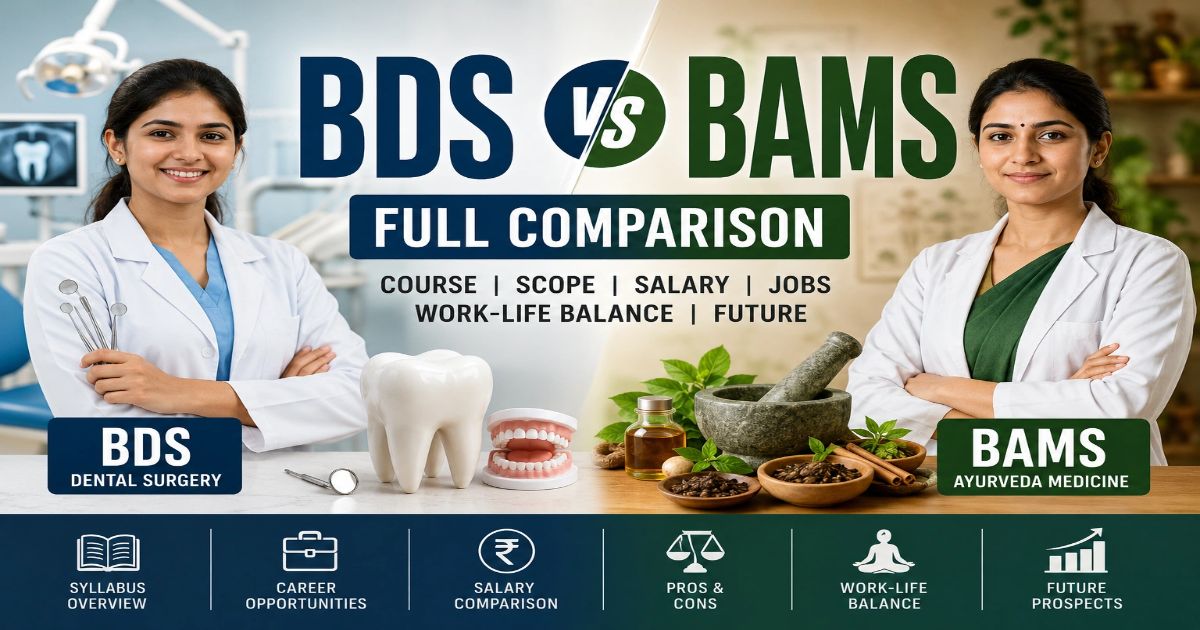
BDS vs BAMS: Comparing Career Scope, Salary, and Suitability in 2026
BDS is a 5+1 year UG course in dentistry, while BAMS is a 5.5 year UG course in Ayurvedic medical principles. Find which one is better by comparing their fees, scope, salary, syllabus and more.
Which is better, BDS or BAMS? is a pivotal question for aspiring medical students, and the answer isn’t universal; it deeply depends on your personal interests, aptitude, and long-term career vision. India produces over 27,000 dentists annually. While the government also supports AYUSH sectors heavily, creating newer jobs every year. This makes the choosing between BDS and BAMS even tougher. While BDS offers a specialized path in modern dentistry, BAMS provides a holistic approach rooted in traditional Ayurvedic principles, each with unique demands and rewards. This article comprehensively breaks down their career scope, salary prospects, work-life balance, and suitability to guide your decision for 2026.
BDS vs BAMS: Fundamental Differences
Deciding whether bds or bams which is better depends on your career aspirations, as these degrees lead to distinct medical fields. BDS focuses on dentistry, while BAMS specializes in Ayurvedic and holistic medicine, each with its own regulatory body and scope of practice.
| Aspect | BDS (Dental) | BAMS (Ayurveda) |
| Core Focus | Oral health, dental surgery, diagnosis and treatment of dental conditions | Ayurvedic medical principles, herbal and traditional therapies |
| Clinical Practice | Structured dental clinical training, including patient care | Traditional clinical training in Ayurveda |
| Regulatory Pathway | Prepares students for recognised dental practice after licensing | Leads to registered practice within its medical system (Ayurveda) |
| Typical Career Direction | Careers in dentistry in clinics, hospitals, and dental healthcare roles | Careers as ayurvedic physicians; roles in wellness and therapy centres |
| Course Duration | 5 years + 1 yr internship | 5.5 years (incl. internship) |
| Internship Requirement | Mandatory | Mandatory |
| NEET UG Requirement | Required | Varies by college |
| Eligibility | 12th PCB with qualifying marks | 12th PCB with qualifying marks |
| Fee Range | Govt: usually under ₹1 lakh total in top govt colleges
Private/Deemed: commonly around ₹8–25 lakh+ total |
Govt: usually ₹25,000–₹1.5 lakh total in many govt colleges
Private/Deemed: commonly ₹5–20 lakh+ total |
| Top Colleges | MAIDS Delhi, IMS BHU Varanasi, Manipal College of Dental Sciences | IMS BHU Varanasi, National Institute of Ayurveda Jaipur, Gujarat Ayurved University Jamnagar |
Career Scope and Growth: BDS (Dental) vs BAMS (Ayurveda) Opportunities 2026
Choosing bds or bams which is better depends on career priorities. BDS offers higher peak earnings but faces extreme saturation and high setup costs. BAMS provides more stable government job growth, thousands of new jobs, and a broader practice scope, including basic allopathic medicine.
| Feature | BDS (Dentistry) | BAMS (Ayurveda) |
| Starting Salary (Pvt Clinic) | ₹12,000 – ₹18,000 / month | ₹20,000 – ₹35,000 / month |
| Govt. Job Salary (Fresher) | ₹55,000+ (Very few seats) | ₹45,000 – ₹60,000 (Many seats) |
| Setup Cost (Own Clinic) | High (₹15 – 25 Lakhs for Chair/X-ray) | Low (₹2 – 5 Lakhs for basic setup) |
| Saturation Level | Extremely High | Moderate |
| Peak Career Earnings | High (If successful private practice) | Moderate to High (Steady flow) |
| Job Scope & Career Prospects | Dental Clinics, Oral Surgery, Cosmetic Dentistry, Corporate sectors and Consultancy etc.; Private Dental Clinics, Orthodontic Centers, Armed forces as dental officers etc. (High) | Ayurveda Hospitals, Wellness Centers, and Herbal Research, lecturer, health care administration etc.; Patanjali, Govt Ayurveda Hospitals, Wellness Retreats, drug manufacturing companies etc. (Moderate to High) |
BDS vs BAMS: Income-wise Comparison
For BAMS graduates in 2026, government job salaries can exceed ₹40,000 per month, offering a clear career path. This section provides a detailed overview of potential earnings for both BDS and BAMS professionals, helping to clarify which is better in terms of initial and long-term financial prospects.
| Profession | Starting Salary (per annum) | Mid-Career Salary (per annum) | Established/Advanced Salary (per annum) |
| BDS | ₹3–₹8 lakh | ₹8–₹15 lakh | ₹15–₹30 lakh (with private clinic/MDS) |
| BAMS | ₹3–₹6 lakh | ₹6–₹12 lakh | ₹10–₹25 lakh (well-established practice) |
BDS vs BAMS: Post-Graduation Life & Work-Life Balance
Navigating post-graduation life quality, particularly work-life balance, is crucial for prospective doctors. While dentistry often offers predictable hours, the BAMS field is seeing significant government support and job creation, making the choice between bds or bams which is better for long-term career satisfaction a complex one.
| Aspect | BDS | BAMS |
| Nature of Work | Dental procedures, oral diagnosis, patient consultations, and clinic-based treatment | Ayurvedic consultation, treatment planning, wellness care, and Panchakarma-related practice |
| Work Setting | Dental clinics, hospitals, private practice, chain dental centres | Ayurvedic clinics, hospitals, wellness centres, Panchakarma centres, private practice |
| Working Hours | Mostly fixed clinic hours and appointment-based schedules | Often fixed OPD hours, but timings vary more by clinic, hospital, or wellness centre |
| Emergency / Night Duty | Usually very limited, except hospital dental cases or trauma work | Generally limited too, though some hospital-based roles may involve longer shifts |
| Work-Life Balance | Usually better and more predictable once practice becomes stable | Can also be balanced, especially in clinic or wellness roles, but depends more on practice type |
| Physical Nature of Work | Procedure-heavy; long sitting hours, fine hand skills, and patient chair-side work | More consultation-based overall, though therapy and Panchakarma work can also be physically demanding |
| Own Setup Requirement | Common for better earnings; dental clinic setup can be expensive | Private practice setup is also common, but initial costs may be lower than a dental clinic |
| Early Career Income Stability | Can be slow initially, especially in crowded urban markets | Can also take time to build, especially in private practice or wellness-focused roles |
| Best Fit For | Students who want structured clinic life and hands-on procedural work | Students who prefer consultation-led care and Ayurveda-based treatment practice |
| Overall Lifestyle Verdict | More predictable and clinic-centred | More flexible, but depends heavily on role and practice model |
Rural vs Urban Practice: Market Receptivity for BDS and BAMS 2026
BAMS Rural vs Urban Practice
When considering rural versus urban practice, a BAMS doctor in a Tier-3 town often earns more initially than a BDS doctor in a Metro city, primarily due to lower competition and setup costs. This section explores market receptivity for both BDS and BAMS, highlighting key differences in scope, demand, and earning potential across various settings.
| Aspect | Urban Practice | Rural Practice |
| Patient Footfall | High, diverse (lifestyle, wellness) | Steady, mostly chronic conditions |
| Fresh Salary Range | ₹30,000–₹70,000/month (private) | ₹40,000–₹80,000+ (govt with incentives) |
| Growth Potential | High via specialization & networking | Stable govt jobs, less financial risk |
| Setup Costs | High (rent, marketing) | Lower, often govt-supported |
| Lifestyle | Fast-paced, urban amenities | Peaceful, community-focused |
| Competition | Very high | Low |
Further, government support for AYUSH is robust, with the Ministry of AYUSH creating thousands of new jobs and actively hiring Ayurvedic Medical Officers (AMO) in almost every Primary Health Center (PHC). Furthermore, BAMS doctors in rural areas of Maharashtra, Karnataka, and UP are allowed to practice basic Allopathic medicine after a ‘Bridge Course’, effectively serving as ‘GPs’ for rural India.
BDS Rural vs Urban Practice
For BDS graduates, urban markets offer higher-paying treatments and specialist demand, but they are also far more saturated. Rural and Tier-2/3 markets usually have lower setup costs, less competition, and better room to build a private practice over time.
| Aspect | Urban Practice | Rural / Tier-2-3 Practice |
| Patient Footfall | Higher overall footfall, but split across many competing clinics and chains | Lower total footfall, but often better visibility if few dentists are available locally |
| Type of Demand | Cosmetic dentistry, braces, implants, RCTs, smile design, premium procedures | Basic dental care, extractions, pain relief, dentures, scaling, fillings, routine oral care |
| Fresh Salary Range | Junior BDS dentists in city clinics often start around ₹15,000–₹30,000/month, depending on city, skills, and clinic type | Salaries vary widely, but private jobs may not always be higher; the bigger advantage is often lower competition and lower living/setup costs |
| Private Practice Potential | High-paying market if you build a strong brand, specialist network, or premium clinic, but growth is slower because competition is intense | Strong long-term potential if you become the trusted local dentist; patient loyalty and repeat visits can build faster in under-served areas |
| Competition | Very high in metros and major Tier-1 cities due to dense concentration of dentists and chain clinics | Lower than metros in many towns, especially where organised dental care is still limited |
| Clinic Setup Cost | Higher rent, interiors, equipment, and marketing costs; a modern clinic can require a significant upfront investment | Lower rent and operating costs make it easier to start a basic or mid-range clinic with less financial pressure |
| Career Growth Path | Better access to specialist mentors, MDS consultants, advanced procedures, corporate chains, and continuing education | Slower exposure to high-end specialty work, but better chances to grow as a general dentist and local practice owner |
| Lifestyle | Fast-paced, commute-heavy, and more competitive, but offers stronger access to advanced dental ecosystems | Slower-paced and community-driven, often with lower overheads and a more stable daily routine |
| Overall Market Receptivity | Good for dentists targeting premium procedures, specialisation, or corporate dentistry—but difficult for freshers without strong skills or differentiation | Often more favourable for fresh BDS graduates who want to build an independent clinic gradually in a less saturated market |
Syllabus Overviews: BDS vs BAMS
BDS Syllabus
The BDS syllabus is spread across 4 academic years plus 1 year of compulsory rotatory internship, covering basic medical sciences, pre-clinical dental training, and core clinical dental subjects.
| BDS Year | Main Subjects / Syllabus |
| 1st Year | Anatomy, Physiology, Biochemistry & Nutrition, Dental Anatomy, Embryology and Oral Histology |
| 2nd Year | General Pathology & Microbiology, General and Dental Pharmacology, Dental Materials, Pre-Clinical Conservative Dentistry, Pre-Clinical Prosthodontics |
| 3rd Year | General Medicine, General Surgery, Oral Pathology and Oral Microbiology |
| 4th Year | Public Health Dentistry, Periodontology, Orthodontics & Dentofacial Orthopaedics, Oral Medicine & Radiology, Oral & Maxillofacial Surgery, Conservative Dentistry & Endodontics, Prosthodontics and Crown & Bridge, Pediatric & Preventive Dentistry |
| Internship | 1-year compulsory rotatory internship in major dental departments and clinical postings |
BAMS Syllabus
The BAMS syllabus under the newer NCISM framework is generally organised into professional years rather than semesters, followed by a 1-year compulsory internship.
| BAMS Professional Year | Main Subjects / Syllabus |
| 1st Professional | Sanskrit and Ayurveda Itihas, Padartha Vigyan, Kriya Sharir, Rachana Sharir, Samhita Adhyayan |
| 2nd Professional | Dravyaguna Vigyan, Rasashastra and Bhaishajya Kalpana, Roga Nidana and Vikriti Vigyan, Charak Samhita |
| 3rd Professional | Agad Tantra, Swasthavritta and Yoga, Prasuti Tantra and Stri Roga, Kaumarbhritya, Charak Samhita (advanced study) |
| Final / 4th Professional | Kayachikitsa, Panchakarma, Shalya Tantra, Shalakya Tantra, Research Methodology and Medical Statistics |
| Internship | 1-year compulsory rotatory internship across clinical Ayurveda departments |
Choosing Your Path: Personal Interest and Aptitude for BDS or BAMS 2026
Choosing between BDS and BAMS requires evaluating core focuses, personal interests, and career aspirations. Understanding the distinct paths each degree offers is crucial for making an informed decision, helping you determine which is better suited for your future.
- Core Focus: BDS specializes in dentistry; BAMS blends Ayurveda with modern fundamentals.
- Personal Interest: Passion for dental health (BDS) or traditional Ayurveda and wellness (BAMS).
- Clinical Practice: Dentistry requires specific oral health training; BAMS offers non-allopathic general medical care.
- Work-Life Balance: Dentistry often provides more predictable hours compared to demanding MBBS schedules.
- Program Review: Essential to review curriculum, clinical exposure, and professional regulations.
- NEET Accessibility: BDS and BAMS may offer more accessible options for moderate NEET scores.
Frequently Asked Questions
1. Which is better in 2026: BDS or BAMS?
Neither is universally better. BDS suits students interested in dentistry and clinic-based procedures, while BAMS fits those drawn to Ayurveda, wellness care, and broader non-dental clinical practice.
2. Who earns more after graduation: BDS or BAMS?
Early salaries often vary by city, role, and practice type. BDS can offer higher long-term earnings through private dental practice, while BAMS may provide steadier government and wellness-sector opportunities.
3. Is BAMS easier than BDS?
Not exactly. BDS is more procedure- and clinic-focused, while BAMS covers Ayurvedic theory, diagnosis, therapies, and modern medical basics. Difficulty depends more on your aptitude and subject interest.
4. Does BAMS have better government job scope than BDS?
In many states, BAMS graduates may find broader AYUSH and public-health openings, while BDS government seats are comparatively fewer and highly competitive. Actual opportunities still vary by state recruitment rules.
5. Is NEET required for both BDS and BAMS in India?
Yes. For mainstream admissions in India, NEET-UG is the standard entrance route for both BDS and BAMS, though counselling and seat allocation rules differ across colleges and states.
6. Which course is better for private practice: BDS or BAMS?
BDS is ideal for students wanting a specialised dental clinic, but setup costs are higher. BAMS can also support private practice, often with lower initial investment and broader wellness positioning.