MBBS vs BDS: Which Medical Career Path is Better in 2026?
Aayush is a writer and content strategist who turns personal stories into brand narratives. With an experience spanning diverse industries, rely on his writing for simplifying complex subjects…
MBBS and BDS are both UG courses with mandatory internships. Find a complete detailed comparison in this guide.
Choosing between MBBS vs BDS is a critical decision for students aiming for a career in healthcare, as both paths lead to highly respected medical professions but diverge significantly in focus and practice. While MBBS prepares you for general medicine and surgery, BDS specializes in oral health. Understanding these core differences is crucial for making an informed choice that aligns with your aspirations. This article will thoroughly compare course structures, career prospects, admission requirements, and financial aspects to help 2026 aspirants decide.
MBBS vs BDS: Side-by-Side Comparison
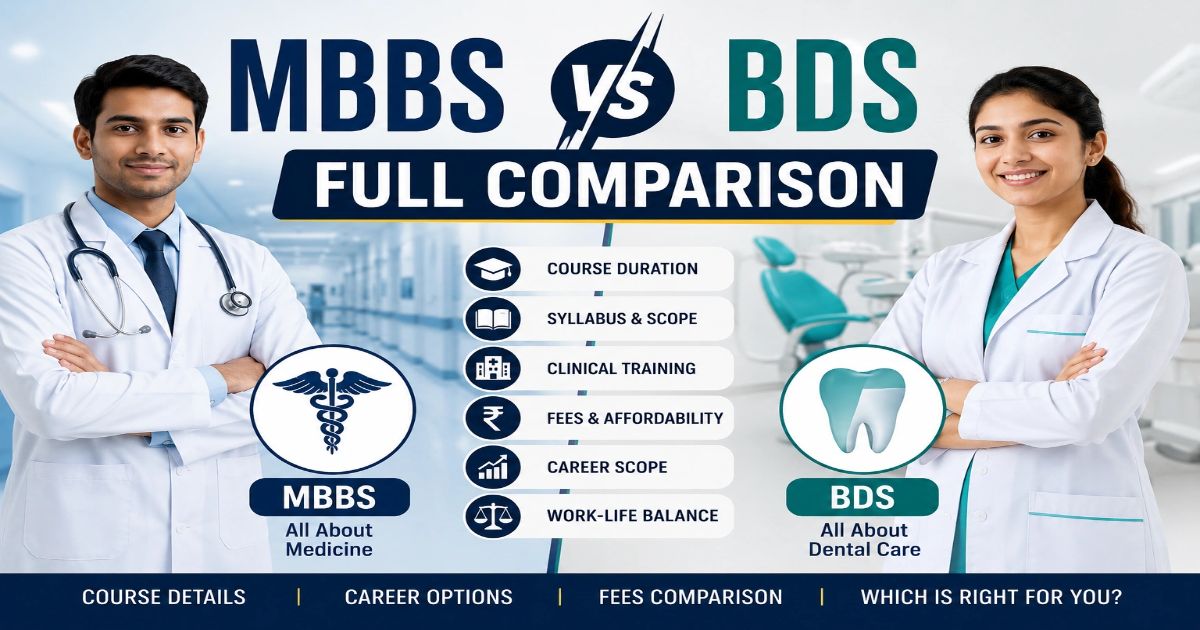
If you’re deciding between MBBS and BDS, the biggest differences come down to course duration, syllabus breadth, clinical training, career scope, and long-term work-life balance.
| Aspect | MBBS | BDS |
| Full Form | Bachelor of Medicine, Bachelor of Surgery | Bachelor of Dental Surgery |
| Course Focus | General medicine, diagnosis, surgery, patient care | Oral health, teeth, gums, dental treatment |
| Duration | 5.5 years (4.5 years study + 1 year internship) | 5 years (4 years study + 1 year internship) |
| Eligibility | 10+2 with PCB + NEET-UG | 10+2 with PCB + NEET-UG |
| Academic Scope | Broad; whole-body medicine | Specialised; dental sciences only |
| Clinical Training | Hospital postings across departments | Dental clinics and dental specialties |
| Difficulty Level | Higher overall academic and clinical load | Rigorous, but narrower in scope |
| Career After UG | Doctor in hospitals/clinics; can pursue PG | Dentist in clinics/hospitals; can pursue MDS |
| PG Entrance | NEET PG / NExT pathway | NEET MDS |
| Career Scope | Medicine, surgery, hospital care, specialisations | Dentistry, oral surgery, orthodontics, private practice |
| Work-Life Balance | More demanding, irregular hours | Usually better, more fixed hours |
| Fee Range | Govt: Rs. 10,000 to Rs. 2 lakhs a year
Private/Deemed: Rs. 7-25 lakhs a year |
Govt: ~₹20,000–₹1 lakh/year
Private/Deemed: ~₹2–8 lakh/year |
| Top Colleges (examples) | AIIMS Delhi, JIPMER Puducherry, CMC Vellore | Maulana Azad Institute of Dental Sciences, Manipal College of Dental Sciences, Saveetha Dental College |
| Best For | Students wanting a full medical career path | Students specifically interested in dentistry |
MBBS vs BDS: Salary Comparison
The healthcare sector is projected to create 88% of new roles in 2026, making medical careers highly attractive. This comparison highlights that while MBBS offers broader medical roles and generally higher salary potential, BDS provides a strong path in niche oral health with significant private practice growth.
| Aspect | MBBS (Doctor) | BDS (Dentist) |
| Fresher Salary | ₹40,000–₹80,000 | ₹20,000–₹50,000 |
| Mid-Level (3-5 years) | ₹80,000–₹1.5 lakhs+ | ₹50,000–₹1 lakh+ |
| Experienced Potential | ₹1–3 lakhs+ (higher with PG) | ₹1–2 lakhs+ (private practice) |
| Government Jobs | More openings, better security | Limited, but stable |
| Private Growth | High in hospitals/specialties | Strong via own clinic/chains |
| Overall Scope | Broader medical roles | Niche oral health, cosmetics |
People Also Read

MBBS Syllabus
The MBBS syllabus in India follows the NMC Competency-Based Medical Education (CBME) curriculum, combining pre-clinical, para-clinical, and clinical training across 4.5 academic years plus 1 year of internship.
| MBBS Year / Stage | Main Subjects / Syllabus |
| 1st Year | Anatomy, Physiology, Biochemistry; Foundation Course, Early Clinical Exposure (ECE), AETCOM, introduction to Community Medicine and Family Adoption Programme |
| 2nd Year | Pathology, Microbiology, Pharmacology, Forensic Medicine & Toxicology; Community Medicine, introductory clinical subjects, clinical postings, AETCOM |
| 3rd Year | Community Medicine, Forensic Medicine & Toxicology, Ophthalmology, ENT; Medicine & allied, Surgery & allied, Pediatrics, Obstetrics & Gynaecology exposure through postings, AETCOM |
| Final Year | General Medicine, General Surgery, Obstetrics & Gynaecology, Pediatrics along with Orthopedics, Dermatology, Psychiatry, Radiodiagnosis, Anesthesiology; advanced clinical postings and AETCOM |
| Electives | Two elective blocks of 15 days each as per the CBME curriculum |
| Internship | 1-year compulsory rotatory internship in major clinical departments after completion of the academic course |
BDS Syllabus
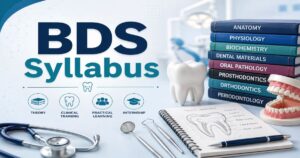
The BDS syllabus in India is set by the DCI/NDC framework and spans 4 academic years plus 1 year of compulsory rotatory internship, covering basic medical sciences, pre-clinical dental subjects, and core clinical dental specialties.
| BDS Year | Main Subjects / Syllabus |
| 1st Year | General Human Anatomy, Physiology, Biochemistry, Dental Anatomy & Oral Histology |
| 2nd Year | General Pathology, General Microbiology, Dental Pharmacology & Therapeutics, Dental Materials, Pre-Clinical Prosthodontics, Pre-Clinical Conservative Dentistry |
| 3rd Year | General Medicine, General Surgery, Oral Pathology & Oral Microbiology |
| 4th Year | Oral Medicine & Radiology, Pediatric & Preventive Dentistry, Orthodontics & Dentofacial Orthopedics, Periodontology, Oral & Maxillofacial Surgery, Conservative Dentistry & Endodontics, Prosthodontics & Crown & Bridge, Public Health Dentistry |
| Internship | 1-year compulsory rotatory internship in major dental departments after the academic course |
Is BDS Easier Than MBBS? Course Difficulty and Work-Life Balance
When comparing MBBS vs BDS in terms of course difficulty and lifestyle, MBBS usually has a broader academic burden and more demanding clinical duties, while BDS is more specialised and often offers a relatively better work-life balance.
| Aspect | MBBS | BDS |
| Academic Load | Broader and more comprehensive syllabus covering the entire human body, diseases, diagnosis, and treatment. | More specialised syllabus focused mainly on oral health, dental sciences, and clinical dental procedures. |
| Course Difficulty | Generally considered more demanding because of wider subject coverage, hospital postings, and high-pressure clinical exposure. | Rigorous in its own way, but comparatively narrower in scope due to its dental specialisation. |
| Stress & Workload | Higher stress due to emergency duties, long hospital hours, ward work, and night shifts during training and practice. | Comparatively lower stress in routine practice, with fewer emergency responsibilities and more structured clinical hours. |
| Work-Life Balance | Often more challenging because doctors may need to handle emergencies, irregular schedules, and extended duty hours. | Usually better because dentists often work in fixed clinic timings and generally do not have emergency night duties. |
| Admission Competitiveness | More competitive because MBBS seats are fewer relative to demand and the course has broader career scope. | Competitive as well, but cut-offs are generally lower than MBBS in many colleges. |
| PG Entrance Difficulty | NEET PG is generally tougher due to a much larger candidate pool and broader syllabus. | NEET MDS is competitive too, but usually involves a smaller pool and a more focused syllabus. |
| Career Scope | Wider medical career options across multiple specialties, hospitals, research, public health, and surgery. | Strong career scope in dentistry, private practice, specialisations, cosmetic dentistry, and oral healthcare. |
| Challenges | Heavy syllabus, higher stress, demanding clinical schedule, emergency exposure, and tougher work-life balance. | Fine motor skill requirements, patient handling, clinic setup costs, and a comparatively narrower healthcare scope than MBBS. |
| Advantages | Broad medical knowledge, wider career opportunities, higher prestige in many settings, and more specialty options. | More specialised training, earlier clinical focus on one domain, and often a better long-term work-life balance. |
| Final Verdict on Work-Life Balance | More stressful and demanding overall | More flexible and balanced overall |
Making the Right Choice: A Step-by-Step Guide for 2026 Aspirants
Choosing the right medical course is a critical decision for 2026 aspirants, requiring careful consideration of various factors. This guide outlines six essential steps to help you navigate options like MBBS, BDS, and BAMS, ensuring your choice aligns with personal interests and career goals.
- Step 1: Understand core focus: MBBS (allopathic), BDS (dentistry), BAMS (Ayurveda).
- Step 2: Compare duration, eligibility, curriculum, career scope, salary, and global recognition. All require NEET UG.
- Step 3: Align choice with interests, strengths, and long-term goals. Dentistry offers more predictable hours.
- Step 4: Consider NEET score and competition. MBBS is highly competitive; BDS and BAMS are more accessible.
- Step 5: Align choice with preferences: MBBS (broad impact), BDS (focused work), BAMS (Ayurveda).
- Step 6: Seek expert guidance if needed. Assess passion; explore career assessment or counselling for roadmapping.
Frequently Asked Questions
1. What subjects are included in the BDS syllabus?
The BDS syllabus includes Anatomy, Physiology, Biochemistry, Dental Anatomy, Pathology, Pharmacology, General Medicine, Oral Pathology, Orthodontics, Periodontology, Prosthodontics, Oral Surgery, Public Health Dentistry, and internship training.
2. Is the BDS syllabus the same in all colleges in India?
The core BDS syllabus is based on DCI/NDC regulations, but colleges and universities may differ slightly in semester structure, teaching approach, internal assessment pattern, and subject sequencing.
3. What is taught in the first year of BDS?
First-year BDS usually covers General Human Anatomy, Physiology, Biochemistry, Nutrition, Dental Anatomy, Embryology, and Oral Histology, building the foundation for later pre-clinical and clinical dental subjects.
4. Which are the main clinical subjects in BDS?
Major clinical BDS subjects include Oral Medicine and Radiology, Periodontology, Orthodontics, Pediatric Dentistry, Conservative Dentistry and Endodontics, Prosthodontics, Public Health Dentistry, and Oral Surgery.
5. Does the BDS syllabus include practical and clinical training?
Yes, BDS includes practical work, pre-clinical exercises, lab training, patient-based clinical postings, and a compulsory rotatory internship, making hands-on learning a major part of the syllabus.
6. Is internship included in the BDS syllabus?
Yes, BDS includes a 1-year compulsory rotatory internship after the academic course, where students train in major dental departments and gain supervised clinical experience.