BDS Course Subjects 2026: Comprehensive Year-wise Syllabus & Curriculum Breakdown
Aayush is a writer and content strategist who turns personal stories into brand narratives. With an experience spanning diverse industries, rely on his writing for simplifying complex subjects…
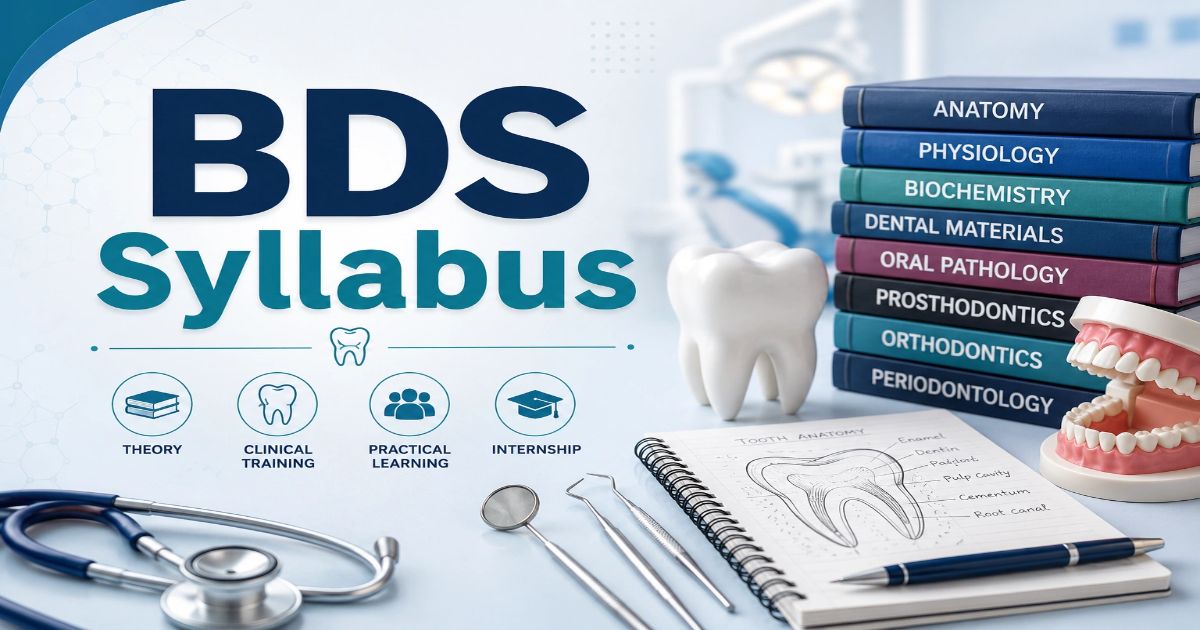
BDS syllabus is divided into 8 semesters across 4 years. Core subjects include Anatomy, Physiology, Biochemistry, Dental Materials, and progressive clinical Dentistry. Find semester-wise and year-wise syllabus here.
The BDS course subjects encompass a rigorous five-year curriculum designed to transform aspiring students into skilled dental professionals. From foundational medical sciences like Anatomy and Physiology to advanced clinical dentistry, the syllabus is meticulously structured to provide a holistic training. In 2026, the National Dental Commission (NDC) replaced the Dental Council of India (DCI) as the regulatory body for BDS. This article offers a comprehensive, year-wise breakdown of the core subjects, practical training components, and university-specific adaptations for the 2026 academic year.
BDS Course Syllabus 2026: Semester-wise Overview
The BDS program is structured over 8 semesters (4 academic years) + 1-year internship, gradually moving from basic medical sciences to advanced clinical dentistry with increasing patient exposure.
| 1st Semester | 2nd Semester |
| General Anatomy (including Embryology & Histology) | General Physiology & Biochemistry (including Nutrition & Dietetics) |
| Dental Anatomy, Embryology & Oral Histology | Dental Materials |
| Preclinical Prosthodontics & Crown and Bridge | Preclinical Prosthodontics & Crown and Bridge (continued / lab work) |
| 3rd Semester | 4th Semester |
| General Pathology & Microbiology | General & Dental Pharmacology & Therapeutics |
| Preclinical Conservative Dentistry | Oral Pathology & Oral Microbiology |
| Dental Pharmacology basics (integrated learning in some universities) | Preclinical Prosthodontics (continued in some colleges) |
| 5th Semester | 6th Semester |
| General Medicine | Oral & Maxillofacial Surgery |
| General Surgery | Oral Medicine & Radiology |
| Oral Pathology (advanced exposure in some curricula) | Orthodontics & Dentofacial Orthopedics |
| Conservative Dentistry & Endodontics (intro clinical exposure) | Pediatric & Preventive Dentistry |
| 7th Semester | 8th Semester |
| Orthodontics & Dentofacial Orthopedics | Prosthodontics & Crown and Bridge |
| Oral Medicine & Radiology | Conservative Dentistry & Endodontics |
| Pediatric & Preventive Dentistry | Periodontology |
| Periodontology | Oral & Maxillofacial Surgery (advanced clinical exposure) |
First Year BDS Subjects 2026: Anatomy, Physiology, Biochemistry Details
The first year BDS course subjects are designed to build a foundational understanding of medical and dental knowledge. This section details the core subjects, including Anatomy, Physiology, Biochemistry, and Dental Anatomy, preparing students for advanced concepts.
| Subject | Key Focus Area |
| General Human Anatomy (including Embryology & Histology) | Structure of the human body with emphasis on head & neck anatomy, embryological development, and basic histology relevant to dentistry |
| General Human Physiology & Biochemistry (including Nutrition & Dietetics) | Functions of human body systems (nervous, cardiovascular, muscular, etc.) and biochemical processes like metabolism, enzymes, and nutrition |
| Dental Anatomy, Embryology & Oral Histology | Tooth morphology, numbering systems, occlusion, development of teeth, and microscopic structure of oral tissues |
| Dental Materials | Properties, manipulation, and clinical use of materials like cements, impression materials, alloys, and restorative materials |
| Pre-clinical Prosthodontics & Crown and Bridge | Basic laboratory training in tooth carving, impressions, and preparation of prosthetic appliances |
People Also Read
Second Year BDS Subjects 2026: Pharmacology, Pathology, Microbiology Curriculum
Pharmacology is a core subject in BDS 2nd year, strengthening foundational medical knowledge and its application in dentistry. The BDS curriculum becomes more clinically oriented, introducing subjects like pathology, microbiology, pharmacology, and preclinical dental sciences that connect theory with hands-on training.
| Subject Name | Detailed Syllabus |
| General Pathology and Microbiology | Cell injury and adaptation. Inflammation, healing and repair. Immunology and hypersensitivity reactions. Neoplasia. Basic bacteriology, virology, and mycology. Sterilization and disinfection techniques. |
| General and Dental Pharmacology and Therapeutics | General principles of pharmacology. Drug action on various body systems. Analgesics, antibiotics, anti-inflammatory drugs. Local anesthetics, general anesthesia basics, drug interactions, adverse effects, and toxicity. |
| Dental Materials | Physical and chemical properties of dental materials. Impression materials, cements, alloys, acrylic resins, ceramics, and composites. Casting procedures, soldering, welding. Biocompatibility and manipulation techniques. |
| Preclinical Conservative Dentistry | Principles of cavity preparation. Tooth cutting and instrumentation techniques. Wax carving exercises. Basic restorative procedures and handling of restorative materials. |
| Preclinical Prosthodontics and Crown & Bridge | Basics of edentulous mouth. Impression techniques and cast preparation. Complete denture fabrication steps. Introduction to occlusion, retention, and stability concepts. |
Third Year BDS Subjects 2026: Oral Medicine, Surgery, Periodontology Syllabus
In the third year of the BDS course, students gain significant clinical exposure, observing real cases to enhance their understanding of patient care. This section details the core bds course subjects and learning areas introduced during this crucial stage of the curriculum.
| Subject Name | Detailed Syllabus |
| General Medicine | Cardiovascular, respiratory, gastrointestinal systems, Infectious diseases: tuberculosis, hepatitis, HIV. Diabetes, immunological and endocrine disordersMedical emergencies in a dental clinic |
| General Surgery | Basic surgical principles: Wound healing, inflammation, hemorrhage, Sterilization and suturing, Management of surgical infections, Maxillofacial trauma, and surgical procedures |
| Oral Pathology & Oral Microbiology | Oral mucosal lesions, Dental caries, pulp and periapical diseases, Odontogenic and non-odontogenic cysts and tumors, Salivary gland diseases, Benign and malignant oral neoplasms Oral cancer screening and biopsy |
| Public Health Dentistry (Community Dentistry) | Dental public health concepts, Epidemiology and survey methods, Water fluoridation, National health programs, School dental health, Field visits and camps |
Final Year BDS Subjects 2026: Prosthodontics, Orthodontics, Pedodontics Breakdown
In the final year of the BDS course, students focus on advanced clinical training and comprehensive patient care. The curriculum includes all major dental specialties, emphasizing diagnosis, treatment planning, and management of complex cases along with community dentistry exposure.
| Subject Name | Detailed Syllabus |
| Oral Medicine & Radiology | Diagnosis of oral diseases, oral mucosal lesions, temporomandibular joint disorders, radiographic techniques, interpretation of radiographs, and advanced imaging methods. |
| Oral & Maxillofacial Surgery | Exodontia, surgical principles, management of maxillofacial trauma, infections, cysts and tumors, biopsies, and basic hospital-based oral surgical procedures. |
| Conservative Dentistry & Endodontics | Diagnosis and management of dental caries, restorative procedures, cavity preparation, root canal treatment, and management of pulpal and periapical diseases. |
| Prosthodontics and Crown & Bridge | Complete and partial dentures, fixed partial dentures, crown preparation, occlusion concepts, impression techniques, and prosthetic rehabilitation. |
| Periodontology | Gingival and periodontal diseases, scaling and root planing, periodontal surgery, and maintenance of periodontal health. |
| Orthodontics & Dentofacial Orthopedics | Malocclusion diagnosis, growth and development, removable and fixed appliances, interceptive orthodontics, and treatment planning. |
| Paediatric & Preventive Dentistry | Dental care for children, preventive dentistry, fluoride therapy, pulp therapy in primary teeth, and behaviour management techniques. |
| Public Health Dentistry (Community Dentistry) | Dental public health principles, epidemiology, biostatistics basics, national oral health programs, preventive strategies, and community dental outreach programs. |
BDS Practical & Clinical Subjects 2026: Hands-on Training Components
The BDS program emphasizes hands-on training, integrating theory with extensive practical learning across its bds course subjects. This comprehensive approach builds essential clinical knowledge and treatment skills, preparing students for real-world dental practice and advanced studies through a structured progression of practical exposure.
- Hands-on Integration: The BDS program combines lectures with practical sessions in dental labs and clinical rotations.
- Early Practical Exposure (2nd Year): Second year connects theory with early practical exposure in Preclinical Prosthodontics and Conservative Dentistry.
- Clinical Exposure (3rd Year): Third year students gain more clinical exposure, observing real cases to improve patient care understanding.
- Advanced Clinical Practice (Final Year): Final year covers diagnosis, surgical treatment, replacing missing teeth, and restorative procedures.
- Internship (5th Year): A one-year mandatory rotating internship provides supervised clinical training in hospitals and clinics.
- Internship Benefits: Internship applies knowledge, improves confidence, practical skills, and understanding of clinic operations.
Throughout the bds course subjects, students develop core skills like clinical diagnosis, patient communication, and basic surgical procedures. Active lab practice is highly recommended to further improve clinical confidence and practical application.
Popular Elective Subjects for BDS Students
BDS electives are college-specific optional modules/workshops designed to enhance clinical exposure and allow students to explore specialized areas of dentistry beyond the core curriculum.
| Elective Subject | Focus Area | Availability / Notes |
| Oral Implantology | Basics of dental implants, case selection, implant procedures, and complication management | Offered in select universities / advanced clinical modules |
| Forensic Odontology | Dental identification, bite marks, age estimation, and legal aspects of dentistry | Common elective/workshop in final year |
| Laser Dentistry | Use of lasers in soft tissue and restorative dental procedures | Skill-based advanced training elective |
| Aesthetic / Cosmetic Dentistry | Smile design, bleaching, veneers, and cosmetic restorations | Offered in modern clinical dentistry programs |
| Dental Ethics & Jurisprudence | Professional ethics, patient consent, legal responsibilities, malpractice laws | Theory-based elective in some universities |
| Behavioural Sciences | Patient psychology, communication skills, anxiety management in dental care | Integrated or optional module in some curricula |
| Geriatric Dentistry | Dental care for elderly patients, age-related oral health issues | Emerging elective in some institutions |
| Public Health Dentistry (Advanced Modules) | Community dentistry, epidemiology, preventive programs, outreach work | Sometimes offered as elective extension |
| Orthodontic / Preventive Mini-Modules | Basics of alignment, interceptive orthodontics, preventive strategies | Usually short-term clinical exposure modules |
Popular Books for BDS
BDS students typically rely on a small set of standard core textbooks that are widely accepted across Indian dental colleges and follow the DCI curriculum.
| Subject | Book Name | Author |
| General Anatomy | BD Chaurasia’s Human Anatomy | B.D. Chaurasia |
| Physiology | Textbook of Medical Physiology | Guyton & Hall |
| Physiology (BDS-focused alternative) | Essentials of Medical Physiology | K. Sembulingam |
| Biochemistry | Biochemistry | U. Satyanarayana |
| Dental Anatomy | Wheeler’s Dental Anatomy, Physiology & Occlusion | Ash & Nelson |
| General Pathology | Robbins Basic Pathology | Kumar, Abbas & Aster |
| Microbiology | Ananthanarayan & Paniker’s Textbook of Microbiology | Paniker & Ananthanarayan |
| Pharmacology | Essentials of Medical Pharmacology | K.D. Tripathi |
| Dental Materials | Phillips’ Science of Dental Materials | Anusavice |
| Oral Pathology | Shafer’s Textbook of Oral Pathology | Shafer, Hine & Levy |
| General Medicine | Davidson’s Principles & Practice of Medicine | Davidson |
| General Surgery | Bailey & Love’s Short Practice of Surgery | Williams et al. |
| Periodontology | Carranza’s Clinical Periodontology | Carranza |
| Orthodontics | Contemporary Orthodontics | William R. Proffit |
| Prosthodontics | Textbook of Prosthodontics | Zarb / Stewart |
Exam Pattern for BDS Students (India, 2026)
The BDS program in India follows a year-wise professional examination system, with each subject carrying equal weightage and combining theory, practical/clinical training, and internal assessment.
Overall Structure
| Component | Structure | Marks Distribution |
| University Written Exam (Theory) | 3-hour paper with descriptive + short answer + MCQs (varies slightly by university) | 70 marks |
| Viva Voce (Oral Examination) | Subject-based oral questioning by external/internal examiners | 20 marks |
| Internal Assessment (Theory) | Periodic tests, assignments, attendance, class performance | 10 marks |
| Practical / Clinical Exam | Hands-on clinical/lab-based evaluation (patient-based or simulation) | 90 marks |
| Internal Assessment (Practical) | Continuous evaluation during practical training | 10 marks |
| Total per Subject | — | 200 marks |
Year-wise Structure
| Year | Subjects | Total Marks |
| 1st BDS | Anatomy, Physiology, Biochemistry, Dental Anatomy | 600 |
| 2nd BDS | Pathology, Microbiology, Pharmacology, Dental Materials, Preclinical Dentistry | 800 |
| 3rd BDS | General Medicine, General Surgery, Oral Pathology, Community Dentistry | 600 |
| Final (4th) BDS | All major clinical dental specialties | 1600 |
Frequently Asked Questions
1. What are the core subjects in BDS?
BDS curriculum under the Bachelor of Dental Surgery focuses on foundational sciences like Anatomy, Physiology, Biochemistry, Dental Materials, and progressive clinical Dentistry training across all academic years and internship.
2. How is BDS syllabus structured year-wise?
The BDS syllabus is structured over four academic years plus internship, regulated by National Dental Commission and formerly Dental Council of India, progressing from basic to advanced clinical Dentistry.
3. What subjects are taught in BDS 2nd year?
Second-year BDS includes Pathology, Microbiology, Pharmacology, Dental Materials, and Preclinical Conservative Dentistry, building strong medical foundations and introducing laboratory-based dental practice and early clinical skill development.
4. Do BDS students get practical training?
Yes, BDS students receive extensive practical training through preclinical labs, clinical postings, hospital exposure, and a mandatory internship, ensuring real-world experience in Dentistry and patient management skills.
5. Which regulatory body controls BDS curriculum?
The BDS curriculum is currently regulated by National Dental Commission, which replaced the Dental Council of India, ensuring updated standards and uniformity in dental education across India.
BDS Course Subjects 2026 – Frequently Asked Questions
What is the duration and structure of the BDS course for 2026?
The BDS course for 2026 is designed for 5 years, which includes 4 years of academic study followed by a 1-year internship. This comprehensive structure covers theory, practicals, seminars, and clinical training to provide in-depth knowledge of oral healthcare.
How can I find the detailed BDS syllabus for 2026?
You can explore the comprehensive BDS syllabus and subjects for 2026, including year-wise and semester-wise lists, on various education portals. Some sources also offer a download option for Top Colleges Syllabus PDF.
What details are important regarding BDS admission for 2026?
For BDS admission in 2026, it is important to check the eligibility criteria and understand the admission process, which may include entrance exams. Information about top colleges, course fees, and career scope is also available.
How do BDS course fees vary in India for 2026?
BDS course fees in India for 2026 vary widely depending on the type of college. Fees differ significantly between government, private, and deemed universities across the country.
Does the BDS course include an internship component?
Yes, the BDS course structure includes a mandatory 1-year internship as part of its 5-year duration. This internship provides essential training and is a key component of the full dental course structure.