Aerospace vs Aeronautical Engineering: Key Distinctions for 2026 Career Paths
Aeronautical Engineering is a 4-yr UG course focusing on designing and building aircrafts. While Aerospace Engineering is a broader 4-yr UG course focusing on both atmospheric and extraterrestrial vehicles. Compare their fees, syllabus, salaries and more here.
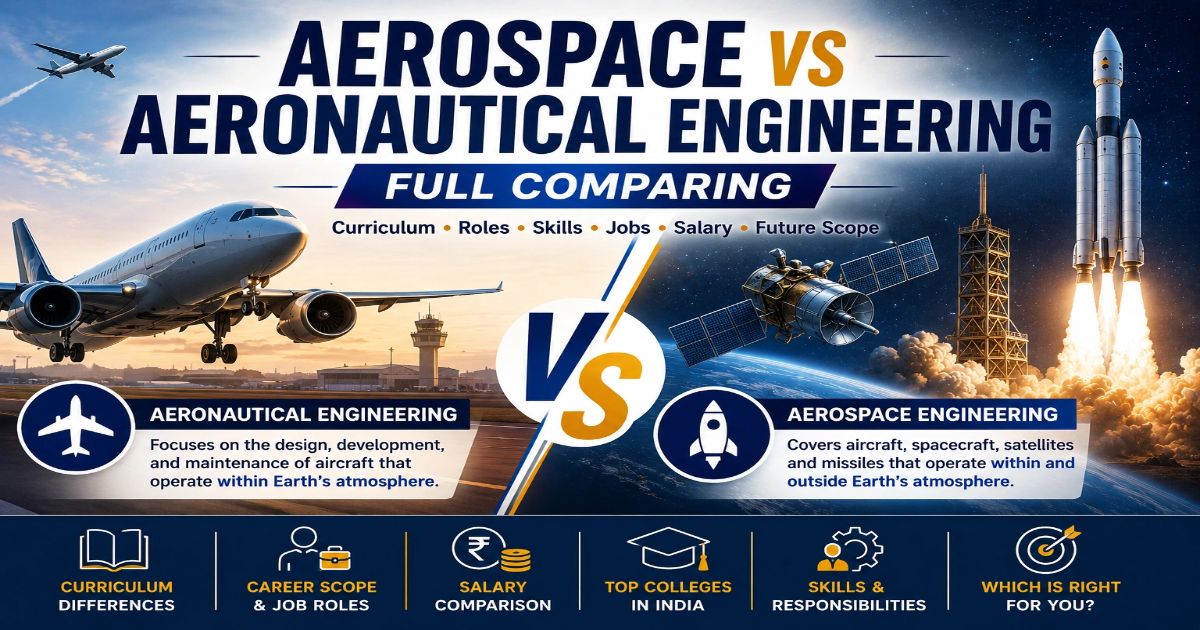
The core distinction in aerospace vs aeronautical engineering lies in their operational domains. Aeronautical engineers design and build aircraft for atmospheric flight, while aerospace engineers encompass both atmospheric and extraterrestrial vehicles. This fundamental difference dictates specialized knowledge in areas from aerodynamics to orbital mechanics. Understanding this divergence is vital for students planning their 2026 career paths, and this article will detail the curriculum, roles, and job market for each field.
Aerospace vs Aeronautical Engineering: Core Distinctions Explained 2026
This section clarifies the core distinctions between aerospace vs aeronautical engineering, two closely related but distinct fields. While both deal with flight, their primary focus areas and operational scopes differ significantly, impacting career paths and specializations within the industry.
| Category | Aeronautical Engineering | Aerospace Engineering |
| Definition | Focuses on aircraft that operate within Earth’s atmosphere. | Covers aircraft, spacecraft, satellites, and missiles. |
| Core Distinction | A narrower field limited to atmospheric flight. | A broader field that includes aeronautical engineering. |
| Operational Scope | Works on airplanes, helicopters, drones, and missiles used in the atmosphere. | Works on aircraft as well as rockets, satellites, and spacecraft. |
| Program Duration | Usually a 4-year undergraduate course. | Usually a 4-year undergraduate course. |
| Eligibility (Class 12) | Generally requires 70–75% in PCM and JEE Main/Advanced at top colleges. | Usually requires at least 60% in PCM; some colleges accept 55% for reserved categories. |
| Top Colleges | Hindustan Institute of Technology and Science, Chandigarh University, School of Aeronautics, and other colleges offering dedicated Aeronautical Engineering programs. | IIT Bombay, IIT Kanpur, IIT Madras, IIST Thiruvananthapuram, and other top institutes offering Aerospace Engineering. |
| Key Skills | Accuracy, analytical thinking, problem-solving, and attention to detail. | Strong maths, scientific aptitude, observation, and problem-solving skills. |
| Job Responsibilities | Designs, tests, and maintains aircraft and related systems. | Designs, tests, and develops aircraft, spacecraft, and space systems. |
| Fresher Salary in India | Around ₹5–11 LPA. | Around ₹6–12 LPA. |
| India Market Status | Strong demand due to India’s fast-growing aviation sector. | Growing scope due to ISRO, defence, and private space companies. |
| Top Recruiters | HAL, NAL, DRDO, ISRO, airlines, and MRO firms. | ISRO, DRDO, HAL, Boeing, Airbus, and space-tech companies. |
| Best For | Students interested mainly in aircraft and aviation. | Students interested in both aviation and space technology. |
Atmospheric vs Space Flight: Aeronautical vs Aerospace Engineering Focus
While aeronautical engineering is confined to atmospheric flight, aerospace engineering encompasses a broader domain, including both atmospheric and space flight, reflecting its wider scope and more complex environments.
| Aspect | Aeronautical Engineering | Aerospace Engineering |
| Scope | Focuses on aircraft that fly within Earth’s atmosphere | Covers both aircraft (aeronautics) and spacecraft (astronautics) |
| Primary Focus | Design, development, and testing of aeroplanes and helicopters | Includes both atmospheric and space flight technologies |
| Key Areas of Study | Aerodynamics, propulsion, flight mechanics, structural design | Aerodynamics, propulsion, avionics, orbital mechanics, space systems |
| Work Environment | Aviation companies, defence, airlines, aircraft manufacturers | Aviation, defence, and space agencies (like ISRO, NASA, SpaceX) |
| Examples of Vehicles | Commercial jets, fighter planes, helicopters | Satellites, rockets, spacecraft, jets, and space stations |
| Typical Employers | Boeing, Airbus, Indian Air Force | NASA, ISRO, SpaceX, DRDO, Boeing, Airbus |
| Complexity of Environment | Deals with stable atmospheric conditions | Deals with both atmospheric and outer space environments |
Aeronautical Engineer vs Aerospace Engineer: Daily Roles and Responsibilities
Both roles involve designing and testing flight systems. The key difference is scope: aeronautical engineers focus on aircraft within Earth’s atmosphere, while aerospace engineers may also work on spacecraft, rockets, and satellites:
| Responsibility Area | Aeronautical Engineer | Aerospace Engineer |
| Primary Focus | Works on aircraft used in the atmosphere. | Works on aircraft, spacecraft, and satellites. |
| Design Work | Designs aircraft structures, engines, and control systems. | Designs aircraft, spacecraft, rockets, and satellite systems. |
| Testing | Tests aircraft performance, safety, and fuel efficiency. | Tests aerospace systems for performance, safety, and reliability. |
| Maintenance & Upgrades | Improves aircraft performance and fixes system issues. | Refines aerospace systems, materials, and designs. |
| Research Work | Studies aerodynamics, aircraft materials, and flight safety. | Researches propulsion, space systems, and advanced aerospace tech. |
| Daily Tools Used | Uses CAD, simulation software, and aircraft testing data. | Uses CAD, simulation tools, structural analysis, and mission data. |
| Safety & Compliance | Ensures aircraft meet aviation and environmental standards. | Ensures systems meet engineering, mission, and safety standards. |
| Production Support | Works with aircraft manufacturing and maintenance teams. | Works with design, testing, and manufacturing teams. |
| Problem-Solving Tasks | Diagnoses aircraft faults and improves performance. | Solves issues in propulsion, structures, and system integration. |
| Typical Workplaces | Airlines, aircraft manufacturers, MRO firms, and defence aviation. | Aerospace companies, defence firms, research labs, and space agencies. |
| Examples of Daily Work | Reviewing aircraft designs, test reports, and repair needs. | Running simulations, testing prototypes, and reviewing system performance. |
B.Tech/B.E. Curriculum Differences: Aeronautical vs Aerospace Engineering 2026
Both Aeronautical and Aerospace Engineering B.Tech/B.E. programs span four years and eight semesters, sharing foundational subjects like Physics and Mathematics. This section details their curriculum distinctions, highlighting the specialized modules that differentiate aerospace vs aeronautical engineering studies.
| Course Aspect | Aeronautical Engineering | Aerospace Engineering |
| Program Duration | 4 years | 4 years |
| Number of Semesters | 8 semesters | 8 semesters |
| Common Foundational Subjects | Physics, Mathematics, Thermodynamics | Physics, Mathematics, Thermodynamics |
| Core Focus Areas | Aerodynamics, propulsion, aircraft structures, avionics, flight mechanics | Includes aerodynamics and propulsion, plus orbital mechanics, spacecraft design, and re-entry systems |
| Practical Training | Regular lab work, projects, and aircraft-related practical sessions | Includes practical training; some programs may dedicate a semester to live-environment training |
Job Market & Salary Comparison: Aeronautical vs Aerospace Engineering 2026
Both fields offer opportunities in aviation, defence, and R&D, but aerospace engineering generally has a broader job market because it spans both aircraft and space systems.
| Category | Aeronautical Engineering | Aerospace Engineering |
| Core Job Market | Focused on aviation, aircraft manufacturing, MRO, and defence aviation. | Covers aviation, defence, drones, satellites, and space-tech roles. |
| Industry Scope | Narrower, as it is limited mainly to aircraft and atmospheric systems. | Broader, as it includes both aircraft and spacecraft sectors. |
| Main Hiring Sectors | Airlines, aircraft OEMs, MRO companies, defence aviation, and aviation safety. | Aerospace manufacturing, defence, ISRO-linked roles, UAV/drone firms, and private space companies. |
| Top Recruiters in India | HAL, NAL, Air India Engineering Services, Indigo-linked maintenance firms, DRDO, and private MRO players. | ISRO, DRDO, HAL, Boeing India, Airbus India, Collins Aerospace, and private space-tech firms. |
| Fresher Salary in India | Usually around ₹3.5–6 LPA; stronger profiles may reach ₹6–8 LPA. | Usually around ₹5–12 LPA; top offers can go higher in specialised roles. |
| Mid-Career Salary | Often ranges from ₹6–12 LPA, depending on role and employer. | Commonly ranges from ₹12–22 LPA in private aerospace, defence, and advanced design roles. |
| Senior-Level Salary | Can rise to ₹20–30+ LPA in specialised or leadership roles. | Can reach ₹25–45+ LPA, especially in senior R&D, defence, or space roles. |
| Job Availability in India | Strongest in aviation hubs with airlines, maintenance, and defence demand. | Growing due to India’s space push, defence manufacturing, drones, and satellite ecosystem. |
| Best Locations | Bengaluru, Hyderabad, Chennai, Pune, and Delhi NCR. | Bengaluru, Hyderabad, Pune, Chennai, and emerging defence corridors. |
| Growth Outlook | Good for students targeting aviation, aircraft maintenance, and defence aviation. | Better long-term growth due to expansion in aerospace, drones, and space-tech. |
Choosing Your Path: Aeronautical vs Aerospace Engineering for 2026 Careers
Aeronautics and Aerospace Engineering are distinct fields, varying in education, career opportunities, and pay scale. This section details the key differences between aerospace vs aeronautical engineering, helping aspiring engineers choose their path for 2026 careers based on their interests and career aspirations.
| Factor | Aerospace Engineering | Aeronautical Engineering |
| Scope | Aircraft and Spacecraft | Aircraft Only |
| Focus Area | Aviation and Space Technology | Aviation Technology |
| Industry Coverage | Aviation, Space, Defense | Aviation and Defense |
| Curriculum Scope | Broader | More Specialized |
| Space Technology | Included | Limited |
| Satellite Systems | Included | Usually Not Included |
| Rocket Technology | Included | Minimal Exposure |
| Career Flexibility | High | Moderate |
| Research Opportunities | Extensive | Good |
| International Opportunities | Very High | High |
| Future Scope | Excellent | Strong |
| Salary Potential | Higher | Competitive |
Frequently Asked Questions
Is there a significant difference in salaries between aerospace and aeronautical engineering?
Yes, aerospace engineering usually offers a slightly higher salary range because it covers both aviation and space sectors. In India, fresher aerospace salaries often start above aeronautical roles.
Do aerospace engineers earn more due to the broader scope of their field?
Often, yes. Aerospace engineers can access jobs in aircraft, spacecraft, satellites, drones, and defence systems, which expands role options and can improve salary growth over time.
Are there specific industries where aerospace engineers tend to earn more?
Yes. Aerospace engineers often earn more in space-tech, defence R&D, satellite systems, UAV/drone firms, and private aerospace manufacturing, especially in specialised design, propulsion, and systems roles.
Which branch has better job scope in India: aeronautical or aerospace engineering?
Aerospace engineering generally offers wider scope because it covers both aircraft and space-related roles. Aeronautical engineering remains strong in aviation, MRO, airlines, and defence aircraft sectors.
Is aeronautical engineering only for students who want to work with aircraft?
Mostly yes. Aeronautical engineering is best for students interested in aircraft design, flight systems, aviation maintenance, and atmospheric flight technologies rather than spacecraft or orbital systems.
Can aeronautical engineers work in the aerospace sector?
Yes. Aeronautical engineers can work in aerospace companies, especially in aircraft design, structures, propulsion, testing, and maintenance roles, though spacecraft-focused jobs may favour aerospace specialisation.