Scope of Aerospace Engineering in India (2026): Jobs, Salary, Top Recruiters & Future
Aerospace Engineering offers a wide scope due steady market growth and future projections. Indian Aerospace Engineers can expect competitive salaries from Rs. 6-12 lakhs annually.
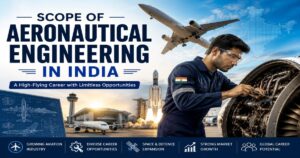
Aerospace engineers in India can expect an average annual salary ranging from ₹6,00,000 to ₹12,00,000 in 2026, driven by a global market projected to reach $62.5 billion. This robust growth, particularly in aviation and space, ensures strong career prospects and around 4,500 annual job openings. Top job roles for Aerospace Engineering graduates in India include Aerospace Design Engineer, Propulsion Systems Engineer, Avionics Engineer, Flight Test Engineer and more. Companies like Boeing, Airbus, HAL, ISRO and others hire Aerospace Engineers with competitive packages. When pursued from a top-tier college, aerospace engineering can offer excellent ROI. Find the complete scope of Aerospace Engineering in this article with top job roles, key colleges, comparison with other fields and more.
Aerospace Engineering Career Outlook 2026: Key Trends & Growth Drivers
The aerospace engineering field is projected to experience robust growth, with the global market reaching around 62.5 billion US dollars by 2026. This dynamic sector, covering aviation, defense, and space, offers promising career prospects.
- Global Market Projection: Around 62.5 billion US dollars by 2026, with steady growth.
- US Job Growth (2024-2034): About 6 percent, faster than average for all occupations.
- US Annual Job Openings: Around 4,500 positions projected per year.
- Field Dynamics 2026: Dynamic, covering aviation, defense, satellites, space exploration, autonomous systems.
- Global Air Traffic Outlook: Expected to double in next decade, strengthening job prospects.
- Required Skills: Blend core engineering with AI, software, and systems thinking.
The robust market and job growth indicate that an aerospace engineer is a good career choice, driven by significant technological advancements and strategic industry expansion. Key trends and specific growth drivers further underscore this positive outlook.
Top Career Paths & Job Roles in Aerospace Engineering for 2026
Aerospace engineering offers diverse and impactful career paths. Professionals contribute to designing, developing, and maintaining advanced aircraft and spacecraft systems, with roles spanning from conceptual design to operational support.
| Job Role | Job Description | Key Recruiters | Salary Range (Approx.) |
|---|---|---|---|
| Aerospace Design Engineer | Designs aircraft/spacecraft structures using CAD, simulations, and testing to ensure performance, safety, and efficiency. | Boeing, Airbus, Hindustan Aeronautics Limited (HAL) | India: ₹6–18 LPA; Global: $70K–120K+ |
| Propulsion Systems Engineer | Works on jet engines, rocket propulsion, and thrust systems for aircraft and spacecraft performance. | ISRO, GE Aerospace, Rolls-Royce | India: ₹6–20 LPA; Global: $75K–130K+ |
| Avionics Engineer | Develops and maintains electronic systems like navigation, communication, autopilot, and control systems. | Honeywell, Boeing, DRDO | India: ₹5–15 LPA; Global: $70K–120K+ |
| Flight Test Engineer | Tests aircraft performance, safety, and compliance by analyzing real-flight data and system behavior. | Airbus, Boeing, ISRO | India: ₹7–18 LPA; Global: $80K–140K+ |
| Aerodynamics Engineer | Studies airflow, lift, drag, and stability to improve aircraft efficiency and fuel performance. | Lockheed Martin, Airbus, DRDO | India: ₹6–16 LPA; Global: $75K–125K+ |
| Satellite Systems Engineer | Designs and manages satellite systems for communication, navigation, Earth observation, and space missions. | ISRO, SpaceX, NASA | India: ₹7–20 LPA; Global: $85K–150K+ |
| Aircraft Maintenance Engineer (AME) | Ensures aircraft safety through inspection, servicing, troubleshooting, and regulatory compliance. | IndiGo, Air India, SpiceJet | India: ₹4–10 LPA; Global: $50K–90K+ |
| Aerospace Project Manager | Manages aerospace projects including budgeting, scheduling, engineering coordination, and delivery. | Boeing, Airbus, ISRO | India: ₹10–30 LPA; Global: $100K–180K+ |
| Research Scientist (Aerospace) | Works on advanced R&D in propulsion, AI in aviation, reusable rockets, and next-gen aerospace tech. | ISRO, NASA, Lockheed Martin | India: ₹8–25 LPA; Global: $90K–160K+ |
| Aerospace Industry (Broader Scope) | Includes defense tech, UAVs, autonomous systems, spacecraft design, and aviation innovation sectors. | DRDO, Boeing, Airbus | Highly variable based on role |
People Also Read



Pros and Cons of an Aerospace Career: Real-World Insights for 2026
Aerospace engineering is a high-impact but demanding field that combines innovation in aviation and space with strong technical responsibility and long-term career growth.
| Pros | Cons |
|---|---|
| Competitive salaries, especially with higher qualifications and experience in global aerospace markets. | Long educational pathway (B.Tech + possible M.Tech/PhD + certifications) required to reach top roles. |
| Opportunity to work on high-impact innovations in aviation, defense, and space exploration. | Highly competitive job market, especially for top companies and space agencies. |
| Global career mobility across airlines, aerospace firms, and space organizations. | High responsibility roles where safety-critical decisions add significant pressure. |
| Diverse sectors including commercial aviation, space missions, UAVs, and defense systems. | Continuous skill upgrading needed due to fast-changing aerospace technologies. |
| Strong societal impact through safer air travel, satellite systems, and space exploration. | Irregular working hours during testing, launches, or project deadlines. |
| Transferable technical skills applicable to AI, robotics, automotive, and defense industries. | Complex technical challenges requiring strong analytical and mathematical ability. |
| Collaborative, multidisciplinary work environment with engineers, scientists, and researchers. | Regional imbalance in opportunities, with fewer high-end roles in some locations. |
| Exposure to cutting-edge research and advanced engineering tools and simulations. | Work environments vary widely (labs, factories, test sites), sometimes involving high stress conditions. |
Aerospace Engineering ROI: Placement vs Fees
Aerospace Engineering offers a moderate to strong ROI in India, but it is highly college-dependent, meaning top institutes deliver excellent returns while private colleges often show lower placement efficiency relative to fees.
| College / Category | Total BTech Fees (Approx.) | Average / Median Placement (LPA) | ROI Insight |
|---|---|---|---|
| Indian Institute of Space Science and Technology (IIST) | ₹6–8 lakh | ₹11–12 LPA median (up to ₹38.5 LPA highest) | Very high ROI due to strong ISRO-linked ecosystem and low fees |
| IITs (IIT Bombay, IIT Madras, IIT Kanpur, etc.) | ₹8–12 lakh | ₹17–25 LPA average (varies by IIT) | Excellent ROI due to high global placement packages |
| Top NITs / Govt colleges | ₹6–10 lakh | ₹10–16 LPA average | Good ROI with stable PSU + private aerospace placements |
| Mid-tier private engineering colleges | ₹8–15 lakh | ₹5–10 LPA average | Moderate to low ROI, depends heavily on student skill |
| Lower-tier private colleges | ₹10–20+ lakh | ₹3–6 LPA average (often non-core roles) | Low ROI, majority shift to IT/services sector |
Top Aerospace Engineering Colleges in India
India offers a mix of IITs, specialized space institutes, and premier engineering colleges that provide strong aerospace engineering programs with admissions mainly through national-level entrance exams like JEE Advanced and JEE Main.
| College Name | Location | Course Fees (Approx.) | Eligibility |
|---|---|---|---|
| Indian Institute of Technology Bombay (IIT Bombay) | Mumbai, Maharashtra | ₹8–10 lakh | 10+2 with PCM + JEE Advanced qualification |
| Indian Institute of Technology Madras (IIT Madras) | Chennai, Tamil Nadu | ₹8–10 lakh | 10+2 with PCM + JEE Advanced qualification |
| Indian Institute of Technology Kanpur (IIT Kanpur) | Kanpur, Uttar Pradesh | ₹8–10 lakh | 10+2 with PCM + JEE Advanced qualification |
| Indian Institute of Technology Kharagpur (IIT Kharagpur) | Kharagpur, West Bengal | ₹9–11 lakh | 10+2 with PCM + JEE Advanced qualification |
| Indian Institute of Space Science and Technology (IIST) | Thiruvananthapuram, Kerala | ₹5–8 lakh | 10+2 with PCM + JEE Advanced qualification |
| National Institute of Technology (NIT Trichy – related aero programs) | Tiruchirappalli, Tamil Nadu | ₹5–7 lakh | 10+2 with PCM + JEE Main + JoSAA counselling |
| PEC University of Technology (PEC Chandigarh) | Chandigarh | ₹6–8 lakh | 10+2 with PCM + JEE Main |
| SRM Institute of Science and Technology | Chennai, Tamil Nadu | ₹12–16 lakh | 10+2 with PCM + SRMJEEE / direct admission |
| Manipal Institute of Technology | Manipal, Karnataka | ₹13–19 lakh | 10+2 with PCM + MET entrance exam |
| Amrita Vishwa Vidyapeetham | Coimbatore, Tamil Nadu | ₹10–14 lakh | 10+2 with PCM + entrance exam/merit-based admission |
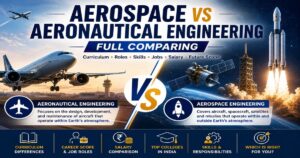
Aerospace vs. Aeronautical Engineering: Which Path is Better in 2026?
Aerospace engineering presents a compelling career path with better opportunities and salary packages compared to aeronautical engineering. This section explores its broad scope, promising job growth, and significant salary potential, helping you decide.
- Overall Career Recommendation: Aerospace engineering offers better opportunities and salary packages than aeronautical engineering.
- Aerospace Engineering Scope: Broader, covering aircraft and spacecraft both within and outside Earth’s atmosphere.
- Aeronautical Engineering Scope: Narrower, focusing solely on aircraft operating within Earth’s atmosphere.
- Aerospace Engineering India Salary: Rs. 4-8 LPA (Entry Level), Rs. 20 lakh and above (Senior)
- US Job Growth (2024-2034): Expected to grow by about 6 percent, faster than average.
- US Median Salary (2024): Aerospace engineers earn a median salary of 134,830 US dollars.
- Global Market Projection (2026): Projected to reach around 62.5 billion US dollars.
Succeeding as an Aerospace Engineer: Essential Skills & Education 2026
A successful aerospace engineering career requires a strong academic foundation combined with technical expertise, soft skills, and continuous exposure to emerging technologies like AI and advanced simulation systems.
| Category | Details |
|---|---|
| Required Degree (Foundational) | Bachelor’s degree in Aerospace Engineering or a related field such as Mechanical or Aeronautical Engineering. |
| Required Degree (Advanced Roles) | Master’s degree for specialization in areas like avionics, propulsion systems, space systems, or aerodynamics. |
| Core Coursework | Fluid dynamics, thermodynamics, propulsion systems, materials science, mathematics, and physics. |
| Essential Technical Skills | CAD design, simulation tools, data analysis, AI integration, materials engineering, and propulsion system understanding. |
| Essential Soft Skills | Communication, teamwork, problem-solving, and interdisciplinary collaboration. |
| Future Skill Requirements (2026) | Integration of AI, software development, systems engineering, and digital twin technologies in aerospace workflows. |
| Practical Experience | Internships, research projects, lab work, and hands-on exposure to aircraft/space systems are critical. |
| Certifications | Industry-recognized certifications such as FAA-related certifications or equivalent aviation authority programs. |
| Competitive Electives | Computer programming, project management, robotics, and emerging aerospace technologies. |
| Leading Indian Institutions | Indian Institute of Space Science and Technology (IIST), IITs, and institutes like Western India Institute of Aeronautics (WIIA). |
Future Trends in Aerospace Engineering: Space Exploration & Aviation 2026
The aerospace engineering market is projected to reach around 62.5 billion US dollars globally by 2026. With US job growth projected at 6 percent through 2034, this section explores key trends and factors shaping future careers in the field.
- Global Market 2026: Projected around 62.5 billion US dollars.
- US Job Growth (2024-2034): About 6 percent, faster than average.
- US Annual Openings: Around 4,500 jobs projected annually.
- Future Trends: Electric/hybrid propulsion, AI design, autonomous drones, satellite constellations, commercial space.
- 2026 Scope: Aviation, defense, satellites, space exploration, autonomous systems, AI tools.
- India Demand: Rapidly growing with government and private initiatives.
Frequently Asked Questions
What are the primary job roles available for Aerospace Engineers in India by 2026?
By 2026, Aerospace Engineers in India can expect roles in aircraft design and analysis, propulsion systems, avionics, maintenance, repair, and overhaul (MRO), and increasingly in drone technology and space exploration projects. Opportunities will span both public sector organizations like ISRO and DRDO, and private aerospace companies.
What is the expected salary range for an entry-level Aerospace Engineer in India in 2026?
An entry-level Aerospace Engineer in India in 2026 can expect an average annual salary ranging from ₹4.5 LPA to ₹8 LPA, depending on the recruiting company, specific role, and the candidate’s academic institution and skills.
Which are the top recruiters for Aerospace Engineers in India by 2026?
Leading recruiters for Aerospace Engineers in India by 2026 will include government entities like ISRO, DRDO, and HAL, alongside private players such as Tata Advanced Systems, Mahindra Aerospace, L&T Technology Services, and various MRO firms and international aerospace giants with Indian operations.
What is the future scope and growth potential for Aerospace Engineers in India towards 2026 and beyond?
The future scope is robust, driven by ‘Make in India’ initiatives, increasing defense spending, growth in commercial aviation, and advancements in space technology and UAVs. Engineers can anticipate significant growth in R&D, manufacturing, and specialized services, with opportunities for rapid career progression in niche areas.
What specialized skills will be most in demand for Aerospace Engineers in India by 2026?
In-demand specialized skills by 2026 will include proficiency in advanced simulation software (e.g., ANSYS, CATIA), knowledge of additive manufacturing, data analytics, AI/ML applications in aerospace, and expertise in composite materials and unmanned aerial systems (UAS) design and operation.