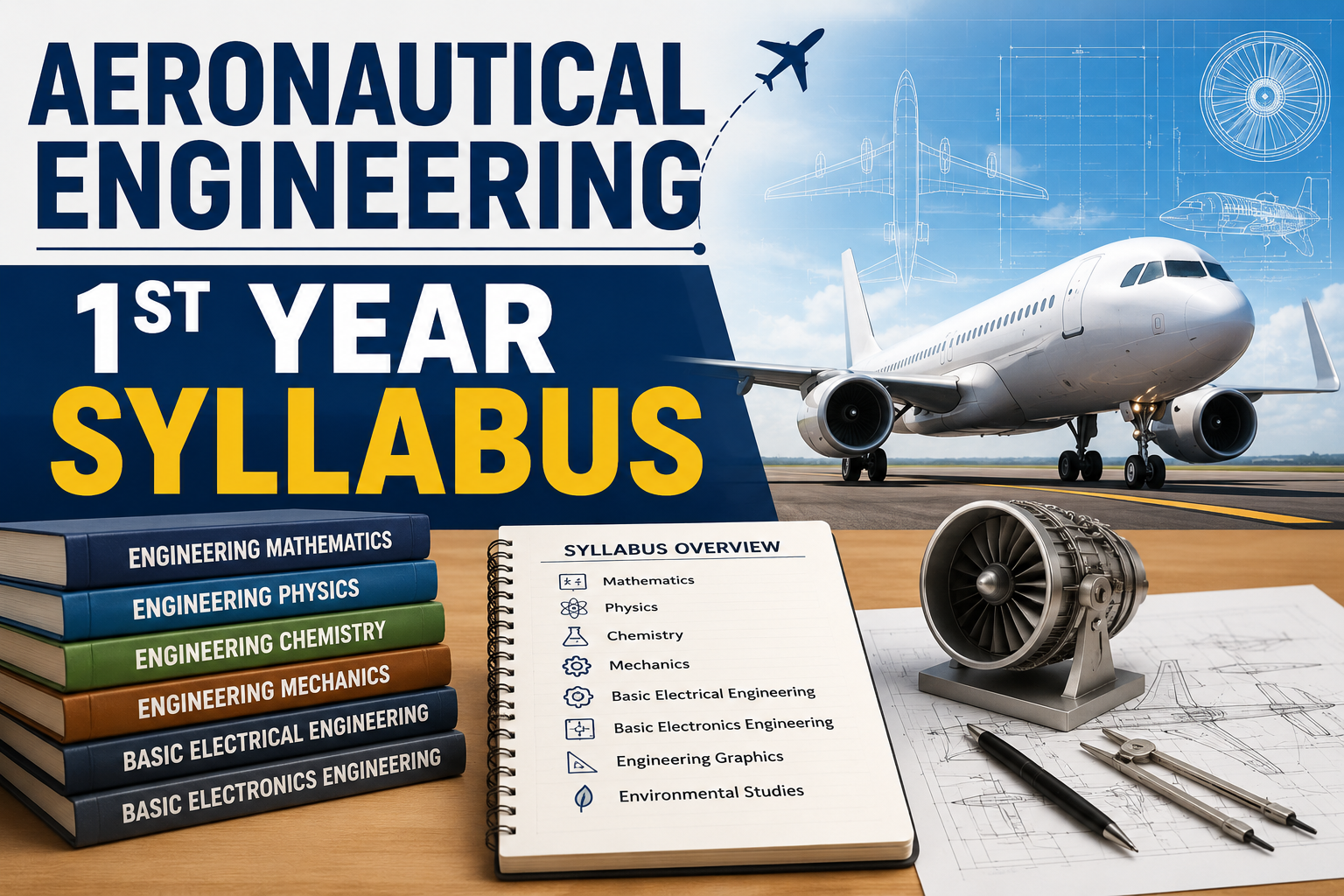
Aeronautical Engineering 1st Year Syllabus: Core Subjects & Curriculum 2026
Aayush is a writer and content strategist who turns personal stories into brand narratives. With an experience spanning diverse industries, rely on his writing for simplifying complex subjects…
Understand the Aeronautical Engineering 1st year syllabus with core subjects, evaluation process and more in this article.
The Aeronautical Engineering Subjects In 1st Year typically lay a robust foundation, blending core engineering principles with essential mathematics and physics to prepare students for the complexities of flight. Aeronautical engineering fees typically range from Rs. 3-24 lakhs, depending on institution type, location and other factors. Students can expect to delve into areas like Engineering Mechanics, Basic Electrical and Electronics Engineering, and advanced calculus, alongside introductory courses specific to aerospace concepts. This article will guide you through the detailed curriculum, practical components, and preparation strategies for your inaugural year in aeronautical engineering.
Core Aeronautical Engineering Subjects in 1st Year (Semesters 1 & 2) 2026
The first year of an Aeronautical Engineering program typically spans two semesters, with examinations occurring semester-wise. Students can expect to study 6-7 subjects per semester. The specific Aeronautical Engineering Subjects In 1st Year may vary across different universities in India.
| Semester | Set 1 Subjects | Set 2 Subjects |
| Semester I / First Semester | Mathematics 1
Physics 1 Chemistry Basics of Mechanics Civil Engineering Basics Aeronautics and aviation Communicative English Practical Lab |
Engineering Mathematics-I
Professional Communication Skills Basic Electrical Engineering, Engineering Physics Introduction to Aerospace Engineering Basic Electrical Laboratory Engineering Physics Laboratory Computer Programming (Theory + Laboratory) |
| Semester II / Second Semester | Mathematics 2
Physics 2 Material Science Thermodynamics Basics of Electronics Engineering Environmental Engineering Practical Lab |
Engineering Physics II
Materials Science and Metallurgy Chemistry Laboratory Engineering Chemistry Engineering Mechanics Environmental Studies Engineering Maths – II Basic Electronics Engineering (Theory+Lab) |
Foundational Science & Mathematics for Aeronautical Engineering 1st Year 2026
First-year Aeronautical Engineering subjects in India encompass a broad range of foundational science and mathematics. These core subjects are crucial for building a strong base in various engineering disciplines, with specific curricula varying across different universities and academic semesters.
| Category | Subjects Covered (Sem I + Sem II + Syllabus 2) |
| Maths | Mathematics I, Mathematics II, Engineering Mathematics I, Engineering Mathematics II |
| Science & Engineering Fundamentals | Physics I, Physics II, Engineering Physics I & II, Chemistry, Engineering Chemistry, Material Science, Metallurgy, Basics of Mechanics, Engineering Mechanics, Thermodynamics, Basic Electrical Engineering, Basic Electronics Engineering, Computer Programming (Theory + Lab), Environmental Engineering & Environmental Studies, Chemistry Lab, Physics Lab, Electrical Lab |
B.Tech Aeronautical Engineering 1st Year Syllabus: Anna University 2026
This section outlines the B.E. Aeronautical Engineering 1st Year Syllabus at Anna University, based on Regulation 2021. It details the core Aeronautical Engineering Subjects In 1st Year across both semesters, including both theory and practical components for a comprehensive understanding of the program’s foundation.
| Semester | Subject Code | Subject Name | Type |
| Semester I | IP3151 | Induction Programme | Theory |
| HS3152 | Professional English – I | Theory | |
| MA3151 | Matrices and Calculus | Theory | |
| PH3151 | Engineering Physics | Theory | |
| CY3151 | Engineering Chemistry | Theory | |
| GE3151 | Problem Solving and Python Programming | Theory | |
| GE3152 | தமிர் மரபு /Heritage of Tamils | Theory | |
| GE3171 | Problem Solving and Python Programming Laboratory | Practical | |
| BS3171 | Physics and Chemistry Laboratory | Practical | |
| GE3172 | English Laboratory | Practical | |
| Semester II | HS3252 | Professional English – II | Theory |
| MA3251 | Statistics and Numerical Methods | Theory | |
| PH3205 | Applied Physics | Theory | |
| BE3251 | Basic Electrical and Electronics Engineering | Theory | |
| GE3251 | Engineering Graphics | Theory | |
| GE3252 | தமிரு் ததொழி்நு்பமு்/ /Tamils and Technology | Theory | |
| GE3271 | Engineering Practices Laboratory | Practical | |
| BE3271 | Basic Electrical and Electronics Engineering Laboratory | Practical | |
| GE3272 | Communication Laboratory /Foreign Language | Practical |
B.Tech vs B.Sc Aeronautical Engineering: 1st Year Subject Differences 2026
Comparing B.Tech and B.Sc Aeronautical Engineering subjects in 1st year reveals distinct curriculum structures. Here is a side by side comparison of the two:
| Aspect | B.Tech Aeronautical Engineering (1st Year) | B.Sc Aeronautical Engineering (1st Year) |
| Program Focus | Engineering-intensive, application and design-oriented curriculum | Science-focused, theory-driven aviation and aerospace fundamentals |
| Semester Structure | Clearly divided into Semester I & II | Less rigid semester-wise engineering structuring (varies by university) |
| Core Subjects (Overall) | Mathematics, Physics, Chemistry, Mechanics, Thermodynamics, Material Science, Electronics, Environmental Engineering | Physics, Mathematics, Aviation Science fundamentals, Aerodynamics, Propulsion basics |
| Semester I Subjects | Mathematics I, Physics I, Chemistry, Mechanics, Civil Engineering basics, Aeronautics, English, Practical Lab | Physics fundamentals, Mathematics basics, introductory aviation/science subjects |
| Semester II Subjects | Mathematics II, Physics II, Material Science, Thermodynamics, Electronics Engineering, Environmental Engineering, Practical Lab | Advanced science topics including aerodynamics, aircraft systems, meteorology basics |
| Engineering Orientation | Strong engineering foundation with labs and technical training | Limited engineering design focus; more conceptual understanding |
| Subject Count (Approx.) | Sem I: 8 subjects, Sem II: 7 subjects | Not fixed; varies by university and syllabus structure |
| Key Learning Areas | Engineering mathematics, mechanics, electronics, materials, applied physics | Aerodynamics, aviation safety, propulsion, navigation, aircraft fundamentals |
Practical & Lab Subjects in Aeronautical Engineering 1st Year 2026
The first year of Aeronautical Engineering Subjects In 1st Year spans two semesters, focusing heavily on practical application. Students gain essential hands-on experience through cutting-edge laboratories, projects, and even piloting activities, ensuring a robust foundation in core engineering principles.
| Aspect | Details |
| Duration of 1st Year | Two semesters |
| Practical Training Methodology | Hands-on training through advanced laboratories, academic projects, and piloting-related activities |
| First Semester Practical Subjects | Basic Electrical Laboratory; Engineering Physics Laboratory; Computer Programming (Theory + Laboratory) |
| Second Semester Practical Subjects | Chemistry Laboratory; Basic Electronics Engineering (Theory + Laboratory) |
| Overall Practical Focus | Continuous lab-based learning across both semesters to strengthen theoretical concepts with real-world applications |
Prerequisite Subjects for Advanced Aeronautical Engineering Studies 2026
To pursue advanced Aeronautical Engineering, students must meet specific admission criteria, typically 12th grade PCM or an engineering diploma. Mastering foundational Aeronautical Engineering subjects in 1st year is crucial, establishing the bedrock for specialized knowledge in aircraft design and related fields.
- Mathematics for Engineers: Covers Calculus, Differential Equations, and Linear Algebra for problem-solving.
- Engineering Physics: Core concepts like Newtonian mechanics, thermodynamics, and electromagnetism enable flight.
- Engineering Chemistry & Materials Science Basics: Introduces properties of metals, composites, and polymers for aircraft.
- Introduction to Computer Science & Programming: Equips students with coding for data analysis, simulations, and CAD.
Popular Aeronautical Engineering 1st Year Books
The first year of Aeronautical Engineering focuses on core subjects like Mathematics, Physics, Engineering Mechanics, and introductory aerospace concepts. These books are widely recommended across Indian and international engineering syllabi to build a strong foundation in science and engineering principles.
| Subject Area | Recommended Books | Key Focus Areas |
| Engineering Mathematics | Higher Engineering Mathematics – B.S. Grewal; Advanced Engineering Mathematics – Erwin Kreyszig | Calculus, differential equations, linear algebra, probability, numerical methods |
| Engineering Physics | Engineering Physics – H.K. Malik & A.K. Singh; Engineering Physics – S.L. Gupta | Quantum mechanics basics, optics, electromagnetism, solid-state physics |
| Engineering Mechanics | Engineering Mechanics: Statics & Dynamics – R.C. Hibbeler; Engineering Mechanics – J.L. Meriam & L.G. Kraige | Force systems, equilibrium, motion, rigid body mechanics |
| Basic Electrical Engineering | Basic Electrical Engineering – D.P. Kothari & I.J. Nagrath; Electrical Technology – B.L. Theraja | Circuit theory, electrical machines, power systems fundamentals |
| Basic Electronics Engineering | Electronic Devices & Circuits – Boylestad & Nashelsky | Semiconductor physics, diodes, transistors, basic circuits |
| Engineering Chemistry | Engineering Chemistry – P.C. Jain & Monica Jain | Electrochemistry, polymers, corrosion, fuels |
| Introduction to Aeronautics | Introduction to Flight – John D. Anderson | Lift, drag, propulsion, aircraft performance |
| Computer Programming (C/C++) | Let Us C – Yashavant Kanetkar; Programming in ANSI C – E. Balagurusamy | Logic building, algorithms, basic coding concepts |
Aeronautical Engineering 1st Year Evaluation Process
The evaluation process in 1st year Aeronautical Engineering across most Indian universities generally follows a continuous internal evaluation plus end-semester examination system. It is designed to assess both theoretical understanding and practical skills through a combination of exams, assignments, labs, and viva.
Typically, each subject is evaluated through internal marks (continuous assessment) and external university exams, with separate evaluation schemes for theory and laboratory courses.
| Component | Description | Typical Weightage |
| Internal Assessment (CIE / Sessional Marks) | Includes mid-term tests, quizzes, assignments, attendance, projects, and class participation | ~20% to 40% |
| End Semester Theory Exam (ESE) | Final written exam conducted by university at the end of semester (3 hours) | ~60% to 80% |
| Laboratory Evaluation (Internal + External) | Practical experiments, record submission, viva voce, and lab performance evaluation | Internal 40% + External 60% (varies slightly) |
| Assignments & Projects | Small coursework tasks, programming exercises, and mini-projects contributing to internal marks | Included in internal assessment |
| Viva Voce (Oral Exam) | Conducted for lab subjects and sometimes theory/project evaluation | Included in practical/external evaluation |
Frequently Asked Questions
What are the 1st year subjects for B.Tech Aeronautical Engineering at Anna University for 2026?
For the 2026 batch, Anna University’s 1st-year B.Tech Aeronautical Engineering subjects under R2025 typically include core engineering mathematics, physics, chemistry, basic electrical, and engineering graphics.
How many theory and practical subjects are there in the first year of Aeronautical Engineering at Anna University?
At Anna University, under Regulation 2021, the first year of B.E. Aeronautical Engineering comprises 12 theory subjects and 6 practical subjects across two semesters.
What is Aeronautical Engineering Subjects In 1st Year?
First-year Aeronautical Engineering subjects focus on foundational aviation science and engineering skills, covering basics like mathematics, physics, and aerodynamics. These form the groundwork for the 4-year program.
What are the eligibility requirements for Aeronautical Engineering Subjects In 1st Year?
Eligibility requires passing or appearing 12th with Physics, Chemistry, and Mathematics or a 3-year engineering diploma, with 45% marks.
How do I apply for Aeronautical Engineering Subjects In 1st Year?
Apply by filling the admission form and qualifying an entrance exam like AME CET 2026, after passing Class 12th with PCM/PCB or a 3-year engineering diploma. Admission is based on your exam rank after counselling.