Top NITs for Aerospace Engineering: Courses, Admissions, & Placements 2026
Aayush is a writer and content strategist who turns personal stories into brand narratives. With an experience spanning diverse industries, rely on his writing for simplifying complex subjects…
Discover the best NITs for Aerospace Engineering in 2026, along with admissions, cutoffs, fees, and placement insights to plan your engineering career.
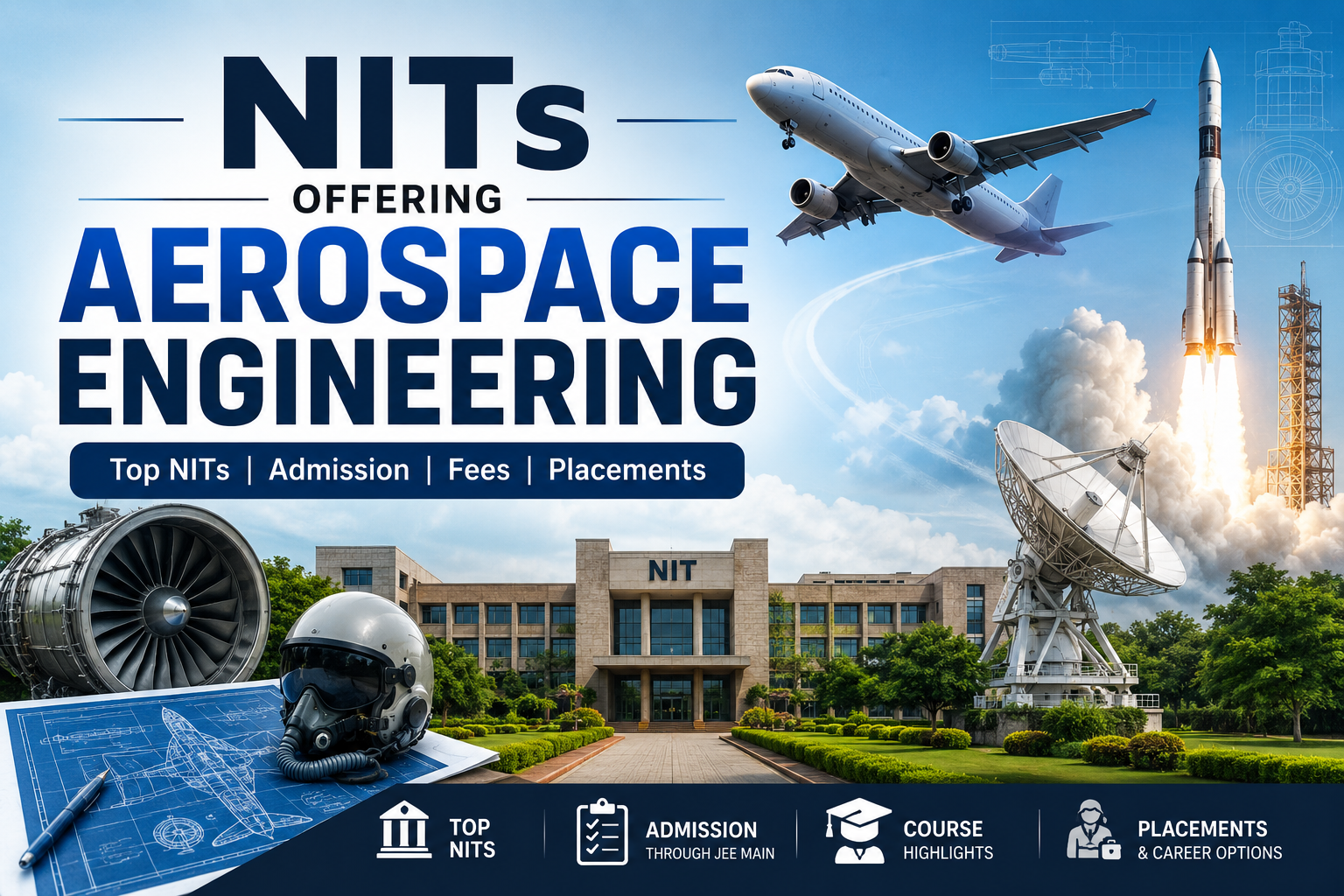
Securing an Aerospace Engineering Course In NIT is highly competitive, as only a select few National Institutes of Technology currently offer this specialized B.Tech program. These institutions provide a rigorous curriculum, state-of-the-art facilities, and excellent placement opportunities, preparing students for dynamic careers in aviation and space exploration. Further, graduates also enjoy a competitive salary after completing aerospace education from NIT. Aerospace Engineering is one of the most sought after aviation courses, among aeronautical engineering and others. This guide details the specific NITs offering Aerospace Engineering, their admission processes, curriculum, placements, and a comparison with IIT programs for 2026 admissions.
Which NITs Offer B.Tech Aerospace Engineering Programs in 2026?
Several National Institutes of Technology (NITs) will offer B.Tech Aerospace Engineering programs in 2026, including NIT Delhi, NIT Trichy, NIT Surathkal, NIT Warangal, NIT Rourkela, and NIT Calicut. This section details these programs and highlights key aspects of top NITs for an Aerospace Engineering Course In NIT.
| NIT | Admission Path (2026) | Approx. Closing Rank Trend | Average Package (₹ LPA) | Top Recruiters |
| National Institute of Technology Tiruchirappalli | JEE Main → JoSAA | ~2,000–3,500 | ~₹12–13 LPA | ISRO, DRDO, Boeing, Honeywell |
| National Institute of Technology Surathkal | JEE Main → JoSAA | ~2,200–4,500 | ~₹11–12 LPA | Airbus, GE Aviation, BEL |
| National Institute of Technology Warangal | JEE Main → JoSAA | ~2,500–4,800 | ~₹13 LPA | Rolls Royce, Lockheed Martin, TAS |
| National Institute of Technology Rourkela | JEE Main → JoSAA | ~3,000–5,500 | ~₹10–11 LPA | DRDO, Honeywell, L&T Aerospace |
| National Institute of Technology Calicut | JEE Main → JoSAA | ~4,500–6,500 | ~₹9–10 LPA | ISRO, Cyient, Quest Global |
| National Institute of Technology Delhi | JEE Main → JoSAA/CSAB | ~1,400–13,000 (varies widely due to new branch) | ~₹6–7 LPA | Emerging placements, core + IT firms |
NIT Delhi Aerospace Engineering: Curriculum, Fees, and Placements 2026
National Institute of Technology Delhi (NIT Delhi) launched its B.Tech Aerospace Engineering program in the Academic Session 2024-2025, built on NEP – 2020 guidelines. This comprehensive Aerospace Engineering Course In NIT offers a multi-exit/multi-entry system and project-based education, ensuring holistic development for students.
Curriculum
The curriculum for the Aerospace Engineering program emphasizes modern pedagogical approaches, including digital pedagogy and flipped learning. It incorporates a Choice Based Credit System, interdisciplinary courses, and strong motivation for entrepreneurship and startups, promoting holistic student development.
| Component | Details |
| Minimum Credits | 160 Credits |
| Certificate Exit Option | 40 Credits after 1st Year |
| Diploma Exit Option | 80 Credits after 2nd Year |
| Advanced Diploma Exit Option | 120 Credits after 3rd Year |
| Minor Degree Options (from 5th Semester) | Artificial Intelligence, Machine Learning, Data Sciences, Communication, VLSI, etc. |
| Specialized Course Areas | Robotics, Mechatronics, Flight Mechanics, Space Dynamics |
Fee Details
The total B.Tech Institute Fee for the first semester at NIT Delhi amounts to ₹1,01,200, which includes both one-time and semester-specific charges. Tuition fee benefits include a 100% waiver for SC/ST/PwD students, 100% remission for economically backward students with family income below ₹1 lakh per annum, and 2/3rd remission for students with family income between ₹1 lakh and ₹5 lakh per annum.
| Particulars | Amount |
| Caution Money (One-Time, Refundable) | ₹20,000 |
| One-Time Fees | ₹1,200 |
| Tuition Fee (per Semester) | ₹62,500 |
| Other Fees (per Semester) | ₹16,500 |
| Annual Fees | ₹1,000 |
| Total | ₹1,01,200 |
Students opting for hostel accommodation will incur a total first-semester fee of ₹38,000, covering caution money and semester charges.
| Particulars | Amount |
| Hostel Caution Money (One-Time, Refundable) | ₹10,000 |
| Mess Caution Money (One-Time, Refundable) | ₹10,000 |
| Hostel Charges (per Semester) | ₹18,000 |
| Total | ₹38,000 |
IIEST Shibpur Aerospace Engineering: Admission Process & Cutoffs 2026
The Indian Institute of Engineering Science and Technology, Shibpur Aerospace Engineering Course is a 4-year B.E./B.Tech. program offered through JEE Main admission and JoSAA/CSAB counselling. Candidates from the general category must secure at least 75% marks or be within the top 20 percentile in Class XII, while SC/ST/PwD candidates require 65% marks or top 20 percentile eligibility. This section outlines eligibility criteria, examination requirements, and the comprehensive breakdown of fees.
Fees
| Item | OC/EWS/OBC (Income > ₹5.0 lakh) | OC/EWS/OBC (Income ₹1-5 lakh) | SC/ST/PwD & Other (Income < ₹1.0 lakh) |
| Admission Fee | 3,000.00 | 3,000.00 | 3,000.00 |
| Tuition Fee | 62,500.00 | 20,833.00 | – |
| Institute Caution Money (refundable) | 6,000.00 | 6,000.00 | 6,000.00 |
| Alumni fee | 2,000.00 | 2,000.00 | 2,000.00 |
| Benevolent fee | 1,000.00 | 1,000.00 | 1,000.00 |
| Convocation registration fee | 3,000.00 | 3,000.00 | 3,000.00 |
| Central computing facility and internet fee (annually) | 3,000.00 | 3,000.00 | 3,000.00 |
| Sports fee (annually) | 1,000.00 | 1,000.00 | 1,000.00 |
| Comprehensive medical insurance premium (annually) | 1,600.00 | 1,600.00 | 1,600.00 |
| Techno-cultural event fee (annually) | 2,000.00 | 2,000.00 | 2,000.00 |
| Semester registration fee | 1,000.00 | 1,000.00 | 1,000.00 |
| Examination fee | 1,500.00 | 1,500.00 | 1,500.00 |
| Library fee | 1,500.00 | 1,500.00 | 1,500.00 |
| Career development, training and placement fee | 1,500.00 | 1,500.00 | 1,500.00 |
| Student activity fee | 1,500.00 | 1,500.00 | 1,500.00 |
| Health care and wellbeing fee | 1,000.00 | 1,000.00 | 1,000.00 |
| Infrastructure maintenance fee | 2,500.00 | 2,500.00 | 2,500.00 |
| Development fee | 1,000.00 | 1,000.00 | 1,000.00 |
| Total | 96,600.00 | 54,933.00 | 34,100.00 |
The approximate total course fees for the B.Tech. program are ₹6.37 Lakhs. Hostel dues, including seat rent, maintenance, electricity, and water, amount to ₹10,000.00 per semester, with an additional ₹1,000.00 for a single room if allotted.
| Category | Waiver Type |
| SC/ST/PwD students | 100% Tuition Fee waiver |
| Most Economically Backward students (family income < ₹1 lakh p.a.) | 100% Tuition Fee remission |
| Other Economically Backward students (family income ₹1 lakh to ₹5 lakh p.a.) | 2/3rd Tuition Fee remission |
Mess Cost at IIEST Shibpur
| Item | Amount (Rupees) |
| Mess Entrance Fee (per year, non-refundable) | 1,700.00 |
| Mess Dues Advance (per semester, adjustable) | 20,000.00 |
| Mess Establishment Fees (per semester, non-refundable) | 6,000.00 |
| Mess caution money (refundable, one time) | 1,000.00 |
| Total amount payable at the time of admission | 28,700.00 |
NIT Aerospace vs IIT Aerospace: Key Differences & Admission Paths 2026
IITs are renowned as the best colleges for engineering in India, particularly for their strong aerospace programs, while NITs are prestigious institutions offering quality education. This section outlines key differences in program focus, admission paths, and expected outcomes for an Aerospace Engineering Course In NIT versus an IIT.
| Parameter | IIT Aerospace Engineering | NIT / IIEST Aerospace Engineering |
| Top Institutes | Indian Institute of Technology Bombay, Indian Institute of Technology Madras, Indian Institute of Technology Kanpur, Indian Institute of Technology Kharagpur | Indian Institute of Engineering Science and Technology, Shibpur and select NIT-linked institutions |
| Admission Exam | JEE Main + JEE Advanced | Primarily JEE Main |
| Counselling Process | JoSAA Counselling through JEE Advanced ranks | JoSAA and CSAB using JEE Main ranks |
| Difficulty Level for Admission | Extremely competitive; top AIRs usually required | Comparatively more accessible |
| Typical Closing Rank Range | Often within AIR 2,000–6,000 for top IITs | Usually broader and less competitive than IIT Aerospace cutoffs |
| Academic Focus | Strong emphasis on research, aerodynamics, propulsion, space systems, and advanced laboratories | More application-oriented engineering with solid theoretical foundations |
| Research Opportunities | Extensive research funding, international collaborations, ISRO/DRDO projects | Good industry-oriented exposure with comparatively fewer large-scale research projects |
| Faculty & Infrastructure | Globally recognized faculty and advanced aerospace labs | Strong teaching infrastructure with growing research facilities |
| Internship & Industry Exposure | Higher access to core aerospace internships and global opportunities | Good placement support with increasing industry partnerships |
| Average Fee Range | Generally ₹8 lakh–₹12 lakh for the full B.Tech program | Usually ₹5 lakh–₹8 lakh for the complete program |
| Placement & Career Scope | Higher average packages and stronger research/foreign study pathways | Strong placement opportunities in core engineering and allied sectors |
| Best Suited For | Students targeting high-end research, R&D, and premium aerospace careers | Students seeking quality aerospace education at comparatively lower competition and cost |
Eligibility Criteria for Admission into NIT Aerospace Engineering Course
Admission into an Aerospace Engineering course at NITs is primarily based on JEE Main performance and centralized counselling through JoSAA. Candidates must meet both entrance exam requirements and academic eligibility set by participating institutes.
- Entrance Exam Requirement: Must qualify JEE Main (Paper 1) with a valid rank for B.Tech admissions through JoSAA counselling.
- Academic Qualification: Must have passed Class 12 (or equivalent) with Physics, Chemistry, and Mathematics as core subjects.
- Minimum Marks Requirement (General): At least 75% aggregate in Class 12 OR be in the top 20 percentile of the respective board.
- SC/ST/PwD Relaxation: Minimum 65% aggregate in Class 12 OR top 20 percentile eligibility.
- Subject Requirement: Physics and Mathematics are compulsory; Chemistry/Biology/Technical Vocational subject as the third subject is accepted as per JoSAA rules.
- Age Criteria: Generally, candidates should have passed Class 12 in the current or previous two academic years (as per JoSAA guidelines).
- Counselling Process: Admission is done via JoSAA Counselling, followed by CSAB special rounds if seats remain vacant.
- Branch Allocation: Aerospace Engineering seat allotment depends on JEE Main rank, category, and seat availability in participating NITs.
Admission Process for NIT Aerospace Engineering Course
The admission process for Aerospace Engineering in NITs is fully centralized and conducted through national-level entrance and counselling systems. Candidates are selected strictly based on JEE Main rank, followed by a structured counselling and seat allocation process.
- Appear for JEE Main: Candidates must register and qualify in JEE Main (Paper 1), conducted by NTA, which is the primary entrance exam for NIT B.Tech admissions.
- Check AIR (All India Rank): Admission eligibility depends on JEE Main rank; no separate entrance exam is conducted by NITs.
- Register for JoSAA Counselling: Qualified candidates must register on the JoSAA portal for centralized counselling conducted for IITs, NITs, IIITs, and GFTIs.
- Choice Filling: Select preferred NITs and Aerospace Engineering (or related branches) during the counselling process.
- Seat Allotment Rounds: Seats are allotted based on rank, category, and availability across multiple JoSAA rounds.
- Seat Acceptance Fee Payment: Candidates must pay the seat acceptance fee to confirm the allotted seat.
- Document Verification: Upload and verify academic and category documents as required by JoSAA.
- Final Reporting: Report physically to the allotted NIT for final admission confirmation and enrollment.
JoSAA Counselling 2026: B.Tech Aerospace Admission Process for NITs
Admission to the B.Tech Aerospace Engineering Course In NITs for 2026 will primarily be through JEE Main 2026 scores, managed by the Joint Seat Allocation Authority (JoSAA). This online counselling process facilitates admissions across 31 participating NITs, offering a total of 24,229 seats. The JoSAA counselling process involves multiple rounds, with an expected registration start in June 2026, followed by subsequent CSAB counselling for any remaining seats.
| S.No | Particulars | Details |
| 1 | JoSAA Counselling Start Date | June 2026 (Tentative) |
| 2 | JoSAA Counselling End Date | July 2026 (Tentative) |
| 3 | Round 1 Seat Allotment | July 2026 (Tentative) |
| 4 | Round 1 Acceptance and Confirmation | July 2026 (Tentative) |
| 5 | Round 2 Seat Allotment | July 2026 (Tentative) |
| 6 | Round 2 Acceptance and Confirmation | July 2026 (Tentative) |
| 7 | Round 3 Seat Allotment | July 2026 (Tentative) |
| 8 | Round 3 Acceptance and Confirmation | July 2026 (Tentative) |
| 9 | Round 4 Seat Allotment | July 2026 (Tentative) |
| 10 | Round 4 Acceptance and Confirmation | July 2026 (Tentative) |
| 11 | Round 5 Seat Allotment | July 2026 (Tentative) |
| 12 | Round 5 Acceptance and Confirmation | July 2026 (Tentative) |
| 13 | Final Round Seat Allotment | July 2026 (Tentative) |
| 14 | Final Round Acceptance and Confirmation | July 2026 (Tentative) |
| 15 | Official Website | josaa.nic.in |
Frequently Asked Questions
Which NITs offer aeronautical engineering in India?
Top NITs offering Aerospace Engineering include NIT Trichy, NIT Surathkal, NIT Warangal, NIT Rourkela, NIT Calicut, and NIT Delhi. Admission is based on JEE Main rank through JoSAA counselling, with availability varying by institute and year.
What are the eligibility requirements for Aerospace Engineering Course In NIT?
Candidates must qualify JEE Main (Paper 1), pass Class 12 with Physics, Chemistry, and Mathematics, and secure at least 75% marks (65% for SC/ST/PwD) or be in the top 20 percentile of their board.
How do I apply for an Aerospace Engineering Course In NIT?
Applicants must appear for JEE Main, register for JoSAA counselling, fill choices of NITs and branches, participate in seat allotment rounds, pay the seat acceptance fee, and complete document verification and reporting.
Is Aerospace Engineering in NITs better than other branches like Mechanical or Civil?
Aerospace Engineering is more specialized and research-oriented, offering careers in ISRO, DRDO, and aviation industries, but it is more niche compared to Mechanical or Civil, which have broader job opportunities.
What are the career options after Aerospace Engineering from NITs?
Graduates can work in ISRO, DRDO, HAL, Airbus, Boeing, and private aerospace firms, or pursue higher studies in aerospace design, propulsion systems, robotics, or space technology.