After BAMS PG Courses: Post-Graduate Medical Options
Nishit Kumar is a senior EdTech industry leader with over a decade of experience in building and scaling education platforms, shaping their product, content, and growth strategy. At…
Alternatively, short-term allopathic diploma courses like CMS Allopathy (18 months), D.C.M.S (3 years), and D.A.M.S (3 years) are available with average fees ranging between INR 25,000 and INR 50,000.
Ayurvedic medical graduates can evaluate clinical, surgical, research, and administrative pathways to advance their practice. Readers will find comprehensive details below regarding post-graduate eligibility criteria, specialization options, fee structures, top colleges, career prospects, and step-by-step admission procedures.
| Parameter | Details |
|---|---|
| Primary Entrance Exam for PG Ayurveda | AIAPGET |
| MD / MS Ayurveda Duration | 3 years |
| Allopathic Courses Fee Range | INR 25,000 – INR 50,000 |
| Entrance Exam for Allopathic Diplomas | NEET (conducted by NTA) |
| Average Salary (Ayurvedic Physician) | Rs. 4.1 LPA |
| Average Salary (Hospital Administrator) | Rs. 6.4 LPA |
List of BAMS PG Courses and Specializations
Post-graduate qualification in traditional medicine allows BAMS graduates to specialize in clinical, surgical, or theoretical branches under standard ayurveda course name categories. Doctor of Medicine (MD in Ayurveda) spans 3 years and focuses on advanced clinical diagnostics, internal medicine, and therapeutics. Master of Surgery (MS in Ayurveda) is a 3-year clinical program concentrating on Ayurvedic surgical techniques, specifically Shalya Tantra (general surgery) and Shalakya Tantra (ophthalmology and ENT operations).
Non-clinical and research-oriented degrees offer alternative academic directions. Master of Science (MSc in Ayurveda) is a 2-year program covering Ayurvedic theory, diagnostics, Rasashastra, and herbal formulations. Master of Pharmacy in Ayurveda (M.Pharm in Ayurveda) takes 2 years and concentrates on medicine formulation, standardization, and pharmaceutical quality control. Advanced research options include M.Phil in Ayurveda (1 to 2 years) focusing on classical text analysis, and PhD in Ayurveda, a doctoral research program requiring a minimum of 3 years after MD/MS or relevant PG qualifications.
Allopathic Courses After BAMS
Diploma and certificate options under the allopathy course after bams category include Certificate/Diploma in Community Medical Services (C.M.S Allopathy), Diploma in Community Medical Services & Essential Drugs Practice for Allopathy Medicine (D.C.M.S), and Diploma in Allopathy Medicine & Surgery (D.A.M.S).
Statutory guidelines govern modern medical practice across the country. Allopathic practice in India is strictly restricted to individuals holding standard allopathic medical degrees such as MBBS or MD under statutory regulation. Short-term allopathic diploma programs provide training for community health work within prescribed legal frameworks rather than independent, unrestricted allopathic clinical practice.
| Course Name | Duration | Average Fees (INR) |
|---|---|---|
| C.M.S Allopathy | 18 months | INR 25,000 |
| D.C.M.S (Diploma in Community Medical Services & Essential Drugs) | 3 years | INR 41,000 |
| D.A.M.S (Diploma in Allopathy Medicine & Surgery) | 3 years | INR 25,000 |
Eligibility and Duration
Admission to postgraduate Ayurvedic clinical courses (MD and MS in Ayurveda) requires a recognized BAMS degree and a qualifying score in the All India AYUSH Post Graduate Entrance Test (AIAPGET). Both MD and MS programs run for a duration of 3 years. Academic postgraduate options like MSc in Ayurveda and M.Pharm in Ayurveda require 2 years of full-time study following a relevant bachelor’s degree in medicine, pharmacy, or life sciences.
Candidates pursuing allopathic diploma courses must fulfill specific entry requirements established for medical training. Candidates must have passed 10+2 with Physics, Chemistry, and Biology/Mathematics securing a minimum of 50% aggregate marks and hold a qualified score in NEET. Age eligibility limits for NEET-based entry require candidates to be between 17 and 25 years of age.
Fees
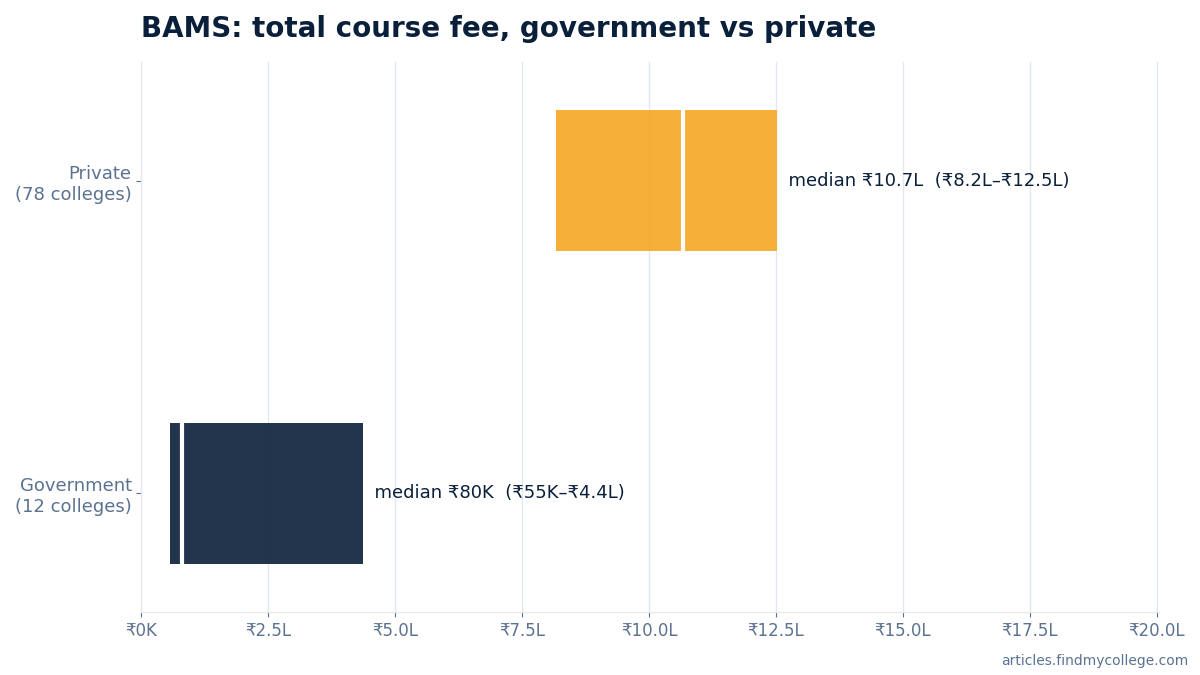
Tuition fees for postgraduate options vary significantly based on whether the course is an Ayurvedic specialization or an allopathic diploma program. Short-term allopathic programs maintain modest fee structures: C.M.S Allopathy costs an average fee of INR 25,000 for 18 months, D.A.M.S charges INR 25,000 over 3 years, and D.C.M.S requires INR 41,000 for its 3-year curriculum.
Candidates should review individual college prospectuses during counselling rounds for updated fee allocations.
Career Options and Salary
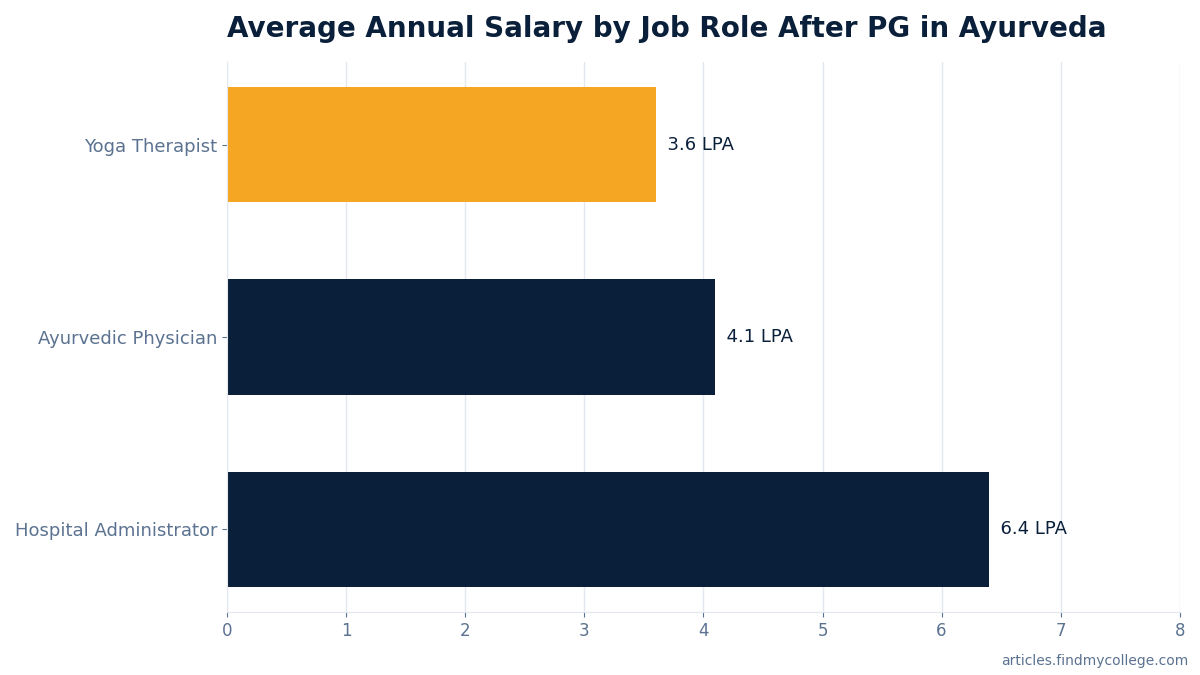
Postgraduate qualifications open up diverse clinical, academic, administrative, and research employment avenues. Post-graduate Ayurvedic professionals enter clinical roles as Ayurvedic Physicians, specialized surgeons, or wellness consultants. Administrative and research opportunities include facility management in corporate hospitals or drug standardization in pharmaceutical research units.
| Job Role | Primary Responsibilities | Average Salary |
|---|---|---|
| Ayurvedic Physician | Diagnoses diseases using Ayurvedic principles and prescribes herbal therapies. | Rs. 4.1 LPA |
| Yoga Therapist | Designs therapeutic yoga and meditation routines for health conditions. | Rs. 3.6 LPA |
| Hospital Administrator | Manages operations, resources, and regulations in healthcare institutions. | Rs. 6.4 LPA |
| General Practitioner (Allopathy roles) | Diagnoses and treats common medical conditions in clinics/hospitals. | INR 50,000 – 60,000 / month |
| Specialist Doctor | Provides specialized clinical care in specific medical branches. | INR 60,000 – 1,00,000 / month |
| Medical Researcher | Conducts medical and pharmaceutical research trials. | INR 50,000 – 80,000 / month |
| Medical Teacher | Teaches medical sciences in colleges, universities, or workshops. | INR 40,000 – 60,000 / month |
| Medical Administrator | Oversees administration in hospitals or government health agencies. | INR 60,000 – 1,00,000 / month |
Top Colleges Offering Post-Graduate Courses
| Course Name | Top Colleges / Universities |
|---|---|
| MD in Ayurveda | IMS BHU, Lucknow University, HPU Shimla, Amrita School of Ayurveda |
| MS in Ayurveda | IMS BHU, HPU Shimla, Ashtang Ayurved Mahavidyalaya Pune, BHU Varanasi |
| MSc in Ayurveda | NIA Jaipur, Gujarat Ayurved University, ITRA Jamnagar, Chinmaya Vishwavidyapeeth Ernakulam |
| M.Pharm in Ayurveda | LPU Jalandhar, Career Point University Hamirpur, Gujarat Ayurved University, ITRA Jamnagar |
| PhD in Ayurveda | NIA Jaipur, BU Bhopal, MUHS Nashik, Vidarbha Ayurved Mahavidyalaya Amravati, Shri Ayurved Mahavidyalaya Nagpur |
| College | City | Ownership | Total course fee | NIRF rank |
|---|---|---|---|---|
| Banaras Hindu University | Varanasi | Government | ₹51,595 | 6 (Medical, 2025) |
| Dr. DY Patil Vidyapeeth | Pune | — | ₹24.00 lakh | 12 (Medical, 2025) |
| Datta Meghe Institute of Medical Sciences | Wardha | — | ₹37.27 lakh | 20 (Medical, 2025) |
| DY Patil University Navi Mumbai | Navi Mumbai | — | ₹50.67 lakh | 45 (Medical, 2022) |
| Bharati Vidyapeeth Deemed University | Pune | — | ₹22.00 lakh | 59 (Overall, 2025) |
| Guru Gobind Singh Indraprastha University | Delhi | — | ₹3.72 lakh | 93 (Overall, 2025) |
| Yenepoya University Mangalore | Mangalore | — | ₹21.57 lakh | 95 (Overall, 2024) |
| KLE University | Belgaum | — | ₹24.75 lakh | 101 (Overall, 2023) |
| Goa University | North Goa | — | ₹6.55 lakh | 101 (Overall, 2023) |
| College | City | Ownership | Total course fee |
|---|---|---|---|
| Ayurvedic and Unani Tibbia College | Delhi | Government | ₹10,700 |
| Kaviraj Ananta Tripathy Sharma Ayurveda College & Hospital | Ganjam | Government | ₹43,519 |
| Banaras Hindu University | Varanasi | Government | ₹51,595 |
| Government Ayurveda College | Thiruvananthapuram | Government | ₹66,150 |
| Government Ayurveda College Tripunithura | Ernakulam | Government | ₹66,150 |
| Vaidyaratnam P.S. Varier Ayurveda College | Malappuram | Government | ₹79,450 |
| Government Ayurveda College Pariyaram | Kannur | Government | ₹79,580 |
| Madhya Pradesh Medical Science University | Jabalpur | Government | ₹1.93 lakh |
| Rajiv Gandhi University of Health Sciences | Bangalore | Government | ₹3.41 lakh |
| R.A. Podar Ayurved Medical College | Mumbai | Government | ₹4.68 lakh |
| College | City | Ownership | Total course fee |
|---|---|---|---|
| Ayurveda College Sulur | Coimbatore | Private | ₹3.50 lakh |
| Dr. Subhash Technical Campus | Junagadh | Private | ₹16.92 lakh |
| Doon Institute of Medical Sciences | Dehradun | Private | ₹13.34 lakh |
| Rajeev Gandhi College | Bhopal | Private | ₹9.12 lakh |
| Bharati Vidyapeeth College of Ayurved | Pune | Private | ₹25.00 lakh |
| Kanachur Institute of Medical Sciences | Mangalore | Private | ₹8.03 lakh |
| SMBT Ayurved College and Hospital | Nashik | Private | ₹15.15 lakh |
| Ahalia Ayurveda Medical College | Palakkad | Private | ₹13.01 lakh |
| MVR Ayurveda Medical College | Kannur | Private | ₹13.17 lakh |
| JSS Ayurvedic Medical College and Hospital | Mysore | Private | ₹12.50 lakh |
| City | Colleges | Fee range | Well-known options |
|---|---|---|---|
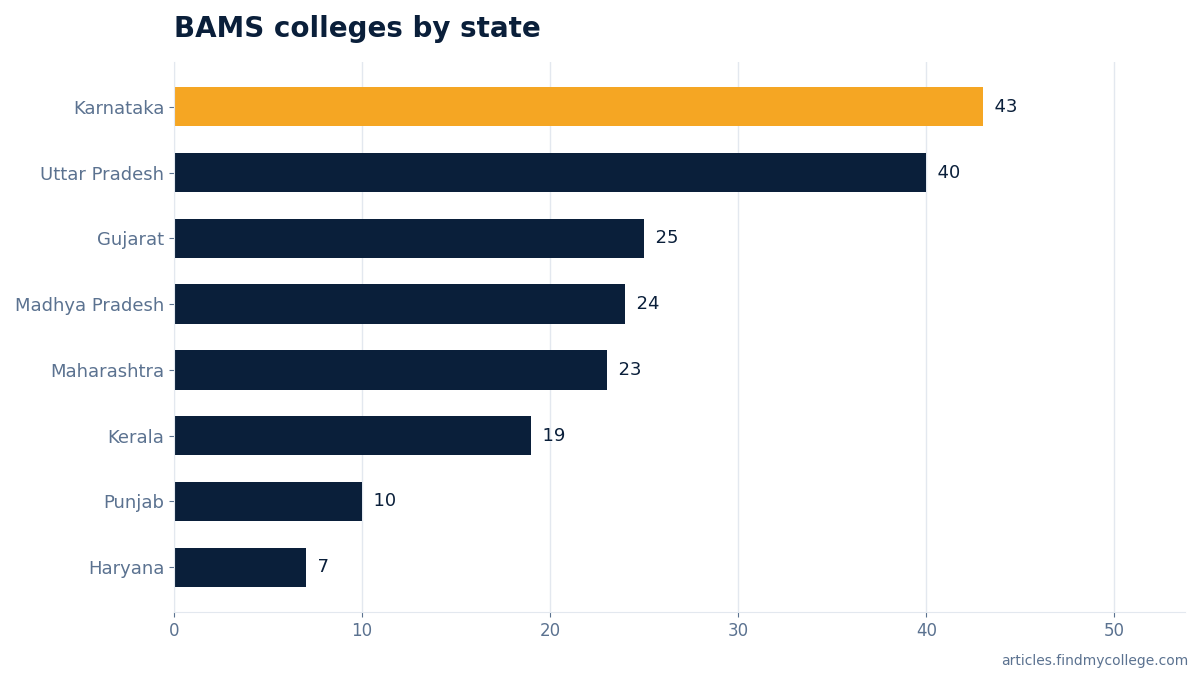
| Bhopal | 17 | ₹7.40 lakh – ₹18.30 lakh | LNCT University, RKDF University Bhopal |
| Bangalore | 9 | ₹3.41 lakh – ₹19.00 lakh | Rajiv Gandhi University of Health Sciences, Hillside Academy |
| Lucknow | 8 | ₹10.05 lakh – ₹12.94 lakh | University of Lucknow, Sardar Patel Institute of Ayurvedic Medical Sciences & Research Centre |
| Belgaum | 6 | ₹5.00 lakh – ₹24.75 lakh | KLE University, Shri B.M.K Ayurveda Mahavidyalaya |
| Vadodara | 5 | ₹13.50 lakh – ₹22.30 lakh | Parul University, Sumandeep Vidyapeeth |
| Palakkad | 5 | ₹9.97 lakh – ₹13.01 lakh | Ahalia Ayurveda Medical College, Poomulli Neelakandan Namboodiripad Memorial Ayurveda Medical College |
| Gadag | 4 | — | DGM Ayurvedic Medical College, Bhagawan Mahaveer Jain Ayurvedic Medical College |
| Chennai | 4 | — | The Tamil Nadu Dr. M.G.R. Medical University, Sri Sairam Ayurveda Medical College and Research Centre |
Institutes such as IMS BHU Varanasi, National Institute of Ayurveda (NIA) Jaipur, and ITRA Jamnagar are among the premier destinations for postgraduate studies. Candidates can pursue MD, MS, MSc, M.Pharm, and PhD courses across these top institutions.
How to Choose
Selecting the ideal postgraduate path requires evaluating long-term professional goals against clinical interests and regulatory environments. Candidates passionate about surgical procedures should target MS in Ayurveda specializations such as Shalya Tantra, whereas those interested in general medicine and internal diagnosis should choose MD in Ayurveda.
Career goals in pharmaceutical development or clinical research favor enrollment in M.Pharm in Ayurveda or MSc in Ayurveda programs. Students looking for corporate administrative roles benefit from healthcare management credentials. Understanding statutory regulations regarding clinical practice boundaries ensures compliance with local medical council laws.
How to Apply for BAMS Admission in 2026: Step by Step
- Check Eligibility Criteria: Candidates must pass 10+2 PCB/PCM with 50% aggregate marks and be between 17 and 25 years old for NEET-based entry, or possess a BAMS degree for MD/MS entry.
- Appear for Entrance Examination: Qualify for NEET conducted by NTA for diploma programs, or AIAPGET for MD/MS postgraduate courses.
- Submit Application Forms: Apply directly to chosen medical colleges by submitting NEET scores, 10+2 marks, and personal details.
- Attend College Interviews: Participate in interviews after colleges shortlist candidates based on NEET scores and 10+2 marks to assess personality and course suitability.
- Complete Seat Allotment: Receive seat allotment based on NEET score, 10+2 marks, and interview performance, then pay the required admission fee.
| What to do | Where | Link |
|---|---|---|
| Compare colleges, fees and cutoffs | BAMS colleges in India | findmycollege.com |
Admission to postgraduate Ayurveda and diploma programs depends on qualifying national entrance tests like AIAPGET or NEET. Final seat allocation relies on academic scores, entrance performance, and college interviews.
FAQs
Can I do masters in Surgery after BAMS?
Yes, BAMS graduates can pursue MS in Ayurveda, which specializes in Ayurvedic surgical procedures like Shalya Tantra and Shalakya Tantra over a duration of 3 years through AIAPGET entrance qualification.
What allopathic courses can be pursued after BAMS?
Short-term allopathic diploma programs available include C.M.S Allopathy (18 months), D.C.M.S (3 years), and D.A.M.S (3 years) with average fees ranging from INR 25,000 to INR 50,000 requiring NEET qualification.
Can a BAMS doctor practice allopathic medicine independently?
In most jurisdictions, independent allopathic medical practice is restricted to practitioners holding MBBS or MD degrees. Short diploma courses provide limited allopathic knowledge within statutory frameworks.
Which entrance exam is required for MD/MS in Ayurveda?
Admission to postgraduate MD and MS courses in Ayurveda requires qualifying the All India AYUSH Post Graduate Entrance Test (AIAPGET).
What is the average salary after completing PG in Ayurveda?
Postgraduate Ayurvedic professionals earn varying packages depending on the role: Ayurvedic Physicians earn around Rs. 4.1 LPA, Yoga Therapists earn Rs. 3.6 LPA, and Hospital Administrators earn Rs. 6.4 LPA on average.
What are the top institutes for pursuing PG courses after BAMS?
Top institutes include IMS BHU Varanasi, National Institute of Ayurveda (NIA) Jaipur, ITRA Jamnagar, Gujarat Ayurved University, HPU Shimla, and Amrita School of Ayurveda.