Bachelor of Management Studies (BMS) Full Form & Guide 2026
Nishit Kumar is a senior EdTech industry leader with over a decade of experience in building and scaling education platforms, shaping their product, content, and growth strategy. At…
Latest update: Bachelor of Management Studies 2026 admissions & dates updated. Read more ›
Welcome to our comprehensive guide on the Bachelor of Management Studies (BMS) full form. This page is designed for students and parents seeking in-depth information about this popular undergraduate management program in India for the 2026 academic year. Understanding the BMS full form and its implications is crucial for making informed career decisions.
What is the Full Form of BMS?
The full form of BMS is Bachelor of Management Studies. It is an undergraduate degree program designed to provide students with a strong foundation in management principles, business administration, and analytical skills, preparing them for entry-level managerial roles or further postgraduate studies.
BMS is a three-year full-time course, typically divided into six semesters, focusing on various aspects of business and management. It aims to develop leadership qualities, decision-making abilities, and a holistic understanding of organizational functions.
What is Bachelor of Management Studies (BMS)? An Overview
The Bachelor of Management Studies (BMS) is an undergraduate professional course that equips students with fundamental management knowledge and practical skills. It covers a wide array of subjects including finance, marketing, human resources, operations, and business analytics, providing a well-rounded perspective on how businesses operate.
Unlike traditional B.Com degrees, BMS has a more application-oriented and industry-focused curriculum, often incorporating case studies, projects, and internships to enhance practical learning. It is an excellent choice for students aspiring to enter the corporate world directly after graduation or pursue an MBA.
What is the eligibility for Bachelor of Management Studies (BMS) in 2026?
To be eligible for the Bachelor of Management Studies (BMS) program in 2026, candidates typically need to have completed their 10+2 (or equivalent) examination from a recognized board with a minimum aggregate score, usually ranging from 45% to 60%. Some top universities and colleges may also require specific subjects like Mathematics or Business Studies at the 10+2 level, and many conduct entrance examinations.
Specific eligibility criteria can vary significantly between institutions. Here’s a general breakdown:
- Educational Qualification: 10+2 or equivalent from a recognized board.
- Minimum Marks: Generally 45-60% aggregate. For reserved categories, this might be slightly lower.
- Subject Requirements: While not universally mandatory, some colleges prefer or require students to have studied Mathematics, Economics, or Business Studies in 10+2.
- Age Limit: Most colleges do not have an upper age limit, but it’s advisable to check individual college notifications.
- Entrance Exams: Many prominent colleges and universities require candidates to clear an entrance exam, followed by a Group Discussion (GD) and Personal Interview (PI) round.
What are the common entrance exams for BMS in 2026?
Admission to top BMS colleges often requires clearing specific entrance examinations. These exams assess a candidate’s aptitude in areas relevant to management studies.
Here are some of the common entrance exams for BMS in 2026:
- DU JAT (Delhi University Joint Admission Test): For admission to BMS programs in various colleges under Delhi University.
- IPU CET (Guru Gobind Singh Indraprastha University Common Entrance Test): For BMS programs in colleges affiliated with GGSIPU.
- SET (Symbiosis Entrance Test): For admission to Symbiosis International University’s management programs.
- NMIMS NPAT (Narsee Monjee Institute of Management Studies National Test for Programs After Twelfth): For various undergraduate programs including BMS at NMIMS.
- UGAT (Under Graduate Aptitude Test): Conducted by AIMA for various undergraduate programs.
Typical Entrance Exam Pattern & Dates (Illustrative for 2026):
| Exam Name | Application Period (Tentative) | Exam Date (Tentative) | Sections Covered |
|---|---|---|---|
| DU JAT | April – May 2026 | June 2026 | Quantitative Ability, Reasoning, General English, General Awareness |
| IPU CET | March – April 2026 | May 2026 | English Language & Comprehension, General Awareness, Logical & Analytical Ability, Management Aptitude |
| NMIMS NPAT | Dec 2025 – May 2026 | Jan – May 2026 (Multiple attempts) | Proficiency in English Language, Quantitative & Numerical Ability, Reasoning & General Intelligence |
Note: These dates are tentative for 2026 and subject to change. Always refer to the official notification of the respective examination bodies.
What is the syllabus for Bachelor of Management Studies (BMS)?
The syllabus for Bachelor of Management Studies (BMS) is comprehensive, covering core management disciplines and elective subjects over six semesters. It aims to provide a strong theoretical base combined with practical applications.
While the exact syllabus can vary by university, common subjects include:
- Semester 1 & 2: Business Communication, Microeconomics, Macroeconomics, Financial Accounting, Principles of Management, Business Law, Quantitative Techniques.
- Semester 3 & 4: Marketing Management, Human Resource Management, Financial Management, Operations Management, Business Ethics, Research Methodology, Organizational Behavior.
- Semester 5 & 6: Strategic Management, International Business, Entrepreneurship, Supply Chain Management, Business Analytics, Electives (e.g., Digital Marketing, Investment Analysis, Industrial Relations), Project Work/Internship.
How much does Bachelor of Management Studies (BMS) cost in India?
The cost of pursuing a Bachelor of Management Studies (BMS) in India varies significantly depending on the type of institution (government vs. private), its reputation, and location. Generally, government colleges are more affordable than private ones.
Here’s an estimated fee range for 2026:
| Institution Type | Annual Fee Range (INR) | Total Course Fee (INR) |
|---|---|---|
| Government/Public Universities | ₹15,000 – ₹60,000 | ₹45,000 – ₹1,80,000 |
| Private Colleges/Universities | ₹80,000 – ₹3,50,000+ | ₹2,40,000 – ₹10,50,000+ |
These figures are approximate and can change. Additional costs like hostel fees, examination fees, and study materials are not included.
Is Bachelor of Management Studies (BMS) worth it for jobs?
Yes, a Bachelor of Management Studies (BMS) degree can be highly worth it for jobs, especially for those aspiring to enter the corporate sector directly after graduation or pursue an MBA. The program equips students with a broad range of business skills, making them suitable for various entry-level managerial and analytical roles.
BMS graduates are often preferred for roles that require a foundational understanding of business operations, critical thinking, and problem-solving abilities. The curriculum’s focus on practical application and industry relevance enhances employability.
What are the career prospects and salary after BMS?
After completing a BMS degree, graduates have diverse career prospects across various industries. The roles typically involve management, analysis, and operational functions.
Common job roles include:
- Marketing Executive: Assisting in marketing campaigns, market research, and brand promotion.
- Sales Executive: Managing client relationships, achieving sales targets, and business development.
- Human Resources Executive: Supporting recruitment, employee relations, and HR operations.
- Financial Analyst (Entry-level): Assisting with financial planning, analysis, and reporting.
- Operations Executive: Optimizing business processes, supply chain management, and logistics.
- Business Development Executive: Identifying new business opportunities and client acquisition.
- Project Coordinator: Assisting in project planning, execution, and monitoring.
Average Salary Ranges for BMS Graduates (Entry-Level, India, 2026):
| Job Role | Average Annual Salary (INR) |
|---|---|
| Marketing Executive | ₹3,00,000 – ₹5,50,000 |
| Sales Executive | ₹2,80,000 – ₹5,00,000 |
| HR Executive | ₹2,50,000 – ₹4,80,000 |
| Financial Analyst (Entry-level) | ₹3,20,000 – ₹6,00,000 |
| Business Development Executive | ₹3,00,000 – ₹5,80,000 |
Salaries can vary based on college reputation, individual skills, industry, company size, and location. Pursuing an MBA after BMS significantly boosts career progression and salary potential.
BMS vs. BBA: Which is better?
Both BMS (Bachelor of Management Studies) and BBA (Bachelor of Business Administration) are undergraduate management degrees, but they often differ in their focus and depth. BMS is generally considered more analytical and rigorous, with a greater emphasis on quantitative techniques and strategic management, while BBA tends to be broader, covering a wider range of business functions with a slightly less intensive analytical approach.
Here’s a comparison to help you decide:
| Feature | Bachelor of Management Studies (BMS) | Bachelor of Business Administration (BBA) |
|---|---|---|
| Focus | More analytical, strategic, and quantitative; often offered by top universities. | Broader, general management; covers various business functions. |
| Curriculum | Deeper dive into specific management theories, business analytics, economics. | Covers a wider range of subjects, sometimes less in-depth. |
| Eligibility/Entrance | Often requires higher 10+2 percentages and competitive entrance exams (e.g., DU JAT). | Eligibility can be slightly more relaxed, though top BBA programs also have competitive exams. |
| Career Path | Strong foundation for MBA, roles in consulting, finance, analytics. | Good for general management roles, entrepreneurship, or further studies. |
| Perception | Often perceived as more rigorous and academically challenging. | Widely recognized, but depth can vary significantly by institution. |
Which is better depends on your aptitude and career goals. If you enjoy analytical thinking, quantitative subjects, and aspire for roles in strategic management or finance, BMS might be a better fit. If you prefer a broader understanding of business and want to explore various functions, BBA could be more suitable.
What are the top colleges for BMS in India?
Several colleges in India are renowned for their Bachelor of Management Studies (BMS) programs, offering excellent faculty, infrastructure, and placement opportunities.
Some of the top colleges for BMS in India include:
- Shaheed Sukhdev College of Business Studies (SSCBS), Delhi University: Highly regarded for its BMS program.
- Deen Dayal Upadhyaya College, Delhi University: Another top college under DU offering BMS.
- Keshav Mahavidyalaya, Delhi University.
- GGSIPU affiliated colleges (e.g., Maharaja Agrasen Institute of Management Studies, Vivekananda Institute of Professional Studies): Offer quality BMS programs.
- NMIMS (Narsee Monjee Institute of Management Studies), Mumbai: Offers a highly sought-after BBA program that is often compared to BMS.
- Symbiosis Centre for Management Studies (SCMS), Pune: Known for its BBA program, which is also a strong alternative.
When choosing a college, consider factors like faculty expertise, curriculum, industry interface, placement records, and infrastructure.
Explore more on FindMyCollege
Related pages for Bachelor of Management Studies aspirants on findmycollege.com:
Frequently Asked Questions
Is Mathematics compulsory for BMS?
Mathematics is not universally compulsory for BMS, but many top universities and colleges, especially those under Delhi University, do require or highly prefer candidates to have studied Mathematics at the 10+2 level. It is crucial to check the specific eligibility criteria of your target colleges.
Can I do an MBA after BMS?
Yes, a BMS degree provides an excellent foundation for pursuing an MBA. Many BMS graduates opt for an MBA to specialize further and enhance their career prospects, as the analytical and management skills gained in BMS are highly beneficial for an MBA program.
What is the difference between BMS and B.Com?
BMS (Bachelor of Management Studies) is a professional management degree focused on business administration and management principles, with an emphasis on practical application. B.Com (Bachelor of Commerce) is a more traditional commerce degree, focusing on accounting, finance, and taxation, with a broader theoretical base in commerce subjects.
Are there any specializations in BMS?
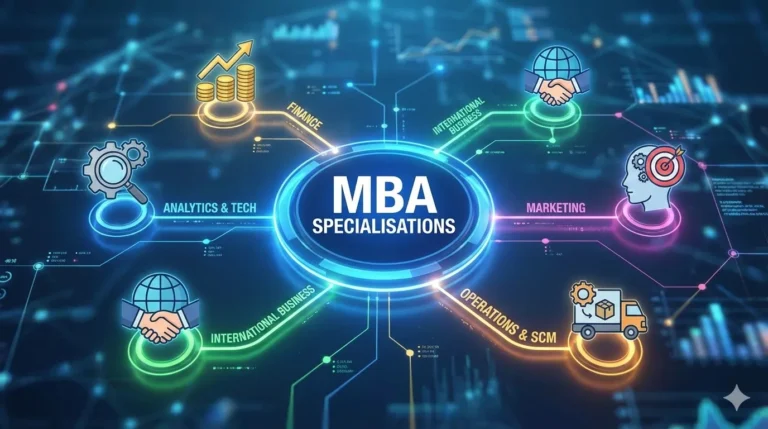
While BMS itself is a specialized management degree, some colleges might offer electives or concentrations in the final year in areas like Marketing, Finance, Human Resources, or Operations. However, deep specialization is typically pursued at the postgraduate (MBA) level.
What skills are developed during a BMS course?
A BMS course helps develop a wide range of skills including critical thinking, problem-solving, analytical skills, leadership, communication, decision-making, teamwork, and a strong understanding of business operations and management principles.
Is BMS a good option for entrepreneurship?
Yes, BMS is a very good option for aspiring entrepreneurs. The curriculum often includes subjects like Entrepreneurship Development, Business Planning, and Strategic Management, providing students with the foundational knowledge and skills needed to start and manage their own ventures.