
MBA in Human Resource Management (India 2026) – Overview
Nishit Kumar is a senior EdTech industry leader with over a decade of experience in building and scaling education platforms, shaping their product, content, and growth strategy. At…
Latest update: MBA in Human Resource 2026 admissions & dates updated. Read more ›
An MBA in Human Resource Management in India for 2026 is a postgraduate degree designed to equip students with advanced knowledge and skills in managing an organization’s most valuable asset: its people. This specialization focuses on strategic HR planning, talent acquisition, employee development, compensation, and labor relations, preparing graduates for leadership roles in the dynamic field of human resources.
Why Pursue an MBA in Human Resource Management in India?
Pursuing an MBA in Human Resource Management in India offers significant career growth opportunities due to the country’s booming economy and increasing emphasis on strategic HR practices across all industries. Indian businesses are recognizing the critical role of HR in achieving organizational objectives, leading to high demand for skilled HR professionals.
Growing Demand for HR Professionals
The Indian job market for HR professionals is experiencing robust growth, driven by multinational corporations expanding their operations and domestic companies professionalizing their HR functions. This trend ensures a steady stream of job opportunities for MBA HR graduates.
Strategic Role of HR in Modern Businesses
Modern businesses view HR as a strategic partner rather not just an administrative function, influencing key business decisions and contributing directly to profitability and sustainability. An MBA in HR prepares you for this elevated role.
Eligibility Criteria for MBA in HR (2026 Intake)
To be eligible for an MBA in Human Resource Management in India for the 2026 intake, candidates typically need a bachelor’s degree from a recognized university and a valid score in a national-level management entrance examination. Specific requirements may vary slightly between institutions.
Academic Qualifications
Applicants must possess a bachelor’s degree in any discipline with a minimum aggregate score, usually ranging from 50% to 60%. Some top-tier institutions might require a higher percentage.
Entrance Examinations
Admission to most reputable MBA HR programs requires a competitive score in exams like CAT, XAT, MAT, CMAT, or GMAT. Some colleges also conduct their own entrance tests.
Work Experience (Optional but Preferred)
While not always mandatory, having 1-3 years of relevant work experience can significantly enhance an applicant’s profile and improve chances of admission to premier institutions, particularly for executive MBA programs.
Course Curriculum and Key Subjects
The MBA in Human Resource Management curriculum is designed to provide a comprehensive understanding of HR principles and practices, covering both theoretical knowledge and practical applications. Key subjects include organizational behavior, talent management, industrial relations, and HR analytics.
Core HR Subjects
- Organizational Behavior & Design
- Human Resource Planning & Acquisition
- Performance Management & Compensation
- Training & Development
- Industrial Relations & Labor Laws
- HR Analytics & Information Systems
Electives and Specializations
Students can often choose electives in areas such as International HR, Change Management, or Leadership Development, allowing for further specialization based on career interests.
Top Colleges for MBA in HR in India (2026)
India boasts several top-tier institutions offering excellent MBA in Human Resource Management programs, known for their rigorous curriculum, experienced faculty, and strong industry connections. These colleges consistently rank high in national surveys.
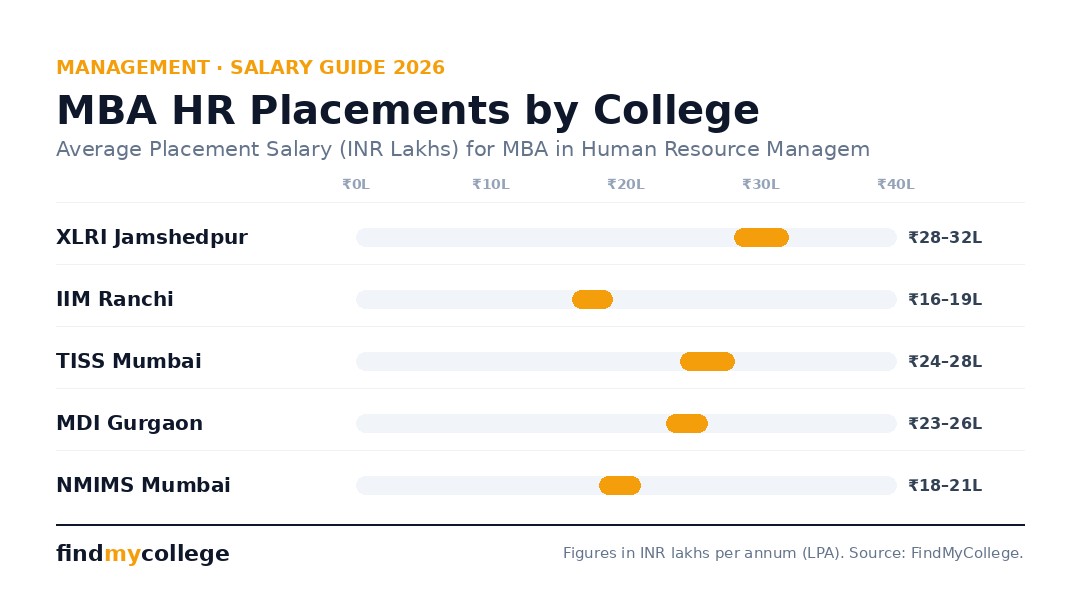
| College Name | Approx. Fees (INR Lakhs) | Avg. Placement Salary (INR Lakhs) | Key Specializations Offered |
|---|---|---|---|
| XLRI Jamshedpur | 23 – 26 | 28 – 32 | Human Resource Management |
| IIM Ranchi | 16 – 18 | 16 – 19 | Human Resource Management |
| TISS Mumbai | 2 – 3 | 24 – 28 | Human Resource Management & Labour Relations |
| MDI Gurgaon | 20 – 23 | 23 – 26 | Human Resource Management |
| NMIMS Mumbai | 22 – 25 | 18 – 21 | Human Resource Management |
Career Prospects and Job Roles
An MBA in Human Resource Management opens doors to a diverse range of rewarding career opportunities across various industries, both in India and globally. Graduates can expect to find roles in talent acquisition, HR consulting, compensation and benefits, and organizational development.
Common Job Titles
- HR Manager / Senior HR Manager
- Talent Acquisition Specialist / Manager
- HR Business Partner
- Compensation & Benefits Manager
- Learning & Development Manager
- HR Consultant
- Organizational Development Specialist
Industry Sectors
Graduates are highly sought after in IT & Tech, Consulting, Manufacturing, Financial Services, Healthcare, and FMCG sectors, among others. The demand for HR professionals is pervasive across almost all organized industries.
Salary Expectations for MBA HR Graduates (2026)
The salary expectations for MBA HR graduates in India for 2026 are highly competitive, with entry-level salaries typically ranging from INR 6-12 lakhs per annum, and experienced professionals commanding significantly higher packages. Salaries are influenced by the college, industry, and individual skills.
Entry-Level Salaries
Fresh graduates from top-tier institutions can expect an average starting salary of INR 10-15 lakhs per annum, while those from other reputed colleges might start in the INR 6-10 lakhs range.
Mid to Senior-Level Salaries
With 5-10 years of experience, HR professionals with an MBA can earn between INR 20-40 lakhs per annum, and those in leadership roles (e.g., VP HR, CHRO) can command upwards of INR 50 lakhs annually.
Frequently Asked Questions
Q: What is the duration of an MBA in Human Resource Management in India?
A: The typical duration for a full-time MBA in Human Resource Management program in India is two years, divided into four to six semesters.
Q: Is work experience mandatory for an MBA in HR?
A: While not always mandatory, having 1-3 years of relevant work experience is often preferred by top colleges and can significantly strengthen your application.
Q: What are the best entrance exams for MBA in HR?
A: The most widely accepted entrance exams for MBA in HR in India are CAT, XAT, MAT, CMAT, and GMAT. XAT is particularly important for XLRI Jamshedpur.
Q: What is the career scope after an MBA in HR?
A: An MBA in HR offers excellent career scope, leading to roles such as HR Manager, Talent Acquisition Specialist, HR Business Partner, Compensation & Benefits Manager, and HR Consultant across various industries.
Q: What is the average fee for an MBA in HR in India?
A: The average fee for an MBA in HR in India can range from INR 2 lakhs to INR 25 lakhs, depending on the institution’s reputation, infrastructure, and faculty expertise.