
BBA vs MBA: Which Management Degree is Better for Your Career in 2026?
Abhijeet Chatterjee is a professional Content and Copy specialist with over five years of experience in crafting compelling content around the Edtech domain. His portfolio includes notable work…
Deciding between BBA and MBA, which is better for your career in 2026, depends heavily on your current academic standing and long-term professional aspirations. While a BBA provides a strong foundational understanding of business principles right after high school, an MBA is an advanced degree designed for professionals seeking to accelerate their careers or transition into leadership roles. This article will meticulously compare both degrees, covering curriculum, career scope, fees, and admission criteria to help you make an informed choice.
BBA vs MBA 2026: Key Differences in Curriculum, Duration, and Focus
Choosing between a BBA and an MBA involves understanding their distinct levels of study, durations, and curriculum focuses. This section details these key differences to help prospective students decide which path, BBA or MBA, is better suited for their career aspirations and educational goals.
- BBA Level of Study: Undergraduate degree
- MBA Level of Study: Graduate degree
- BBA Duration: Typically three years
- MBA Duration: Usually two years
- BBA Curriculum Focus: Basic business concepts, foundational courses
- MBA Curriculum Focus: Advanced business strategies, leadership skills
While BBA programs establish fundamental business knowledge, an MBA builds upon this with advanced strategies. The choice often depends on career stage and desired depth of business expertise.
| Aspect | BBA Details | MBA Details |
|---|---|---|
| Duration Variations | 3 or 4-year undergraduate programme; can be finished in 4 years | Can be cut to just one year (accelerated programs) |
| Curriculum Subjects | Accounting, Marketing, Management, Human Resources, Economics | Strategic Management, Business Analytics, Leadership Development, Financial Strategy |
| Syllabus Examples/Core | Principles of Management, Business Mathematics and Statistics, Operations Research, Business Economics, Financial and Management Accounting, Production and Material Management,
Business Communication, Organisational Behaviour, Public Relations and Corporate Communication, Information Technology for Business, Project Management, Entrepreneurship, Business Law, and Business Policy and Strategy |
Accounting, Economics, Finance, Marketing, Operations Management and Organisational Behaviour |
| Specializations | Marketing, HR, or Finance (basic and introductory) | Business analytics, digital marketing, and leadership (diverse and in-depth) |
| Program Focus | Introduces fundamental business concepts, builds foundational skills (Communication, Leadership, Decision-making), ideal for entry-level jobs; prioritizes practical business abilities | Targets professionals with work experience to improve leadership skills and delve further into corporate ideas, aims for higher-level managerial roles or
starting own business; emphasizes theoretical business knowledge, prepares for managerial roles |
This detailed comparison highlights how BBA programs lay a broad foundation for entry-level roles, whereas MBA programs offer specialised, advanced knowledge for leadership and strategic positions, making the decision of BBA or MBA a strategic career choice.
BBA vs MBA Career Scope 2026: Salary Packages & Top Job Roles
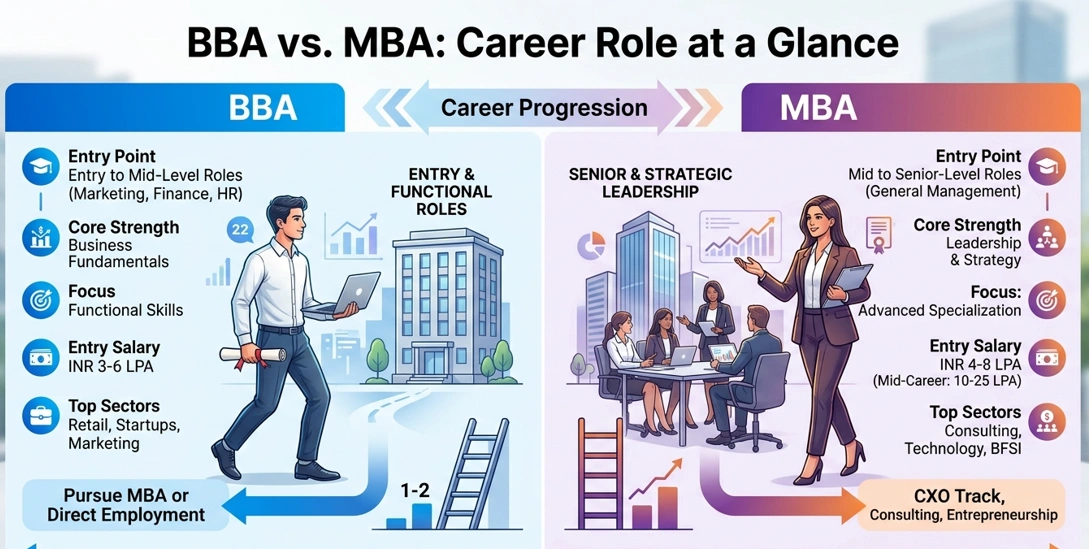
Choosing between a BBA and MBA often comes down to where you are in your career journey. A BBA builds a strong business foundation and opens doors to entry-level corporate roles right after graduation. An MBA, on the other hand, equips professionals with advanced leadership, strategy, and specialisation skills to move into senior and high-paying positions.
The 2026 job market increasingly rewards candidates who combine academic knowledge with practical, skill-based expertise. Employers across consulting, banking, technology, and FMCG sectors are actively hiring professionals with domain-specific strengths in areas like data analytics, digital marketing, and financial strategy.
BBA Career Scope 2026: Jobs & Salary by Specialisation
A BBA degree offers wide-ranging career options across core business functions. Below are the most popular BBA specialisations along with key job roles and expected salary ranges for fresh graduates in 2026:
MBA Career Scope 2026: Jobs & Salary by Specialisation
An MBA significantly accelerates earning potential and opens doors to leadership-track roles across industries. Popular MBA specialisations and their corresponding career outcomes in 2026 are as follows:
| MBA Specialisation | Top Job Roles | Entry-Level Salary (INR) | Mid-Career Salary (INR) |
|---|---|---|---|
| Finance | Investment Banker, CFO Track, Financial Controller, Risk Manager | 6 – 12 LPA | 15 – 30 LPA |
| Marketing | Brand Manager, Product Manager, Marketing Director, CMO Track | 5 – 10 LPA | 12 – 25 LPA |
| Human Resources | HR Business Partner, Talent Manager, HR Director | 5 – 8 LPA | 12 – 20 LPA |
| Business Analytics | Data Analyst, Business Intelligence Manager, Analytics Consultant | 6 – 12 LPA | 15 – 28 LPA |
| Operations & SCM | Supply Chain Manager, Operations Head, Logistics Director | 5 – 9 LPA | 12 – 22 LPA |
| Consulting | Management Consultant, Strategy Analyst, Business Advisor | 8 – 15 LPA | 18 – 35 LPA |
BBA vs MBA: Earning Potential Over Career Stages
BBA & MBA Admission Criteria 2026: Eligibility, Entrance Exams, and Cutoffs
Admission to BBA and MBA programs in 2026 involves distinct eligibility criteria and entrance exams. This section details the academic requirements, age limits, and key application deadlines for both degrees, helping you decide BBA or MBA which is better for your career goals.
| Institution | Admission Criteria | Application Date (Tentative) |
|---|---|---|
| Greater Noida Institute of Management, GNIM | Merit | September 2026 |
| Delhi University | CUET | June 2026 |
| Assam University | Merit | September 2026 |
| IPU New Delhi | Entrance | March 2026 to May 2026 |
| Chandigarh University | CUET | 1 May to 25 July 2026 |
| Manipal University | CUET | 1 May to 25 July 2026 |
| Madras Christian College, Chennai | Merit | June 2026 |
| Christ University, Bengaluru | Entrance | December 10 – April 28, 2026 |
| Loyola College, Chennai | Merit + PI | June 2026 |
| Anil SurendraModi School of Commerce, Mumbai | NPAT | December 06 – May 20, 2026 |
| NMIMS | NPAT | December 06 – May 20, 2026 |
| Ambedkar University, Delhi | CUET | June 2026 |
| Indian Institute of Tourism and Travel Management (IITTM) | Merit-Based | September 2026 |
| Amity University | Written Test + Merit | January 2026 |
| Poornima University | Merit-Based | November 2026 |
| DayanandSagar University | Merit/DSAT | November 2026 |
| HPU Shimla | Entrance Based | May 2026 |
| Maulana Abul Kalam Azad University of Technology, West Bengal | MAKAUT CET | June 2026 |
| FLAME University | Admission Test + Interview | October 2026 |
| ICFAI University Dehradun | Personal Interview | December 04, 2025 – July 04, 2026 |
| Symbiosis International University | SET | December 12 – April 13, 2026 |
The table above outlines tentative application deadlines and admission criteria for various institutions offering BBA programs in 2026, highlighting both merit-based and entrance-based admissions.
BBA vs MBA Fees 2026: Cost of Study & Return on Investment Analysis
Pursuing an MBA in India represents a significant financial commitment, with tuition fees alone ranging from ₹3 lakhs to ₹25 lakhs. This section analyzes the comprehensive costs of an MBA, including opportunity costs, and projected return on investment. It also offers a financial comparison with BBA programs.
| Institution Category | Fee Range (Complete Program) |
|---|---|
| Government Colleges & IIMs | ₹2 lakhs-₹25 lakhs |
| Mid-Tier Private Universities | ₹3 lakhs-₹10 lakhs |
| Premium Private B-Schools | ₹12 lakhs-₹25 lakhs+ |
MBA course fees in India vary widely by institution category, with premium private B-schools and top government colleges commanding the highest fees, reflecting the diverse educational landscape.
| Expense Category | Cost Range (Total Program) | Key Considerations |
|---|---|---|
| Accommodation & Meals | ₹1 lakh-₹3 lakhs | On-campus vs. off-campus, city location |
| Books & Materials | ₹20,000-₹50,000 | Case studies, subscriptions, textbooks |
| Technology & Equipment | ₹60,000-₹1 lakh | Laptop, software, digital tools |
| Living Expenses | ₹1.2 lakhs-₹3.6 lakhs | Transport, personal expenses over 2 years |
| Opportunity Cost | ₹6 lakhs-₹20 lakhs+ | Salary foregone during full-time MBA |
Beyond tuition, the total investment for an MBA course in India can exceed ₹20 lakhs for a mid-tier program, significantly impacted by living expenses and the substantial opportunity cost of foregone salary.
| Institution Tier | Average Starting Salary | Median Salary | Top Offers |
|---|---|---|---|
| Top IIMs & Premier B-Schools | ₹25 lakhs-₹35 lakhs | ₹20 lakhs-₹28 lakhs | ₹50 lakhs+ (consulting, finance) |
| Mid-Tier Private Universities | ₹8 lakhs-₹15 lakhs | ₹7 lakhs-₹12 lakhs | ₹20 lakhs-₹25 lakhs |
| Tier-2/3 Institutions | ₹4 lakhs-₹8 lakhs | ₹3.5 lakhs-₹6 lakhs | ₹12 lakhs-₹15 lakhs |
Post-MBA salaries in India demonstrate a clear correlation with institution tier, with graduates from top IIMs and premier B-schools commanding significantly higher starting, median, and top offers.
| Scenario | Total Investment | Pre-MBA Salary | Post-MBA Salary | Annual Gain | Payback Period |
|---|---|---|---|---|---|
| Premium B-School Graduate | ₹30 lakhs (₹20 lakhs fees + ₹10 lakhs living/opportunity cost) | ₹6 lakhs per annum | ₹25 lakhs per annum | ₹19 lakhs | 1.6 years |
| Mid-Tier University Graduate | ₹15 lakhs (₹8 lakhs fees + ₹7 lakhs living/opportunity cost) | ₹5 lakhs per annum | ₹12 lakhs per annum | ₹7 lakhs | 2.1 years |
| Lower-Tier Institution Graduate | ₹8 lakhs (₹4 lakhs fees + ₹4 lakhs living/opportunity cost) | ₹4 lakhs per annum | ₹6 lakhs per annum | ₹2 lakhs | 4 years |
Return on investment for an MBA varies significantly, with graduates from premium B-schools achieving a payback period as short as 1.6 years due to substantial annual salary gains.
| Program | Average Tuition (U.S.) | Average Salary (U.S.) |
|---|---|---|
| BBA | $27,077 (out-of-state, 2025) | $89,650 (ZipRecruiter, 2025) |
| MBA | $61,800 average cost (Zippia, 2023) | $165,372 (ZipRecruiter, 2025) |
Comparing U.S. data, an MBA requires a significantly higher financial investment than a BBA, yet it also yields a considerably higher average salary, which helps in deciding BBA Or MBA Which Is Better for long-term financial growth.
Top 10 BBA & MBA Colleges in India 2026 by NIRF Rankings
The NIRF Rankings 2025 were officially released by Union Education Minister Dharmendra Pradhan on September 4, 2025, in New Delhi. This section presents the top institutions for both MBA and BBA programs, offering insights into which is better based on their latest rankings, including projections for 2026.
| Program | Institution | NIRF Ranking | Ranking Year |
|---|---|---|---|
| MBA | Indian Institute of Management Ahmedabad | 1 | 2025 |
| MBA | Indian Institute of Management Bangalore | 2 | 2025 |
| MBA | Indian Institute of Management Kozhikode | 3 | 2025 |
| MBA | Indian Institute of Technology Delhi | 4 | 2025 |
| MBA | Indian Institute of Management Lucknow | 5 | 2025 |
| MBA | Indian Institute of Management Mumbai | 6 | 2025 |
| MBA | Indian Institute of Management Calcutta | 7 | 2025 |
| MBA | Indian Institute of Management Indore | 8 | 2025 |
| MBA | Management Development Institute (MDI) Gurgaon | 9 | 2025 |
| MBA | XLRI Xavier School of Management, Jamshedpur | 10 | 2025 |
| BBA | IIM Bangalore – BBA in Digital Business and Entrepreneurship (BBA-DB) | 2nd | 2026 |
| BBA | IIM Kozhikode – BBA-MBA Integrated Program | 3rd | 2026 |
| BBA | St. Xavier’s College, Mumbai | 6th | 2026 |
| BBA | Symbiosis Centre for Management Studies (SCMS), Pune | 9th | 2026 |
| BBA | Deen Dayal Upadhyaya College (University of Delhi) | 26th | 2026 |
| BBA | IIM Sambalpur (Bachelor of Science in Management and Public Policy) | 50th | 2026 |
| BBA | TAPMI Bengaluru (BBA Honours) | 58th | 2026 |
| BBA | Christ University (Bangalore Central Campus) | 60th | 2026 |
| BBA | NMIMS Mumbai – Anil Surendra Modi School of Commerce | 84th | 2026 |
| BBA | Shaheed Sukhdev College of Business Studies (SSCBS), Delhi University | 101-150 | 2026 |
This comprehensive table highlights the leading institutions for both MBA and BBA programs, with IIM Ahmedabad topping the MBA list for 2025 and IIM Bangalore’s BBA-DB program securing a high rank for 2026, providing a clear reference for students deciding BBA or MBA which is better for their career path.
How to Apply for BBA/MBA 2026: Step-by-Step Admission Process Guide
Understanding the admission process for BBA programs and integrated BBA+MBA courses is crucial for prospective students. This guide outlines the step-by-step journey for 2026 applicants, helping you navigate whether a BBA or MBA which is better for your career path.
- Research and Shortlist: Identify colleges aligning with career goals, budget, and location preferences.
- Check Eligibility: Confirm secondary education (Class 12) completion and consistent academic performance.
- Submit Application: Create an account, enter details, and review carefully before submitting online.
- Entrance Exam: Prepare for standardized tests (SAT, ACT) or institute-specific entrance exams.
- Application Review: Admissions team evaluates; shortlisted candidates may face interviews or assessments.
- Admission Decision: Successful applicants receive an offer; accept and confirm enrolment.
The admission process for a BBA program often involves a holistic evaluation, considering not just exam scores but also leadership potential and genuine interest in business.
| Requirement | Details |
|---|---|
| Minimum Aggregate Marks | Usually 45%-60% in Class 12. |
| Compulsory Subjects | Some colleges may require English or Mathematics. |
| Age Bar | Generally, none, but some universities require 17 to 25 years. |
| Other Skills | English language proficiency, communication, and analytical skills. |
These eligibility criteria highlight the academic foundation and specific subject requirements for BBA admissions.
- Choose Program: Select the BBA + MBA integrated program from the available courses.
- Fill Application: Complete the form with the necessary details like name, phone, and email ID.
- Program Payment: Pay for the program using the official Amity University link.
- Submit Form: Submit the completed application form to register for the program.
- Enrollment Details: After registration, students receive instructions to proceed with the course.
Frequently Asked Questions
What is the minimum eligibility for BBA and MBA admission in 2026?
For BBA, candidates need a minimum of 45–60% marks in Class 12 from any recognised board. For MBA, a bachelor’s degree in any stream with at least 50% marks is required, along with a valid entrance exam score such as CAT, MAT, XAT, or GMAT.
Which has better salary, BBA or MBA?
MBA graduates consistently earn higher salaries. BBA freshers can expect INR 3–6 LPA at entry level, while MBA graduates from reputed colleges start at INR 4–15 LPA. Mid-career MBA professionals can earn INR 10–25 LPA, making MBA the stronger option for long-term earning potential.
What are the top entrance exams for MBA admission in India in 2026?
The top MBA entrance exams in India in 2026 are CAT (for IIMs), XAT (for XLRI), MAT, GMAT, SNAP (for Symbiosis), NMAT (for NMIMS), CMAT, and IIFT. Most top B-schools accept CAT scores, while international aspirants prefer GMAT for global MBA programmes.
How much does an MBA cost in India in 2026?
MBA fees in India vary widely by institution. Government colleges and IIMs charge INR 2–25 lakhs for the full programme. Mid-tier private universities charge INR 3–10 lakhs, while premium private B-schools can charge INR 12–25 lakhs or more for the complete 2-year programme.
Is a BBA degree necessary before pursuing an MBA?
No, a BBA is not mandatory before an MBA. Candidates with any bachelor’s degree in engineering, science, arts, or commerce are eligible for MBA admission. However, a BBA background provides a strong business foundation that complements MBA coursework, particularly in finance, marketing, and management subjects.
Which BBA or MBA college is best in India in 2026?
For MBA, IIM Ahmedabad, IIM Bangalore, and IIM Kozhikode rank 1st, 2nd, and 3rd respectively as per NIRF 2025 rankings. For BBA, IIM Bangalore’s BBA-Digital Business programme, IIM Kozhikode’s integrated BBA-MBA, and St. Xavier’s College Mumbai are among the top-ranked institutions in India.