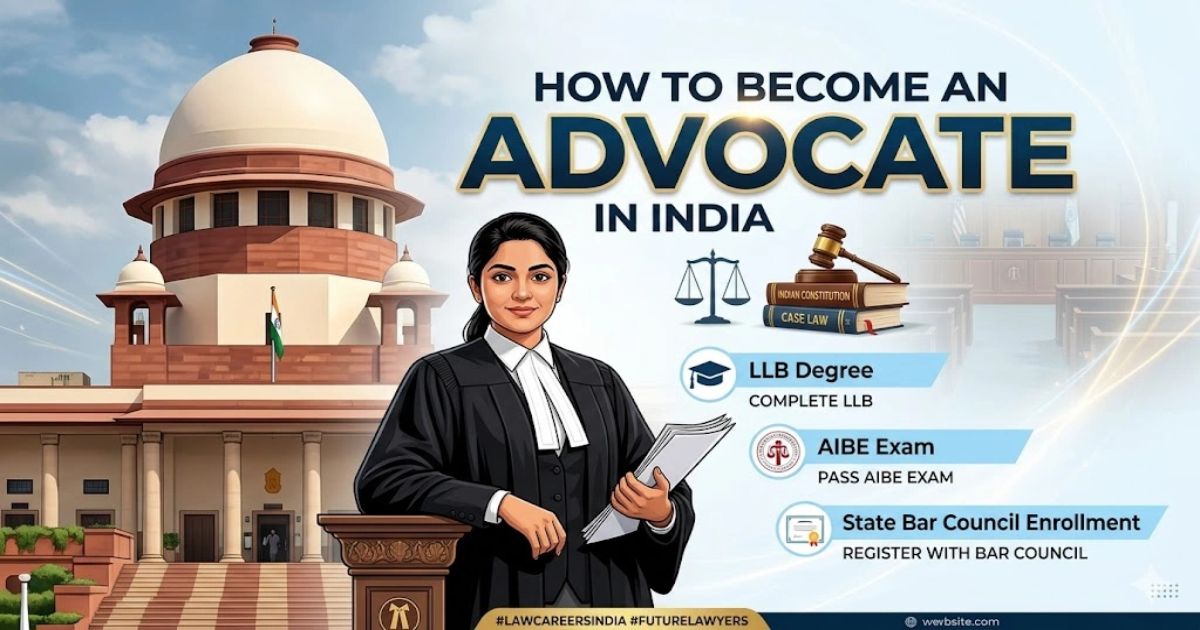
Becoming an Advocate in India: 2026 Eligibility, Education & Enrollment Process
An advocate is a lawyer registered with a State Bar Council and authorised to practice law. It takes 5-6 years after 12th to become an advocate. Find complete details on eligibility, Bar Council enrollment, career pathways and more here.
Understanding how to become an advocate in India by 2026 primarily involves completing a recognized law degree and successfully enrolling with a State Bar Council. An advocate is a lawyer who is enrolled with a State Bar Council and authorized to practice law. There are over 24 national law universities in India, with roughly 1.5 lakh lawyers produced annually. It takes roughly 5-6 years after 12th to become an advocate. The time taken depends on whether a candidate is pursuing a 3-year or 5-year LLB program after your 12th standard. This guide provides step-by-step instructions to become an advocate. Find eligibility, entrance requirements, Bar Council enrollment instructions, career pathways and more here.
Difference Between a Lawyer and an Advocate?
Although the terms are often used interchangeably, an advocate is a specific category of lawyer who is authorized to practice before courts after fulfilling Bar Council requirements.
| Basis | Lawyer | Advocate |
| Definition | A person who has completed a law degree (LLB). | A lawyer who is enrolled with a State Bar Council and authorized to practice law. |
| Court Representation | May provide legal advice, research, drafting, and consultancy services. | Can represent and argue cases before courts and tribunals. |
| Bar Council Enrollment | Not mandatory for all legal roles. | Mandatory. |
| AIBE Requirement | Not necessarily required for non-litigation legal careers. | Must satisfy applicable AIBE requirements to obtain a Certificate of Practice (CoP). |
| Typical Career Areas | Corporate legal departments, legal consultancy, academia, research, compliance. | Litigation, court practice, legal representation, advocacy before courts. |
| Relationship | Not every lawyer is an advocate. | Every advocate is a lawyer. |
Eligibility to Become an Advocate in India by 2026
To become an advocate in India, candidates must obtain a recognized law degree and meet the enrollment requirements prescribed by the Bar Council of India and State Bar Councils.
| Eligibility Requirement | Details |
| Citizenship | Generally, Indian citizens are eligible to enroll as advocates under the Advocates Act, 1961. |
| Minimum Age | Candidates must be at least 21 years old at the time of enrollment with a State Bar Council. |
| Upper Age Limit | There is no upper age limit for enrollment as an advocate. |
| Educational Qualification | Complete a 3-Year LLB after graduation or a 5-Year Integrated LLB after Class 12. |
| Recognized Law Degree | The LLB degree must be obtained from a Bar Council of India (BCI)-recognized law institution. |
| Academic Stream | Students from any stream (Science, Commerce, Humanities, etc.) are eligible to pursue law. |
| State Bar Council Enrollment | After obtaining the LLB degree, candidates must enroll with a State Bar Council. |
| AIBE Requirement | Advocates must satisfy the applicable All India Bar Examination (AIBE) requirements to obtain a Certificate of Practice (CoP). |
People Also Read




Step-by-Step Guide to Becoming An Advocate
After building a strong educational foundation and gaining initial practical insights, the journey to becoming a certified advocate involves several critical regulatory and professional milestones. These subsequent steps ensure formal authorization and continuous professional development.
| Step | Description |
| Step 1: Enroll with State Bar Council | Register within six months of LLB completion; submit documents for provisional enrollment. |
| Step 2: Complete Internship/Training | Undergo a one-year internship with a practicing advocate (if required). |
| Step 3: Clear All India Bar Exam (AIBE) | Pass this mandatory BCI exam to receive your Certificate of Practice. |
| Step 4: Receive Certificate of Practice (CoP) | Formally authorizes you to practice law as an advocate in India. |
| Step 5: Begin Practice under Senior Advocate | Learn courtroom protocol, drafting, and client management from experienced professionals. |
| Step 6: Continuing Legal Education (CLE) | Participate in ongoing programs to stay updated and enhance professional skills. |
Bar Council Enrollment Process for Advocates in India 2026
Bar Council Enrollment is the first step towards obtaining a Certificate of Practice (CoP). The steps for Bar Council Enrollment are detailed below:
| Step | Process | Key Details (2026) |
| 1. Complete an LLB Degree | Obtain a 3-year or 5-year LLB degree from a BCI-recognized law college/university. | Only graduates from BCI-recognized institutions are eligible for enrollment and AIBE. |
| 2. Apply to a State Bar Council | Submit an enrollment application to the State Bar Council where you wish to enroll as an advocate. | State Bar Councils conduct enrollment under the Advocates Act, 1961. |
| 3. Submit Required Documents | Upload or submit educational and identity documents. | Commonly required documents include LLB degree/provisional degree, semester marksheets, Class 10 & 12 certificates, ID proof, photographs, affidavit, and address proof. Requirements may vary by State Bar Council. |
| 4. Verification of Documents | The Enrollment Committee scrutinizes the application and verifies credentials. | State Bar Councils may conduct physical or online verification. Several councils have introduced digital enrollment systems. |
| 5. Enrollment Approval | After successful verification, the candidate’s name is entered on the State Roll of Advocates. | Once enrolled, the candidate becomes an advocate enrolled with the State Bar Council. |
| 6. Register for AIBE | Apply for the All India Bar Examination conducted by the Bar Council of India. | The AIBE is the national certification examination for advocates. In 2026, the BCI announced that AIBE would be conducted twice a year. |
| 7. Clear the AIBE | Pass the AIBE to demonstrate basic professional competence and legal knowledge. | AIBE XXI (2026) was scheduled for 7 June 2026. |
| 8. Obtain Certificate of Practice (CoP) | After satisfying AIBE requirements, advocates receive the necessary authorization to practice law. | The Certificate of Practice enables advocates to appear before courts and tribunals across India. |
| 9. Begin Legal Practice | Start practicing independently, join a law firm, or work under a senior advocate. | Advocates can practice in courts throughout India subject to applicable rules. |
AIBE Exam
Exam Overview
| Particulars | Details |
| Exam Name | All India Bar Examination (AIBE) |
| Conducting Body | Bar Council of India |
| Exam Mode | Offline (Pen-and-Paper, OMR-based) |
| Question Type | Multiple Choice Questions (MCQs) |
| Total Questions | 100 |
| Total Marks | 100 |
| Marks per Question | 1 Mark |
| Negative Marking | No Negative Marking |
| Exam Duration | 3 Hours 30 Minutes (210 Minutes) |
| Number of Subjects | 19 Law Subjects |
| Qualifying Marks (General/OBC) | 45 out of 100 |
| Qualifying Marks (SC/ST/PwD) | 40 out of 100 |
| Language Options | English, Hindi, and selected regional languages |
| Bare Acts Allowed | Yes, unmarked and unannotated bare acts are permitted |
| Purpose of Exam | Qualifying examination for obtaining a Certificate of Practice (CoP) |
| Frequency | Conducted twice a year from 2026 onwards |
Major Subjects
| Subject Area | Approximate Questions |
| Constitutional Law | 10 |
| Civil Procedure Code (CPC) | 10 |
| Criminal Procedure Code (CrPC/BNSS) | 10 |
| Indian Penal Code (IPC/BNS) | 8 |
| Evidence Law (Evidence Act/BSA) | 8 |
| Family Law | 8 |
| Contract Law & Related Laws | 8 |
| Torts, Motor Vehicles & Consumer Protection | 5 |
| Administrative Law | 4 |
| Labour & Industrial Laws | 4 |
| Professional Ethics | 4 |
| Taxation Law | 4 |
| Public International Law | 4 |
| ADR, Company Law, Environmental Law, Cyber Law, IPR, Land Acquisition | Remaining questions |
3 year or 5 year LLB: Which Course to Choose to Become an Advocate?
Both the 3-year LLB and 5-year integrated LLB qualify graduates to enroll with a State Bar Council and become advocates in India; the right choice depends primarily on your educational stage and career goals.
| Course | Choose If You’re… |
| 5-Year Integrated LLB (BA LLB, BBA LLB, BCom LLB, etc.) | A Class 12 student who has already decided to pursue law as a career and wants to start legal education immediately after school. |
| 5-Year Integrated LLB | Interested in combining legal studies with subjects such as humanities, business, management, commerce, or economics. |
| 5-Year Integrated LLB | Seeking longer exposure to internships, moot courts, legal aid clinics, and campus recruitment opportunities. |
| 5-Year Integrated LLB | Preparing for admission through law entrance exams such as CLAT, AILET, SLAT, or university-specific tests. |
| 3-Year LLB | Already a graduate in any discipline (BA, BCom, BSc, BTech, BBA, etc.) and looking to qualify as an advocate. |
| 3-Year LLB | Considering a career switch to law after completing another bachelor’s degree. |
| 3-Year LLB | Interested in entering the legal profession without spending an additional five years on an integrated programme. |
| 3-Year LLB | Planning to leverage your existing academic background alongside legal qualifications, such as engineering, commerce, management, or science. |
| Either Course | Your ultimate goal is to become an advocate, appear for the All India Bar Examination (AIBE), and practice law in courts. Both pathways are recognized for legal practice. |
| Either Course | You are interested in careers such as litigation, corporate law, judiciary preparation, legal consulting, compliance, arbitration, or public service. |
Entrance Exams Required to Become an Advocate
Popular entrance exams for law include CLAT, AILET, SLAT and CUET among others. Here is a quick overview of the most popular law entrances in India with dates and other details:
| Exam | Required For | Course Level | Conducting Body | When to Take | 2026 Exam Date / Status |
| Common Law Admission Test (CLAT) | Admission to National Law Universities (NLUs) and participating law schools | 5-Year LLB, LLM | Consortium of National Law Universities | After Class 12 | 7 December 2025 (for 2026 admissions) |
| All India Law Entrance Test (AILET) | Admission to BA LLB (Hons.) and other law programmes at NLU Delhi | 5-Year LLB, LLM | NLU Delhi | After Class 12 | 14 December 2025 (for 2026 admissions) |
| Common University Entrance Test (CUET PG) | Admission to 3-Year LLB programmes at universities such as the University of Delhi and certain other participating institutions | 3-Year LLB | National Testing Agency (NTA) | After Graduation | Conducted in March 2026; results declared on 24 April 2026 |
| Symbiosis Law Admission Test (SLAT) | Admission to law programmes at Symbiosis International University law schools | 5-Year LLB | Symbiosis International (Deemed University) | After Class 12 | 20 December 2025 and 28 December 2025 |
| Law School Admission Test—India (LSAT—India) | Previously accepted by several private law schools; candidates should verify current admission policies | 5-Year LLB, 3-Year LLB | Various institutions | As per institution requirements | No nationwide 2026 schedule applicable; acceptance varies by institution |
| MHT CET Law | Admission to law colleges in Maharashtra | 3-Year LLB, 5-Year LLB | State Common Entrance Test Cell Maharashtra | After Class 12 or Graduation | 3-Year LLB: 1–2 April 20265-Year LLB: 8 May 2026 |
| AP LAWCET | Admission to law colleges in Andhra Pradesh | 3-Year LLB, 5-Year LLB | Andhra Pradesh State authorities | After Class 12 or Graduation | 2026 dates to be announced |
| TS LAWCET | Admission to law colleges in Telangana | 3-Year LLB, 5-Year LLB | Telangana State authorities | After Class 12 or Graduation | 2026 dates to be announced |
| University-Specific Law Entrance Tests | Admission to individual universities such as law schools under private and state universities | 3-Year LLB, 5-Year LLB | Respective universities | Varies by institution | Dates vary by university |
| All India Bar Examination (AIBE) | Mandatory certification for legal practice after obtaining an LLB and enrolling with a State Bar Council | Post-LLB | Bar Council of India | After LLB completion | 2026 examination schedule not yet announced |
Timeline: How Many Years It Would Take to Become an Advocate?
It takes 5-6 years on average to become an advocate after 12th. The major point of difference is the choice between a 3-year and a 5-year LLB course. Take a look at the complete timeline below:
| Stage | After Class 12 (5-Year LLB Route) | After Graduation (3-Year LLB Route) |
| Complete Class 12 | Completed | Completed |
| Bachelor’s Degree | Not required | 3 years |
| LLB Degree | 5 years | 3 years |
| State Bar Council Enrollment | 1–3 months | 1–3 months |
| AIBE Registration & Qualification | Typically 3–12 months | Typically 3–12 months |
| Certificate of Practice (CoP) | Issued after fulfilling applicable AIBE requirements | Issued after fulfilling applicable AIBE requirements |
| Total Time to Become an Advocate | Approximately 5.5–6 years after Class 12 | Approximately 6.5–7 years after Class 12 |
Law Career Path After 12th in India: 2026 Roadmap
It takes approximately 5.5 years to become a qualified advocate. India’s legal services market is experiencing over 30% annual growth, offering a robust career path for aspiring lawyers. Here are some popular job roles with salary ranges:
| Job Role | Key Recruiters | Average Salary Range (₹ per annum) |
| Advocate / Litigator | Independent practice, litigation chambers, district courts, High Courts, Supreme Court chambers | ₹3–8 LPA (initial years); can increase substantially with experience and clientele |
| Corporate Lawyer | Cyril Amarchand Mangaldas, AZB & Partners, Khaitan & Co, Trilegal | ₹6–22 LPA for freshers; higher at Tier-1 law firms |
| Legal Associate | Law firms, consulting firms, legal process outsourcing companies | ₹4–12 LPA |
| In-House Legal Counsel | Reliance Industries, Tata Group, Infosys, HDFC Bank | ₹8–25 LPA (entry to mid-level) |
| Judicial Services Officer (Civil Judge) | State Judicial Services | ₹8–15 LPA (including allowances) |
| Public Prosecutor / Assistant Public Prosecutor | State Governments, Prosecution Departments | ₹6–12 LPA |
| Legal Officer | Banks, PSUs, Insurance Companies, Regulatory Bodies | ₹7–15 LPA |
| Compliance Officer | Banks, FinTech companies, MNCs, listed companies | ₹6–18 LPA |
| Intellectual Property (IP) Lawyer | IP law firms, technology companies, pharmaceutical companies | ₹6–20 LPA |
| Legal Consultant | Consulting firms, corporates, NGOs, international organizations | ₹5–15 LPA |
Mandatory Internships & Practical Training for Aspiring Advocates 2026
Aspiring advocates must complete a mandatory internship or training program under a working advocate as a crucial step in the enrollment process. This section details the essential practical training requirements for how to become an advocate, including specific durations and the experience needed for higher roles like Advocate-on-Record.
- Mandatory Training: Aspiring advocates must complete an internship under a working advocate for enrollment.
- Training Purpose: Imparts practical knowledge of courtroom procedures, client interaction, drafting, and legal practice aspects.
- Typical Duration: Training typically lasts 1 year, but varies by state.
- AOR Obligatory Training: A 1-year training under a working AOR is required for Advocate-on-Record status.
- AOR Practice Experience: Qualify as AOR with 4 years active legal practice after State Bar Council enrollment.
Frequently Asked Questions
1. What qualifications are required to become an advocate in India?
To become an advocate, you must complete a 3-year LLB after graduation or a 5-year integrated LLB after Class 12 from a Bar Council of India (BCI)-recognized institution, enroll with a State Bar Council, and fulfill the applicable AIBE requirements.
2. What is the difference between a lawyer and an advocate?
A lawyer is anyone who has obtained an LLB degree, whereas an advocate is a lawyer who has enrolled with a State Bar Council and is authorized to represent clients before courts and tribunals.
3. Which entrance exams are required for admission to law courses?
Popular law entrance exams include CLAT, AILET, SLAT, MHT CET Law, AP LAWCET, TS LAWCET, and CUET PG (for several 3-year LLB programmes). The exam required depends on the law college and course you choose.
4. How many years does it take to become an advocate after Class 12?
Students pursuing a 5-year integrated LLB typically become advocates in about 5.5–6 years, including enrollment and AIBE requirements. Those opting for a 3-year LLB after graduation generally take about 6.5–7 years from Class 12.
5. Is the All India Bar Examination (AIBE) mandatory?
Yes. After enrolling with a State Bar Council, advocates must satisfy the applicable AIBE requirements prescribed by the Bar Council of India to obtain a Certificate of Practice (CoP) and continue their professional legal practice.
6. Can students from Science or Commerce backgrounds become advocates?
Yes. There is no mandatory stream requirement for law admissions. Students from Science, Commerce, Humanities, and other educational backgrounds can pursue a 5-year integrated LLB after Class 12 or a 3-year LLB after graduation.
7. Can I become an advocate without appearing for CLAT?
Yes. CLAT is only one of several law entrance exams. Many universities admit students through AILET, SLAT, MHT CET Law, CUET PG, state-level law entrance tests, or university-specific admission processes. Passing CLAT is not mandatory to become an advocate.








![Ph.D in Law Eligibility 2026 – [College Name]](https://articles.findmycollege.com/wp-content/uploads/2026/07/phd-in-law-eligibility-criteria-2026-cover-768x403.jpg)