
B.Sc Bioinformatics Syllabus and Semester-Wise Subjects
Nishit Kumar is a senior EdTech industry leader with over a decade of experience in building and scaling education platforms, shaping their product, content, and growth strategy. At…
B.Sc Bioinformatics is a 3-year (6-semester) undergraduate degree that integrates biological sciences with computer science, mathematics, and statistics.
Students planning to pursue this degree can review the detailed semester-wise curriculum, core and elective subjects, practical laboratory requirements, recommended textbooks, top colleges, fee structures, and step-by-step admission guidelines below.
| Parameter | Details |
|---|---|
| Course Duration | 3 Years (6 Semesters) |
| Eligibility Criteria | 10+2 with Biology / Science stream and 40% to 50% aggregate marks |
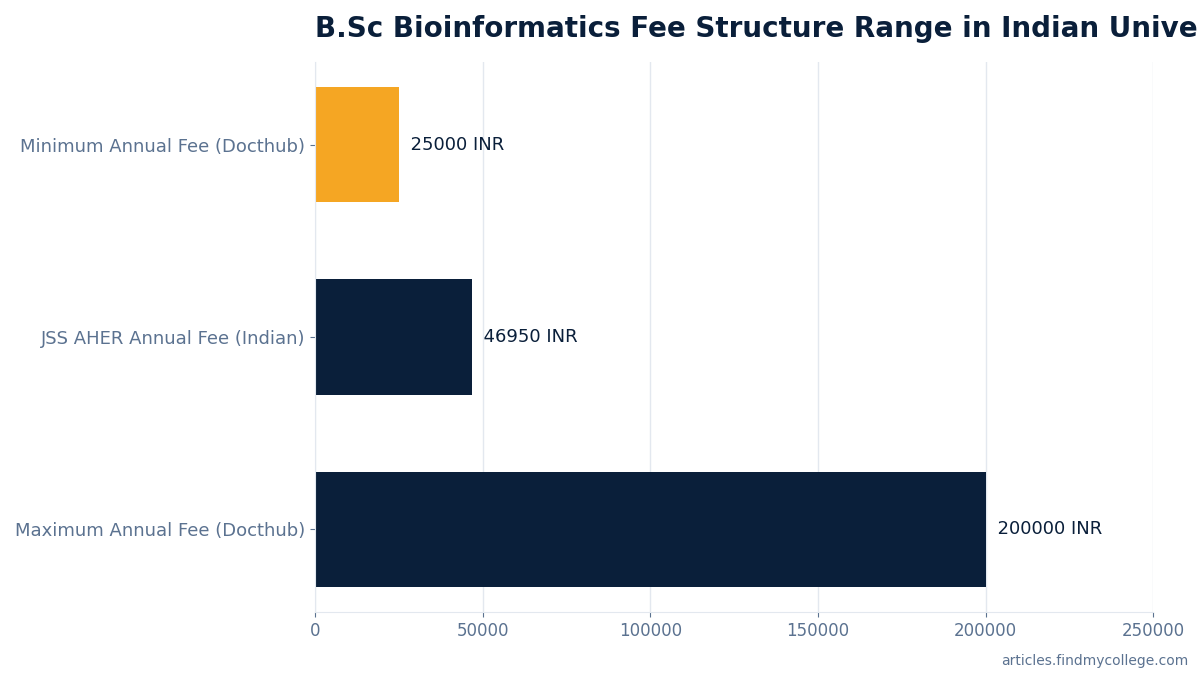
| Average Course Fee | INR 25,000 – INR 2,00,000 per year (INR 46,950/year at JSS AHER) |
| NRI Course Fee (JSS AHER) | USD 1,350 per year |
| Average Graduate Salary | INR 5 – 8 LPA (Average ~INR 6,20,000 per year) |
| Core Curricular Domains | Biology, Computer Science, Data Science, and Mathematics |
B.Sc Bioinformatics Subjects Year-wise
The three-year academic journey transitions from foundational biological concepts to advanced computational models. Universities design the course structure across six distinct semesters to combine lecture-based theory with hands-on laboratory modules.
First-Year Subjects (Semesters 1 and 2)
First-year coursework introduces basic biological systems, cell biology, genetics fundamentals, biomathematics, and information technology.
| Semester | Subject Code / Type | Subject Title | Core Learning Objective |
|---|---|---|---|
| Semester 1 | Core / Foundation | Introduction to Information Technology | Evolution of computing hardware, software, OS, and computer networks |
| Semester 1 | Core Course | Fundamentals of Biological Systems / Cell Biology | Structure of prokaryotic & eukaryotic cells, cell transport, organelles |
| Semester 1 | Core Course | Fundamentals of Genetics | Mendelian laws, genetic terminology, allelic interactions, and mutations |
| Semester 2 | Core Course | Introduction to Bioinformatics | Overview of computational biology tools, scope, and BLAST applications |
| Semester 2 | Core Course | General Microbiology | Microbial diversity, growth kinetics, and viral genome organization |
| Semester 2 | Core Course | Biochemistry & Biophysics | Chemical forces, peptide structures, thermodynamic laws, and kinetics |
| Semester 2 | Allied Course | Biomathematics / Discrete Structures | Set operations, matrices, vectors, and linear algebra fundamentals |
| Semester 2 | Practical | Practical II: Biochemistry & Microbiology | Qualitative analysis of biomolecules, microbial staining, and tools |
Second-Year Subjects (Semesters 3 and 4)
Second-year subjects transition into core computing and biophysics, covering programming languages, database systems, biostatistics, and recombinant DNA technology. Students learn to handle structural databases and write software scripts for data extraction.
| Semester | Subject Title | Subject Type | Key Topics Covered |
|---|---|---|---|
| Semester 3 | Advanced Biocomputing | Core Theory | Algorithmic thinking, data structures, and high-performance computing |
| Semester 3 | Introduction to Programming in C | Core Theory | Control structures, functions, arrays, pointers, and file operations |
| Semester 3 | Physiology and Biochemistry | Core Theory | Metabolic pathways, cell energetics, respiration, and enzymatic activity |
| Semester 3 | Immunology & Immunotechnology | Core Theory | Immune system components, antigen-antibody interactions, immunoinformatics |
| Semester 3 | Organic & Physical Chemistry | Allied Course | Chemical bonding, functional groups, and analytical chemistry principles |
| Semester 4 | Databases & DBMS in Biology | Core Theory | Relational database concepts, SQL, biological databanks (NCBI, PDB) |
| Semester 4 | Biostatistics & Operations Research | Core Theory | Probability distributions, correlation, linear regression, hypothesis testing |
| Semester 4 | Plant & Animal Biotechnology | Core Theory | Recombinant DNA techniques, tissue culture, genetic engineering concepts |
| Semester 4 | Practical IV | Core Practical | C Programming lab, database management, and structural visualization |
Third-Year Subjects (Semesters 5 and 6)
Third-year modules advance into high-level computational biology, functional genomics, web programming, and molecular modelling. The final semester culminates in drug design simulations and a capstone research project submission.
| Semester | Subject Title | Subject Type | Curriculum Focus |
|---|---|---|---|
| Semester 5 | Molecular Biology | Core Theory | DNA replication, transcription, translation, and gene regulation |
| Semester 5 | Proteomics & Functional Genomics | Core Theory | Proteome analysis tools, 2D gel electrophoresis, mass spectrometry |
| Semester 5 | Web Programming & Perl | Core Theory | Perl scripting, CGI, web interface construction for biological data |
| Semester 5 | Microbiology & Immunology | Core Theory | Pathogen genetics, diagnostic assays, immunoinformatics principles |
| Semester 5 | Open Elective Course | Elective | Basic Bioinformatics Concepts & Biological Databases for non-majors |
| Semester 6 | Molecular Modelling & Drug Designing | Core Theory | Molecular docking, QSAR models, ligand-target interaction analysis |
| Semester 6 | Applied Bioinformatics | Core Theory | Next-generation sequencing (NGS) data processing, systems biology |
| Semester 6 | Choice-Based Elective | Elective Paper | Advanced domain topic selected by student |
| Semester 6 | Practical VI & Lab Tools | Core Lab | Drug design simulations, Perl/DBMS scripting, advanced tools |
B.Sc Bioinformatics Electives and Specialisations
Undergraduate bioinformatics degree programs offer elective papers alongside core coursework. Standard elective options include Biotechniques, Genetics and Evolution, Biophysical Sciences, and Computer Applications in Biology. Specialisations allow candidates to align their academic output with specific industry sub-sectors.
| Specialisation Domain | Core Subjects / Focus Areas | Domain Details |
|---|---|---|
| Sequence Analysis & Structure | DNA/RNA Structure, Protein Sequencing | Focuses on decoding hidden structural patterns in nucleic acids and proteins. |
| Metabolic Computing | Metabolic Networks, Synthetic Lethality | Compares metabolic activities and biochemical network pathways across organisms. |
| Biological Data Mining | Gene Finding, Disease Prognosis | Applies data science techniques to identify disease markers and gene networks. |
| Chemoinformatics & Drug Design | Molecular Docking, QSAR, Ligand Analysis | Employs computational models to design novel therapeutic molecules. |
B.Sc Bioinformatics Practicals and Projects
Practical laboratory training forms a fundamental component of the undergraduate curriculum. Practical examinations in Year 1 involve basic techniques in cell biology, tissue identification, squash preparation for mitosis and meiosis, biomolecule testing, and software applications in MS Office.
Advanced lab sessions across later semesters cover qualitative tests for biomolecules, microbial staining, isolation of nucleic acids, C programming, database manipulation using SQL, and protein structure visualization. In the final year, candidates execute practical work in molecular docking, Perl scripting, and Next-Generation Sequencing (NGS) data processing, concluding with an independent research project report, poster presentation, and oral viva voce examination.
Books for B.Sc Bioinformatics
| Book Title | Author(s) | Key Coverage Area |
|---|---|---|
| Beginning Perl for Bioinformatics | James Tisdall | Bioinformatics Programming |
| Developing Bioinformatics Computer Skills | Cynthia Gibas, Per Jambeck | Computer Skills |
| Structural Bioinformatics | Philip E. Bourne, Helge Weissig | Structural Analysis |
| Introduction to Protein Structure | Carl-Ivar Branden, John Tooze | Structural Analysis |
| Scientific Research Methodology | Biju Dharmapalan | Research Methodology |
Recommended authors include James Tisdall, Cynthia Gibas, Per Jambeck, and B. Alberts et al.
B.Sc Bioinformatics Colleges and Fee Structure
| College | City | Ownership | Total course fee | NIRF rank |
|---|---|---|---|---|
| Saveetha Institute of Medical and Technical Sciences | Chennai | — | ₹5.00 lakh | 13 (Overall, 2025) |
| University of Hyderabad | Hyderabad | — | ₹55,220 | 18 (Overall, 2025) |
| JSS Academy of Higher Education & Research | Mysore | — | ₹1.41 lakh | 21 (Overall, 2025) |
| Bharathidasan University | Tiruchirappalli | — | ₹1.88 lakh | 36 (Overall, 2025) |
| Bishop Heber College | Tiruchirappalli | Private (aided) | ₹1.80 lakh | 46 (Overall, 2025) |
| Holy Cross College (Autonomous) Tiruchirappalli | Tiruchirappalli | Private (aided) | — | 52 (Overall, 2025) |
| Sathyabama Institute of Science and Technology | Chennai | — | ₹2.03 lakh | 53 (Overall, 2025) |
| Sri Ramachandra Institute of Higher Education and Research | Chennai | — | ₹4.05 lakh | 60 (Overall, 2025) |
| College | City | Ownership | Total course fee |
|---|---|---|---|
| Government Holkar Science College | Indore | Government | ₹56,800 |
| Post Graduate Government College | Chandigarh | Government | ₹78,195 |
| BJB Autonomous College | Bhubaneswar | Government | ₹1.00 lakh |
At least 78 colleges offer B.Sc Bioinformatics (government 4, private 22). Private colleges report a median total course fee of ₹78,210, with the middle half ranging between ₹67,716 and ₹1.25 lakh among 14 institutions with published fee structure data.
How to Apply for B.Sc Bioinformatics Admission in 2026: Step by Step
- Check Eligibility Criteria: Ensure completion of 10+2 with Science stream (Physics, Chemistry, and Biology/Mathematics) with a minimum aggregate score of 40% to 50%.
- Submit College / University Application: Apply through the official portal of target institutions (e.g., JSS AHER, Mahatma Gandhi University, Bharathidasan University, or DU) submitting academic transcripts.
- Appear for Entrance Exam (If Applicable): Participate in university-specific entrance examinations or merit-based screening tests conducted by the respective admission authority.
- Pay Course Fees to Confirm Admission: Deposit the annual tuition fee (ranging from INR 25,000 to INR 2,00,000 depending on the college, or INR 46,950/year at JSS AHER).
| What to do | Where | Link |
|---|---|---|
| Compare colleges, fees and cutoffs | B.Sc Bioinformatics colleges in India | findmycollege.com |
FAQs
How to join bioinformatics after 12th?
To join B.Sc Bioinformatics after 12th, pass your 10+2 higher secondary examination with Science (having Biology as a subject) securing at least 40% to 50% aggregate marks, and apply to eligible universities based on merit or entrance test.
Is bioinformatics a good career with a strong future?
Yes, bioinformatics has a strong future due to expanding applications in genomics, drug discovery, personalized medicine, and big data analysis in pharmaceutical, biotechnology, and healthcare IT industries.
What job roles can B.Sc Bioinformatics graduates pursue?
Graduates can pursue job roles such as Bioinformatics Analysts, Data Scientists, Computational Biologists, and Research Associates in pharmaceutical and biotechnology firms, research organizations, and healthcare IT industries.
What is the eligibility criteria for B.Sc Bioinformatics?
Candidates must have passed 10+2 or equivalent from a recognized board in the Science stream with Biology as a mandatory subject, achieving at least 40% to 50% aggregate marks.
What is the average starting salary after B.Sc Bioinformatics?
The average salary for bioinformatics graduates in India ranges between INR 5 LPA and INR 8 LPA, depending on individual skills and the employer.