Blockchain Technology Courses: Certification and Degree Programs
- 23 Mar 2026Blockchain Developer Salary Benchmarks Updated for Indian Tech Roles
Updated compensation data shows blockchain developers in India earn 50% to 100% higher packages than traditional software roles, ranging up to ₹45 LPA for senior talent.
Blockchain technology courses in India range from university degree programs (B.Tech/M.Tech/e-Masters) to online professional certifications, covering cryptography, smart contracts, Ethereum, and Hyperledger Fabric. Graduates earn average starting salaries of ₹3 LPA – ₹6 LPA for entry-level roles, scaling up to ₹15 LPA – ₹45 LPA for senior blockchain developers.
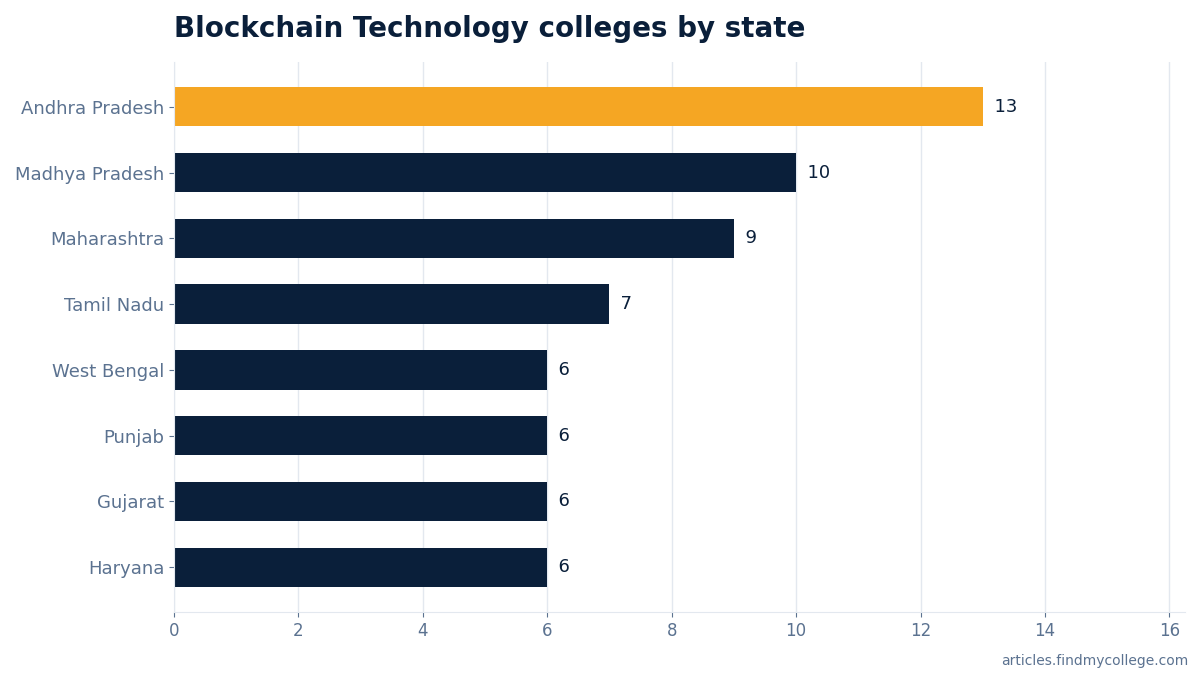
At least 86 colleges offer Blockchain Technology courses across India, with private university fees featuring a median total course fee of ₹3.04 lakh. This complete guide details degree tracks, professional certifications, fee structures, eligibility criteria, and career outcomes for aspiring blockchain professionals.
| Parameter | Details |
|---|---|
| Average Starting Salary | ₹3 LPA – ₹6 LPA (Entry-Level) |
| Mid-Level Salary Range | ₹10 LPA – ₹18 LPA (3-5 years experience) |
| IIT Kanpur CS731 Course Duration | 40 lecture hours (3 hours per week + projects) |
| IIT Kanpur Course Prerequisites | Programming expertise, computer security, cryptography, and networking |
| Online Certification Option (UniAthena) | Free learning with paid CIQ UK 20-credit PG Certificate option |
| Top Paying Specialization | NFT & DeFi Development (₹10 LPA – ₹22 LPA) |
List of Blockchain Technology
| Module Name | Topics Covered | Lecture Hours |
|---|---|---|
| Introduction & Distributed Record Keeping | Distributed record keeping, Nakamoto Consensus, Hash pointers, Byzantine Generals problem | 3 Hours |
| Basic Distributed Computing | Atomic broadcast, Consensus, Byzantine fault-tolerance models | 4 Hours |
| Basic Cryptographic Primitives | Collision-resistant hash functions, Digital signatures, Public key crypto, Zero-knowledge systems | 4 Hours |
| Blockchain 1.0 | Bitcoin operations, Proof of Work, Proof of Stake alternatives, Bitcoin scripting | 5 Hours |
| Blockchain 2.0 | Ethereum, Smart Contracts, Turing Completeness, Legal contract enforcement | 8 Hours |
| Blockchain 3.0 | Hyperledger Fabric, Plug-and-play consensus, Permissioned blockchain platforms | 8 Hours |
| Privacy & Security Issues | Pseudo-anonymity, Zcash, Zk-SNARKS, Sybil & 51% attacks, Algorand, Sharding | 8 Hours |
Blockchain technology spans multiple evolutionary phases, including Bitcoin (Blockchain 1.0), Ethereum (Blockchain 2.0), and Hyperledger Fabric (Blockchain 3.0). Specialized platforms such as Zcash and Algorand enhance anonymity preservation, consensus scalability, and network security.
Eligibility and Duration
Eligibility requirements for blockchain programs depend on the academic level and course type. Institutional degree modules, such as IIT Kanpur’s CS731 course, target Ph.D. scholars, Master’s students, 3rd and 4th year undergraduate engineering students, M.Tech enrollees, MS in Cyber Security students, and e-Masters candidates.
Course duration ranges from 40 lecture hours in targeted academic subjects to multi-year degree specializations. Candidates enrolled in rigorous academic tracks are required to build and deploy projects across at least three distinct blockchain development platforms. Professional short courses, such as UniAthena’s executive program, cater to broader audiences including technical professionals, supply chain managers, fintech startup leaders, and government personnel.
How to Choose
Choosing the right blockchain program depends on your current technical background and long-term career goals. Engineering students and computer science graduates seeking deep protocol-level expertise should opt for university degree specializations (B.Tech, M.Tech, MS in Cyber Security, or e-Masters). These programs provide essential grounding in Byzantine fault tolerance, zero-knowledge proofs, and multi-platform development across Ethereum, Hyperledger Fabric, and Bitcoin scripting.
Working professionals, fintech founders, and supply chain leads should evaluate short-term professional certifications, such as the 20-credit PG Certificate awarded by CIQ UK via UniAthena.
How to Apply for Blockchain Technology Admission in 2026: Step by Step
- Select Academic Track or Professional Certification: Choose between degree courses (B.Tech/M.Tech/MS in Cyber Security/e-Masters at IIT Kanpur) or online executive certifications (such as UniAthena CIQ UK PG Certificate).
- Register on Official Institute Portal: Apply directly on official institutional portals, such as the IIT Kanpur e-Masters enrollment portal or UniAthena online learning portal.
- Complete Hands-on Project Modules: Fulfill lecture module requirements (e.g. 40 lecture hours at IIT Kanpur) and build practical applications across at least 3 blockchain development platforms.
- Earn Certification and Academic Credits: Complete course evaluations and practical exams to earn academic course credits or claim a verified Postgraduate Certificate from awarding bodies like CIQ UK.
| What to do | Where | Link |
|---|---|---|
| Compare colleges, fees and cutoffs | Blockchain Technology colleges in India | findmycollege.com |
FAQs
Is blockchain a high paying job?
Yes. Blockchain developers in India earn 50% to 100% more than traditional tech roles. Entry-level packages range from ₹3 LPA to ₹6 LPA, while senior professionals command between ₹15 LPA and ₹45 LPA.
Is blockchain difficult to learn?
Blockchain requires a solid grounding in computer security, networking, cryptography, and programming.
What is the best certification for blockchain?
The best certification depends on your goal: university-level programs like IIT Kanpur’s CS731 / e-Masters offer deep technical mastery, while short courses like UniAthena’s CIQ UK 20-credit PG Certificate suit professionals seeking fast-track executive skills.
Is a career in blockchain worth it?
Yes. With companies like Amazon, IBM, and TCS actively hiring in India, specialized developers with expertise in Solidity, Hyperledger, or DeFi command high salaries ranging from ₹8 LPA up to ₹22 LPA.
What are the eligibility criteria for blockchain courses?
Eligibility varies: university courses like IIT Kanpur CS731 require 3rd/4th year UG or PG standing with programming and security prerequisites, while short online certifications accept technical and non-technical professionals alike.
Which top companies hire blockchain developers in India?
Leading employers in India include Amazon (₹12–20 LPA), IBM (₹10–18 LPA), TCS (₹8–16 LPA), Accenture (₹8–15 LPA), Cognizant (₹8–14 LPA), and Infosys (₹7–14 LPA).