QA Job Qualifications: Educational Requirements and Skills
To meet QA job qualifications, candidates typically need a bachelor’s or master’s degree in a related field, strong knowledge of software testing methodologies, SQL, and automation tools like Selenium, JIRA, and Postman. Freshers are eligible for entry-level roles with average starting salaries around ₹3,00,000 per annum.
Below is a breakdown of educational eligibility, core testing skills, job roles, full-stack testing responsibilities, experience-wise salaries, top hiring employers, and the complete step-by-step career pathway for quality assurance engineers.
| Parameter | Details |
|---|---|
| Educational Eligibility | Bachelor’s or Master’s degree in a related field |
| Fresher Eligibility | Freshers welcomed by many IT and software companies |
| Entry-Level Salary (1 Year) | ₹3,00,000 per annum (average) |
| Mid-Career Salary (5-9 Years) | ₹6,00,000 per annum (average) |
| Experienced Salary (10-19 Years) | ₹17,00,000 per annum (average) |
| Top Employers | Amazon, Oracle, Fidelity Investments, TCS, Dassault Systems, HCL |
| Core Automation Tools | Selenium, Cypress, JUnit, TestNG, UFT/QTP, Katalon |
| Core API & Back-End Tools | Postman, RestAssured, SOAP UI, JMeter |
What is Software Testing & QA
Quality Assurance (QA) and software testing focus on evaluating software applications to verify that they meet product specifications and operate cleanly without defect. A Quality Assurance Engineer ensures that software products pass rigorous testing cycles before deployment to live production environments.
Full Stack QA Experts evaluate the complete software stack. This includes front-end UI/UX user interface testing, back-end server architecture, database validation, and application programming interfaces (APIs). Modern QA practices combine manual test execution with automated testing frameworks, performance testing, continuous integration pipelines, and defect management systems across the Software Development Life Cycle (SDLC).
Software Testing & QA Eligibility
- Educational Qualification: A bachelor’s or master’s degree in a related field is the standard qualification required for a QA Engineer.
- Fresher Opportunity: Freshers are welcomed by many tech companies for entry-level QA engineer positions.
- Prior Experience: Prior experience in application development and quality assurance can help candidates stand out in the job market and earn higher salaries.
Tech companies frequently welcome freshers for entry-level QA engineer roles. A bachelor’s or master’s degree in a related field provides the standard educational qualification for entering this career path.
Software Testing & QA Syllabus and Subjects
Mastering quality assurance requires technical expertise across manual testing concepts, test automation frameworks, database manipulation, and project management applications. Candidates must understand SDLC phases, Agile methodologies, black-box testing, white-box testing, and regression testing protocols.
The primary tools and technical skill categories required for QA engineering qualifications are outlined below:
| Category | Tools & Methodologies |
|---|---|
| Front-End & UI Testing | Selenium, Cypress, JUnit, TestNG, UFT/QTP, Katalon, Microsoft Coded UI, Watir, Ruby, Cucumber |
| Back-End & API Testing | Postman, SOAP UI, RestAssured, SQL, Database testing |
| Performance & Load Testing | JMeter |
| Defect & Project Tracking | JIRA, HP ALM, Azure DevOps / TFS |
| Build & CI/CD Pipelines | Jenkins, GitLab CI |
| Methodologies | Agile Development, Black-box testing, White-box testing, Regression testing, SDLC |
Core Job Roles and Responsibilities in Quality Assurance
| Role Title | Primary Responsibilities |
|---|---|
| Test Analyst | Tests static requirements to verify completeness and accuracy of product specifications. |
| Test Designer | Develops comprehensive test case sets and sets up test environments. |
| Test Executor | Executes test cases, logs software defects, and outlines methods to reproduce or resolve bugs. |
| Test Manager | Supervises team testing tasks, controls requirements, ensures deadlines are met, and communicates with stakeholders. |
| Full Stack QA Expert | Manages end-to-end testing across front-end UI, back-end APIs, databases, servers, and CI/CD pipelines. |
Software quality assurance encompasses distinct roles including Test Analysts, Test Designers, Test Executors, Test Managers, and Full Stack QA Experts. Each role carries dedicated responsibilities ranging from requirement verification to end-to-end system testing.
Essential Soft Skills and Analytical Competencies for QA Engineers
Clear communication and precise documentation ensure that defect reports contain reproduction steps that help development teams isolate and resolve errors quickly:
| Skill Name | Importance in QA Engineering |
|---|---|
| Analytical Skills | Critical thinking to identify flaws, risk assessment, and detailed requirement analysis. |
| Problem-Solving | Identifying root causes of software bugs and assisting developers in defect resolution. |
| Communication Skills | Conveying technical and non-technical issues clearly to developers and business stakeholders. |
| Documentation | Writing step-by-step test cases, defect reports, and test execution progress logs. |
| Time Management | Managing test timelines to align with release schedules and tight project deadlines. |
| Teamwork & Adaptability | Collaborating with product managers and developers while adapting to changing tools. |
Software Testing & QA Career Scope and Salary
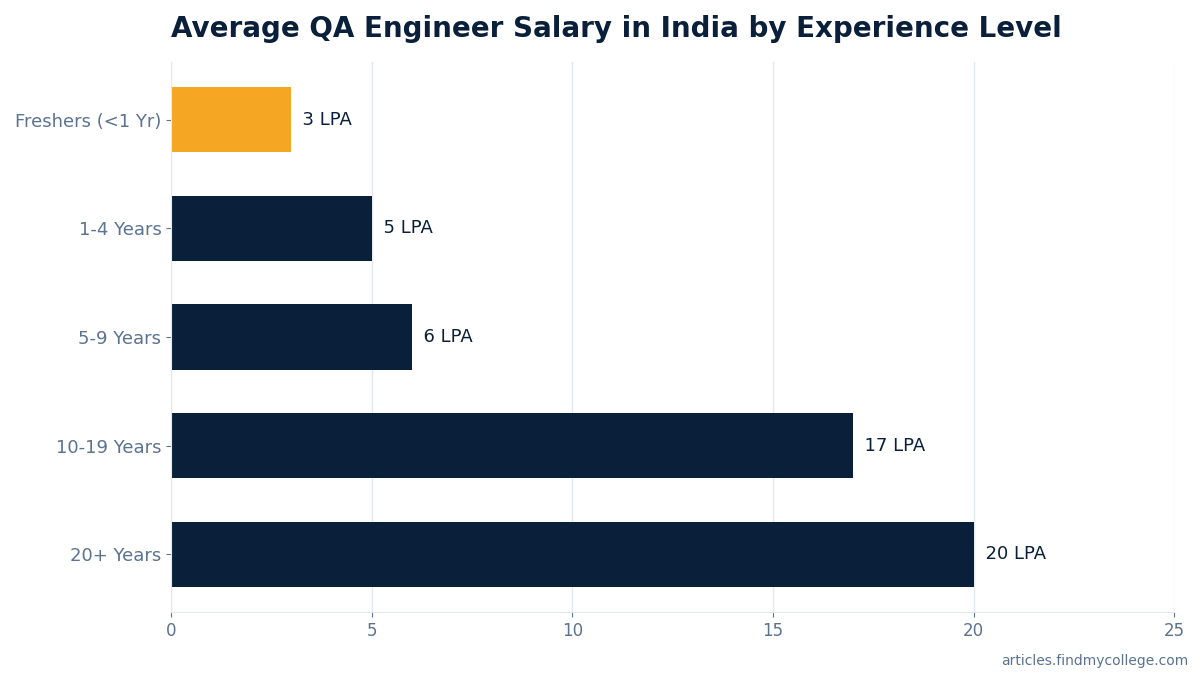
A career in quality assurance provides predictable salary growth as candidates accumulate hands-on experience in test automation, performance tuning, and test project management. Entry-level QA Engineers with less than a year of experience start with an average annual salary of ₹3,00,000.
Average annual compensation across experience tiers in India is structured as follows:
| Experience Level | Years of Experience | Average Salary (per annum) |
|---|---|---|
| Entry-Level / Fresher | Less than 1 year | ₹3,00,000 |
| Early-Career | 1 – 4 years | ₹5,00,000 |
| Mid-Career | 5 – 9 years | ₹6,00,000 |
| Experienced | 10 – 19 years | ₹17,00,000 |
| Late-Stage | 20+ years | ₹20,00,000 and above |
Remuneration levels also vary based on employer scale, tech specialization, and domain requirements. Major technology companies and global IT service firms offer competitive compensation packages for qualified test engineers:
| Employer Name | Average Salary (INR / Year) |
|---|---|
| HCL Technologies Ltd. | ₹2,53,000 |
| Flextronics International | ₹2,55,500 |
| Synerzip | ₹3,50,000 |
| Tata Consultancy Services Ltd (TCS) | ₹4,64,516 |
| Dassault Systems Inc. | ₹5,71,402 |
| Fidelity Investments | ₹6,82,609 |
| Amazon.com Inc. | ₹8,24,000 |
How to Apply for Software Testing & QA Admission in 2026: Step by Step
- Learn Software Testing Fundamentals: Understand SDLC, test planning, manual testing techniques, black-box/white-box testing, defect logging, and regression testing.
- Master Database & Scripting Languages: Learn basic computer programming, SQL scripting, and database manipulation techniques to perform back-end verification.
- Gain Expertise in Automation Tools: Learn automated testing frameworks such as Selenium, Cypress, JUnit, or TestNG, alongside API testing tools like Postman and SOAP UI.
- Build Real-World Testing Projects: Gain practical experience by creating end-to-end automated test suites for web applications or contributing to open-source software.
- Apply for Entry-Level QA Positions: Prepare a targeted QA resume listing technical tools (Selenium, JIRA, SQL) and apply for entry-level QA Engineer, Test Analyst, or Test Executor roles.
| What to do | Where | Link |
|---|---|---|
| Compare colleges, fees and cutoffs | Software Testing & QA colleges in India | findmycollege.com |
FAQs
What qualifications do you need to be a quality assurance officer?
What do I need to be a QA?
To become a QA engineer, you need an eligible academic background (Bachelor’s/Master’s), understanding of testing life cycles, scripting/SQL skills, proficiency in tools like Selenium, JIRA, or Postman, and strong analytical problem-solving abilities.
What are the responsibilities of a quality specialist?
A QA specialist tests application requirements, builds test plans, executes manual and automated test cases, logs defects with reproduction steps, and ensures final software meets product specifications.
Is QA considered a technical skill?
Yes, QA engineering requires technical proficiency in manual and automated testing tools, SQL scripting, database testing, API testing, performance testing, and build and CI/CD pipelines.
What skills should a Quality Assurance Engineer include on their resume?
Include testing tools (Selenium, Postman, JIRA, JMeter), database/SQL scripting, SDLC/Agile methodologies, test case execution, defect management, and analytical problem-solving skills on your resume.
What is the average starting salary for a QA Engineer in India?
Entry-level QA Engineers with less than 1 year of experience earn an average starting salary of ₹3,00,000 per annum in India.