Bachelor in Media Science (B.Sc.) India 2026: Overview
Nishit Kumar is a senior EdTech industry leader with over a decade of experience in building and scaling education platforms, shaping their product, content, and growth strategy. At…
Latest update: Bachelor in Media Science 2026 admissions & dates updated. Read more ›
Welcome to the comprehensive overview of the Bachelor in Media Science (B.Sc.) program in India for the academic year 2026. This page is designed for prospective students and parents seeking detailed information about this dynamic undergraduate degree, which blends scientific principles with media applications. As the media landscape evolves, a B.Sc. in Media Science equips students with a unique interdisciplinary skill set, preparing them for diverse roles in a technology-driven industry.
What is Bachelor in Media Science (B.Sc.)?
The Bachelor in Media Science (B.Sc.) is an undergraduate degree program that integrates scientific methodologies and analytical thinking with various aspects of media production, communication, and technology. Unlike traditional arts-focused media courses, a B.Sc. in Media Science emphasizes the technical, scientific, and research-oriented dimensions of media, including digital media technologies, data analytics in media, media psychology, and advanced production techniques.
This program typically spans three years, divided into six semesters, and focuses on developing both theoretical understanding and practical skills. Students learn about the science behind visual effects, sound engineering, web development for media, media research, and the psychological impact of media content.
What is the Eligibility for Bachelor in Media Science in 2026?
To be eligible for the Bachelor in Media Science (B.Sc.) program in 2026, candidates must generally have completed their 10+2 (or equivalent) examination from a recognized board with a science stream background. While some institutions may accept students from other streams, a strong foundation in Physics, Chemistry, and Mathematics (PCM) or Physics, Chemistry, and Biology (PCB) is often preferred or mandatory.
- Academic Qualification: Completion of 10+2 or equivalent.
- Minimum Marks: Typically, a minimum aggregate of 45-50% in the 10+2 examination is required, though this can vary by institution. Some premier colleges may demand higher percentages (e.g., 60% or above).
- Stream Requirement: Primarily Science stream (PCM/PCB). Some colleges might consider students from Commerce or Arts with specific bridge courses or higher minimum percentages.
- Age Limit: Generally, there is no upper age limit, but some universities might have specific criteria.
How to Get Admission to Bachelor in Media Science in 2026?
Admission to the B.Sc. in Media Science program in 2026 typically involves a combination of merit in 10+2 and performance in entrance examinations, followed by personal interviews or group discussions. The application process usually begins in the spring of the admission year.
Application Process Steps:
- Research Colleges: Identify colleges offering B.Sc. Media Science and check their specific eligibility criteria and application deadlines.
- Fill Application Form: Complete the online or offline application form, providing all necessary academic and personal details.
- Appear for Entrance Exam: Many reputable institutions conduct their own entrance tests (e.g., SET, CUET, IPU CET, Manipal Entrance Test). Some may also consider national-level exams if applicable.
- Interview/Group Discussion: Shortlisted candidates may be called for a personal interview (PI) or group discussion (GD) round to assess communication skills, general awareness, and aptitude for media.
- Merit List & Counseling: Based on combined scores, a merit list is published, followed by counseling and document verification.
Key Admission Dates (Tentative 2026):
| Activity | Tentative Dates (2026) |
|---|---|
| Application Start | February – March |
| Application End | April – May |
| Entrance Exams | May – June |
| Results & Merit List | June – July |
| Counseling & Admissions | July – August |
What are the Specializations and Subjects in Bachelor in Media Science?
The B.Sc. in Media Science offers a range of specializations, allowing students to focus on specific areas within the media industry. The curriculum is designed to provide a strong foundation in core media concepts while also delving into the scientific and technical aspects.
Common Specializations:
- Digital Media & Web Technologies: Focuses on web design, development, SEO, content management systems, and digital marketing.
- Animation & Visual Effects (VFX): Covers 2D/3D animation, motion graphics, compositing, and visual storytelling.
- Sound Design & Audio Production: Explores acoustics, sound engineering, music production, and audio post-production for various media.
- Media Analytics & Research: Involves data collection, analysis, audience research, and understanding media consumption patterns.
- Broadcast Technology: Deals with the technical aspects of television and radio broadcasting, studio operations, and transmission.
- Game Design & Development: Focuses on the technical and creative aspects of video game creation.
Typical Subjects per Semester (Illustrative):
| Semester | Core Subjects | Electives/Practical |
|---|---|---|
| Semester 1 | Introduction to Media & Communication, Fundamentals of Computing, English Communication, Media History | Basic Photography, Graphic Design Principles |
| Semester 2 | Media Laws & Ethics, Digital Marketing Basics, Web Technologies I, Media Psychology | Video Production Fundamentals, Audio Editing |
| Semester 3 | Advanced Web Technologies, Data Analytics for Media, Media Research Methods, Advertising & PR | Animation Basics, UI/UX Design |
| Semester 4 | Cyber Media & Society, Broadcast Technology, Sound Engineering, Visual Effects Fundamentals | Advanced Photography, Documentary Filmmaking |
| Semester 5 | Cross-Cultural Communication, Media Entrepreneurship, Advanced Animation/VFX, Mobile Media | Game Design Principles, Media Project Management |
| Semester 6 | Dissertation/Project Work, Internship, Emerging Media Trends, Media & Globalization | Portfolio Development, Advanced Sound Design |
How much does Bachelor in Media Science cost in India?
The cost of pursuing a Bachelor in Media Science (B.Sc.) in India varies significantly based on the type of institution (government vs. private), its reputation, location, and the facilities offered. Generally, private colleges tend to have higher fees than government-funded universities.
Fee Ranges (Annual, Tentative 2026):
- Government Universities/Colleges: ₹30,000 – ₹1,00,000 per annum
- Private Universities/Colleges: ₹1,00,000 – ₹4,00,000+ per annum
These figures typically cover tuition fees, examination fees, and basic lab charges. Additional expenses like hostel accommodation, mess charges, study materials, and personal expenses are separate and can add another ₹50,000 – ₹1,50,000 annually, depending on lifestyle and location.
Is Bachelor in Media Science worth it for jobs? What are the Career Prospects?
Yes, a Bachelor in Media Science (B.Sc.) is highly worth it for jobs, especially for students interested in the technical and analytical aspects of the media industry. The interdisciplinary nature of the degree, combining science with media, opens up a wide array of career opportunities in a rapidly evolving digital landscape. Graduates are well-prepared for roles that require both creative insight and technical proficiency.
Top Career Prospects and Roles:
- Digital Marketing Specialist: SEO, SEM, social media marketing, content strategy.
- Web Developer/Designer: Front-end, back-end, UI/UX for media platforms.
- Animator/VFX Artist: 2D/3D animation, motion graphics, special effects for film, TV, and gaming.
- Sound Engineer/Designer: Audio recording, mixing, mastering for film, music, and broadcast.
- Media Analyst/Researcher: Audience research, data interpretation, trend analysis for media companies.
- Content Creator/Strategist: Developing content for digital platforms, focusing on data-driven engagement.
- Broadcast Technologist: Managing technical operations for TV/radio channels.
- Game Developer: Designing and programming video games.
- Technical Writer: Creating documentation for media software and hardware.
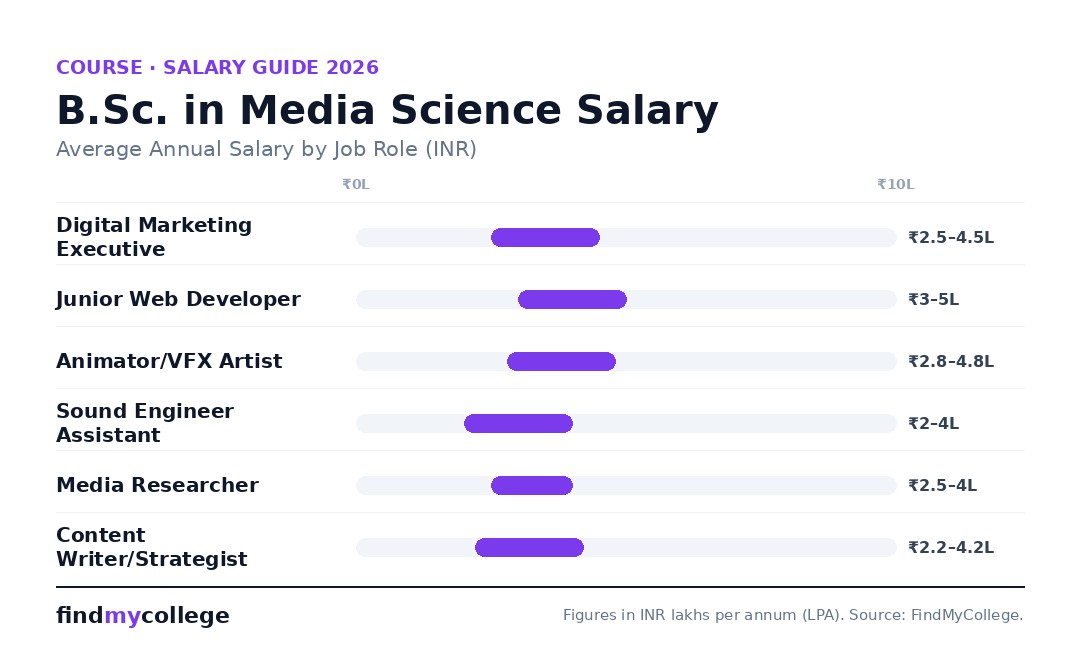
Average Salary Ranges (Entry-Level, Annual, Tentative 2026):
Salaries can vary significantly based on skills, location, company size, and specific role. These are entry-level averages for fresh graduates.
| Job Role | Average Annual Salary (INR) |
|---|---|
| Digital Marketing Executive | ₹2.5 Lakh – ₹4.5 Lakh |
| Junior Web Developer | ₹3.0 Lakh – ₹5.0 Lakh |
| Animator/VFX Artist | ₹2.8 Lakh – ₹4.8 Lakh |
| Sound Engineer Assistant | ₹2.0 Lakh – ₹4.0 Lakh |
| Media Researcher | ₹2.5 Lakh – ₹4.0 Lakh |
| Content Writer/Strategist | ₹2.2 Lakh – ₹4.2 Lakh |
B.Sc. Media Science vs. BA Media/Journalism: Which is Better?
Choosing between a B.Sc. in Media Science and a BA in Media/Journalism depends entirely on a student’s interests, aptitude, and career aspirations. Both are excellent degrees but cater to different facets of the media industry.
Comparison Table:
| Feature | B.Sc. in Media Science | BA in Media/Journalism |
|---|---|---|
| Focus | Technical, scientific, analytical, digital technologies, production, research. | Creative, theoretical, communication, content creation, reporting, ethics. |
| Stream Preference | Science (PCM/PCB often preferred/required). | Any stream (Arts/Humanities often preferred). |
| Key Skills Developed | Coding, data analysis, animation software, sound engineering, web development, media psychology. | Writing, reporting, editing, interviewing, public speaking, critical thinking, media ethics. |
| Career Paths | Web Developer, Animator, VFX Artist, Sound Engineer, Digital Marketer, Media Analyst, Game Developer. | Journalist, Reporter, Editor, PR Specialist, Content Writer, Copywriter, Filmmaker, Media Planner. |
| Curriculum Example | Web Technologies, Data Science for Media, Animation, Sound Design, Media Psychology. | News Reporting, Feature Writing, Media Ethics, Communication Theories, Broadcast Journalism. |
If you are passionate about the technical side of media, enjoy problem-solving, have an aptitude for science and technology, and envision a career in digital production, animation, web development, or media analytics, then B.Sc. in Media Science is likely a better fit. If your strengths lie in storytelling, writing, communication, critical analysis of social issues, and you aspire to be a journalist, content creator, or PR professional, then a BA in Media/Journalism would be more suitable.
Frequently Asked Questions
Is a B.Sc. in Media Science a difficult course?
The difficulty of a B.Sc. in Media Science depends on your aptitude for both scientific/technical subjects and creative media concepts. It requires a blend of analytical thinking, problem-solving skills, and creative application. Students with a strong science background and an interest in technology often find it manageable and engaging.
Can I pursue a Master’s degree after B.Sc. Media Science?
Yes, after completing a B.Sc. in Media Science, you can pursue various Master’s degrees such as M.Sc. in Digital Media, M.Sc. in Animation & VFX, MBA in Media Management, MA in Mass Communication (with a technical focus), or even specialized postgraduate diplomas in areas like Data Science for Media or UI/UX Design.
Are internships mandatory in B.Sc. Media Science?
While not always explicitly mandatory by all universities, internships are highly recommended and often integrated into the curriculum (especially in the final year) for B.Sc. Media Science programs. They provide invaluable practical experience, industry exposure, and networking opportunities, significantly boosting employability.
What are the top colleges for B.Sc. Media Science in India?
Some of the reputable institutions offering B.Sc. in Media Science or similar programs include Symbiosis International University (Pune), Manipal Academy of Higher Education (Manipal), Amity University (various campuses), Guru Gobind Singh Indraprastha University (Delhi), and various state universities with dedicated media departments. It’s crucial to research specific program structures and faculty expertise.
Is mathematics required for B.Sc. Media Science?
While not always a strict requirement for admission in all colleges, a basic understanding of mathematics (up to 10+2 level) is highly beneficial for B.Sc. Media Science, especially for subjects like data analytics, web development, game design, and understanding algorithms in digital media. Some programs may require a science stream with mathematics.
What is the scope of B.Sc. Media Science abroad?
The scope for B.Sc. Media Science graduates abroad is excellent, particularly in countries with advanced media and technology industries like the USA, UK, Canada, Germany, and Australia. The blend of scientific and media skills is highly valued, opening doors to roles in digital agencies, tech companies, film studios, gaming companies, and research institutions globally.
Are there any scholarships available for B.Sc. Media Science students?
Yes, many universities offer merit-based scholarships, entrance exam-based scholarships, or need-based financial aid for B.Sc. Media Science students. Additionally, various government schemes and private organizations provide scholarships for undergraduate studies. It’s advisable to check with individual colleges and national scholarship portals.
What is the difference between B.Sc. Media Science and B.Tech. Media Technology?
While both are technical, B.Sc. Media Science focuses more on the application of scientific principles within media, often covering a broader range of media types and their underlying science. B.Tech. Media Technology is an engineering degree, typically more intensive in core engineering subjects (like electronics, computer science) applied specifically to media hardware, software, and systems, often with a stronger emphasis on innovation and development of media technologies themselves.