BPT – Bachelor of Physiotherapy Fees in India 2026
Nishit Kumar is a senior EdTech industry leader with over a decade of experience in building and scaling education platforms, shaping their product, content, and growth strategy. At…
Latest update: BPT – Bachelor of Physiotherapy 2026 admissions & dates updated. Read more ›
Welcome to the comprehensive guide on BPT – Bachelor of Physiotherapy Fees in India for 2026. This page is designed to provide prospective students and their parents with a detailed understanding of the financial aspects, eligibility criteria, and career prospects associated with pursuing a BPT degree in India. We cover everything from tuition fees and admission processes to potential scholarships and return on investment, ensuring you have all the information needed to make an informed decision.
What is the BPT – Bachelor of Physiotherapy Course?
The Bachelor of Physiotherapy (BPT) is an undergraduate academic course dealing with the science of physical movement and its application in preventing, diagnosing, and treating disabilities and diseases. It is a 4.5-year program, including a mandatory 6-month internship, focusing on restoring function, reducing pain, and promoting health and wellness through physical methods.
How much does BPT – Bachelor of Physiotherapy cost in India for 2026?
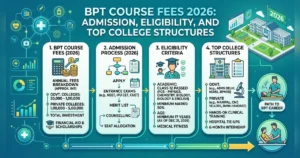
The cost of pursuing a BPT – Bachelor of Physiotherapy degree in India for 2026 varies significantly based on the type of institution (government vs. private) and its location, generally ranging from INR 50,000 to INR 5,00,000 per annum. Government colleges typically offer lower fees due to subsidies, while private institutions have higher fees reflecting their infrastructure, faculty, and facilities.
BPT Fees in Government Colleges (2026)
Government colleges offer a more affordable option for BPT, with annual fees typically ranging from INR 50,000 to INR 1,50,000. These institutions are highly sought after due to their lower cost and often excellent academic reputation. Admission is usually highly competitive, based on national or state-level entrance exams.
People Also Read
BPT Fees in Private Colleges (2026)
Private colleges for BPT generally have higher fees, ranging from INR 1,50,000 to INR 5,00,000 or more per annum. The fee structure in private institutions can vary widely, influenced by factors such as college ranking, infrastructure, campus facilities, and placement records. Some private universities may also include additional charges for hostel accommodation, mess, and other amenities.
Detailed BPT Fee Structure Comparison (2026)
Here’s a general overview of the BPT fee structure across different types of institutions for the academic year 2026:
| Fee Component | Government Colleges (Annual Range) | Private Colleges (Annual Range) |
|---|---|---|
| Tuition Fees | INR 40,000 – INR 1,20,000 | INR 1,20,000 – INR 4,50,000 |
| Admission Fees (One-time) | INR 5,000 – INR 15,000 | INR 10,000 – INR 50,000 |
| Examination Fees | INR 2,000 – INR 5,000 | INR 3,000 – INR 8,000 |
| Library/Lab Fees | INR 1,000 – INR 3,000 | INR 2,000 – INR 10,000 |
| Miscellaneous/Development Fees | INR 2,000 – INR 10,000 | INR 5,000 – INR 20,000 |
| Total Annual Fees (Approx.) | INR 50,000 – INR 1,50,000 | INR 1,50,000 – INR 5,00,000+ |
What are the eligibility criteria for BPT – Bachelor of Physiotherapy?
To be eligible for BPT – Bachelor of Physiotherapy, candidates must have successfully completed their 10+2 (or equivalent) examination with Physics, Chemistry, and Biology (PCB) as compulsory subjects, typically with a minimum aggregate score of 50% (45% for reserved categories). Age limits and specific entrance exam requirements may also apply depending on the institution.
Common Eligibility Requirements for BPT (2026)
- Educational Qualification: Passed 10+2 or equivalent examination from a recognized board.
- Compulsory Subjects: Physics, Chemistry, and Biology (PCB) are mandatory. English is often also required.
- Minimum Marks: Generally, an aggregate of 50% in PCB subjects for the general category, and 40-45% for SC/ST/OBC candidates.
- Age Limit: Most colleges require candidates to be at least 17 years old as of December 31st of the admission year. There is usually no upper age limit, but some institutions might have one.
- Entrance Exams: Many top colleges and universities require candidates to qualify in state or national-level entrance exams.
What entrance exams are required for BPT – Bachelor of Physiotherapy admissions in 2026?
Admission to BPT – Bachelor of Physiotherapy programs in 2026 often requires candidates to appear for and qualify in various state-level or national-level entrance examinations. Some prominent exams include NEET (for some universities), CET (Common Entrance Test) conducted by various states, and specific university-level entrance tests.
Key BPT Entrance Exams (2026)
| Entrance Exam | Conducting Body | Application Period (Approx.) | Exam Date (Approx.) | Applicability |
|---|---|---|---|---|
| NEET UG | NTA | Feb – Mar 2026 | May 2026 | For some BPT programs, especially in deemed/private universities. |
| IPU CET | GGSIPU, Delhi | Mar – Apr 2026 | May – Jun 2026 | For BPT admission in GGSIPU affiliated colleges. |
| KCET | KEA, Karnataka | Feb – Mar 2026 | Apr – May 2026 | For BPT admission in Karnataka colleges. |
| MHT CET | CET Cell, Maharashtra | Feb – Mar 2026 | Apr – May 2026 | For BPT admission in Maharashtra colleges. |
| UP CNET | ABVMU, UP | May – Jun 2026 | Jul 2026 | For BPT admission in government and private colleges in UP. |
Are there scholarships available for BPT – Bachelor of Physiotherapy students?
Yes, numerous scholarships are available for BPT – Bachelor of Physiotherapy students to help alleviate the financial burden of education. These scholarships are offered by government bodies, private organizations, NGOs, and individual colleges, often based on merit, financial need, or specific demographic criteria.
Types of Scholarships for BPT Students
- Merit-Based Scholarships: Awarded to students with excellent academic records in their 10+2 exams or high scores in entrance tests.
- Need-Based Scholarships: Provided to economically disadvantaged students who demonstrate financial need.
- Government Scholarships: Schemes like the National Scholarship Portal (NSP) offer various scholarships for minority students, SC/ST/OBC students, and economically weaker sections.
- College/University Specific Scholarships: Many institutions offer their own scholarships to attract talented students or support deserving ones.
- Private Organization Scholarships: NGOs and private trusts often provide scholarships for paramedical courses, including BPT.
Is BPT – Bachelor of Physiotherapy worth it for jobs and salary outcomes?
Yes, pursuing a BPT – Bachelor of Physiotherapy is generally worth it for jobs and salary outcomes, especially given the growing demand for healthcare professionals focused on rehabilitation and wellness. Graduates can find employment in diverse settings, and salaries tend to increase significantly with experience and specialization.
Career Prospects and Salary for BPT Graduates
Physiotherapists play a crucial role in healthcare, and the demand is steadily rising due to an aging population, increased awareness of physical fitness, and a rise in lifestyle diseases and sports injuries. Graduates can work in hospitals, rehabilitation centers, sports clinics, private practices, NGOs, and even pursue higher education or research.
| Job Role | Average Starting Salary (INR per annum) | Average Mid-Career Salary (INR per annum) |
|---|---|---|
| Physiotherapist | 2,50,000 – 4,00,000 | 4,00,000 – 8,00,000 |
| Sports Physiotherapist | 3,00,000 – 5,00,000 | 5,00,000 – 10,00,000+ |
| Rehabilitation Specialist | 3,00,000 – 4,50,000 | 4,50,000 – 9,00,000 |
| Clinical Instructor | 2,80,000 – 4,20,000 | 4,00,000 – 7,50,000 |
| Lecturer/Professor | 3,50,000 – 5,50,000 | 5,50,000 – 12,00,000+ |
Salaries can vary based on location (metros generally offer higher pay), employer type (private hospitals often pay more than government ones), and the individual’s skills and specialization (e.g., sports physiotherapy, neurological physiotherapy).
How does BPT compare to other paramedical courses in terms of fees and career?
BPT – Bachelor of Physiotherapy generally has a moderate to high fee structure compared to some other paramedical courses like DMLT or B.Sc. in Medical Imaging Technology, but it often offers a stronger and more independent career path with significant growth potential and direct patient interaction.
BPT vs. Other Paramedical Courses: A Brief Comparison
- BPT (Bachelor of Physiotherapy): Focuses on physical rehabilitation. Higher fees, longer duration (4.5 years), but offers direct patient care, independent practice potential, and good salary growth.
- B.Sc. Nursing: Focuses on patient care, administration of medication, and assisting doctors. Similar fee range to BPT, high demand, but different scope of practice.
- B.Sc. Medical Lab Technology (MLT): Focuses on diagnostic testing. Lower fees than BPT, shorter duration (3 years), but primarily lab-based work with less direct patient interaction.
- B.Sc. Radiology/Imaging Technology: Focuses on operating imaging equipment (X-ray, MRI, CT). Moderate fees, good demand, but specialized technical role.
What are the financing options for BPT – Bachelor of Physiotherapy?
Several financing options are available for BPT – Bachelor of Physiotherapy, including education loans from public and private banks, scholarships, and installment payment plans offered by some institutions. These options help students manage the course fees effectively.
Education Loan Options
- Public Sector Banks: SBI, PNB, Bank of Baroda, etc., offer education loans with competitive interest rates and flexible repayment terms. They often cover tuition fees, hostel charges, and other academic expenses.
- Private Sector Banks & NBFCs: HDFC Bank, ICICI Bank, Axis Bank, Avanse, InCred, etc., also provide education loans, sometimes with quicker processing but potentially higher interest rates.
- Eligibility for Loans: Typically requires a co-applicant (parent/guardian), good academic record, and admission to a recognized institution.
Explore more on FindMyCollege
Related pages for BPT – Bachelor of Physiotherapy aspirants on findmycollege.com:
Frequently Asked Questions
What is the duration of the BPT – Bachelor of Physiotherapy course?
The BPT – Bachelor of Physiotherapy course is typically 4.5 years long, which includes 4 years of academic study and a mandatory 6-month clinical internship.
Can I pursue BPT after completing my 12th grade with subjects other than PCB?
No, Physics, Chemistry, and Biology (PCB) are almost universally mandatory subjects in 10+2 for BPT admission in India. Some institutions may also require English as a compulsory subject.
Are there any age limits for BPT admission in 2026?
Most colleges require candidates to be at least 17 years old as of December 31st of the admission year. While there’s generally no upper age limit, it’s advisable to check specific college guidelines.
What is the typical return on investment (ROI) for a BPT degree?
The ROI for a BPT degree is generally considered good. While initial salaries might be moderate, the demand for physiotherapists is high and growing, leading to significant salary increases with experience, specialization, and the option of private practice, which can yield substantial income.
Do BPT colleges offer hostel facilities, and are their fees included in the overall course fees?
Many BPT colleges, especially private ones, offer hostel facilities. However, hostel fees are almost always separate from the academic course fees and need to be paid additionally. These can range from INR 60,000 to INR 1,50,000 per annum depending on the city and facilities.
Can I practice physiotherapy independently after completing BPT?
Yes, after completing your BPT degree and the mandatory internship, you are eligible to register with the respective state physiotherapy council and practice independently. Many physiotherapists choose to open their own clinics or offer home-based services after gaining some experience.
Is there a demand for BPT graduates abroad?
Yes, there is a significant demand for qualified physiotherapists in many countries, including the USA, UK, Canada, Australia, and Gulf nations. However, you may need to clear specific licensing exams and meet local registration requirements to practice internationally.