BSc Agriculture Course Fees 2026: Government vs Private College Fees
Abhijeet Chatterjee is a professional Content and Copy specialist with over five years of experience in crafting compelling content around the Edtech domain. His portfolio includes notable work…
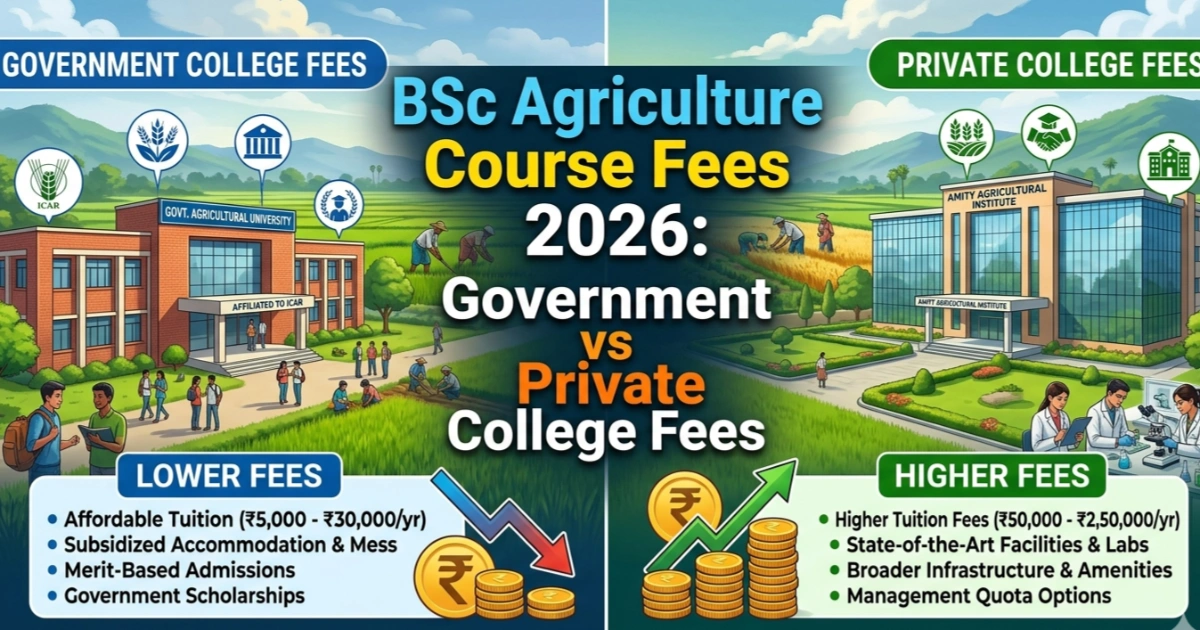
The average BSc Agriculture Course Fees for 2026 in India can range significantly, typically from ₹15,000 to ₹1,50,000 annually, depending heavily on whether you choose a government or private institution. Government colleges generally offer more affordable options compared to their private counterparts. This article will break down these costs, explore influencing factors, and guide you through scholarships and additional expenses.
Government vs Private BSc Agriculture Fees: Detailed Comparison
The fee gap between government and private BSc Agriculture colleges in India is substantial and is one of the most important factors students need to consider before applying. Government and ICAR-affiliated agricultural universities typically charge between ₹2,500 and ₹50,000 per year in tuition, while private universities range from ₹50,000 to ₹2,00,000 per year, sometimes even higher at premium deemed universities. Over a full 4-year programme, this difference can amount to anywhere between ₹3 lakh and ₹7 lakh in total cost.
Fee Comparison: Government vs Private BSc Agriculture Colleges
| Parameter | Government / ICAR-Affiliated | Private (Non-ICAR) |
| Annual tuition fees | ₹2,500 – ₹50,000 | ₹50,000 – ₹2,00,000 |
| Total 4-year tuition cost | ₹10,000 – ₹2,00,000 | ₹2,00,000 – ₹8,00,000 |
| Hostel & mess (per year) | ₹20,000 – ₹50,000 | ₹50,000 – ₹1,20,000 |
| Lab & practical charges | ₹2,000 – ₹10,000 | ₹10,000 – ₹30,000 |
| Examination fees | ₹500 – ₹2,000 | ₹2,000 – ₹8,000 |
| Estimated total 4-year cost | ₹1,40,000 – ₹4,00,000 | ₹5,00,000 – ₹12,00,000 |
| Admission route | ICAR AIEEA / CUET / State entrance exams | University entrance / CUET / Direct |
| Scholarship availability | High — NSP, ICAR, state govt. schemes | Moderate — institution-level only |
| ICAR accreditation | Yes (mandatory for most) | Varies — many are non-ICAR |
Government BSc Agriculture Colleges: Fee Range by Institution Type
| Institution Type | Examples | Annual Fee Range (₹) |
| Central agricultural universities | IARI New Delhi, BHU Varanasi | ₹8,000 – ₹25,000 |
| State agricultural universities (SAUs) | PAU Ludhiana, TNAU Coimbatore, UAS Bangalore | ₹20,000 – ₹50,000 |
| Central universities with agriculture faculties | Aligarh Muslim University, Banaras Hindu University | ₹12,000 – ₹30,000 |
| ICAR-affiliated government colleges | AAU Jorhat, BCKVV Mohanpur | ₹10,000 – ₹35,000 |
Private BSc Agriculture Colleges: Fee Range by Tier
| College Tier | Examples | Annual Fee Range (₹) |
| Budget private colleges | Sage University, MGI Meerut, Invertis University | ₹40,000 – ₹80,000 |
| Mid-range private colleges | Sharda University, Chandigarh University, TMU Moradabad | ₹80,000 – ₹1,40,000 |
| Premium private/deemed universities | Amity University, LPU, SRM University, VIT | ₹1,40,000 – ₹2,00,000 |
ICAR vs Non-ICAR Private College: What the Difference Means
| Factor | ICAR-Accredited College | Non-ICAR Private College |
| Fee range | ₹20,000 – ₹1,00,000 per year | ₹50,000 – ₹2,00,000 per year |
| Degree recognition | Nationally recognised by ICAR & UGC | UGC recognised but not ICAR |
| Government job eligibility | Higher eligibility for ARS, SRF, JRF, & state agri jobs | Limited for ICAR-specific positions |
| Scholarship access | ICAR JRF/SRF scholarships accessible after PG | Not eligible for ICAR scholarships |
| Placement support | Strong through state agri departments & ICAR network | Dependent on individual college |
Total Cost of Studying BSc Agriculture: 4-Year Estimate
| Cost Head | Government College (₹) | Private College (₹) |
| Tuition (4 years) | 40,000 – 2,00,000 | 2,00,000 – 8,00,000 |
| Hostel & mess (4 years) | 80,000 – 2,00,000 | 2,00,000 – 4,80,000 |
| Books, lab & misc. (4 years) | 20,000 – 50,000 | 40,000 – 1,20,000 |
| Examination & registration | 5,000 – 15,000 | 10,000 – 30,000 |
| Estimated total (4 years) | ₹1,45,000 – ₹4,65,000 | ₹4,50,000 – ₹14,30,000 |
Which Should You Choose?
- Choose a government or ICAR-affiliated college if your priority is affordability, government job eligibility, scholarship access, and academic credibility backed by ICAR standards
- Choose a private college if you could not secure a seat in a government institution, prefer a specific city or campus, or want more flexible admission criteria with better infrastructure at select premium universities
- Always verify ICAR accreditation before enrolling in any private agricultural college, as this directly impacts your eligibility for government agricultural jobs, ICAR scholarships, and higher studies through ICAR-NET
BSc Agriculture Course Fees 2026: Average Govt College Fees Across India
BSc Agriculture is a 4-year undergraduate programme with one of the widest fee ranges of any science degree in India. Government agricultural universities, including IARI, ICAR-affiliated state universities, and central universities, charge as low as ₹10,000 to ₹50,000 per year, while private universities typically charge between ₹1.2 lakh and ₹2 lakh per year. The overall average annual fee across India stands at approximately ₹60,000 to ₹1,20,000 when factoring in both government and private institutions together.
Fees vary based on institution type, state, affiliation, course specialisation, and whether hostel and lab charges are included. Students from reserved categories may also be eligible for fee waivers, scholarships, or subsidised seats under state government schemes.
BSc Agriculture Fees: Government Colleges in India
| College | State | Annual Fee (₹) |
| IARI (Indian Agricultural Research Institute), New Delhi | Delhi | ~₹8,000 (tuition only) |
| Tamil Nadu Agricultural University (TNAU), Coimbatore | Tamil Nadu | ₹21,000 – ₹36,000 |
| Punjab Agricultural University (PAU), Ludhiana | Punjab | ₹25,000 – ₹40,000 |
| G.B. Pant University of Agriculture & Technology, Pantnagar | Uttarakhand | ₹25,000 – ₹45,000 |
| Banaras Hindu University (BHU), Varanasi | Uttar Pradesh | ₹12,000 – ₹25,000 |
| University of Agricultural Sciences (UAS), Bangalore | Karnataka | ₹20,000 – ₹35,000 |
| Assam Agricultural University (AAU), Jorhat | Assam | ₹15,000 – ₹30,000 |
| Anand Agricultural University (AAU), Anand | Gujarat | ₹20,000 – ₹40,000 |
| Horticultural College & Research Institute, Tamil Nadu | Tamil Nadu | ₹36,000 |
| BCKVV, Mohanpur | West Bengal | ₹10,000 – ₹20,000 |
Private BSc Agriculture College: Detailed Overview
Understanding the BSc Agriculture Course Fees is crucial for prospective students. This section provides a detailed overview of the fee structures for both government and private institutions, highlighting the general annual fee ranges and specific college examples to help in financial planning for the program.
| College | State | Annual Fee (₹) |
| Lovely Professional University (LPU), Phagwara | Punjab | ₹1,40,000 – ₹1,80,000 |
| Amity University, Noida | Uttar Pradesh | ₹1,50,000 – ₹2,00,000 |
| SRM University, Chennai | Tamil Nadu | ₹1,20,000 – ₹1,80,000 |
| Sharda University, Greater Noida | Uttar Pradesh | ₹1,10,000 – ₹1,50,000 |
| Chandigarh University | Punjab | ₹1,20,000 – ₹1,60,000 |
| Sage University, Bhopal | Madhya Pradesh | ₹40,000 – ₹80,000 |
| MGI Meerut | Uttar Pradesh | ₹50,000 – ₹80,000 |
| Teerthanker Mahaveer University (TMU), Moradabad | Uttar Pradesh | ₹60,000 – ₹1,20,000 |
| Karnavati University, Gandhinagar | Gujarat | ₹4.16 lakh (total) |
| Invertis University, Bareilly | Uttar Pradesh | ₹60,000 – ₹90,000 |
Top BSc Agriculture Govt Colleges Fees: IARI BSc Agriculture Fees 2026
The Indian Agricultural Research Institute (IARI), New Delhi, a deemed university under Section 3 of the UGC Act, 1956, and affiliated with ICAR, is one of India’s most prestigious institutions for agricultural education. The BSc/BTech fee structure at IARI is remarkably affordable compared to most private agricultural universities, with a total tuition fee of just ₹4,000 per semester across all four years. The same fee structure applies to students at IARI-Assam, IARI-Jharkhand, and ITAB Ranchi.
IARI BSc Agriculture: Semester-wise Fee Breakup
| Fee Component | Amount (₹) |
| Registration fee (one-time) | 500 |
| Caution money (refundable) | 10,000 |
| Tuition fee | 4,000 |
| Examination fee | 600 |
| Hostel fee | 2,000 |
| Water & electricity charges | 1,000 |
| PGS Journal Subscription fee (annual) | 200 |
| PG School Calendar charges (one time) | 200 |
| PGSS Union fee (annual) | 300 |
| PGSSU Magazine fee (annual) | 100 |
| Students’ Sports Fund (annual) | 200 |
| PGSSU Cultural & Literary Activities fee (annual) | 600 |
| Identity card fee (one time) | 100 |
| Student Welfare Fund (annual) | 200 |
| IARI Alumni Life Membership fee (one time) | 250 |
| Total | ₹20,250 |
Year 1 — Semester II
| Fee Component | Amount (₹) |
| Tuition fee | 4,000 |
| Hostel fee | 2,000 |
| Water & electricity charges | 1,000 |
| Total | ₹7,000 |
Year 2, 3 & 4 — Semester I (Each Year)
| Fee Component | Amount (₹) |
| Tuition fee | 4,000 |
| Examination fee | 600 |
| Hostel fee | 2,000 |
| Water & electricity charges | 1,000 |
| PGS Journal Subscription fee (annual) | 200 |
| PGSS Union fee (annual) | 300 |
| PGSSU Magazine fee (annual) | 100 |
| Students’ Sports Fund (annual) | 200 |
| PGSSU Cultural & Literary Activities fee (annual) | 600 |
| Student Welfare Fund (annual) | 200 |
| Total | ₹9,200 |
IARI BSc Agriculture: Total 4-Year Fee Summary
| Year | Semester I (₹) | Semester II (₹) | Annual Total (₹) |
| Year 1 | 20,250 | 7,000 | 27,250 |
| Year 2 | 9,200 | 7,000 | 16,200 |
| Year 3 | 9,200 | 7,000 | 16,200 |
| Year 4 | 9,200 | 7,000* | 16,200* |
| Grand Total | ~₹75,850 |
BSc Agriculture Course Fees: Various Components
Understanding the BSc Agriculture Course Fees involves examining various components like tuition, examination, and one-time charges. For instance, Teerthanker Mahaveer University provides a detailed breakdown of its BSc (Hons.) Agriculture program costs, while other institutions like Brainware University offer a total four-year fee.
| S.No | Fee Details | Amount |
| 1 | Tuition Fee | Rs 61,200 /- ( per Semester ) |
| 2 | Examination Fee | Rs 4,500 /- ( per Semester ) |
| 3 | Lab Charges | Rs 500 /- ( per Semester ) |
| 4 | Enrolment Fee | Rs 1,000 /- ( One Time ) |
| 5 | Admission Registration Fee | Rs 5,000 /- ( One Time ) |
| 6 | Admission Processing Fee | Rs 2,500 /- ( One Time ) |
| 7 | Application Fees | Rs 1,000 /- ( One Time ) |
Top BSc Agriculture Colleges 2026: Fee Structures & Range
The BSc Agriculture Course Fees vary significantly across institutions. Government colleges generally offer lower annual fees compared to private ones. This section details general fee ranges and provides a comprehensive breakdown of fees for undergraduate agriculture programs at the College of Agriculture, Pune, along with scholarship information for other universities.
| Sr.No. | Item | Bachelor’s degree (I Term) | Bachelor’s degree (II Term) |
| A) College fees. | |||
| 1 | Tuition Fee- Govt. and Govt aided | 6000 | 6000 |
| 2 | Registration fee | 400 | 400 |
| 3 | Eligibility Fee# | 400 400 | — |
| 4 | College caution money | 2000© | — |
| 5 | Library fees | 800 | 800 |
| 6 | Subscription towards Students Council Activities | ||
| i) | Sports, Gymkhana and allied activities. | 1000 | 1000 |
| ii) | Co-operative Society (Share + Membership fee) | 200# | — |
| iii) | Annual Prize Distribution Function | 400 | — |
| iv) | College magazine | 400 | — |
| v) | Ashwamedh Sport Fee | 50 | — |
| 7 | University Medical Examination Fee. | 200 | — |
| 8 | Identity Card | 100# | — |
| 9 | Student’s Aid Fund | 200# | — |
| 10 | Grade Card | 200 | 200 |
| 11 | Examination Fee | 3200 | — |
| 12 | Students safety insurance premium. | 100 | — |
| Total (A) | 15650 +[400 ] | 8400 | |
| (B) Hostel | |||
| 1 | Hostel Caution money | 3000© | — |
| 2 | Maintenance charges | 3000 | 3000 |
| 3 | Electricity Charges | 3000 | 3000 |
| 4 | Mess deposit. | 2000© | — |
| Total (B) | 11000 | 6000 | |
| Grand Total (A+B) | 26650 +[400 ] | 14400 | |
The detailed fee structure for B.Sc. (Hons.) Agriculture and Horticulture at the College of Agriculture, Pune, shows a first-term total of 26650 +[400 ] Rupees, significantly higher than the second-term total of 14400 Rupees, largely due to one-time caution money and various initial fees.
- Government Colleges: Annual fees range from ₹50,000 to ₹1,50,000.
- Private Colleges: Annual fees range from ₹1,00,000 to ₹2,50,000.
- Rabindranath Tagore University (RNTU): Annual fee is approximately ₹70,000 to ₹1,00,000.
- Mangalayatan University Aligarh: Per semester examination fees are Rs.3500.
- Mangalayatan University Aligarh: One-time refundable security deposit is Rs.5000.
- TMU Jain Students: Up to 20% off tuition, up to 30% off hostel fees.
- TMU Non-Jain (60-69.9% marks): 10% entry-level scholarship.
- TMU Non-Jain (70-79.9% marks): 15% entry-level scholarship.
- TMU Non-Jain (80-89.9% marks): 25% entry-level scholarship.
- TMU Non-Jain (90%+ marks): 50% entry-level scholarship.
- TMU Chancellor’s Scholarship: 20% per year for Staff Wards.
- TMU Meritorious Sports Aspirant: Up to 100% special scholarship.
- TMU Visually Impaired Employees’ Wards: 50% per year special scholarship.
Applying for BSc Agriculture Scholarships & Financial Aid 2026
Scholarships are available for the BSc (Hons.) Agriculture (ICAR-Accredited) program for the year 2026, offering significant financial aid opportunities. This section outlines various scholarship schemes, including specific exemptions and waivers, to help students manage their BSc Agriculture Course Fees and related expenses.
- Jain Students: Upto 20% tuition, 30% hostel fees for entire program duration.
- Chancellor’s Scholarship: 20% per year for staff wards, excluding Collaborative, Dental, Medical.
- Sports Aspirants: Upto 100% for District/State/National/International level sports aspirants.
- Visually Impaired Wards: 50% per year for entire program duration for TMU employees’ wards.
- RNTU Meritorious: Scholarships offered to meritorious students to help reduce financial burdens.
- Category Waivers: Available for excellent scores, EWS, or reserved categories (SC, ST, OBC).
Many colleges, including RNTU, provide scholarships to deserving students based on academic performance or financial need, helping to alleviate BSc Agriculture Course Fees. These provisions aim to support a diverse student body.
| Scholarship Aspect | Detail |
| Application Year | Available in the admission year only. |
| Program Duration Eligibility | Not applicable for programs of one year or less. |
| Multiple Scholarships | Not available to a single student. |
BSc Agriculture Additional Costs 2026: Hostel, Exam, & Other Fees
Prospective students considering the BSc Agriculture Course Fees should also budget for various additional expenses. These include one-time charges like admission and enrolment fees, alongside recurring costs such as examination and lab charges. Understanding these extra fees is crucial for financial planning.
- TMU Admission Registration Fee: Rs 5,000 (One Time)
- TMU Examination Fee: Rs 4,500 per Semester
- Mangalayatan Security Deposit: Rs.5000/ (One time paid, Refundable)
- Mangalayatan Per Semester Examination Fees: Rs.3500/
- TMU Hostel Fee Scholarship: Jain students get up to 30% exemption on hostel fees.
- TMU Admission Processing Fee: Rs 2,500 (One Time)
Beyond these primary charges, other essential fees contribute to the overall BSc Agriculture Course Fees. These include smaller one-time payments and recurring lab charges, varying by institution.
| Item | University | Amount | Frequency |
| Lab Charges | TMU | Rs 500 | per Semester |
| Enrolment Fee | TMU | Rs 1,000 | One Time |
| Application Fees | TMU | Rs 1,000 | One Time |
| Registration Fees | Mangalayatan University | INR 500 | One Time |
Frequently Asked Questions
1. What is the total fee for BSc Agriculture at IARI New Delhi?
The total 4-year fee at IARI New Delhi is approximately ₹75,850, including tuition, hostel, water and electricity charges, examination fees, and one-time charges. The tuition fee is just ₹4,000 per semester, making IARI one of the most affordable premier agricultural institutions in India.
2. What is the average BSc Agriculture fee in India in 2026?
The average annual BSc Agriculture fee in India ranges from ₹10,000 to ₹50,000 at government colleges and ₹50,000 to ₹2,00,000 at private universities. Overall, the national average across both government and private institutions is approximately ₹60,000 to ₹1,20,000 per year depending on institution type and location.
3. Is BSc Agriculture cheaper at government or private colleges?
Government and ICAR-affiliated colleges are significantly cheaper, with annual tuition ranging from ₹2,500 to ₹50,000. Private colleges typically charge ₹50,000 to ₹2,00,000 per year. Over 4 years, the total cost difference between government and premium private colleges can be as high as ₹8–10 lakh.
4. Does ICAR accreditation affect BSc Agriculture fees?
ICAR-accredited colleges generally charge moderate fees and offer students access to ICAR scholarships, JRF/SRF fellowships, and better government job eligibility. Non-ICAR private colleges may charge more but lack these benefits. Always verify ICAR accreditation status before enrolling to ensure your degree has full national recognition.
5. What entrance exams are required for BSc Agriculture admission in India?
The primary entrance exam for BSc Agriculture is ICAR AIEEA (All India Entrance Examination for Admission), which fills 15% All India Quota seats. CUET is accepted at central universities. Several states conduct their own entrance exams, while some private colleges offer direct or merit-based admissions.
6. Is the caution money paid at IARI refundable?
Yes, the caution money of ₹10,000 paid at the time of admission to IARI is fully refundable upon successful completion of the course or at the time of leaving the institution. It is a security deposit and does not form part of the academic or hostel fee.
7. What scholarships are available for BSc Agriculture students in India?
BSc Agriculture students can apply for ICAR merit scholarships, the National Scholarship Portal (NSP) for state and central government schemes, and institution-level scholarships at private universities. Students from SC/ST/OBC categories are also eligible for additional fee waivers and stipends under state agricultural department schemes.