BSc Mathematics Syllabus 2026: Semester-wise Breakdown, NEP Curriculum & More
Aayush is a writer and content strategist who turns personal stories into brand narratives. With an experience spanning diverse industries, rely on his writing for simplifying complex subjects…
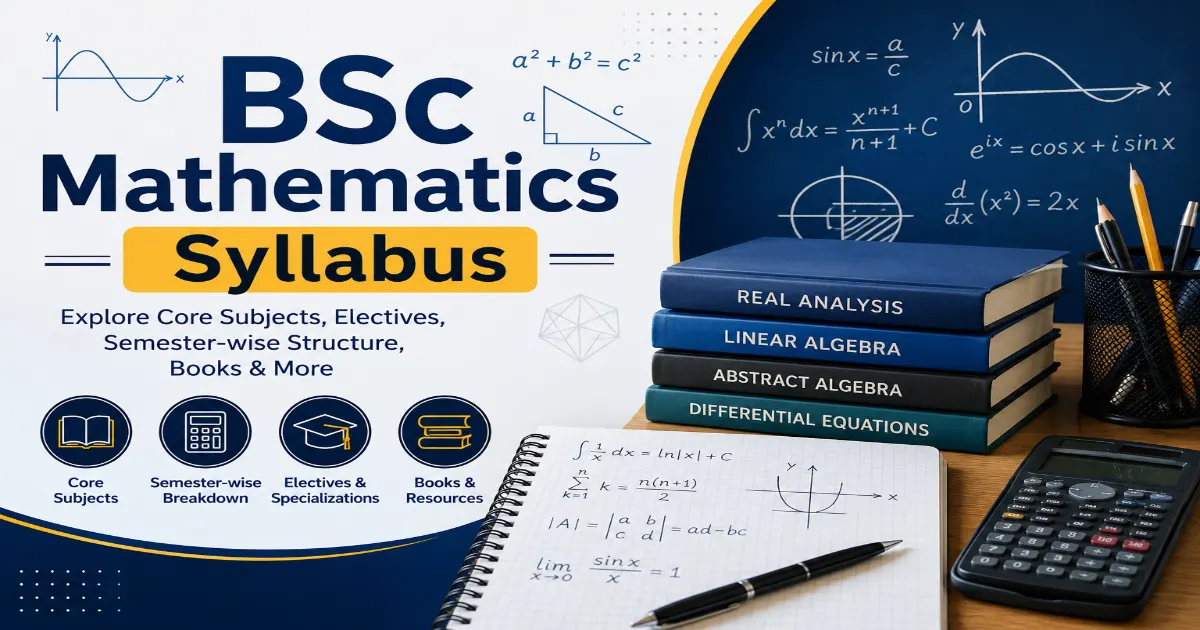
Explore BSc Mathematics syllabus in detail with in-depth semester-wise breakdown. Find CBCS syllabus, NEP syllabus, core subjects, electives, popular books and more here.
The BSc Mathematics syllabus for 2026 is meticulously structured to provide a robust foundation in core mathematical disciplines, integrating modern pedagogical approaches under the NEP 2020 framework. Students can expect a year-wise progression through essential subjects like Algebra, Calculus, and Analysis, alongside elective options that deepen their understanding. This article details the comprehensive course structure, key topics, and how university-specific syllabi align with the latest educational reforms.
BSc Mathematics Semester-Wise Syllabus Overview: Core & Elective Subjects
The BSc Mathematics program spans three years, comprising six semesters, with a strong emphasis on developing fundamental mathematical abilities in algebra, calculus, and data analysis. This comprehensive bsc mathematics syllabus focuses on core subjects like algebra, calculus, and data analysis, alongside practical and skill development courses to ensure a well-rounded education.
| Semester | Core Subjects | Elective Options |
| Semester 1 | Differential Calculus, Algebra, Trigonometry, Vector Algebra | Computer Fundamentals & Programming, Environmental Studies |
| Semester 2 | Integral Calculus, Analytical Geometry, Differential Equations (Ordinary), Probability Theory | Data Structures & Algorithms, Basic Statistics |
| Semester 3 | Real Analysis, Abstract Algebra (Group Theory), Mathematical Methods, Linear Algebra | Discrete Mathematics, Graph Theory, Mathematical Modelling |
| Semester 4 | Complex Analysis, Ring Theory & Vector Spaces, Partial Differential Equations, Numerical Methods | Operations Research, Financial Mathematics, Python Programming |
| Semester 5 | Metric Spaces, Topology, Mechanics, Number Theory | Actuarial Mathematics, Cryptography, Data Science Fundamentals |
| Semester 6 | Functional Analysis, Differential Geometry, Project/Dissertation | Advanced Statistics, Machine Learning Basics, Optimization Techniques |
| General Electives | N/A | Mathematical Economics, Biomathematics, Quantum Mechanics, Astronomy |
| Applied Electives | N/A | Statistical Inference, Time Series Analysis, Data Analytics, Scientific Computing |
| Advanced Electives | N/A | Advanced Abstract Algebra, Advanced Real Analysis, Fluid Dynamics, Elasticity |
Key Topics in BSc Mathematics: Algebra, Calculus, Analysis, and More 2026
The BSc Mathematics syllabus for 2026 spans 3 years, covering a broad spectrum of topics from foundational concepts to advanced theories. This comprehensive program emphasizes core mathematical abilities in algebra, calculus, and data analysis, preparing students for diverse specializations.
| BSc Maths Subjects | Topics Covered |
| Algebra, Trigonometry and Differential Calculus | Tangent and Normals of a Conic (Cartesian and Parametric form), Orthoptic Locus, Chords in terms of given points, Polar Co-ordinates, Polar Equation of a line, Polar Equation of Circle, Polar Equation of Conic, Polar Equations of tangents and Normals, Chords of Conic Sections. |
| Real Analysis | Continuous Functions, Combinations of Continuous Functions, Continuous Functions on Intervals, Uniform Continuity, The Derivative, The Mean Value Theorem, L’ Hospital Rules, Taylor’s Theorem. |
| Calculus | Expansion of functions using Maclaurin’s theorem and Taylor’s theorem, Concavity and points of inflexion, Curvature and Evolutes, Length of arc as a function derivative of arc, Partial derivatives, The Chain rule, Extreme values and saddle points, Lagrange multipliers. |
| Set theory and Theory of Equations | Equivalence relations, Partition of a Set, Arbitrary unions and intersections. De Morgan’slaws, Countable and Uncountable sets, Fundamental Theorem of Algebra, Relation between the roots and coefficient of a general polynomial equation in one variable, Synthetic division. |
| Vector Calculus | Dot and cross product of vectors, Ordinary derivatives of vectors, Continuity and differentiability of a vector function, Derivatives of sum, Dot product, Cross product and Triple product of vectors, Constant vector functions, Partial differentiation of vector functions. |
| Infinite Series | Infinite series and examples. Convergent, Divergent and Oscillatory series, Partial sum of series. Series of non-negative terms, Necessary and sufficient condition for convergence, Cauchy’s general principle of convergence. Geometric series. The Pseries(Harmonic), Comparison tests (different forms), D’Alembert’s ratio test, Raabe’s test,. |
| Fourier Transforms | Periodic functions, Fourier series of functions of period 2π and 2l. Fourier series of odd and even functions, half range sine and cosine series |
| Mechanics | Velocities and accelerations in Cartesian, polar, and intrinsic coordinates. Equations of motion refer to a set of rotating axes. Motion of a projectile in a resisting medium. The motion of a particle in a plane under different laws of resistance. |
People Also Read
BSc Mathematics Syllabus Under NEP 2020 & CBCS Framework 2026
The BSc Mathematics syllabus under NEP 2020 is generally designed as a four-year undergraduate programme (FYUGP) under the CBCS and credit-based framework, featuring multidisciplinary electives, skill enhancement courses (SEC), value-added courses (VAC), internships, and research projects. Most universities also follow flexible exit options and Academic Bank of Credits (ABC) guidelines while structuring semester-wise mathematics subjects.
Major Subjects
| Semester | Major/Core Areas Commonly Covered | Additional NEP/CBCS Components | Typical Credits* |
| I | Algebra, Differential Calculus, Trigonometry, Mathematical Methods | AEC, VAC, Environmental Studies, Communication Skills | 20–24 |
| II | Integral Calculus, Vector Algebra, Analytical Geometry, Differential Equations | SEC, Programming/Python, Minor Course | 20–24 |
| III | Real Analysis, Linear Algebra, Group Theory, Numerical Techniques | Multidisciplinary Course (MDC), Skill Enhancement | 20–24 |
| IV | Advanced Calculus, Ordinary Differential Equations, Ring Theory, Probability Basics | VAC, Open Electives, Practical/Computational Lab | 20–24 |
| V | Complex Analysis, Partial Differential Equations, Abstract Algebra, Multivariate Calculus | Minor/Elective Papers, Research Orientation | 20–24 |
| VI | Metric Spaces, Topology Basics, Mathematical Statistics, Operations Research | Internship/Project/Field Work | 20–24 |
| VII | Functional Analysis, Numerical Methods, Mathematical Modelling, Research Methodology | Dissertation/Research Courses, Advanced Electives | 20–24 |
| VIII | Mathematical Finance, Graph Theory, Fluid Dynamics, Advanced Applied Mathematics | Major Project/Research Thesis | 20–24 |
Common Minor Subjects
| Common Minor/Elective Subjects Under NEP | Examples |
| Computer & Computational Skills | Python, Programming for Mathematics, Data Analysis |
| Applied Sciences | Mathematical Physics, Statistics, Operations Research |
| Skill-Based Courses | Financial Mathematics, Actuarial Mathematics, Cryptography |
| Interdisciplinary Courses | Economics, Computer Science, Data Science, AI Basics |
| Value Added Courses (VAC) | Yoga, Environmental Studies, Indian Knowledge Systems |
Popular BSc Mathematics Books
BSc Mathematics students commonly use books covering calculus, algebra, real analysis, linear algebra, differential equations, and advanced pure mathematics throughout their undergraduate studies.
| Book Name | Author(s) |
| Thomas’ Calculus | George B. Thomas Jr., Maurice D. Weir |
| Principles of Mathematical Analysis | Walter Rudin |
| Linear Algebra | Kenneth Hoffman & Ray Kunze |
| Linear Algebra | Serge Lang |
| A Course of Pure Mathematics | G. H. Hardy |
| Contemporary Abstract Algebra | Joseph A. Gallian |
| Calculus on Manifolds | Michael Spivak |
| Introduction to Commutative Algebra | Michael Atiyah & Ian G. Macdonald |
| Mathematics for Degree Students for B.Sc. | P. K. Mittal |
| Linear Algebra Done Right | Sheldon Axler |
How to Access Your BSc Mathematics University Syllabus 2026
Most universities release the BSc Mathematics syllabus on their official academic or examination portals in PDF format. Students can access semester-wise subjects, credit structures, NEP/CBCS details, and examination patterns through the university syllabus section.
- Visit the Official University Website: Open your university’s official website using a web browser.
- Go to the Academics or Syllabus Section: Look for tabs such as “Academics”, “Curriculum”, “NEP 2020”, or “Syllabus”.
- Select Undergraduate Programmes: Choose the UG or undergraduate section from the academic menu.
- Choose BSc Mathematics Course: Find “BSc Mathematics” or “Bachelor of Science in Mathematics” from the programme list.
- Select Academic Session 2026: Open the syllabus applicable for the 2025–26 or 2026 academic session.
- Download Semester-wise PDF: Download the syllabus PDF containing semester-wise subjects, credits, and electives.
- Check NEP/CBCS Guidelines: Verify whether the syllabus follows NEP 2020, FYUGP, or CBCS regulations.
- Refer to Examination Scheme: Review internal assessment, practicals, project work, and semester examination patterns mentioned in the document.
- Contact the Department if Needed: Reach out to the Mathematics department or examination cell for updated or revised syllabus copies if links are unavailable.
Frequently Asked Questions
What is bsc mathematics syllabus?
The BSc Mathematics syllabus is a semester-wise undergraduate curriculum covering algebra, calculus, analysis, geometry, statistics, and applied mathematics, along with electives, practicals, projects, and skill-based subjects under CBCS or NEP frameworks.
What are the eligibility requirements for bsc mathematics syllabus?
Candidates must complete Class 12 from a recognised board with Mathematics as a compulsory subject. Many universities also require Physics and Chemistry, along with minimum aggregate marks for admission.
How do I apply for bsc mathematics?
Students can apply through university admission portals by submitting Class 12 marks, registration forms, and required documents. Some universities also accept entrance exams like CUET for admission.
What are some popular books for BSc Mathematics syllabus?
Popular BSc Mathematics books include Thomas’ Calculus by George B. Thomas, Principles of Mathematical Analysis by Walter Rudin, and Linear Algebra Done Right by Sheldon Axler.
What are the core subjects for BSc Mathematics syllabus?
Core BSc Mathematics subjects commonly include Algebra, Calculus, Real Analysis, Differential Equations, Linear Algebra, Complex Analysis, Topology, Numerical Methods, Probability, Statistics, Mechanics, and Mathematical Modelling across semesters.