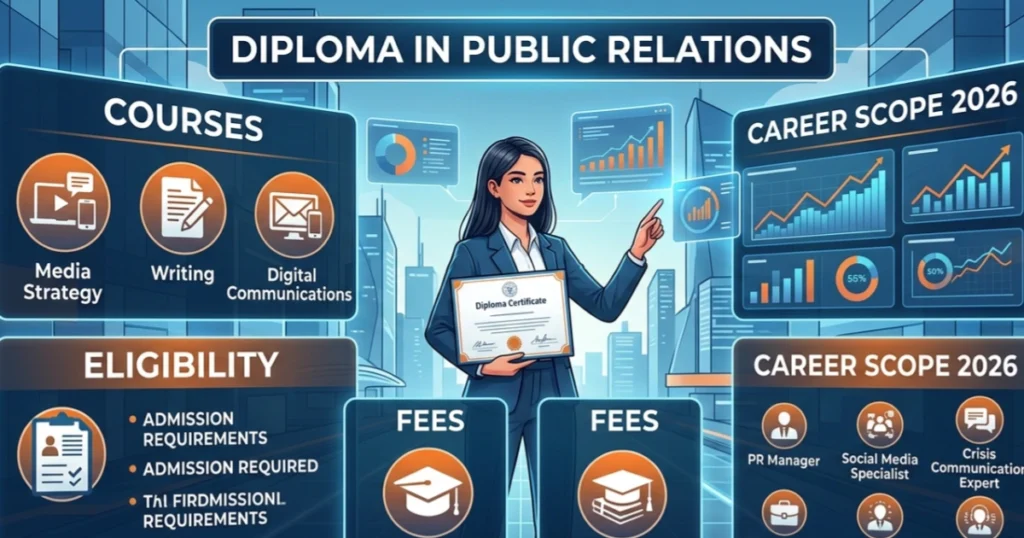
Diploma in Public Relations: Courses, Eligibility, Fees, and Career Scope 2026
Abhijeet Chatterjee is a professional Content and Copy specialist with over five years of experience in crafting compelling content around the Edtech domain. His portfolio includes notable work…
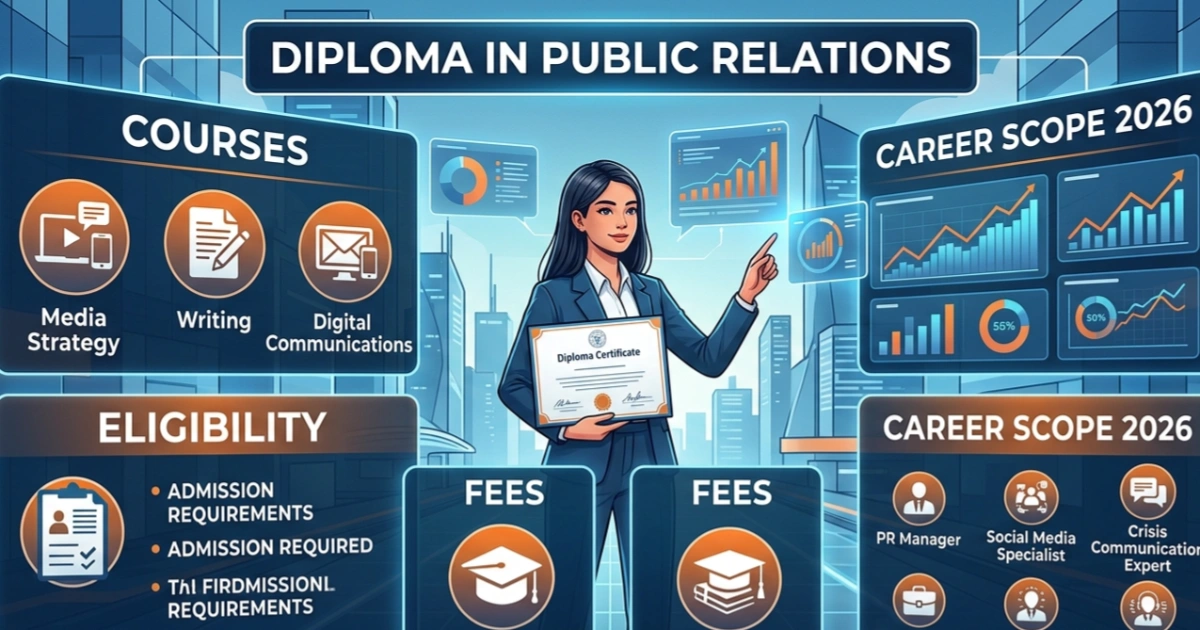
A Diploma in Public Relations offers a focused and practical pathway into the dynamic world of communication, equipping aspiring professionals with essential skills to manage reputation and build strong brand narratives. In today’s rapidly evolving media landscape, mastering strategic communication is crucial for individuals and organizations alike. This comprehensive guide explores the course overview, eligibility criteria, fees, and promising career scope for a PR Diploma in 2026, alongside insights into top colleges and course formats.
Diploma in Public Relations: Course Overview and Key Learning Outcomes 2026
The Diploma in Public Relations is a postgraduate, industry-focused program preparing individuals to plan and execute communication strategies. With sustained growth projected for the Indian PR industry, this program equips students for key roles in reputation management and integrated marketing communications, meeting modern demands for strategic impact.
| Level | Salary Range |
| Entry-level | ₹2.5–4 LPA |
| Mid-level | ₹4–7 LPA |
| Senior-level | ₹7–12 LPA+ |
| Top roles | ₹12–20 LPA+ |
Top Colleges for Diploma in Public Relations in India 2026
There are several reputed institutions across India offering Diploma and PG Diploma programs in Public Relations, with a strong concentration of colleges in Delhi, Mumbai, and other major cities. Below is a verified and updated list for 2026, with corrected fee structures, admission timelines, and accepted entrance exams.
| College Name | Location | Course Name | Total Fees (INR) | College Type | Duration |
| Xavier’s Institute of Communication (XIC) | Mumbai, Maharashtra | Public Relations and Corporate Communication | 3,48,830 (incl. GST) | Independent | 10 months |
| School of Communications & Reputation (SCoRe) | Mumbai, Maharashtra | PG Programme in Public Relations | 2,25,000 + GST | Private | 10 months |
| Indian Institute of Mass Communication (IIMC) | New Delhi, Delhi | Advertising and Public Relations | 1,45,000 | Government | 1 year |
| Institute of Marketing Communications India (IMCI) | Noida, Uttar Pradesh | Public Relations and Advertising | 1,25,000 (classroom); 23,000 (distance/online) | Private | 1 year |
| AAFT Institute | Noida, Uttar Pradesh | Public Relations | 1,20,000 to 1,55,000 | Private | 1 year |
| Manav Rachna International Institute of Research and Studies | Faridabad, Haryana | Advertising and Public Relations | 1,36,000 | Private | 1 year |
| Bharatiya Vidya Bhavan SP College of Communication | New Delhi, Delhi | Public Relations | 45,000 | Private | 10 months |
| National Academy of Event Management and Development (NAEMD) | Mumbai, Maharashtra | Event Management and Public Relations | 90,000 (approx.) | Private | 1 year |
| Kerala Institute of Tourism and Travel Studies (KITTS) | Thiruvananthapuram, Kerala | Public Relations | 30,000 | Government | 1 year |
| Delhi School of Communications (DSC) | New Delhi, Delhi | Communication (includes PR) | Not publicly disclosed | Private | 2 years |
| NBA School of Mass Communication | New Delhi, Delhi | Public Relations | Not publicly disclosed | Private | 1 year |
| Venkateshwara Open University | Papum Pare, Arunachal Pradesh | Public Relations | Not publicly disclosed | Private | 1 year |
| Takshshila College | Chhatarpur, Madhya Pradesh | Public Relations | Not publicly disclosed | Private | 1 year |
| Shashi School of Business and Media | Patna, Bihar | Public Relations | Not publicly disclosed | Private | 1 year |
| Singhania University | Jhunjhunu, Rajasthan | Public Relations | 25,000 to 30,000 (approx.) | Private | 1 year |
| CMJ University | East Khasi Hills, Meghalaya | Public Relations | Not publicly disclosed | Private | 1 year |
Diploma in Public Relations Syllabus: Core Subjects and Modules 2026
The Diploma in Public Relations syllabus for 2026 encompasses a range of core subjects designed to equip students with modern communication skills. Programs like the PG Diploma in Advertising and Public Relations (offered by institutes such as IIMC) integrate PR theory with hands-on industry training across two semesters, followed by a one-month industry attachment.
The course is structured to provide basic and emerging concepts in public relations, advertising, corporate communication, and allied fields. It also enables students to integrate various communication functions with organisational goals and strategies, while sensitising them to social and gender communication issues.
PG Diploma Core Subjects
The PG Diploma in Advertising and Public Relations covers ten papers spanning both theory and practicals, with a strong emphasis on applied skills and campaign production.
| Paper No. | Subject | Theory Marks | Practical Marks |
| I | Communication Theories, Concepts and Process | 70 | 30 |
| II | Marketing | 40 | 60 |
| III | Advertising: Principles, Concepts and Management | 50 | 50 |
| IV | Media Planning | 40 | 60 |
| V | Creativity and Campaign Planning | 25 | 75 |
| VI | Public Relations & Corporate Communication: Principles, Tools & Techniques | 50 | 50 |
| VII | Government and Public Service Communication | 50 | 50 |
| VIII | New Media: Concepts and Applications | 25 | 75 |
| IX | Production Techniques & Methods | 25 | 75 |
| X | Advertising, Marketing, and PR Research | 25 | 75 |
| Total | 400 | 600 |
Program/Module Breakdown: Key Details
| Program/Module Category | Key Details |
| Communication Theories & Process | Covers classical and contemporary models (Lasswell, Berlo, Shannon-Weaver), mass communication theories (agenda setting, cultivation, two-step flow), development communication, visual communication, and folk media |
| Marketing | Topics include economics basics, marketing strategy (STP, 4/6/7P), consumer behaviour, product management, IMC, and laws/ethics in marketing |
| Advertising: Principles & Management | Covers advertising concepts, ad agency structure, account management, advertising and society (gender/ethics), strategic planning, and brand management |
| Media Planning | Includes an overview of global/Indian media, media research (TAM, ABC, Census data), media strategy, media buying, and budgeting methods |
| Creativity & Campaign Planning | Focuses on creative process, creative writing, language in advertising, campaign planning, entrepreneurship, and full-group campaign production exercise |
| PR & Corporate Communication | Covers PR models (Grunig), media relations, corporate governance, crisis communication, CSR, financial communication, investor relations, and internal communications |
| Government & Public Service Communication | Includes government information systems (PIB, Doordarshan, AIR), media relations, public service advertising (PSA), crisis communication by government, and social media for governance |
| New Media: Concepts & Applications | Topics include digital PR, online reputation management, digital advertising, social media data management, and hands-on workshops (Google Analytics, infographics, CMS, blogging) |
| Production Techniques & Methods | Covers art and design, print production, photography, electronic media production, digital graphics software (Photoshop, InDesign, CorelDraw), and web/mobile elements |
| Advertising, Marketing & PR Research | Covers marketing research, advertising research, PR evaluation, SPSS, and an individual Research Project Study submitted in Semester II |
Semester-Wise Subject Distribution
| Semester | Focus Area | Key Papers |
| Semester I (Sept to Jan) | Conceptual and theoretical inputs | Communication Theories, Marketing, Advertising, Media Planning, PR & Corporate Communication, Government Communication, New Media, Research (Part A) |
| Semester II (Jan to April) | Hands-on skills, group campaigns, and industry attachment | Creativity & Campaign Planning, Production Techniques, Research Project Study (Part B), One-month Industry Attachment |
Paper VI: PR and Corporate Communication — Detailed Unit Breakdown
This is the most directly relevant paper for PR diploma students, covering seven units with both theory (50 marks) and practicals (50 marks).
| Unit | Topic | Sessions | Marks |
| I | Understanding PR & Corporate Communication — definitions, history, pioneers (Ivy Lee, Bernays), Grunig’s models | 10 | 10 |
| II | PR Practice and Process — in-house vs consultancy, campaigns, client-agency relationship, PR measurement | 10 | 10 |
| III | PR and Media — media relations, press releases, press conferences, backgrounders, media tracking | 5 | 5 |
| IV | PR’s Evolving Role — influencer relations, global PR, cross-cultural communication, entertainment, and celebrity management | 5 | 5 |
| V | Introduction to Corporate Communication — stakeholder segmentation, internal and external communications, CC plan | 10 | 5 |
| VI | Corporate Communication Strategies and Tools — corporate governance, reputation management, CSR, investor relations, internal communication | 10 | 10 |
| VII | Crisis Communication — types of crises, phases of crisis management, media handling, case studies | 2 | 5 |
People Also Read
Diploma in Public Relations: Important Admission Dates 2026
Admission timelines for Diploma and PG Diploma in Public Relations programs in India vary significantly depending on whether the institution follows a government entrance exam cycle (CUET-PG) or its own institute-level process. Most programs commence between July and September 2026, with applications opening as early as January/February.
| College | Application Start | Application Last Date | Entrance Exam | Result / Merit List | Counselling / Admission | Classes Begin |
| Xavier’s Institute of Communication (XIC), Mumbai | January 2026 | May 31, 2026 | XIC OET: April 12, 18, 19, 2026 (Online) | May 2026 | May to June 2026 | June/July 2026 |
| School of Communications & Reputation (SCoRe), Mumbai | Rolling admissions | Rolling (Summer Batch and Winter Batch) | NCAT + Personal Interview | Declared on rolling basis | On selection | Summer Batch: July 2026; Winter Batch: January 2027 |
| Indian Institute of Mass Communication (IIMC), New Delhi | CUET-PG registration opened Jan 2026 | January 20, 2026 (CUET-PG last date) | CUET-PG 2026 (Mass Communication paper) | June 2026 (tentative) | June to July 2026 | August 2026 |
| Delhi School of Communications (DSC), New Delhi | April 2026 (approx.) | June 2026 (approx.) | Institute selection process / Merit | June/July 2026 | July 2026 | August/September 2026 |
| Institute of Marketing Communications India (IMCI), Noida | Open (rolling admissions) | Open throughout year | Merit / Direct Admission | Immediate on selection | Rolling | July/August 2026 |
| AAFT Institute, Noida | Open year-round | Rolling | AAFT Global Entrance Exam (GEE) + Personal Interview | Declared post interview | On selection | July 2026 (tentative) |
| Manav Rachna International Institute, Faridabad | February/March 2026 | June 2026 | CUET-PG / MAT / SNAP / CAT / Direct | June/July 2026 | July 2026 | July/August 2026 |
| NBA School of Mass Communication, New Delhi | April/May 2026 | June 2026 | Merit based | June/July 2026 | July 2026 | August 2026 |
| Bharatiya Vidya Bhavan SP College of Communication, New Delhi | April 2026 | June 2026 | Merit based | June 2026 | June/July 2026 | July/August 2026 |
| National Academy of Event Management and Development (NAEMD), Mumbai | March/April 2026 | June 2026 | Institute entrance + Personal Interview | June 2026 | June/July 2026 | July/August 2026 |
| Kerala Institute of Tourism and Travel Studies (KITTS), Thiruvananthapuram | May/June 2026 | July 2026 | State level / Merit | July 2026 | July/August 2026 | August 2026 |
| Dr PDBH Government PG College, Pauri Garhwal, Uttarakhand | CUET-PG registration: January 2026 | January 20, 2026 (CUET-PG last date) | CUET-PG 2026 | June 2026 | State counselling: July 2026 | August 2026 |
| Venkateshwara Open University, Arunachal Pradesh | May/June 2026 | July/August 2026 | Merit based | On rolling basis | Rolling | August/September 2026 |
| Takshshila College, Chhatarpur, MP | April/May 2026 | June/July 2026 | Merit based | July 2026 | July 2026 | August 2026 |
| Shashi School of Business and Media, Patna | April/May 2026 | June 2026 | Merit based | June/July 2026 | July 2026 | August 2026 |
| Singhania University, Jhunjhunu, Rajasthan | May 2026 | July 2026 | Merit based / Direct | July 2026 | July 2026 | August 2026 |
| CMJ University, East Khasi Hills, Meghalaya | May 2026 | July 2026 | Merit based / Direct | July 2026 | July/August 2026 | August 2026 |
Key Deadlines to Note
- CUET-PG last date (applicable for IIMC, Manav Rachna, government colleges): January 20, 2026 — this deadline has already passed for the 2026-27 batch, meaning CUET-PG aspirants should prepare for the 2027 cycle
- XIC OET last application date: May 31, 2026
- XIC OET exam dates: April 12, 18, and 19, 2026 (online mode)
- SCoRe: Operates on a rolling basis with two batches annually — Summer (July start) and Winter (January start)
- AAFT Noida: Admissions open year-round via AAFT Global Entrance Exam (GEE)
PG Diploma vs Diploma in Public Relations: Key Differences 2026
Comparing a PG Diploma in Public Relations with an Advanced Diploma in Public Relationship reveals distinct differences, primarily in eligibility and duration. The PG Diploma typically requires a university degree, while the Advanced Diploma is accessible after 10+2, making it suitable for different academic backgrounds.
- PG Diploma Eligibility: Any degree from a recognized university.
- Advanced Diploma Eligibility: Completion of 10+2 or equivalent.
- PG Diploma Duration: One Year (Non-Semester System).
- Advanced Diploma Duration: Six Months.
- PG Diploma Total Seats (IIMC): 77.
- Advanced Diploma Course Fee (Discounted): ₹5,750.
Further details for the Advanced Diploma in Public Relationship highlight its online examination structure and original course fee, offering insights into its assessment and cost.
| Feature | Detail |
| Advanced Diploma Original Fee | ₹11,500 |
| Advanced Diploma Exam Questions | 60 (Multiple Choice Questions) |
| Advanced Diploma Exam Duration | 120 minutes |
| Advanced Diploma Exam Max Marks | 600 |
| Advanced Diploma Exam Passing Marks | 40% |
Online vs Offline Diploma in Public Relations Courses 2026
Diploma in Public Relations courses offer a diverse range of options, from free online programs to intensive offline courses costing over ₹6,80,000. This comparison highlights key differences in duration, cost, eligibility, and features to help prospective students make informed decisions for 2026.
| Option Type | Institute/Course Name | Course Type/Level | Duration | Cost (INR) | Eligibility | Key Features/Notes |
| Online | Diploma in Public Relation Officer | Diploma | Six Months | ₹4,750 (originally ₹9,500) | 10+2 (higher Secondary) or equivalent | Online examination (120 mins, 60 MCQs, 40% passing marks); Lifetime validity; Free job assistance; Certificate in 7 days (soft) / 45 days (hard). |
| Online | Diploma in Advertising and Public Relations | Diploma | Six Months | ₹4,750 (originally ₹9,500) | 10th (high school) education or equivalent | Online examination (120 mins, 60 MCQs, 40% passing marks); Lifetime validity; Free job assistance; Certificate in 7 days (soft) / 45 days (hard). |
| Online (Distance Learning) | Institute of Marketing Communications India | Graduate Diploma in Public Relations and Advertising | One year | ₹23,000 | High school completion | Offers extensive instruction across 13 modules. |
| Online (Distance Learning) | Institute of Marketing Communications India | Executive Diploma in Public Relations and Advertising | One year | ₹25,000 | High school completion | Offers extensive instruction across 13 modules. |
| Online (Free Course) | Alison | Diploma in Public Relations | Not specified (Avg. Hours mentioned) | Free to enrol, study, and complete | Beginner Level | Certification requires 80% or higher in the final course assessment. |
| Offline (Top 10 in India for 2026) | Xavier’s Institute of Communication, Mumbai | Diploma (Public Relations and Corporate Communication specialization) | 10-month full-time | ₹2,63,870 (includes GST, registration, library fees) | 12+3 (graduation), age limit 35 and below | 32 modules, 451 sessions; Classes from 10 am to 8:30 pm. |
| Offline (Top 10 in India for 2026) | Symbiosis Institute (SIMC, Pune & SSMC, Bangalore) | MBA in Communication Management (specialization in Public Relations) | Two years (four semesters) | ₹6,81,950 | Not explicitly stated (MBA program) | Best media and communication college in India. |
| Offline (Top 10 in India for 2026) | School of Communications & Reputation (SCoRe), Mumbai | Postgraduate Diploma in Public Relations | 10 months | ₹2,50,000 + GST | Not explicitly stated | PRCAI approved; Practical approach with field visits and case studies; Offers scholarships. |
| Offline (Top 10 in India for 2026) | Delhi School of Communications (DSC), Delhi | 2-year Post-Graduate Diploma Degree in Communication | 2 years | Not specified | Not explicitly stated (post-graduate diploma) | Classes 8:30 am to 1:30 pm (six hours daily); Includes a full-time internship lasting more than six months. |
| Offline (Top 10 in India for 2026) | Indian Institute of Mass Communication (IIMC), Delhi | One-year Post-Graduation Diploma Program in Public Relations and Advertising | One year | ₹1,23,000 | Not explicitly stated (post-graduation diploma) | Established in 1981 to satisfy the expanding need for PR professionals. |
| Offline (Typical Classrooms) | Institute of Marketing Communications India | Graduate Diploma in Public Relations and Advertising | One year | ₹120,000 | High school completion | Offers extensive instruction across 13 modules. |
| Offline (Part-time Study) | Institute of Marketing Communications India | Executive Diploma in Public Relations and Advertising | One year | ₹120,000 | High school completion | Offers extensive instruction across 13 modules. |
The comparison table illustrates that online Diploma in Public Relations options are generally more affordable and flexible, with some even being free, while top offline institutes offer comprehensive, full-time programs at significantly higher costs.
Career Opportunities and Job Prospects After PR Diploma 2026
A Diploma In Public Relations opens doors to diverse and promising career opportunities across various industries. Graduates gain practical skills and industry-specific exposure, significantly enhancing their job prospects. This section explores the dynamic landscape of PR careers, growth potential, and salary expectations in India.
- Overall Prospects: Diverse opportunities, improved by diploma skills.
- Demand in India: Significant rise, industry expanding due to brand reputation focus.
- Growth Potential: Rapid from entry-level to strategic leadership roles like CCO.
- Long-Term: Promising, professionals always in demand across all sectors.
- International: Diploma opens doors, communication principles universally relevant.
- Fastest-Growing: Digital communication is a key area, ensuring long-term prospects.
The field’s scope is growing, with strong demand across corporate, media, government, and digital industries, offering excellent opportunities in branding, online reputation management, and influencer marketing. Emerging specializations like influencer partnerships, digital listening, online crisis management, sustainability communication,
Frequently Asked Questions
What is the difference between PG diploma and PG?
A PG diploma typically spans 12-16 months for specialization after graduation, whereas a PG (Master’s degree) is a full master’s degree that generally carries more weightage.
What is a Diploma In Public Relations?
The Professional Diploma in Public Relations and PR Management by MTF Institute covers PR types, strategy, content creation, media relations, campaign planning, ethics, and crisis management.
What are the eligibility requirements for a Diploma in Public Relations?
Candidates must have passed the 10 or 10+2 examination from any stream or an equivalent recognized board exam with a minimum of 50% marks.
How do I apply for a Diploma in Public Relations?
To apply, shortlisted students report for Counseling and Document Verification at college reporting centers. Documents are verified for qualification, leading to enrollment in the Diploma in Public Relations course.
What is the application timeline for the Diploma in Public Relations?
The application timeline for the Diploma in Public Relations is determined by individual universities, with most considering your graduation aggregate score for admission.
What is the expected cutoff for the Diploma in Public Relations?
For top Diploma in Public Relations colleges, cutoffs generally range from 60% to 70%. Scoring above 70% is recommended for a safer admission chance.