Bachelor of Vocational Studies (Public Services) India 2026
Nishit Kumar is a senior EdTech industry leader with over a decade of experience in building and scaling education platforms, shaping their product, content, and growth strategy. At…
Latest update: Bachelor of Vocational Studies (Public Services) 2026 admissions & dates updated. Read more ›
Welcome to the comprehensive overview of the Bachelor of Vocational Studies (B.Voc) in Public Services for the academic year 2026 in India. This page is designed to provide prospective students and their parents with a detailed understanding of this unique vocational degree, covering everything from its core definition to career outcomes, helping you make an informed decision about your future.
What is Bachelor of Vocational Studies (Public Services)?
The Bachelor of Vocational Studies (B.Voc) in Public Services is an undergraduate degree program designed to equip students with practical skills and knowledge essential for various roles within the public sector. It emphasizes a blend of theoretical understanding and hands-on training, making graduates job-ready for government, non-profit, and public utility organizations.
Unlike traditional degrees, the B.Voc program, particularly in Public Services, focuses on skill development aligned with industry needs. It integrates general education components with multiple exit points (Diploma, Advanced Diploma) allowing flexibility for students to join the workforce at different stages of their education. The curriculum is often developed in collaboration with industry partners to ensure relevance and employability.
What is the eligibility for Bachelor of Vocational Studies (Public Services) in 2026?
To be eligible for the B.Voc in Public Services program in 2026, candidates must typically have completed their 10+2 (or equivalent) examination from a recognized board, with a minimum aggregate percentage, usually ranging from 45% to 50%.
Specific eligibility criteria can vary slightly between universities and colleges. Some institutions might prefer candidates from a particular stream (e.g., Arts or Commerce), while others may have no such restrictions. There is generally no age limit for admission to B.Voc programs. Certain colleges might also conduct an entrance examination or a personal interview as part of their selection process. It is always advisable to check the specific requirements of your preferred institutions.
What is the admission process for B.Voc Public Services in 2026?
The admission process for B.Voc Public Services in 2026 typically involves applying to colleges, possibly appearing for an entrance exam, and then participating in counseling or an interview based on merit.
Here’s a general step-by-step guide:
- Application Submission: Fill out the online or offline application form for your chosen colleges, usually available from April to June 2026.
- Entrance Exam (if applicable): Some universities conduct their own entrance tests (e.g., CUET for central universities, or state-level exams). Prepare for general aptitude, current affairs, and basic reasoning.
- Merit List/Cut-off: Colleges release merit lists based on 10+2 marks or entrance exam scores.
- Counseling/Interview: Shortlisted candidates may be called for counseling to choose specializations or for a personal interview to assess their communication skills and interest.
- Document Verification & Fee Payment: Submit required documents (mark sheets, ID proof, etc.) and pay the admission fee to secure your seat.
People Also Read


What is the syllabus and subjects covered in B.Voc Public Services?
The B.Voc Public Services syllabus is designed to provide a holistic understanding of public administration, governance, and community development, combining core public service subjects with vocational skills.
The curriculum typically spans six semesters, covering subjects like Public Administration, Indian Constitution, Ethics in Public Services, Disaster Management, Social Welfare Policies, Communication Skills, and Computer Applications. Practical components often include internships, field projects, and skill-based training modules. Specializations might include areas like Urban Governance, Rural Development, or Public Policy.
Typical B.Voc Public Services Semester-wise Subjects (Illustrative)
| Semester | Core Subjects | Skill Components / Electives |
|---|---|---|
| I | Introduction to Public Administration, Indian Constitution, English Communication | Computer Fundamentals, Office Automation Tools |
| II | Principles of Economics, Public Policy & Planning, Environmental Studies | Data Entry & Management, Basic Accounting for Public Services |
| III | Ethics in Public Services, Disaster Management, Social Welfare Administration | Public Relations & Communication, Project Management Basics |
| IV | Local Governance, Human Rights, Research Methodology | Field Work/Internship, Data Analysis Tools |
| V | E-Governance, Urban & Rural Development, International Relations | Grant Writing, Conflict Resolution |
| VI | Public Finance, Contemporary Issues in Public Services, Public Grievance Redressal | Advanced Internship/Project, Entrepreneurship in Public Sector |
How much does Bachelor of Vocational Studies (Public Services) cost in India?
The cost of pursuing a B.Voc in Public Services in India varies significantly based on the type of institution, ranging from INR 15,000 to INR 80,000 per annum for government colleges and INR 50,000 to INR 2,00,000 per annum for private institutions.
Government-funded universities and colleges generally have lower fee structures due to subsidies. Private institutions, while offering potentially better infrastructure or industry connections, typically charge higher fees. Additional costs may include examination fees, hostel charges, study materials, and project expenses. Scholarships are often available based on merit or financial need, which can help offset these costs.
Estimated Annual Fee Ranges for B.Voc Public Services (2026)
| Institution Type | Annual Fee Range (INR) | Additional Costs (Approx. Annual, INR) |
|---|---|---|
| Government/State University | 15,000 – 80,000 | 5,000 – 20,000 (Excluding Hostel) |
| Private University/College | 50,000 – 2,00,000 | 10,000 – 50,000 (Excluding Hostel) |
Is Bachelor of Vocational Studies (Public Services) worth it for jobs?
Yes, the Bachelor of Vocational Studies (Public Services) is increasingly becoming a valuable degree for job prospects, especially for roles requiring practical skills and a direct understanding of public sector operations.
The vocational nature of the B.Voc program means graduates are equipped with specific, job-ready skills, making them attractive to employers in various public and semi-public organizations. The emphasis on internships and practical training provides real-world experience, often leading to direct placements. While traditional degrees focus on theoretical knowledge, B.Voc aims to bridge the skill gap, enhancing employability in a competitive job market. It’s particularly beneficial for those aspiring to roles in government administration, NGOs, social work, and public utility services.
What are the career prospects and salary after B.Voc Public Services?
Graduates of B.Voc Public Services can find employment in various government departments, NGOs, public sector undertakings, and social welfare organizations, with starting salaries typically ranging from INR 2.5 LPA to INR 5.0 LPA.
Common job roles include Administrative Assistant, Project Coordinator, Community Development Officer, Social Worker, Public Relations Officer, and roles in disaster management or local governance. With experience and further education (e.g., a Master’s in Public Administration), career progression can lead to managerial and policy-making positions. The public sector offers stability and opportunities for service, while NGOs provide avenues for direct community impact.
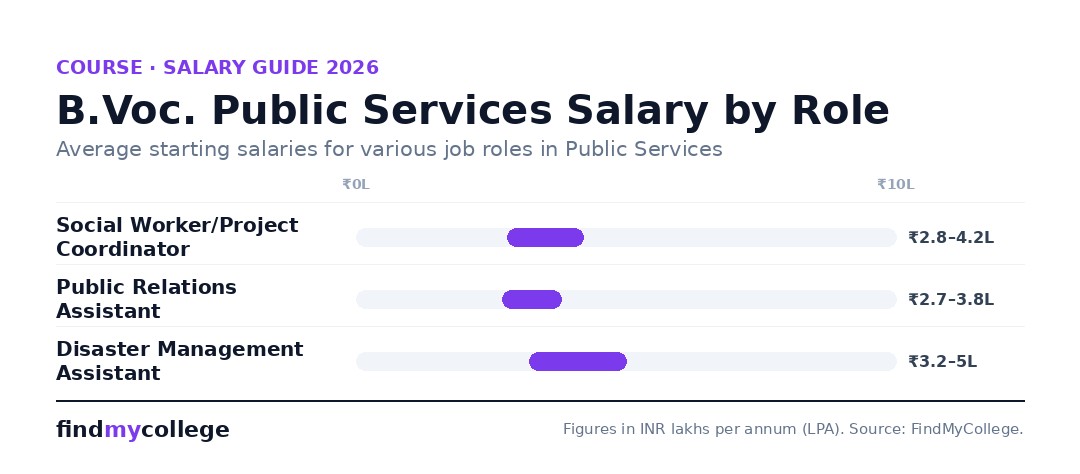
Illustrative Career Roles & Salary Ranges after B.Voc Public Services
| Job Role | Typical Employers | Average Starting Salary (INR per annum) | Growth Potential |
|---|---|---|---|
| Administrative Assistant | Govt. Departments, PSUs, NGOs | 2.5 – 4.0 Lakhs | Administrative Officer, Manager |
| Community Development Officer | NGOs, Rural/Urban Local Bodies | 3.0 – 4.5 Lakhs | Program Manager, Senior CDO |
| Social Worker/Project Coordinator | NGOs, Social Welfare Depts. | 2.8 – 4.2 Lakhs | Team Lead, Project Manager |
| Public Relations Assistant | Govt. Info. Depts., PSUs | 2.7 – 3.8 Lakhs | PR Officer, Communications Manager |
| Disaster Management Assistant | NDRF, State Disaster Mgmt. Authorities | 3.2 – 5.0 Lakhs | Disaster Response Officer |
How does B.Voc Public Services compare to traditional BA or B.Com degrees?
B.Voc Public Services differs from traditional BA or B.Com degrees primarily in its vocational focus, practical skill development, and industry alignment, making graduates more job-ready for specific public sector roles.
While a BA (e.g., in Public Administration or Political Science) provides a strong theoretical foundation and a B.Com focuses on commerce and business principles, B.Voc Public Services integrates theory with extensive practical training, internships, and skill-based modules. This makes B.Voc graduates particularly suited for entry-level positions that require immediate application of skills, whereas BA/B.Com graduates might often pursue further studies or competitive exams for similar roles.
What are the top colleges for B.Voc Public Services in India?
Several universities and colleges across India offer quality B.Voc Public Services programs, with prominent institutions often being state universities or those affiliated with central bodies.
While specific rankings can vary, some well-regarded institutions known for their vocational programs or public administration studies that may offer B.Voc Public Services include Delhi University colleges, various state universities (e.g., in Maharashtra, Karnataka, Uttar Pradesh), and some private universities with a strong focus on skill development. It’s recommended to check the UGC website and individual university portals for the most up-to-date list of accredited programs and their specific offerings for 2026.
Frequently Asked Questions
Can I pursue higher education after B.Voc Public Services?
Yes, after completing a B.Voc in Public Services, you are eligible to pursue higher education, such as a Master’s in Public Administration (MPA), MBA in Public Policy, or other relevant postgraduate degrees. The UGC guidelines ensure that B.Voc degrees are recognized for further studies.
Are there any entrance exams for B.Voc Public Services?
While many colleges admit students based on 10+2 merit, some universities, especially central universities, may require candidates to appear for entrance exams like the Common University Entrance Test (CUET) for admission to B.Voc programs. Always check the specific college’s admission policy for 2026.
What is the duration of the B.Voc Public Services program?
The B.Voc Public Services program is typically a three-year undergraduate degree, divided into six semesters. It also offers multiple exit points after one year (Diploma) and two years (Advanced Diploma).
Is B.Voc Public Services recognized by the government?
Yes, the B.Voc degree is fully recognized by the University Grants Commission (UGC) and is considered equivalent to other Bachelor’s degrees for employment and higher education purposes, particularly in government and public sector roles.
What skills will I gain from B.Voc Public Services?
You will gain a range of practical skills including administrative management, public policy analysis, community engagement, disaster management, communication, data handling, project coordination, and ethical decision-making relevant to public service.
Can I prepare for UPSC/State PSC exams after B.Voc Public Services?
Yes, the foundational knowledge gained in subjects like Public Administration, Indian Constitution, and Public Policy can be highly beneficial for preparing for UPSC Civil Services or State Public Service Commission (PSC) examinations. Many graduates combine their B.Voc with dedicated exam preparation.