Civil Engineer Degree: B.Tech Course Details, Eligibility and Scope
Nishit Kumar is a senior EdTech industry leader with over a decade of experience in building and scaling education platforms, shaping their product, content, and growth strategy. At…
A Civil Engineering degree (B.Tech / B.E.) is a 4-year undergraduate degree requiring 10+2 education with Physics, Chemistry, and Mathematics and a minimum of 50% aggregate marks.
At least 2,078 colleges offer this program across India, making it essential to evaluate curriculum structures, entrance tests, state-wise tuition fees, and campus placement records before securing admission. Below is a detailed breakdown covering eligibility criteria, semester subjects, top institutes, and career scope.
| Parameter | Details |
|---|---|
| Course Duration | 4 Years / 8 Semesters |
| Degree Names | B.Tech (Bachelor of Technology) / B.E. (Bachelor of Engineering) |
| Eligibility Criteria | 10+2 with Physics, Chemistry, and Mathematics (PCM) with minimum 50% aggregate marks |
| Required AICTE Credits | 160 to 164 total credits (18 extra credits for Honours/Minor) |
| Entrance Exams | JEE Main, JEE Advanced, BITSAT, VITEEE, WBJEE, MHT CET, KCET, KEAM |
| Course Fee Range | INR 6,000 to INR 25,00,000 |
What is B.Tech Civil Engineering
B.Tech Civil Engineering focuses on the planning, designing, construction, and maintenance of physical structures such as buildings, bridges, roads, airports, and water supply systems. It equips engineering students with analytical and practical skills required to execute large-scale infrastructure projects while ensuring structural stability and environmental sustainability.
The AICTE model curriculum specifies 160 to 164 credits for a regular B.Tech Civil Engineering degree, with an additional 18 credits achievable through MOOCs for students opting for an Honours or Minor degree. The underlying coursework balances basic sciences, engineering principles, core structural topics, and hands-on design projects.
| Category | Breakup of Credits (Total 164) |
|---|---|
| Humanities and Social Sciences including Management (HSMC) | 06 |
| Basic Science Courses (BSC) | 24 |
| Engineering Science Courses (ESC) | 20 |
| Professional Core Courses (PCC) | 58 |
| Professional Elective Courses (PEC) | 26 |
| Multidisciplinary Open Elective Courses (MOPEC) | 12 |
| Project Work, Seminar & Industry Internship | 16 |
| Indian Knowledge System (IKS) | 02 |
Difference Between B.E. Civil Engineering and B.Tech Civil Engineering
| Aspect | B.E. Civil Engineering | B.Tech Civil Engineering |
|---|---|---|
| Duration | 4 years | 4 years |
| Curriculum Focus | Generally more theoretical | Relatively more practical-oriented |
| Job Prospects | Similar job prospects | Similar job prospects |
Both B.E. and B.Tech in Civil Engineering are 4-year undergraduate degrees offering similar job prospects. The main distinction is that B.Tech is designed with a relatively greater focus on practical applications compared to B.E.
Specialisations and Major Fields in B.Tech Civil Engineering
Civil engineering encompasses multiple technical domains that allow students to focus on specific infrastructure sectors. Major specialisations available within undergraduate electives and postgraduate research include Structural Engineering, Geotechnical Engineering, Transportation Engineering, Environmental Engineering, Water Resources Engineering, and Construction Technology & Management.
Graduates who complete a B.Tech in Civil Engineering have higher studies options such as M.Tech in Structural Engineering, M.Tech in Construction Technology & Management, and M.Tech in Infrastructure Engineering to advance their specialization.
B.Tech Civil Engineering Eligibility
To gain admission to a B.Tech Civil Engineering course, candidates must meet specific academic qualification requirements established by engineering councils and universities across India:
- Candidates must have passed Class 10+2 or equivalent examination from a recognized central or state board.
- Must have studied Physics, Chemistry, and Mathematics (PCM) as compulsory subjects in Class 12.
- Must have secured at least 50% aggregate marks in the qualifying examination.
B.Tech Civil Engineering Admission Process
- Educational Qualification: Complete 10+2 education with Physics, Chemistry, and Mathematics as core subjects, securing at least 50% marks.
- Entrance Examinations: Qualify in national, university, or college-level entrance exams such as JEE Main or BITSAT, as admissions are offered through entrance-based or merit-based processes.
- Degree Completion: Gain admission to complete the 4-year B.Tech in Civil Engineering degree program.
Admission to B.Tech Civil Engineering programs is conducted through merit-based or entrance-based selection. Candidates must fulfill 10+2 subject requirements and qualify in examinations like JEE Main or BITSAT.
B.Tech Civil Engineering Syllabus and Subjects
| Year | Semesters | Core Subjects & Labs |
|---|---|---|
| Year 1 | Semester 1 & 2 | Engineering Mathematics-I & II, Engineering Physics, Engineering Chemistry, Engineering Mechanics, Programming for Problem Solving, Engineering Graphics & Design |
| Year 2 | Semester 3 & 4 | Strength of Materials, Building Materials & Construction, Surveying & Geomatics, Fluid Mechanics, Engineering Geology, Concrete Technology, Geotechnical Engineering-I |
| Year 3 | Semester 5 & 6 | Structural Analysis, Design of Reinforced Concrete Structures, Geotechnical Engineering-II, Transportation Engineering, Environmental Engineering-I & II, Estimation & Quantity Surveying, Design of Steel Structures, Water Resources Engineering |
| Year 4 | Semester 7 & 8 | Construction Project Management, Irrigation Engineering, Professional Electives (Prestressed Concrete, Earthquake Engineering), Industrial Internship, Major Project |
Under the AICTE curriculum, professional core courses account for 58 credits, basic sciences for 24 credits, and engineering sciences for 20 credits. Meanwhile, Mahindra University requires at least 165 total credits, including 47 in Basic Sciences and 28 in Basic Engineering.
B.Tech Civil Engineering Fees
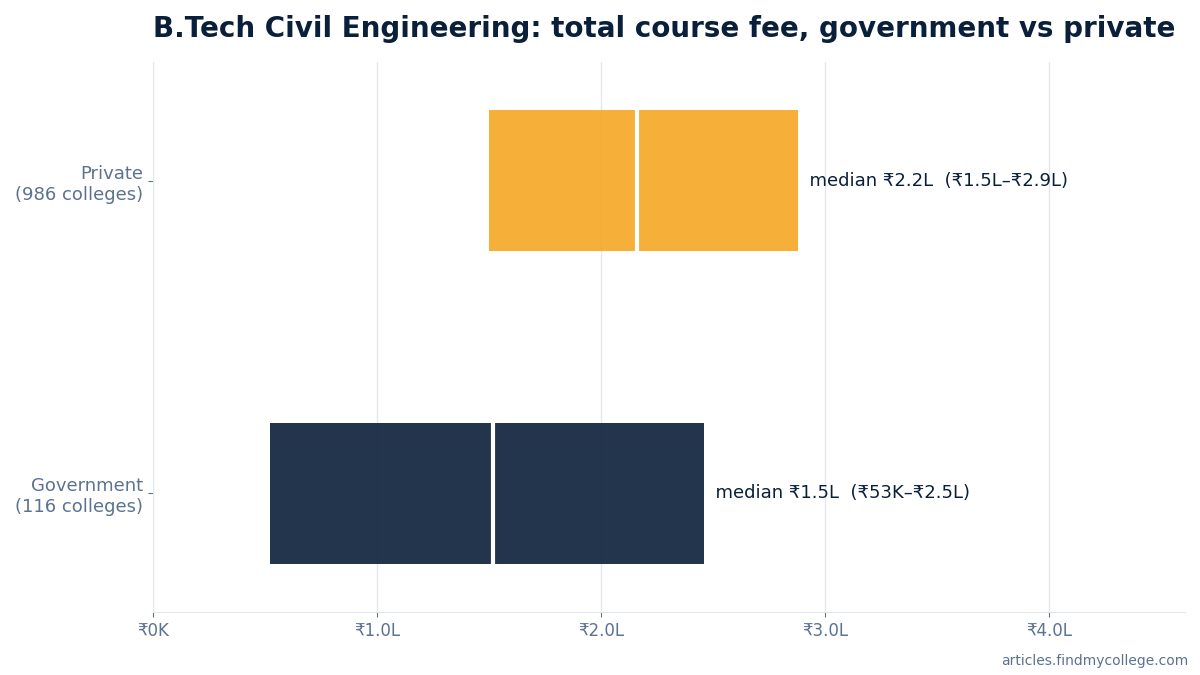
Course tuition varies significantly based on college ownership. At least 2,078 colleges offer B.Tech Civil Engineering in India, including 138 government institutes and 1,039 private colleges. Government institutions record a median total course fee of ₹1.52 lakh, with the middle half ranging between ₹52,524 and ₹2.46 lakh (based on 116 colleges with fee data).
For private engineering colleges, the median total course fee stands at ₹2.16 lakh, with the middle half falling between ₹1.50 lakh and ₹2.88 lakh (based on 986 colleges with fee data). High-end private institutions include BITS Pilani (INR 16.41 Lacs total fee), Thapar Institute of Engineering & Technology (INR 15.06 Lacs), and KIIT Bhubaneswar (INR 14.91 Lacs).
| College | City | Ownership | Total course fee |
|---|---|---|---|
| Government Engineering College Rajkot | Rajkot | Government | ₹6,000 |
| Government Engineering College Bhavnagar | Bhavnagar | Government | ₹6,000 |
| Government Engineering College Bharuch | Bharuch | Government | ₹6,000 |
| Government Engineering College Bhuj | Bhuj | Government | ₹6,000 |
| Government Engineering College Valsad | Valsad | Government | ₹6,000 |
| Lukhdhirji Engineering College | Morvi | Government | ₹6,000 |
| Government Engineering College Siwan | Siwan | Government | ₹7,500 |
| Government Engineering College Thrissur | Thrissur | Government | ₹10,000 |
| Government Engineering College Banaskantha | Banaskantha | Government | ₹11,360 |
| Rashtrakavi Ramdhari Singh Dinkar College of Engineering | Begusarai | Government | ₹12,200 |
| College | City | Total course fee |
|---|---|---|
| Wisdom School of Management Lucknow | Lucknow | ₹2.45 lakh |
| Royal School of Engineering and Technology | Guwahati | ₹4.41 lakh |
| Harcourt Butler Technological University | Kanpur | ₹3.95 lakh |
| College | City | Ownership | Total course fee | NIRF rank |
|---|---|---|---|---|
| Indian Institute of Technology Madras | Chennai | Government | ₹9.05 lakh | 1 (Overall, 2025) |
| Indian Institute of Technology Bombay | Mumbai | Government | ₹8.75 lakh | 3 (Overall, 2024) |
| Jamia Millia Islamia University | Delhi | Government | ₹77,200 | 4 (Overall, 2025) |
| Indian Institute of Technology Kanpur | Kanpur | Government | ₹7.41 lakh | 5 (Overall, 2025) |
| Indian Institute of Technology Kharagpur | Kharagpur | Government | ₹8.74 lakh | 6 (Overall, 2025) |
| Indian Institute of Technology Roorkee | Roorkee | — | ₹8.93 lakh | 6 (Overall, 2025) |
| Amrita Vishwa Vidyapeetham | Coimbatore | — | ₹10.10 lakh | 8 (Overall, 2025) |
| Indian Institute of Technology New Delhi | Delhi | Government | ₹8.63 lakh | 8 (Overall, 2025) |
| National Institute of Technology Rourkela | Rourkela | — | ₹1.40 lakh | 9 (Overall, 2025) |
| College | City | Ownership | Total course fee | Average package |
|---|---|---|---|---|
| Shri Govindram Seksaria Institute of Technology and Science | Indore | Private (aided) | ₹4.36 lakh | 7.21 LPA |
| Walchand College of Engineering | Sangli | Private (aided) | ₹2.51 lakh | 6.09 LPA |
| Azad Institute of Engineering and Technology | Lucknow | Private | ₹90,000 | 5.97 LPA |
| Galgotias College of Engineering and Technology | Greater Noida | Private | ₹3.47 lakh | 5.76 LPA |
| Pimpri Chinchwad College of Engineering | Pune | Private | ₹4.83 lakh | 5.54 LPA |
| Aditya Institute of Technology and Management | Tekkali | Private | ₹3.18 lakh | 5.15 LPA |
| Vidya Jyothi Institute of Technology | Hyderabad | Private | ₹4.40 lakh | 5.12 LPA |
| Jaipur Engineering College and Research Centre | Jaipur | Private | ₹84,000 | 4.96 LPA |
| TKM College of Engineering | Kollam | Private (aided) | — | 4.83 LPA |
| Gayatri Vidya Parishad College of Engineering | Visakhapatnam | Private | ₹3.15 lakh | 4.79 LPA |
| City | Colleges | Fee range | Well-known options |
|---|---|---|---|
| Hyderabad | 63 | ₹1.12 lakh – ₹20.20 lakh | Indian Institute of Technology Hyderabad, Jawaharlal Nehru Technological University Hyderabad |
| Jaipur | 56 | ₹84,000 – ₹9.52 lakh | Manipal University Jaipur, Kautilya Institute of Technology and Engineering and School of Management |
| Bhopal | 54 | ₹71,940 – ₹5.77 lakh | Maulana Azad National Institute of Technology, Laxmipati Institute of Science and Technology |
| Bhubaneswar | 45 | ₹95,000 – ₹10.50 lakh | Indian Institute of Technology Bhubaneswar, Kalinga Institute of Industrial Technology |
| Lucknow | 45 | ₹90,000 – ₹10.00 lakh | University of Lucknow, Integral University |
| Meerut | 36 | ₹80,000 – ₹4.57 lakh | Swami Vivekanand Subharti University, IIMT University |
| Guntur | 33 | ₹73,000 – ₹7.21 lakh | Acharya Nagarjuna University, Vignan’s Foundation for Science, Technology, and Research |
| Pune | 29 | ₹72,434 – ₹13.10 lakh | MIT World Peace University, Symbiosis International University Pune |
B.Tech Civil Engineering Career Scope and Salary
- Common Job Roles: Structural Engineer, Site Engineer, Geotechnical Engineer, Construction Engineer, Transportation Engineer, Water Resource Engineer, and Environmental Engineer.
- Top Recruiters: Larsen & Toubro, Tata Projects, Hindustan Construction Company, GMR Group, Shapoorji Pallonji, and Power Grid Corporation of India Ltd.
- Higher Studies Options: M.Tech in Structural Engineering, M.Tech in Construction Technology & Management, and M.Tech in Infrastructure Engineering.
The median average placement package across 124 reporting engineering colleges is 3.54 LPA. Graduates can pursue diverse roles across infrastructure development, private construction firms, and public sector organizations.
How to Apply for B.Tech Civil Engineering Admission in 2026: Step by Step
- Check Eligibility Criteria: Pass Class 10+2 examination with Physics, Chemistry, and Mathematics (PCM) securing at least 50% aggregate marks from a recognized board.
- Register and Appear for Entrance Exams: Apply and take national or state-level engineering entrance exams such as JEE Main, JEE Advanced, BITSAT, VITEEE, WBJEE, MHT CET, KCET, or KEAM.
- Participate in Counselling Process: Register for central or state counselling authorities (e.g., JoSAA, CSAB, WBJEEB, KEA) based on entrance exam ranks and select Civil Engineering as the preferred branch.
- Seat Allotment & Document Verification: Accept the allotted college seat, submit required documents (10th/12th mark sheets, entrance scorecard, identity proof, category certificate) for verification.
- Pay Admission Fees and Confirm Admission: Pay the term or annual tuition fees (ranging between INR 6,000 for government institutes to over INR 16 Lacs for private institutes) to lock the seat.
| What to do | Where | Link |
|---|---|---|
| Compare colleges, fees and cutoffs | B.Tech Civil Engineering colleges in India | findmycollege.com |
FAQs
How to become a civil engineer after 12th?
To become a civil engineer after 12th, complete 10+2 with Physics, Chemistry, and Mathematics with at least 50% marks, clear an entrance exam like JEE Main or BITSAT, and complete a 4-year B.Tech in Civil Engineering.
Is B.Tech civil engineering good?
Yes, B.Tech Civil Engineering offers strong scope due to national and international infrastructure growth, leading to employment in leading public and private sector construction firms with starting packages up to INR 9 LPA.
What is the average salary after a civil engineering degree in India?
Across 124 colleges, the median average placement package is 3.54 LPA, with starting packages reaching up to INR 9 LPA depending on technical expertise, job role, and employer.
Which college in Kolkata is considered top for civil engineering?
Jadavpur University, IIEST Shibpur, and Narula Institute of Technology (NiT) are among the top institutions in and around Kolkata offering Civil Engineering programs.
What are the common specialisations available in civil engineering?
Major specialisations include Structural Engineering, Geotechnical Engineering, Transportation Engineering, Environmental Engineering, Water Resources Engineering, and Construction Technology & Management.
What is the key difference between B.E. and B.Tech in Civil Engineering?
While both are 4-year undergraduate degrees with similar job prospects, B.Tech is generally designed with a relatively greater focus on practical applications compared to B.E.