Cloud Computing Courses: Types, Certifications and Online Options
Nishit Kumar is a senior EdTech industry leader with over a decade of experience in building and scaling education platforms, shaping their product, content, and growth strategy. At…
Cloud computing courses in India range from short 2-hour free introductory lessons on Simplilearn to 12-week academic programs at IIT Kharagpur via NPTEL and 3-month practical bootcamps costing up to ₹50,000 at SKILLOGIC. Certification exam fees vary from ₹1,000 for NPTEL proctored e-certificates to $150–$599 (approx. ₹12,860–₹51,355) for global vendor credentials from AWS, Azure, GCP, CSA, and ISC2.
This detailed resource details course types, eligibility criteria, fee structures, college options, global certifications, average salaries, and step-by-step admission processes for students and IT professionals.
| Parameter | Details |
|---|---|
| Course Duration | 2 Hours (Introductory) to 12 Weeks (Academic) or 3 Months (Bootcamp) |
| Eligibility | UG/PG students, fresh graduates, and IT professionals (basic networking, computer architecture, and math/stats preferred for advanced tracks) |
| Course Fee (India) | Free for self-learning; up to ₹50,000 for 3-month instructor-led bootcamps |
| Certification Exam Fee | ₹1,000 (IIT e-certificate exam) to ₹12,860 – ₹51,355 ($150 – $599 for AWS, GCP, CCSP) |
| Average Salary in India | ₹5,00,000 per annum for Cloud Computing Engineers (as of August 2025) |
| Primary Platforms Covered | Amazon Web Services (AWS), Microsoft Azure, Google Cloud Platform (GCP) |
List of Cloud Computing Options and Providers
Students and working professionals can choose from short foundational introductory videos, academic university curricula, intensive bootcamps, and executive certifications depending on their learning goals and schedule.
| Course Name | Provider / Institution | Duration | Course Fee | Certificate Availability |
|---|---|---|---|---|
| Introduction to Cloud Computing | Simplilearn SkillUp | 2 Hours (90 days access) | Free | Free e-certificate upon completion |
| Cloud Computing Course | IIT Kharagpur (NPTEL) | 12 Weeks | Free (INR 1,000 for exam) | Graded e-certificate (Proctored exam) |
| Cloud Computing Training Course | SKILLOGIC | 3 Months (70+ hrs training) | Up to INR 50,000 | Course completion certificate |
| Certified AI for Cloud Professionals | The Knowledge Academy | 1 Day (or 8 hours self-paced) | Enquire for discount pricing | Professional certification |
Courses by Cloud Stream and Major Service Providers
Cloud learning tracks are categorized by cloud service platforms and vendor-neutral security disciplines. Entry-level certifications include AWS Cloud Practitioner (CLF-C02) for foundational AWS cloud infrastructure and pricing models, and Microsoft Certified Azure Fundamentals (AZ-900) for testing virtual machines, containers, Kubernetes, security, and cloud service differences like IaaS versus PaaS.
Role-specific associate and professional certifications evaluate candidates on practical deployment, architectural design, and cloud defense strategies across enterprise environments.
| Certification Name | Certifying Body | Approx. Exam Fee (INR / USD) | Key Topics Tested |
|---|---|---|---|
| AWS Certified Solutions Architect – Associate | Amazon Web Services (AWS) | ~₹12,860 ($150 USD) | AWS compute, storage, networking, database, architecture design, and deployment |
| Google Certified Professional Cloud Architect | Google Cloud Platform (GCP) | ~₹17,147 ($200 USD) | Designing, planning, managing dynamic, scalable, and secure GCP cloud systems |
| Microsoft Certified: Azure Fundamentals (AZ-900) | Microsoft Azure | Vendor Standard Pricing | IaaS vs PaaS, Azure VMs, containers, Kubernetes, networking, and security basics |
| Certificate of Cloud Security Knowledge (CCSK) | Cloud Security Alliance (CSA) | ~₹38,152 ($445 USD) | Vendor-neutral cloud security fundamentals, governance, risk management, and compliance |
| Certified Cloud Security Professional (CCSP) | ISC2 | ~₹51,355 ($599 USD) | Advanced cloud security architecture, platform security, data security, and operations |
Eligibility and Duration for Cloud Computing Courses
Prerequisites for cloud training vary significantly based on course depth and track design:
- Beginner and Foundational Courses: Designed for freshers and IT beginners with no prior cloud experience required. Duration ranges from 2 hours to short video tracks.
- Academic NPTEL Programs (IIT Kharagpur): Formulated for undergraduate/postgraduate students and researchers. Prior basic knowledge of computer architecture, computer organisation, and networking concepts is preferred. Duration is 12 weeks.
- Comprehensive Professional Bootcamps (SKILLOGIC): Tailored for fresh graduates and IT working professionals with prior IT exposure and basic mathematics or statistics backgrounds. Duration spans 3 months with 70+ hours of instructor-led sessions in online, classroom, or self-paced modes.
- Advanced Specialized Tracks: Targeted at Cloud Architects, DevOps Engineers, and Data Scientists requiring basic cloud computing principles and platform familiarity. Formats include 1-day live training or 8 hours of self-paced learning.
Fees Structure for Cloud Computing Courses in India
Course fees range from completely free self-learning modules to professional bootcamp programs and high-tier global certification vouchers.
| Category | Provider Type | Fee Range (INR) | Key Inclusions |
|---|---|---|---|
| Free Self-Paced Courses | Online Learning Platforms (Simplilearn) | ₹0 | Video lessons, basic conceptual quizzes, online e-certificate |
| Free IIT Courses (NPTEL) | IIT Kharagpur via NPTEL/SWAYAM | ₹0 (₹1,000 for optional exam) | 12-week lectures, assignments, optional proctored exam for e-certificate |
| Instructor-Led Professional Bootcamps | Private Institutes (SKILLOGIC) | Up to ₹50,000 | 70+ hours training, capstone projects, internship & job assistance, 1-yr e-learning access |
For context, professional training course fees in India capped at ₹50,000 compare favorably with international tuition costs of $670 USD in the USA and 590.75 Euros in Europe.
Top Colleges and Institutions Offering Cloud Computing Courses
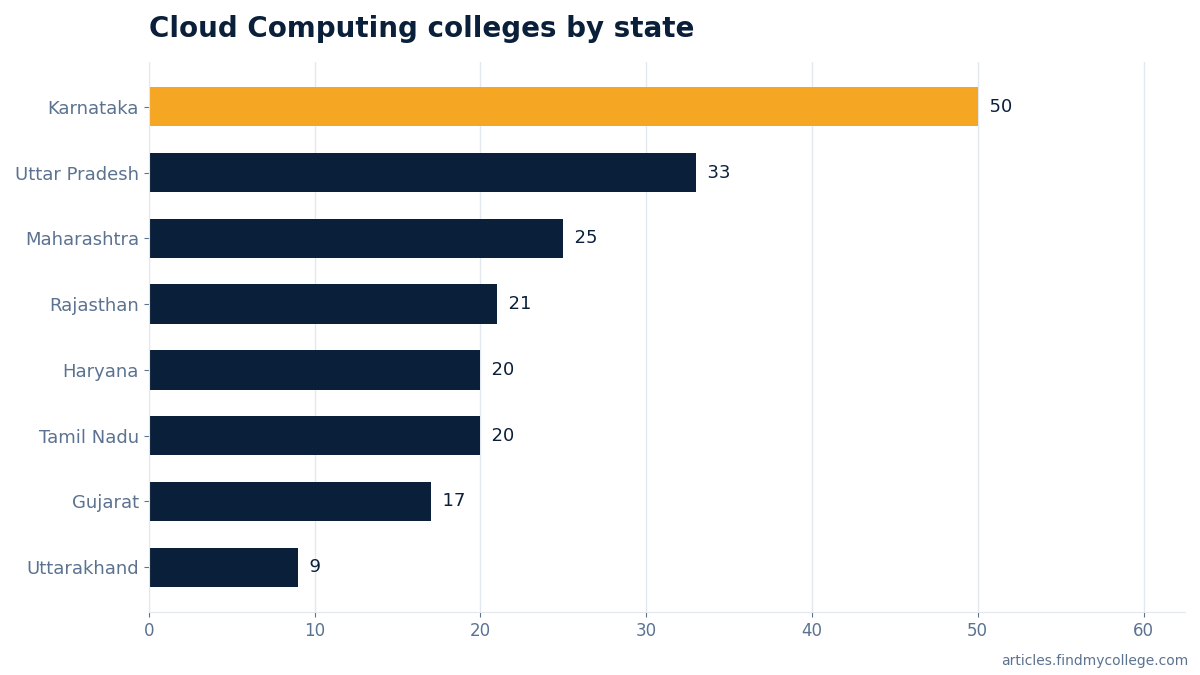
At least 262 colleges offer Cloud Computing in India, including 4 government institutions and 53 private colleges. Across state distributions, Karnataka leads with 50 colleges, followed by Uttar Pradesh (33), Maharashtra (25), Rajasthan (21), Haryana (20), and Tamil Nadu (20). For private colleges with fee data, the median total course fee is ₹2.52 lakh, with the middle half ranging between ₹1.55 lakh and ₹3.36 lakh.
| College | City | Ownership | Total Course Fee |
|---|---|---|---|
| Chandigarh University | Chandigarh | Private | ₹2.44 lakh |
| Uttaranchal University | Dehradun | Private | ₹2.80 lakh |
| Mount Carmel College | Bangalore | Private (aided) | ₹4.83 lakh |
| IIMT University | Meerut | Private | ₹2.97 lakh |
| Karnavati University | Gandhi Nagar | Private | ₹11.00 lakh |
| Nehru Institute of Engineering and Technology | Coimbatore | Private | ₹2.06 lakh |
| Institute of Management Studies Noida | Noida | Private | ₹3.41 lakh |
| Sapthagiri College of Engineering | Bangalore | Private | ₹4.50 lakh |
| Surana College | Bangalore | Private | ₹4.00 lakh |
| H.R. Group of Institutions | Ghaziabad | Private | ₹1.95 lakh |
Government colleges offer affordable degree programs in cloud and technology domains across several states.
| College | City | Ownership | Total Course Fee |
|---|---|---|---|
| Mumbai University | Mumbai | Government | ₹77,237 |
| Visvesvaraya Technological University | Belgaum | Government | ₹1.77 lakh |
| Jagannath University Bahadurgarh | Bahadurgarh | Government | ₹2.55 lakh |
Regional choices are distributed across major tier-1 and tier-2 technology hubs.
| City | Colleges | Fee Range | Well-known Options |
|---|---|---|---|
| Bangalore | 38 | ₹1.27 lakh – ₹16.80 lakh | Alliance University, Jain University |
| Pune | 15 | ₹1.25 lakh – ₹13.14 lakh | MIT World Peace University, Symbiosis International University Pune |
| Gurgaon | 13 | ₹2.25 lakh – ₹14.41 lakh | G D Goenka University, IILM University |
| Jaipur | 11 | ₹1.40 lakh – ₹8.55 lakh | JECRC University, Vivekananda Global University |
| Chennai | 9 | ₹1.39 lakh – ₹13.00 lakh | Saveetha Institute of Medical and Technical Sciences, Vels Institute of Science, Technology & Advanced Studies |
| Lucknow | 7 | ₹2.79 lakh – ₹11.20 lakh | Integral University, Maharishi University of Information Technology Lucknow |
| Meerut | 6 | ₹1.50 lakh – ₹4.15 lakh | IIMT University, Vidya Knowledge Park |
| Dehradun | 6 | ₹1.47 lakh – ₹13.32 lakh | DIT University, Uttaranchal University |
Distance and online degree opportunities exist through institutions such as Visvesvaraya Technological University (Belgaum, ₹1.77 lakh total fee), Parul Institute of Engineering and Technology (Vadodara, ₹5.25 lakh total fee), and Hindustan Online Centre for Open and Digital Education (Chennai, ₹1.39 lakh total fee).
Career Options and Salary After Cloud Courses
Graduates entering the cloud industry pursue roles such as Cloud Engineer, AWS/Azure Solutions Architect, DevOps Engineer, Cloud Security Specialist, and Cloud Systems Administrator.
According to Glassdoor data as of August 2025, the average salary for cloud computing engineers in India is ₹5,00,000 per year. Across 6 reporting colleges with placement metrics, the median average placement package is 3.4 LPA. Compensation scales significantly higher for candidates holding advanced certifications like AWS Solutions Architect, GCP Cloud Architect, or ISC2 CCSP.
How to Choose the Right Cloud Computing Course
- For Beginners and Freshers: Start with free introductory modules (Simplilearn) or vendor-entry courses like AWS Cloud Practitioner or Azure Fundamentals (AZ-900) to build core conceptual knowledge without heavy financial investment.
- For Degree Students and Researchers: Opt for 12-week NPTEL academic courses offered by IIT Kharagpur on SWAYAM to gain theoretical grounding in fundamentals, management issues, security challenges, and research trends for a nominal exam fee of ₹1,000.
- For Job-Seekers Needing Hands-On Skills: Enroll in a 3-month bootcamp like SKILLOGIC (up to ₹50,000) that includes capstone projects, Linux, Python, SQL labs, and internship support.
- For Experienced IT Professionals: Target credential-focused tracks such as Google Certified Professional Cloud Architect (~₹17,147) or ISC2 CCSP (~₹51,355) to qualify for senior architectural and security engineering roles.
Selecting an appropriate course depends on your current technical experience and career goals.
How to Apply for Cloud Computing Admission in 2026: Step by Step
- Check eligibility and background prerequisites: Verify if you meet basic criteria. Introductory courses require no background, while academic programs like IIT Kharagpur prefer prior knowledge of networking and computer architecture.
- Select learning format and platform: Choose between free self-paced video modules (Simplilearn), 12-week academic courses (IIT Kharagpur via SWAYAM/NPTEL), or 3-month instructor-led bootcamps (SKILLOGIC).
- Register on the official course portal: Enroll by signing in with Google, Microsoft, or SWAYAM credentials on official platform portals.
- Complete course modules and hands-on projects: Complete video lessons, weekly assignments, capstone projects, and lab exercises covering Python, SQL, Linux, AWS, Azure, or GCP.
- Register and pay for certification examination: Pay ₹1,000 for NPTEL e-certificate proctored exams, or $150–$599 for vendor exams like AWS, Azure, GCP, or CCSP.
- Appear for proctored exam and receive e-certificate: Take the proctored examination online or at designated test centres to obtain your graded e-certificate.
| What to do | Where | Link |
|---|---|---|
| Compare colleges, fees and cutoffs | Cloud Computing colleges in India | findmycollege.com |