Computer Course Certificate Programs: Overview and Scope
Nishit Kumar is a senior EdTech industry leader with over a decade of experience in building and scaling education platforms, shaping their product, content, and growth strategy. At…
| Parameter | Details |
|---|---|
| Short-Term Certificate Duration | 1 Month to 3 Months |
| Diploma Course Duration | 6 Months to 12 Months |
| Basic Certificate Eligibility | Class 8th or Class 10th Pass |
| UG Degree Eligibility (BTech/BCA/BSc) | Class 12th in Science stream with minimum 55% aggregate marks |
| Average Starting Salary (BTech CSE) | ₹4 LPA to ₹8 LPA |
What is Computer Courses
A computer course certificate program provides structured technical training in basic software applications, programming languages, system maintenance, and digital operations. Short-term certificates such as the Basic Computer Course (BCC) and Certificate in Computer Application (CCA) are introductory 3-month options designed to establish core digital literacy.
These programs cater to candidates at various education levels, offering rapid skill acquisition without requiring long-term academic commitments. Short-term certification formats focus on specific tools like Tally, C/C++, or web design, enabling learners to qualify for entry-level technical roles or enhance administrative efficiency in office environments.
Computer Courses Eligibility
Eligibility criteria for computer certificate and diploma programs depend on the depth and duration of the curriculum. Introductory certificate options, including the Basic Computer Course (BCC) and Certificate in Computer Application (CCA), require candidates to have passed Class 8th or Class 10th. These basic courses maintain open entry criteria to promote digital literacy across diverse background levels.
Academic requirements become higher for full degree pathways, where candidates applying for university computer programs generally need a Class 12th pass in the Science stream with a minimum of 55% aggregate marks.
Computer Courses Admission Process
Admission to short-term computer certificate and diploma courses is primarily direct and merit-based. Applicants submit their academic credentials directly through authorized skilling institutes, recognized open learning portals like NIOS, or designated training centers.
For degree-level computer applications and engineering programs offered by universities, formal entrance tests may be mandated. Candidates targeting university engineering tracks register for entrance examinations such as BITSAT for BITS Pilani campuses. Once selected, students undergo combined theoretical instruction and practical laboratory sessions before sitting for final evaluations to secure official certification.
People Also Read
Computer Courses Syllabus and Subjects
The curriculum for computer certificate courses is structured around practical computing tools, fundamental logic, and technical application skills. Introductory modules focus on system hardware, operating system file management, and office productivity tools. Advanced training introduces database design, basic scripting, and web layout techniques.
| Syllabus Category | Core Modules & Topics Covered | Key Practical Skills Taught |
|---|---|---|
| Computer Fundamentals & OS | Hardware/Software basics, Windows 7/NT/XP, Linux, OS file management | System operations, file management, troubleshooting |
| Office Productivity Tools | MS Word, MS Excel, MS PowerPoint, MS Access | Document creation, data spreadsheets, business presentations |
| Database Management (DBMS) | DBMS & RDBMS concepts, MySQL, SQL queries, table structures | Data entry, table creation, database management |
| Programming Fundamentals | C, C++, Java, Python, control statements, algorithms | Logic development, writing basic code, syntax debugging |
| Web Designing & Internet | HTML, CSS, JavaScript, Web page design, Email & Network basics | Web design layout, online communication, web browsing |
Top Computer Courses Colleges
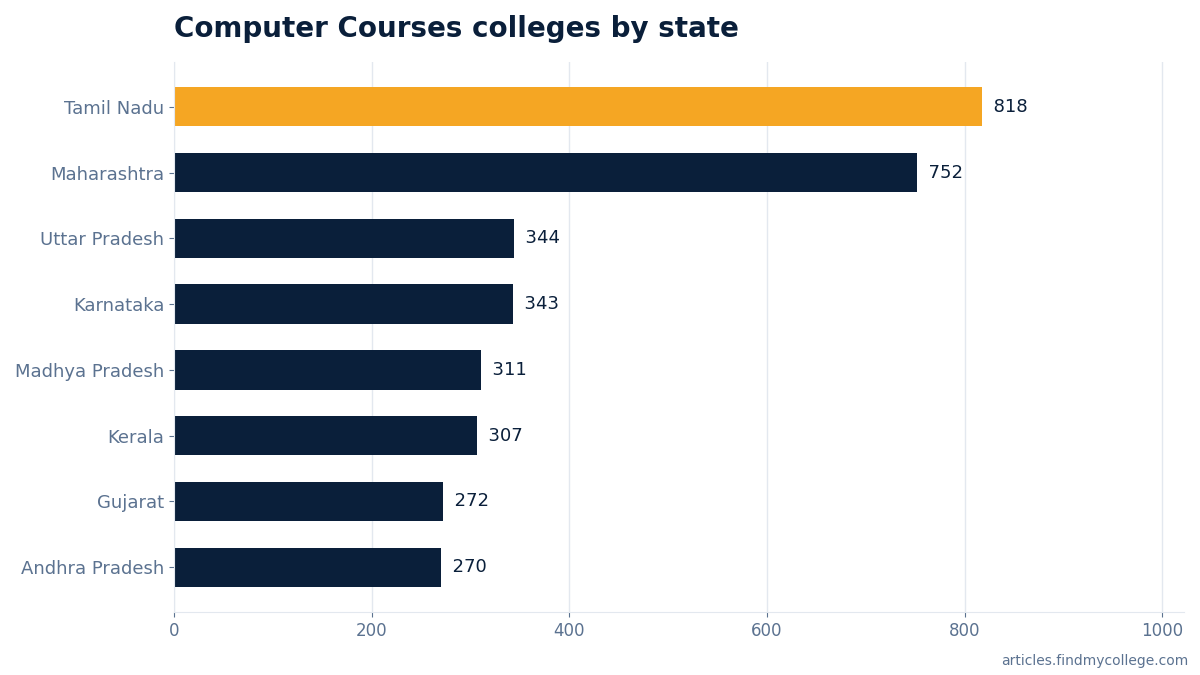
Computer education programs are widely distributed across Indian states and major educational hubs. Leading state distributions include Tamil Nadu with 818 colleges, Maharashtra with 752 colleges, Uttar Pradesh with 344 colleges, Karnataka with 343 colleges, Madhya Pradesh with 311 colleges, and Kerala with 307 colleges.
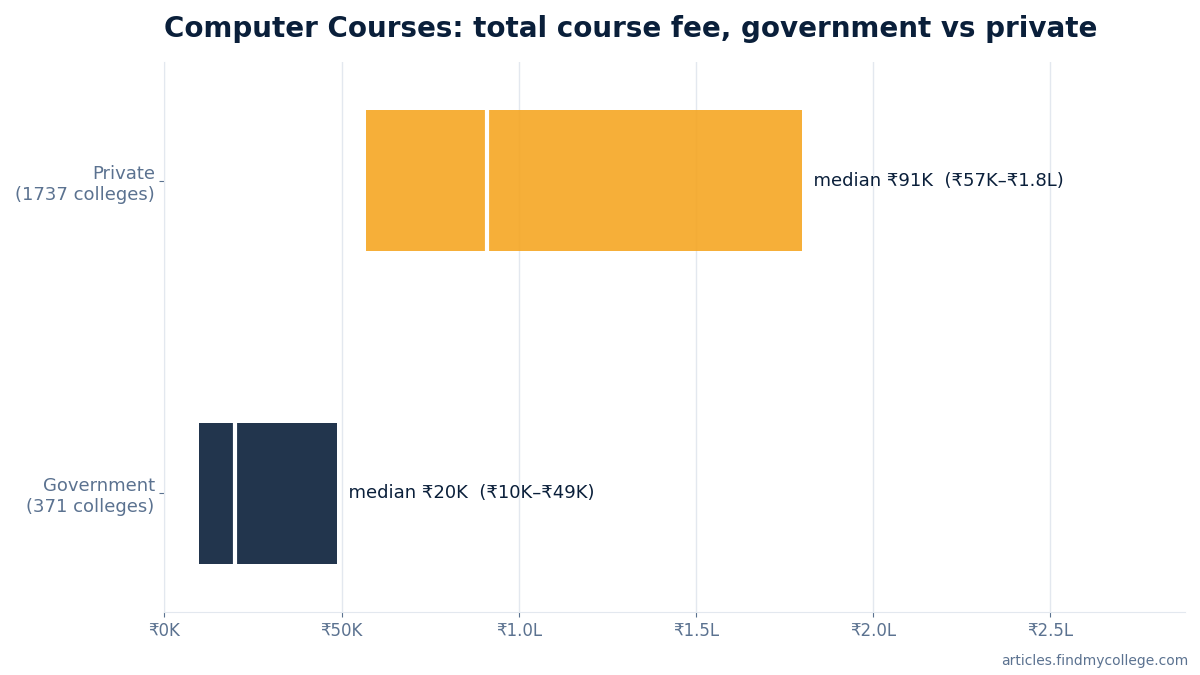
Prominent cities offering high concentrations of computer training options include Pune with 195 colleges (fee range ₹23,340 – ₹15.60 lakh), Chennai with 161 colleges (fee range ₹5,001 – ₹12.00 lakh), Bangalore with 149 colleges (fee range ₹26,750 – ₹20.10 lakh), Hyderabad with 127 colleges (fee range ₹14,250 – ₹17.60 lakh), Coimbatore with 112 colleges (fee range ₹25,500 – ₹16.10 lakh), Mumbai with 102 colleges (fee range ₹5,500 – ₹11.25 lakh), Kolkata with 96 colleges (fee range ₹6,117 – ₹7.65 lakh), and Indore with 89 colleges (fee range ₹6,402 – ₹8.80 lakh).
| College | City | Ownership | Total course fee | NIRF rank |
|---|---|---|---|---|
| Indian Institute of Science | Bangalore | — | ₹92,400 | 1 (Overall, 2025) |
| Miranda House | Delhi | Government | — | 2 (Overall, 2025) |
| Jawaharlal Nehru University | Delhi | Government | — | 2 (Overall, 2025) |
| Indian Institute of Technology Bombay | Mumbai | Government | ₹10.89 lakh | 3 (Overall, 2024) |
| Manipal University Manipal | Manipal | — | ₹4.00 lakh | 3 (Overall, 2025) |
| Hans Raj College | Delhi | Government | ₹96,845 | 3 (Overall, 2025) |
| Kirori Mal College | Sonipat | Private | ₹50,790 | 4 (Overall, 2025) |
| Jamia Millia Islamia University | Delhi | Government | ₹7,800 | 4 (Overall, 2025) |
| Delhi University | Delhi | Government | ₹7,130 | 5 (Overall, 2025) |
| College | City | Ownership | Total course fee | Average package |
|---|---|---|---|---|
| Sri Krishna Arts and Science College | Coimbatore | Private | ₹32,000 | 8.5 LPA |
| Vidya Pratishthan’s Kamalnayan Bajaj Institute of Engineering and Technology Baramati | Pune | Private | ₹1.81 lakh | 7.2 LPA |
| BMS Institute of Technology and Management | Bangalore | Private | ₹11.24 lakh | 6.07 LPA |
| Pimpri Chinchwad College of Engineering | Pune | Private | ₹3.42 lakh | 6 LPA |
| Galgotias College of Engineering and Technology | Greater Noida | Private | ₹3.47 lakh | 5.76 LPA |
| Delhi Technical Campus Greater Noida | Greater Noida | Private | ₹4.68 lakh | 5.45 LPA |
| Ramnarain Ruia Autonomous College | Mumbai | Private (aided) | ₹33,507 | 5.43 LPA |
| Dayananda Sagar College of Engineering | Bangalore | Private | ₹3.35 lakh | 5.27 LPA |
| Thiagarajar College of Engineering | Madurai | Private (aided) | ₹1.54 lakh | 5.1 LPA |
| Fergusson College | Pune | Private (aided) | ₹56,846 | 5.02 LPA |
| City | Colleges | Fee range | Well-known options |
|---|---|---|---|
| Pune | 195 | ₹23,340 – ₹15.60 lakh | Dr. DY Patil Vidyapeeth, Fergusson College |
| Chennai | 161 | ₹5,001 – ₹12.00 lakh | Saveetha Institute of Medical and Technical Sciences, Sri Ramachandra Institute of Higher Education and Research |
| Bangalore | 149 | ₹26,750 – ₹20.10 lakh | Alliance University, Christ University |
| Hyderabad | 127 | ₹14,250 – ₹17.60 lakh | University of Hyderabad, International Institute of Information Technology Hyderabad |
| Coimbatore | 112 | ₹25,500 – ₹16.10 lakh | Amrita Vishwa Vidyapeetham, P.S.G College of Technology |
| Mumbai | 102 | ₹5,500 – ₹11.25 lakh | Indian Institute of Technology Bombay, Homi Bhabha National Institute |
| Kolkata | 96 | ₹6,117 – ₹7.65 lakh | Jadavpur University, The West Bengal National University of Juridical Sciences |
| Indore | 89 | ₹6,402 – ₹8.80 lakh | IPS Academy Indore, Devi Ahilya Vishwavidyalaya |
| College | City | Total course fee |
|---|---|---|
| Vignan’s Foundation for Science, Technology and Research Online | Guntur | ₹99,000 |
| University of Mumbai, Institute of Distance & Open Learning | Mumbai | ₹30,755 |
| Venkateshwara Open University | Naharlagun | ₹56,000 |
| Harcourt Butler Technological University | Kanpur | ₹1.20 lakh |
| University School of Open Learning, Panjab University | Chandigarh | ₹25,110 |
How to Apply for Computer Courses Admission in 2026: Step by Step
- Check Eligibility Requirements: Verify entry criteria based on course level: Class 8th or 10th pass for basic certificates (BCC, CCC, DCA) or Class 12th in Science stream with 55% aggregate for university computer degrees.
- Select the Right Certificate or Diploma Course: Choose between 1 to 3-month short-term skill certificates (BCC, CCC, Tally, C/C++), 6 to 12-month diplomas (DCA, ADCA, Hardware & Networking), or 3-4 year degree options.
- Register on Official Educational Portals: Apply directly through recognized open learning bodies (such as NIOS), authorized skilling institutes (IIST Computer Institute, NIACT Education), or university application portals.
- Appear for Entrance Examinations (If Applicable): For university-level engineering computer programs, register and appear for entrance tests like BITSAT for BITS Pilani campuses.
- Complete Practical Lab Work and Coursework: Undergo theory and hands-on lab training covering computer fundamentals, operating systems, MS Office tools, DBMS, and programming languages.
- Clear Final Examination and Receive Certification: Pass the evaluation test conducted at the end of the term to receive a course certificate for job applications or further studies.
| What to do | Where | Link |
|---|---|---|
| Compare colleges, fees and cutoffs | Computer Courses colleges in India | findmycollege.com |