Dentist Career in India: Course, Scope and Roles
Nishit Kumar is a senior EdTech industry leader with over a decade of experience in building and scaling education platforms, shaping their product, content, and growth strategy. At…
To become a licensed dentist in India, candidates must complete the 5-year Bachelor of Dental Surgery (BDS) program, which includes 4 academic years and a 1-year compulsory rotatory internship, after clearing NEET-UG. Starting salaries for fresh BDS graduates range between ₹25,000 to ₹50,000 per month (₹4–5 LPA), while specialized MDS doctors and private practice owners can earn ₹1.5 lakh to ₹5 lakh per month.
This breakdown details the educational roadmap for dental aspirants, covering academic eligibility, qualifying entrance exams, year-wise syllabus requirements, course fee structures, top recognized colleges, and long-term career perspectives in India and abroad.
| Parameter | Details |
|---|---|
| Primary Qualification | Bachelor of Dental Surgery (BDS) |
| Course Duration | 5 Years (4 Academic Years + 1 Year Internship) |
| Mandatory Entrance Exam | NEET-UG (for BDS) |
| Academic Eligibility | 10+2 with Physics, Chemistry, Biology, and English (50% Gen, 40% SC/ST/OBC) |
| Minimum Age Limit | 17 years completed on or before 31st December of admission year |
| Total BDS Seats in India | Approximately 27,600 (~4,000 in Government Colleges) |
| Average Course Fees | Govt: ₹15,000 – ₹1,00,000/year; Private: ₹2,00,000 – ₹6,00,000/year |
| Fresh BDS Starting Salary | ₹25,000 – ₹50,000 per month (₹4–5 LPA) |
What is a Dentist Career
A dentist is a licensed medical professional specializing in oral health, treating conditions affecting the teeth, gums, and jaw structure. In India, pursuing a primary dental career requires enrolling in a Bachelor of Dental Surgery (BDS) degree. BDS requires 4 years of classroom and pre-clinical education followed by a 1-year compulsory rotatory internship to grant clinical practicing rights.
Beyond the core BDS degree, the oral healthcare sector offers non-clinical and allied support roles through specialized diploma and undergraduate programs. Graduates can also pursue advanced specialization through a 3-year Master of Dental Surgery (MDS) degree after fulfilling internship requirements.
Dentist Career Eligibility
Candidates aspiring to join a BDS degree course must meet strict age and academic qualifications set by central regulatory bodies. Applicants must complete their 10+2 or equivalent examination with Physics, Chemistry, Biology, and English as core subjects, obtaining an aggregate score of at least 50% (40% for SC/ST/OBC categories). Candidates must also complete 17 years of age by December 31 of the admission year.
Appearing for and qualifying NEET-UG is mandatory for BDS admissions in India; board exam percentages alone cannot secure a BDS seat. The minimum qualifying percentile cutoffs in NEET-UG are:
- General Category: 50th percentile
- General-PWD Category: 45th percentile
- SC / ST / OBC Categories: 40th percentile
Dentist Syllabus and Subjects
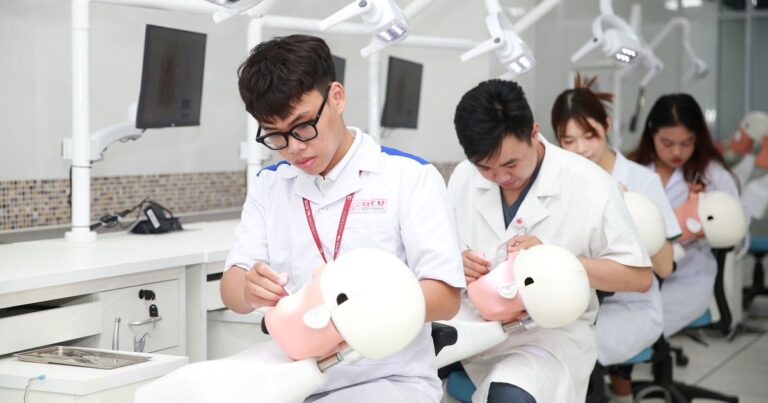
The BDS academic structure balances basic medical sciences during the initial years with intensive pre-clinical laboratory work and clinical patient handling in later stages. For instance, under the Panjab University BDS curriculum, students transition from general human anatomy to specialized clinical branches over four years.
| Academic Year | Core Theory & Practical Subjects | Assessment Type | Total Marks |
|---|---|---|---|
| 1st Year | Human Anatomy & Genetics, General Physiology, Biochemistry & Nutrition, Dental Anatomy & Oral Histology | Theory + Practicals | 800 Marks |
| 2nd Year | General Pathology, General Microbiology, Pharmacology, Dental Materials, Pre-Clinical Conservative, Pre-Clinical Prosthodontics | Theory + Practicals | 1000 Marks |
| 3rd Year | General Medicine, General Surgery, Oral Pathology & Oral Microbiology | Theory + Practicals | 600 Marks |
| 4th Year | Prosthodontics, Pediatric Dentistry, Endodontics, Periodontology, Oral Surgery, Orthodontics, Public Health Dentistry, Oral Medicine & Radiology | Theory + Practicals | 1600 Marks |
Career Scope, Practice Options, and Global Licensing Pathways
- Private Practice: Setting up an independent private dental clinic requires an estimated capital investment of ₹5 lakh to ₹15 lakh.
- Postgraduate Specialisation: Master of Dental Surgery (MDS) is a 3-year postgraduate course available across 9 specialisations following BDS and internship.
- Global Practice: Indian dental graduates can practice abroad by passing country-specific licensing exams such as ORE (UK), ADC (Australia), or NDEB (Canada).
The India dental services market was valued near USD 4,300 million in 2025 and is projected to reach USD 8,550 million by 2031. Graduates can pursue higher clinical training, private practice, or international practice pathways.
How to Apply for Dentist (Career) Admission in 2026: Step by Step
- Check Eligibility Criteria: Complete 10+2 with Physics, Chemistry, Biology, and English scoring at least 50% aggregate (40% for SC/ST/OBC) and complete 17 years of age by Dec 31.
- Register and Appear for NEET-UG: Submit online application for NEET-UG via NTA portal and obtain a valid score meeting national qualifying cutoffs (50th percentile for General).
- Seat Allotment and Document Verification: Secure seat allotment based on NEET merit rank, verify 10th/12th mark sheets, NEET scorecards, and identity certificates.
- Pay Admission Fees and Join BDS Course: Pay mandatory annual tuition fees to confirm admission and commence 4 academic years plus 1 year rotatory internship.
- Register with State Dental Council: Upon completing internship, obtain mandatory registration with the State Dental Council / National Dental Commission to legally practice dentistry.
| What to do | Where | Link |
|---|---|---|
| Compare colleges, fees and cutoffs | Dentist (Career) colleges in India | findmycollege.com |
FAQs
How can I become a dentist in India?
Complete 10+2 with PCB (minimum 50% aggregate), qualify NEET-UG, enrol in a 5-year BDS program (4 academic years plus 1-year rotatory internship), and register with a State Dental Council.
Can I study dentist without NEET?
You cannot become a licensed BDS doctor without qualifying NEET-UG. However, allied dental courses such as 2-year Diplomas in Dental Hygiene or Dental Mechanics do not require NEET.
How much does a BDS doctor earn in India per month?
Fresh BDS graduates earn ₹25,000 to ₹50,000 per month (₹4–5 LPA) as junior dentists or associates. Experienced practitioners, clinic owners, and MDS specialists earn ₹1.5 lakh to ₹5 lakh monthly.
What field of dentistry pays the most?
Orthodontics is among the highest-earning dental specialisations in private practice, generating ₹15 LPA to ₹30 LPA, followed by Endodontics, Prosthodontics, and Oral Surgery.
Does it take 8 years to be a dentist?
No, a basic dentist qualification (BDS) takes 5 years (4 academic years plus 1-year internship). Pursuing an additional 3-year MDS post-graduation extends total training to 8 years.
How many fields are there in dentistry?
There are 9 recognised MDS postgraduate specialisations in India, including Orthodontics, Endodontics, Prosthodontics, Periodontology, Oral & Maxillofacial Surgery, Pediatric Dentistry, Oral Medicine & Radiology, Oral Pathology, and Public Health Dentistry.