Diploma Course Subjects and Semester Wise Syllabus Overview
Nishit Kumar is a senior EdTech industry leader with over a decade of experience in building and scaling education platforms, shaping their product, content, and growth strategy. At…
- 1 Jan 2026Vidyalankar Polytechnic Awarded Three-Year NBA Accreditation
Vidyalankar Polytechnic received NBA accreditation for its diploma engineering programs covering the academic period from 1 January 2026 to 31 December 2028. - 26 Oct 2025UPES Releases Space Technology & Satellite Engineering Career Insights
UPES published updated academic guidance detailing skill requirements and career prospects in satellite engineering and space technology.
Diploma course subjects vary by discipline and duration (ranging from 6-month certificates to 3-year technical polytechnics). For a 3-year Polytechnic Diploma in Information Technology, the curriculum spans 6 semesters, covering foundational sciences, Applied Mathematics, and C programming in year one, data structures and DBMS in year two, and Python, Cloud Computing, IoT, and Major Projects in year three.
Readers will find details on core theoretical papers, practical laboratory modules, recommended textbooks, top colleges, fee structures, placement statistics, and step-by-step admission procedures.
| Parameter | Details |
|---|---|
| Course Duration | 6 months to 3 years depending on specialization and stream background |
| Polytechnic Entry Qualification | Class 10th for 3-year regular entry, or Class 12th (PCM) for 2-year lateral entry directly into the second year |
| Academic Structure | 6 semesters across 3 years for polytechnic engineering and IT diplomas |
| Average Course Fees | Rs 2,500 to Rs 4.0 lakhs across government and private polytechnic institutes |
| Academic Governing Bodies | State Boards of Technical Education (e.g., MSBTE, BTEUP, JUT) following AICTE course guidelines |
Diploma Courses Subjects Year-wise
First-year polytechnic engineering subjects build essential foundational knowledge in applied sciences, mathematical concepts, and core engineering practices common across technical branches. In the second semester, discipline-specific introductory programming, electronics, and drafting subjects are introduced.
The second year introduces core technical principles, focusing on software design, data structures, network communication, database systems, and operational frameworks. The final year advances to emerging technologies, cloud platforms, mobile applications, industrial training, and major capstone projects.
Branch-Wise Polytechnic Engineering Subjects
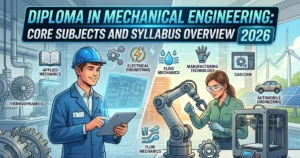
Polytechnic diploma curricula align with specific industry verticals. Mechanical engineering focuses on physical machines, thermodynamics, and manufacturing technologies, while civil engineering emphasizes structural surveying, building materials, and earthquake-resistant design rules.
Electrical and electronics streams teach energy generation, circuit systems, logic design, and signal processing. Information technology covers programming, networking, web architectures, database design, and cloud integration.
| Engineering Branch | Core Subjects Covered | Key Learning & Lab Modules |
|---|---|---|
| Civil Engineering | Surveying, Construction Materials, Concrete Technology | Earthquake Resistant Building Construction (IS:1893 & IS:13920 provisions) |
| Electronics Engineering (ECE) | Analog & Digital Circuits, Communication Systems | Logic Gates, Combinational/Sequential Circuit Design, Shift Registers & Counters |
| Information Technology | Programming in C/Java/Python, DBMS, Computer Networks, Operating Systems | Web Development, Cloud Computing, Android App Development, IoT |
Diploma Courses Electives and Specialisations
- Semester 5 Specialisations & Practicals: Software Engineering, Web Development using PHP, Computer Programming using Python, Information Security & IT Laws, Internet of Things, Industrial Training, and Minor Project Work.
- Semester 6 Electives & Projects: Development of Android Applications, Cloud Computing, Industrial Management and Entrepreneurship Development, Elective paper, and Major Project Work.
- Practical Training Components: Workshop Practice, Technical Drawing, Lab Manuals, Minor Projects in Semester 5, and Major Projects in Semester 6.
Final-year polytechnic students complete elective specialization papers along with hands-on industrial training and major software or hardware projects. These practical components help bridge theoretical knowledge and technical implementation.
People Also Read

Diploma Courses Practicals and Projects
- Practical Training Components: Curricula include Workshop Practice, Technical Drawing, and Lab Manuals.
- Fifth Semester Modules: Students undergo hands-on industrial training and execute Minor Projects in Semester 5.
Practical learning modules and industrial training form essential components of polytechnic diploma curricula. Students complete structured project work alongside elective papers during their final academic year.
Books for Diploma Courses
| Subject / Discipline | Book Title | Author / Publisher | Target Syllabus Coverage |
|---|---|---|---|
| Applied Mechanics | Applied Mechanics for Engineering and Polytechnic Courses | Prof. Harbhajan Singh (Abhishek Publications) | Mandatory AICTE syllabus (Forces, Friction, Center of Gravity, Simple Lifting Machines) |
| Digital Electronics | Digital Electronics | Dr. S.K. Bhattacharya | Number Systems, Logic Gates, Combinational & Sequential Logic, Counters, A/D & D/A Converters |
| Engineering Drawing | Engineering Drawing 1 | Punjab Rai (Thapar University) | 1st Semester common subject across technical education boards |
| Communication Skills | English & Communication Skills – 1 & 2 | P.K. Singla & Alwinder Dhillon | Reading, Speaking, Listening, and Writing Skills for technical/non-technical courses |
| Civil Engineering | Earthquake Resistant Building Construction For Polytechnic | Prof. Harbhajan Singh | Seismic design parameters, IS:1893 and IS:13920 provisions for civil diploma |
| Mechanical Engineering | Mechanical Engineering Drawing | Prof. Raj Kumar | Mechanical component drawing and exam prep for polytechnic students |
| Management | Entrepreneurship Development & Management | Umesh Saroj | 6th semester compulsory paper for engineering diploma programs |
| Database Systems | Relational Database Management System | N.P. Singh | State technical board syllabus |
Standard polytechnic textbooks align with AICTE guidelines and state technical board syllabi across disciplines. Key subjects covered include Applied Mechanics, Digital Electronics, Engineering Drawing, and Relational Database Management System.
Top Polytechnic Colleges, Entrance Examinations, and Fee Overview
At least 6935 colleges offer Diploma Courses across India, comprising 486 government institutions and 2736 private colleges. For government institutions, the median total course fee is ₹25,000, with the middle half of fees falling between ₹11,280 and ₹70,128 based on data from 307 colleges with fee data. Private diploma colleges exhibit a median fee of ₹86,000, with the middle half ranging from ₹60,000 to ₹1.30 lakh across 1800 colleges with fee data.
State-level college distribution shows high concentration in key educational hubs. Maharashtra leads with 1049 colleges, followed by Uttar Pradesh with 963, Tamil Nadu with 427, Karnataka with 412, Madhya Pradesh with 407, and Gujarat with 336 institutions. Across 120 reporting institutions, diploma graduates achieve a median average placement package of 2.9 LPA.
State polytechnic admissions rely on state-level entrance tests such as JEECUP (UP), JEXPO (West Bengal), AP-POLYCET (Andhra Pradesh), TS POLYCET (Telangana), CG PPT (Chhattisgarh), HP PAT (Himachal Pradesh), DCECE (Bihar), and Delhi CET. Graduates can secure direct 2nd-year lateral entry into B.Tech/B.E. programs or pursue AMIE certification equivalent to a B.E. degree in 3 years.
| Polytechnic Institute Name | Location | Total Course Fee Structure |
|---|---|---|
| Veermata Jijabai Technological Institute (VJTI) | Mumbai, Maharashtra | ₹1,20,000 |
| Government Polytechnic | Pune, Maharashtra | ₹2,00,000 |
| S H Jondhale Polytechnic | Thane, Maharashtra | ₹1,50,000 |
| Vivekanand Education Society’s Polytechnic | Mumbai, Maharashtra | ₹1,60,000 |
| Jabalpur Engineering College | Jabalpur, Madhya Pradesh | ₹1,35,000 |
| Aditya Engineering College | Bangalore, Karnataka | ₹63,000 |
| Agnel Polytechnic | Navi Mumbai, Maharashtra | ₹3,00,000 |
| Anjuman Polytechnic | Nagpur, Maharashtra | ₹3,52,000 |
| College | City | Ownership | Total course fee | NIRF rank |
|---|---|---|---|---|
| Indian Institute of Technology Madras | Chennai | Government | ₹5.80 lakh | 1 (Overall, 2025) |
| Jawaharlal Nehru University | Delhi | Government | ₹20,245 | 2 (Overall, 2025) |
| Hans Raj College | Delhi | Government | — | 3 (Overall, 2025) |
| Manipal University Manipal | Manipal | — | ₹25,000 | 3 (Overall, 2025) |
| Punjab Agricultural University | Ludhiana | — | ₹64,335 | 3 (Overall, 2025) |
| Jamia Millia Islamia University | Delhi | Government | ₹5,610 | 4 (Overall, 2025) |
| Delhi University | Delhi | Government | ₹34,900 | 5 (Overall, 2025) |
| Banaras Hindu University | Varanasi | Government | ₹5,164 | 6 (Overall, 2025) |
| Indian Institute of Technology Kharagpur | Kharagpur | Government | ₹25.00 lakh | 6 (Overall, 2025) |
| College | City | Ownership | Total course fee |
|---|---|---|---|
| Indira Gandhi National Open University | Delhi | Government | ₹5,000 |
| Maharaja Chhatrasal Bundelkhand Vishwavidyalaya | Chhatarpur | Government | ₹5,000 |
| Jiwaji University | Gwalior | Government | ₹5,000 |
| Pt. Chiranji Lal Sharma Govt. P.G. College | Karnal | Government | ₹5,118 |
| Banaras Hindu University | Varanasi | Government | ₹5,164 |
| Dr. A.P.J. Abdul Kalam Technical University | Lucknow | Government | ₹5,170 |
| Govt. Shikshan Mahavidyalaya | Nagaon | Government | ₹5,200 |
| Mumbai University | Mumbai | Government | ₹5,350 |
| Yashwantrao Chavan Maharashtra Open University | Nashik | Government | ₹5,358 |
| Jadavpur University | Kolkata | Government | ₹5,410 |
How to Apply for Diploma Courses Admission in 2026: Step by Step
- Register for State Polytechnic Entrance Exams: Fill out the online application form for relevant state polytechnic entrance tests such as JEECUP (UP), JEXPO (West Bengal), AP-POLYCET (AP), TS POLYCET (Telangana), CG PPT (CG), HP PAT (HP), DCECE (Bihar), or Delhi CET.
- Download Admit Card & Sit for Entrance Examination: Download official admit card displaying exam date, roll number, and exam center location, and participate in the offline/online entrance examination.
- Participate in Centralised Merit Counselling: Upon announcement of entrance results, attend state counselling rounds to fill preferred polytechnic institutes and diploma branches based on merit rank.
- Complete Document Verification & Pay Course Fees: Submit required academic documents (10th/12th marksheets, identity proof, photo) at the allotted polytechnic college and pay admission fees ranging from ₹2,500 to ₹3,52,000 depending on the institution.
FAQs
Is diploma means 12th?
No, a polytechnic diploma is a technical skill-building qualification. A 3-year diploma after 10th serves as a direct professional qualification and enables lateral entry into the second year of B.Tech/B.E. programs.
What is polytechnic engineering?
Polytechnic engineering is a 3-year technical education system focused on practical, hands-on training in branches like Mechanical, Civil, Electrical, Electronics, and IT, bridging theory and real-world industrial practice.
Can I get a job after polytechnic?
Yes, diploma holders can join public sector undertakings (such as Railways, GAIL, ONGC, DRDO, BHEL, NTPC) in technician roles, enter private manufacturing/IT firms, or start self-employed technical enterprises.
Which diploma is best to study?
High-paying choices include Diploma in Engineering (avg salary ₹3–6 LPA), Diploma in Digital Marketing (₹4–8 LPA), Diploma in IT (avg ₹5.5 LPA), Diploma in Pharmacy (₹3–5 LPA), and Diploma in Fashion Design (₹3–6 LPA).
What is a 1 year diploma in computer science?
A 1-year computer science/IT diploma is a short-term job-oriented course covering focused skills like Web Design & Development, UI/UX, coding, and CMS, rather than full 3-year polytechnic engineering depth.
Which book is best for polytechnic subjects?
Key recommended textbooks include Applied Mechanics by Prof. Harbhajan Singh, Digital Electronics by Dr. S.K. Bhattacharya, Engineering Drawing 1 by Punjab Rai, and Relational Database Management System by N.P. Singh.