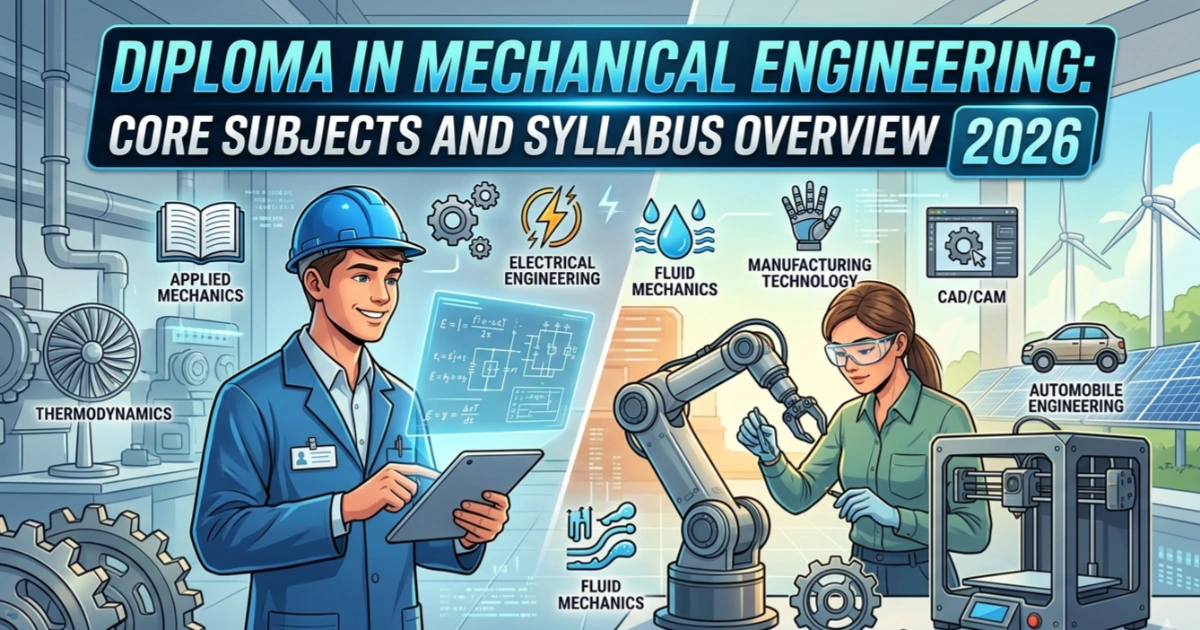
Diploma in Mechanical Engineering: Core Subjects and Syllabus Overview 2026
Abhijeet Chatterjee is a professional Content and Copy specialist with over five years of experience in crafting compelling content around the Edtech domain. His portfolio includes notable work…
Understanding the core Mechanical Diploma Subjects is crucial for aspiring engineers, as they form the bedrock of a successful career in the dynamic field of mechanical engineering. These subjects equip students with essential theoretical knowledge and practical skills, preparing them for industry demands. This article provides a detailed overview of the core syllabus, semester-wise breakdown, and key differences from B.Tech programs, ensuring you’re well-informed about the 2026 curriculum.
Essential Diploma Mechanical Engineering Subjects Across Semesters 2026
The 3-year Mechanical Diploma program spans 6 semesters, equipping students with essential theoretical and practical knowledge. This section details the core and elective Mechanical Diploma Subjects, covering areas like thermodynamics, fluid mechanics, design, and manufacturing across the curriculum.
| Year/Semester | Subjects | Topics Covered | Subject Type |
| 1st Year | Physics-I | Unit and Dimensions, Force and Motion, Work, Power and Energy, Temperature, Properties of Matter | Core |
| 1st Year | Mathematics-I | Series, Determinants, Vector Algebra, Trigonometry, Complex Numbers | None |
| 1st Year | Chemistry-I | Atomic Structure, Classification of Elements, Electro Chemistry, Chemical Kinetics, Solid State and Colloids | None |
| 1st Year | Engineering Mechanics | System of Forces, Moment & Couple, Equilibrium, Stresses & Strain | None |
| 1st Year | Basic Electrical & Electronics Engineering | Terminology, Concepts, D.C. Circuits, A.C. Circuits, Magnetic Circuits, Semiconductors, Logic Circuits | None |
| 1st Year | English For Communication | Grammar & Usage, Comprehension, Precis | None |
| 1st Year | Physics-II | Waves & Vibrations, Optics, Electrostatics, Current Electricity, Semi Conductor Physics | None |
| 1st Year | Mathematics-II | Differential Calculus, High Order Derivatives, Integral Calculus, Coordinate Geometry | None |
| 1st Year | Chemistry-II | Lubricantsm Fuels & Environmental Pollution, Water Treatment & Corrosion, Glass & Ceramics, Organic Chemistry | None |
| 1st Year | Mechanical Engineering | Thermal Engineering, Machine Components, Gears, Mechanisms, Lubrication | None |
| 1st Year | Programming in C | Inout/Output, Storage Unites, Features of C, Array and Structures, Union & Structure | None |
| 1st Year | Workshop Technology | Carpentry, Metal Fabrication, Machine Shop, Foundry | None |
| 1st Year | Computer Programming Lab | Introduction to GUI using Windows Operating System, DOS Commands, Introduction to Word, Introduction to MS-Excel. | Laboratory/Practical |
| 1st Year | Physics Lab | Measuring Devices, Meters, Surface Tension, Volume and Atmospheric Pressure, Viscosity, Modulus of Rigidity | None |
| 1st Year | Chemistry Lab | Analysis of Acidic & Basic Radicals, Bleaching Poweder, Hardness and Chloride Content in Water, Hazardous Chemicals | None |
| 1st Year | Workshop Technology Lab | Carpentry Shop, Sheet Metal Working & Soldering Shop, Fitting Shop, Plumbing Shop, Smithy Shop, Welding Shop, Machine Shop, Fastening Shop | None |
| 1st Year | Basic Electrical and Electronics Engineering Lab | Ohm’s Law, KVL, KVL, Energy Meter, PN Junction Diode, NPN/PNP Transistors, Logic Gates | None |
| 2nd Year | Material Science | Structure of Metals, Deformation, Properties & Usage of Metals, Non-Metallic Materials, Testing of Metal Alloys | Core |
| 2nd Year | Strength of Materials | Stress-Strain, Properties of Materials, Complex Stresses, Shear Force, Bending Moment, Simple Bending, Slopes & Deflection of Beams, Columns & Struts | None |
| 2nd Year | Manufacturing Technology-I | General Forming Processes, Welding, Foundry Practice, Powder Metallurgy | None |
| 2nd Year | Thermal Engineering | Thermodynamics, Steam, Gas Turbine, Air Compressor, Integral Combustion Plant | None |
| 2nd Year | Machine Design | Machine Parts, Load, Riveted & Welded Joints, Bending Moment, Twisting Moment, Design of Gear | None |
| 2nd Year | Fluid Mechanics | Hydrostatics, Buoyancy, Fluid Flow, Energy & Momentum Equation, Orifices, Notches & Wires, Flow Through Pipes, Channels | None |
| 2nd Year | Manufacturing Technology-II | Forging, Rolling, Press Forming, Conventional Metal Cutting Processes, Metal Finishing Process, Surface Treatment & Finishing | None |
| 2nd Year | Measurements & Metrology | Principles & Classification of Measuring Instruments, Transducers, Comparators, Surface Finish, Temperature Measurement | None |
| 2nd Year | Environmental Studies | Ecosystem, Natural Resources, Pollution, Disaster Management | None |
| 2nd Year | Tool Engineering | Metallic Cutting, Machinability, Dies & Construction, Die Design | Elective |
| 2nd Year | Heat Transfer | Conduction, Fins, Convection, Radiation, Heat Exchangers | None |
| 2nd Year | Farm Equipment & Machinery | Farm Mechanization, Field Capacities, Field Efficiency, Machines Used for Tillage, Sowing, Planting, Transplanting Equipment, Farm Machine | None |
| 2nd Year | Computer Integrated Manufacturing | CIM, CAD, CAM, Computer Aided Manufacturing, Computer Aided Production Scheduling, Integrating NC Machines, Robots, AGVS, NC Equipment | None |
| 2nd Year | Refrigeration & Airconditioning | Refrigeration Systems, Refrigeration Equipments, Flow Controls, Air Conditioning | None |
| 2nd Year | Material Handling Systems | Hoisting Machinery & Equipments, Conveying Machinery, Components, Material Handling Equipment | None |
| 2nd Year | Manufacturing Technology Lab | Microstructures, Crushing Strength of Materials, Shock Resistance, Metallurgical Microscope | Laboratory/Practical |
| 2nd Year | Thermodynamics Lab | Thermo Couple, Pyrometer, High-Pressure Boilers, Steam Turbine Models, Fuel Supply & Lubrication System in Engine | None |
| 2nd Year | Fluid Mechanics Lab | Piezometer Tube, Mechanical Flow Meter, Manometers, Pressure Gauge, Bernoulli’s Theorem | None |
| 2nd Year | Measurement & Metrology Lab | Optical Projectors, Comparators, Autocollimator, Gear Tooth Vernier, Micrometer, Slip Gauge | None |
| Third Year | Advanced Manufacturing Processes | Jigs & Fixtures, Jig Boring, Plastic Processing, Modern Machining Processes, CNC Milling Machines, Machine Tool Automation, SPM | Core |
| Third Year | Theory of Machines & Mechanisms | Cams & Followers, Power Transmission, Flywheel & Governors, Brakes, Dynamometers, Balancing & Vibrations | None |
| Third Year | Industrial Engineering & Management | Plant Engineering, Plant Safety, Production Planning & Control, Quality | None |
Diploma in Mechanical Engineering Syllabus 2026
Diploma in Mechanical Engineering Syllabus
Semester-Wise Diploma Mechanical Engineering Syllabus Breakdown 2026
The Diploma in Mechanical Engineering program spans 3 years, divided into 6 semesters, covering a range of core and elective Mechanical Diploma Subjects. Each semester typically includes 5-8 subjects, encompassing both theory and practical components, designed to build a strong foundation in engineering principles.
| Semester | Yearly Subject Focus | Specific Mechanical Diploma Subjects |
| 1 | Force Systems, Machine Components, Mechanisms, Workshop Technology | Engineering Mathematics-1 Engineering Physics-1 Communication Skills Engineering Chemistry-1 Engineering Drawing-1 Workshop Technology |
| 2 | Force Systems, Machine Components, Mechanisms, Workshop Technology | Engineering Mathematics-2 Engineering Physics-2 Basic Electrical & Electronics Engineering Engineering Chemistry and Environmental Studies-2 Strength of Material Engineering Drawing-2 Workshop Technology |
| 3 | Material Science, Stress and Strain, Manufacturing Science, Hydrostatics, Material Handling | Advanced Strength of Material Thermal Engineering-I Fundamentals of Electronics Manufacturing Processes I Engineering Materials Mechanical Engineering Drawing Professional Practice-I BASIC MECHANICAL ENGINEERING (4 Credits) COMPUTER AIDED MACHINE DRAWING PRACTICE (2 Credits) MATERIAL SCIENCE & ENGINEERING (3 Credits) |
| 4 | Material Science, Stress and Strain, Manufacturing Science, Hydrostatics, Material Handling | Manufacturing Processes II Theory of Machines & Mechanism Thermal Engineering-II Principles of Electrical Engineering Development of Life Skill-II Professional Practice-II |
| 5 | Power Transmission, Quality Control, CNC Programming and Machining, Material Management, Machine Design | Fluid Mechanics & Machinery Advanced Manufacturing Processes Measurement & Control Power Engineering Industrial Project & Entrepreneurship Computer Programming Professional Practice-III |
| 6 | Power Transmission, Quality Control, CNC Programming and Machining, Material Management, Machine Design | Design of Machine Elements Industrial Management Fluid Power Production Management Project and Seminar General Viva Professional Practice-IV |
Key Foundational Subjects: Applied Mechanics and Thermodynamics in DME
The Diploma in Mechanical Engineering (DME) curriculum features a robust set of Mechanical Diploma Subjects, emphasizing both theoretical understanding and practical application. Foundational subjects like Engineering Mechanics are introduced early, with applied mechanics and thermodynamics explored in subsequent years, ensuring comprehensive skill development.
| Year/Semester | Subjects | Topics Covered | Subject Type |
| 1st Year | Physics-I | Unit and Dimensions, Force and Motion, Work, Power and Energy, Temperature, Properties of Matter | Core |
| 1st Year | Physics-II | Waves & Vibrations, Optics, Electrostatics, Current Electricity, Semi Conductor Physics | None |
| 1st Year | Engineering Mechanics | System of Forces, Moment & Couple, Equilibrium, Stresses & Strain | Core |
| 1st Year | Physics Lab | Measuring Devices, Meters, Surface Tension, Volume and Atmospheric Pressure, Viscosity, Modulus of Rigidity | Laboratory/Practical |
| 2nd Year | Strength of Materials | Stress-Strain, Properties of Materials, Complex Stresses, Shear Force, Bending Moment, Simple Bending, Slopes & Deflection of Beams, Columns & Struts | None |
| 2nd Year | Thermal Engineering | Thermodynamics, Steam, Gas Turbine, Air Compressor, Integral Combustion Plant | Core |
| 2nd Year | Fluid Mechanics | Hydrostatics, Buoyancy, Fluid Flow, Energy & Momentum Equation, Orifices, Notches & Wires, Flow Through Pipes, Channels | None |
| 2nd Year | Thermodynamics Lab | Thermo Couple, Pyrometer, High-Pressure Boilers, Steam Turbine Models, Fuel Supply & Lubrication System in Engine | Laboratory/Practical |
| 2nd Year | Fluid Mechanics Lab | Piezometer Tube, Mechanical Flow Meter, Manometers, Pressure Gauge, Bernoulli’s Theorem | Laboratory/Practical |
Diploma vs. B.Tech Mechanical Engineering: Core Subject Differences 2026
Comparing Diploma and B.Tech in Mechanical Engineering reveals distinct differences in course duration and subject focus. A Diploma typically lasts 3 years, emphasizing technical skills and industry-focused training, whereas a B.Tech degree spans 4 years, providing comprehensive theoretical and advanced knowledge, including specific Mechanical Diploma Subjects.
| Aspects | Diploma in Mechanical Engineering | Degree in Mechanical Engineering |
| Course Duration | 3 Years | 4 Years |
| Focus | Technical skills and industry-focused training | Fundamental and advanced theoretical knowledge and skills in the field |
| Job Roles/Opportunities | Limited technical positions, entry-level roles | Advanced engineering roles, Broader opportunities |
| Cost | Comparatively less | Generally higher |
| Who Should Choose? | Ideal for those looking for a quick entry into the workforce. | Ideal for those who are looking for a long-term professional career in the field. |
| Salary Range | INR 1.80 LPA – INR 2.64 LPA | INR 1.0 LPA – INR 7.0 LPA |
Practical & Lab Subjects: Hands-on Skills for Diploma Mechanical Engineers
The Diploma Mechanical Engineering program spans three years, structured across VI Semesters, emphasizing hands-on skills. This approach ensures students gain practical understanding through building and testing, rather than just theoretical study, making it a core aspect of Mechanical Diploma Subjects.
| Semester I | Semester II | Semester III | Semester IV | Semester V |
| Communication Skills in English Lab | Applied Physics Lab | Material Testing Lab | Theory of Machines & Mechanisms Lab | Manufacturing Engineering Lab-II |
| Applied Chemistry lab | Fundamentals of Electrical & Electronics Engineering Lab | Manufacturing Engineering Lab-I | Applied Fluid Mechanics & Machinery Lab | Measurements & Metrology Lab |
| Introduction to IT Systems | Computer Programming Lab | Thermal Engineering Lab-I | Thermal Engineering lab-II | Industrial Project I |
| Engineering Mechanics Lab | Engineering Graphics | Internship -I/ Industrial training-I | Internship-II/ Industrial traini | |
| Engineering Workshop Practice |
This syllabus highlights a structured progression of lab work and industrial training across five semesters, ensuring students gain extensive practical exposure in various engineering disciplines and real-world industry settings, crucial for Mechanical Diploma Subjects.
Frequently Asked Questions
What core subjects are included in a Mechanical Engineering Diploma?
Core subjects in a Mechanical Engineering Diploma include Mathematics, Applied Physics, Applied Chemistry, Hydraulics, Fluid Mechanics, CAD, and Thermodynamics.
What career opportunities are available after completing a Mechanical Diploma?
After a Mechanical Diploma, opportunities span Design, Manufacturing, Quality Control, and Government/PSU sectors in roles like maintenance and technical support, including in Gujarat’s industries.
How does a Mechanical Diploma differ from a B.Tech in Mechanical Engineering?
A B.Tech is a four-year program with a comprehensive curriculum combining theory and practice. A Diploma is typically a three-year course, focusing on practical skills for immediate employment.
How can I choose the best specialization within Mechanical Diploma subjects?
Align your choice with personal interests and long-term career goals. Consider specializations like CAD/CAM, manufacturing technology, or thermal engineering, which lead to diverse roles in automotive and aerospace.