Electronics and Communication Courses: Diploma, UG & PG Options
Nishit Kumar is a senior EdTech industry leader with over a decade of experience in building and scaling education platforms, shaping their product, content, and growth strategy. At…
- 28 Sep 2026COEP Tech published revised fee structures for FY BTech and MTech
COEP Technological University released notification of revised fee structures for first-year BTech, BPlanning, direct second-year BTech, and MTech regular/specialized programs for AY 2026-27.
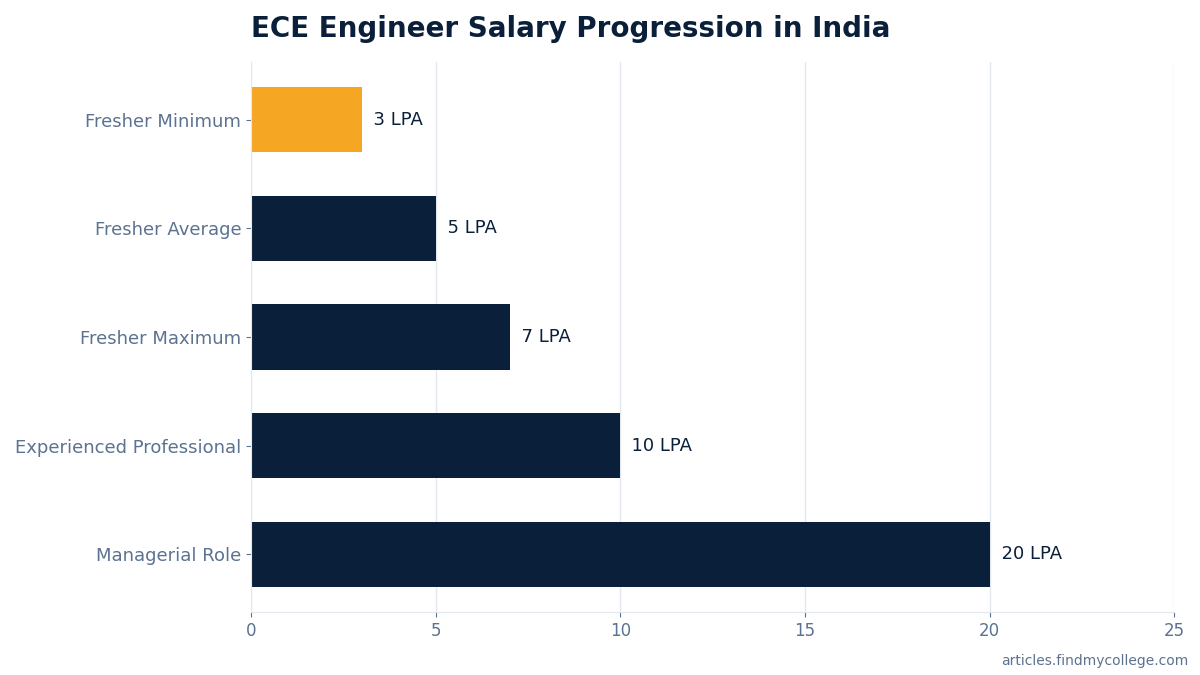
Electronics and Communication Engineering (ECE) courses are available at Diploma (3 years), Undergraduate (BTech/BE, 4 years), and Postgraduate (MTech/ME, 2 years) levels, with average course fees ranging between ₹1,800 and ₹24 Lakhs. ECE freshers typically receive starting salary packages between ₹3 LPA and ₹7 LPA across semiconductor, telecom, software, and public sector organizations.
Below is a detailed guide covering eligibility requirements, fee structures, diploma and degree options, top engineering colleges, career scope, starting salaries, and step-by-step admission processes for electronics and communication programs in India.
| Parameter | Details |
|---|---|
| Course Duration | Diploma: 3 years | UG (BTech/BE): 4 years | PG (MTech/ME): 2 years | PhD: 3 to 6 years |
| UG Eligibility | Class 12 pass with Physics, Chemistry, and Mathematics (PCM) and valid entrance score |
| Course Fees Range | ₹1,800 to ₹24 Lakhs |
| Average Starting Salary | ₹3 LPA to ₹7 LPA (Average ₹5 LPA) |
| Key Entrance Exams | JEE Main, JEE Advanced, GATE, MHT CET, KCET, TS EAMCET, AP EAMCET, BITSAT, VITEEE |
| Top Recruiters | BEL, BHEL, HPCL, Texas Instruments, Intel, Siemens, Wipro |
Course Levels: Diploma, BTech, MTech, and Certification Programs
Students can enter the ECE field through standard full-time degrees, lateral entry options, or hybrid working professional pathways. Full-time 4-year BTech courses carry an average annual fee of ₹1,00,000 to ₹2,00,000 across Indian engineering colleges. Diploma holders seeking to upgrade their qualifications can opt for a BTech Lateral Entry program, which takes 3 years to complete and requires an average annual fee of ₹45,000.
Additionally, AICTE-approved BTech programs for Working Professionals operate in hybrid modes for diploma holders with 2 to 3 years of work experience, costing ₹90,000 to ₹1,00,000 per year.
| Program Type | Duration | Average Annual Fee | Key Eligibility Requirement |
|---|---|---|---|
| BTech Full-Time | 4 Years | ₹1,00,000 – ₹2,00,000 | Class 12 (PCM) with minimum 50% aggregate |
| BTech Lateral Entry | 3 Years | ₹45,000 | 3-Year Engineering Diploma Certificate |
| BTech for Working Professionals | 3 Years | ₹90,000 – ₹1,00,000 | 3-Year Diploma + 2-3 years relevant work experience |
Pure Electronics Engineering versus Electronics and Communication Engineering
While both fields share foundational principles in circuit design and semiconductor physics, Pure Electronics Engineering concentrates on physical electronic hardware and power electronics. In contrast, Electronics and Communication Engineering extends this scope to include signal transmission, antennas, and network protocols.
| Parameter | Pure Electronics Engineering | Electronics & Communication Engineering (ECE) |
|---|---|---|
| Core Focus | Design, development, and application of electronic devices and circuits | Transmission, reception, and processing of signals across communication networks |
| Key Topics | Semiconductor physics, analog & digital electronics, power electronics | Communication theory, microwave engineering, antennas, wireless & networking |
| Primary Job Roles | Electronics Engineer, Circuit Designer, Embedded Systems Engineer | Communication Engineer, Network Engineer, RF Engineer, Wireless Engineer |
Eligibility and Duration
Course duration and eligibility criteria for ECE vary depending on the academic level. For full-time 4-year BTech and BE programs, candidates must pass Class 12 with Physics, Chemistry, and Mathematics (PCM).
Academic cutoffs depend on institutional ownership. Government and top-tier colleges require a minimum PCM average of 75% in Class 12 (65% for SC/ST/PwD candidates), whereas private colleges set eligibility between 50% and 60% aggregate marks. Postgraduate programs such as MTech require a relevant 4-year bachelor’s degree in engineering.
List of B.Tech ECE Colleges
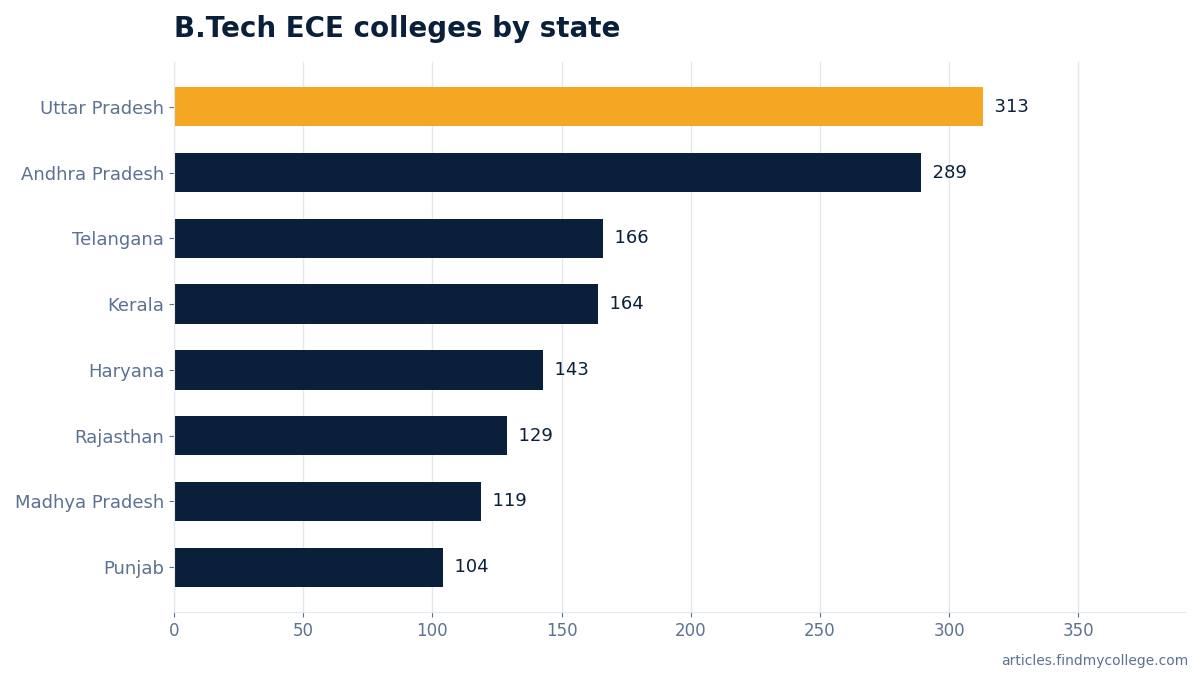
At least 1998 colleges offer B.Tech ECE in India, including 110 government colleges and 990 private colleges. The distribution of institutions across key states includes Uttar Pradesh with 313 colleges, Andhra Pradesh with 289 colleges, Telangana with 166 colleges, Kerala with 164 colleges, Haryana with 143 colleges, and Rajasthan with 129 colleges. The median average placement package across 119 colleges offering BTech ECE stands at 3.58 LPA.
| College | City | Ownership | Total course fee | NIRF rank |
|---|---|---|---|---|
| Jawaharlal Nehru University | Delhi | Government | ₹5.51 lakh | 2 (Overall, 2025) |
| Manipal University Manipal | Manipal | — | ₹3.34 lakh | 3 (Overall, 2025) |
| Jamia Millia Islamia University | Delhi | Government | ₹77,200 | 4 (Overall, 2025) |
| Delhi University | Delhi | Government | ₹5.88 lakh | 5 (Overall, 2025) |
| Indian Institute of Technology Roorkee | Roorkee | — | ₹8.93 lakh | 6 (Overall, 2025) |
| Indian Institute of Technology Kharagpur | Kharagpur | Government | ₹8.74 lakh | 6 (Overall, 2025) |
| Amrita Vishwa Vidyapeetham | Coimbatore | — | ₹20.10 lakh | 8 (Overall, 2025) |
| National Institute of Technology Rourkela | Rourkela | — | ₹1.40 lakh | 9 (Overall, 2025) |
| Govind Ballabh Pant University of Agriculture and Technology | Pantnagar | — | ₹1.75 lakh | 9 (Overall, 2025) |
| Aligarh Muslim University | Aligarh | — | ₹1.02 lakh | 10 (Overall, 2025) |
| College | City | Ownership | Total course fee |
|---|---|---|---|
| Government Engineering College Rajkot | Rajkot | Government | ₹6,000 |
| Government Engineering College Bhavnagar | Bhavnagar | Government | ₹6,000 |
| Government Engineering College Bharuch | Bharuch | Government | ₹6,000 |
| Government Engineering College Bhuj | Bhuj | Government | ₹6,000 |
| Government Engineering College Thrissur | Thrissur | Government | ₹10,000 |
| Visvesvaraya Technological University | Belgaum | Government | ₹17,420 |
| Muzaffarpur Institute of Technology | Muzaffarpur | Government | ₹22,120 |
| Shri Phanishwar Nath Renu Engineering College | Araria | Government | ₹25,600 |
| Government Engineering College Kozhikode | Kozhikode | Government | ₹28,250 |
| JNTUA College of Engineering Kadapa | Kadapa | Government | ₹28,580 |
| College | City | Ownership | Total course fee | Average package |
|---|---|---|---|---|
| Shri Govindram Seksaria Institute of Technology and Science | Indore | Private (aided) | ₹4.36 lakh | 7.21 LPA |
| Bhagwan Parshuram Institute of Technology | Delhi | Private | ₹6.63 lakh | 6.25 LPA |
| BVRIT Hyderabad College of Engineering for Women | Hyderabad | Private | ₹3.69 lakh | 5.96 LPA |
| Galgotias College of Engineering and Technology | Greater Noida | Private | ₹3.47 lakh | 5.76 LPA |
| Aditya Institute of Technology and Management | Tekkali | Private | ₹3.18 lakh | 5.15 LPA |
| Vidya Jyothi Institute of Technology | Hyderabad | Private | ₹4.40 lakh | 5.12 LPA |
| Jaipur Engineering College and Research Centre | Jaipur | Private | ₹1.07 lakh | 4.96 LPA |
| ABES Engineering College | Ghaziabad | Private | ₹4.98 lakh | 4.88 LPA |
| TKM College of Engineering | Kollam | Private (aided) | — | 4.83 LPA |
| Gayatri Vidya Parishad College of Engineering | Visakhapatnam | Private | ₹3.15 lakh | 4.79 LPA |
| City | Colleges | Fee range | Well-known options |
|---|---|---|---|
| Hyderabad | 85 | ₹1.20 lakh – ₹28.40 lakh | International Institute of Information Technology Hyderabad, Jawaharlal Nehru Technological University Hyderabad |
| Jaipur | 58 | ₹1.07 lakh – ₹20.08 lakh | Manipal University Jaipur, Kautilya Institute of Technology and Engineering and School of Management |
| Bhopal | 53 | ₹81,000 – ₹9.94 lakh | Maulana Azad National Institute of Technology, Indian Institute of Science Education and Research Bhopal |
| Lucknow | 42 | ₹90,000 – ₹9.40 lakh | University of Lucknow, Integral University |
| Meerut | 41 | ₹80,000 – ₹4.57 lakh | Swami Vivekanand Subharti University, IIMT University |
| Guntur | 39 | ₹73,000 – ₹8.20 lakh | Acharya Nagarjuna University, Vignan’s Foundation for Science, Technology, and Research |
| Kolkata | 37 | ₹30,826 – ₹9.03 lakh | Amity University Kolkata, Institute of Engineering and Management |
| Bangalore | 32 | ₹1.85 lakh – ₹20.24 lakh | Alliance University, Jain University |
Fee Structures for Government and Private Colleges
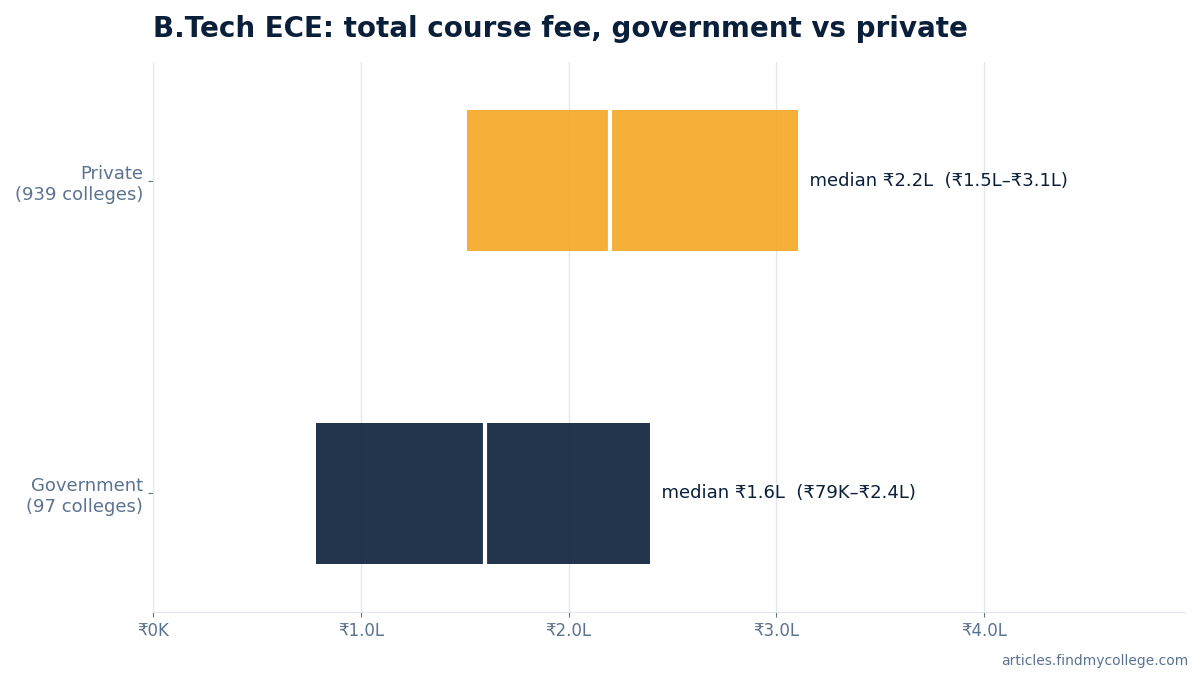
The total course fees for ECE programs across Indian institutes range between ₹1,800 and ₹24 Lakhs depending on ownership type, infrastructure, and academic level. Government engineering colleges maintain lower costs, with a median total course fee of ₹1.60 lakh and the middle half falling between ₹78,600 and ₹2.39 lakh (based on 97 colleges with fee data).
Private engineering colleges reflect a median total course fee of ₹2.20 lakh, with the middle half spanning between ₹1.51 lakh and ₹3.10 lakh (based on 939 colleges with fee data). Annual tuition fees for full-time 4-year BTech degrees generally range from ₹1,00,000 to ₹2,00,000, while lateral entry programs average ₹45,000 per year and hybrid programs for working professionals cost ₹90,000 to ₹1,00,000 annually.
Diploma in Electronics and Communication: Subjects and Practical Labs
- Practical Syllabus: Includes Basic Electronics Workshop and Digital & Microprocessor Laboratories.
- Government Technical Jobs: Opportunities in All India Radio (AIR), Doordarshan, VSNL, MTNL, police, and defence laboratories.
Diploma programs in ECE focus on practical training to prepare students for technical roles. Completing the program enables graduates to pursue government employment across telecommunications, media, and defence organizations.
Career Options and Salary Prospects in ECE
Entry-level freshers typically receive starting salary packages between ₹3 LPA and ₹7 LPA across semiconductor firms, software companies, telecom operators, and public sector organizations. Experienced engineers moving into senior managerial roles can see career salaries ranging from ₹15 LPA to ₹25 LPA.
Top recruiting organizations for ECE engineers include leading public and private enterprises such as Intel, Texas Instruments, Siemens, BEL, BHEL, and HPCL. Diploma holders can also secure technical roles in state and central government units like All India Radio (AIR), Doordarshan, VSNL, MTNL, police departments, and defence laboratories.
How to Choose the Right ECE Course and Upskill
Selecting the appropriate ECE program requires evaluating academic level, institutional credentials, total tuition fees, and long-term career goals. Prospective students should review accreditation, faculty qualifications, and campus placement records before finalizing their choice.
To enhance employment prospects in specialized engineering domains, students and graduates can enroll in industry-recognized professional certification courses after ECE. Key certifications include VLSI design and Embedded Systems programs (offered by institutes like CDAC and Vector India) as well as networking certifications such as Cisco CCNA and CCENT.
How to Apply for B.Tech ECE Admission in 2026: Step by Step
- Check Eligibility Criteria: Verify Class 10 qualification for Diploma or Class 12 with Physics, Chemistry, and Mathematics (minimum 50-75% aggregate) for BTech.
- Register and Appear for Entrance Exams: Apply for national exams (JEE Main, JEE Advanced, GATE) or state/university exams (MHT CET, KCET, TS EAMCET, AP EAMCET, BITSAT, VITEEE).
- Document Verification and Seat Allotment: Verify mark sheets, entrance scorecard, category certificates, and identity proofs during allotment rounds.
- Pay Admission Fees and Complete Enrollment: Pay mandatory tuition and university fees (such as COEP Tech AY 2026-27 published fee schedules) to confirm admission.
| What to do | Where | Link |
|---|---|---|
| Compare colleges, fees and cutoffs | B.Tech ECE colleges in India | findmycollege.com |
FAQs
What is electronic and communication?
Electronics and Communication Engineering (ECE) is an engineering branch focusing on designing electronic devices, circuit systems, signal processing, and communication networks connecting modern technology tools like smartphones, satellite systems, and smart automation.
Is ECE under BTech?
Yes, ECE is one of the most popular specializations offered under the 4-year Bachelor of Technology (BTech) and Bachelor of Engineering (BE) degree programs across top technical universities in India.
Is ECE a high paying job?
ECE offers strong financial growth. Freshers start between ₹3 LPA and ₹7 LPA, while experienced engineers in niche domains like VLSI, AI hardware, and managerial roles can earn between ₹15 LPA and ₹25 LPA.
What is the scope of B.Tech in Electronics and communication?
BTech ECE graduates have broad scope across 5G telecom, AI hardware, semiconductor fabrication, IoT, and robotics, working with top firms like Intel, Texas Instruments, Siemens, BEL, BHEL, and HPCL.
What does BTech EEE stand for?
What are the fees for a BTech degree in India?
Average annual tuition fees for full-time BTech programs range from ₹1,00,000 to ₹2,00,000 per year, while total ECE course fees across institutes range between ₹1,800 and ₹24 Lakhs.