Embedded Systems: Course Details, Eligibility and Career Options
Nishit Kumar is a senior EdTech industry leader with over a decade of experience in building and scaling education platforms, shaping their product, content, and growth strategy. At…
Up to 98 percent of all microprocessors produced worldwide are used in embedded systems.
At least 187 colleges offer Embedded Systems specialisations with a median total course fee of ₹1.14 lakh for private institutes. Below is an overview of course eligibility, syllabus subjects, top colleges, fee structures, and career options.
| Parameter | Details |
|---|---|
| Core Hardware Types | Microcontroller Unit (MCU), Microprocessor Unit (MPU), System on Chip (SoC), FPGA, DSP |
| Primary Hardware Components | Sensors, A-D Converters, Processors/ASICs, D-A Converters, Actuators |
| Performance Scale Categories | Small-scale (=8-bit MCU), Medium-scale (16-32-bit MCU), Sophisticated-scale |
| Functional Classification | Standalone, Mobile, Networked, Real-Time (Hard & Soft) |
| Primary Programming Languages | C, C++, Assembly Language, C# |
| Operating Systems Used | Real-Time Operating System (RTOS), Linux, Android OS |
| Historical Origin | Apollo Guidance Computer (1960s) |
What is Embedded Systems
- Sensors: Convert physical environmental quantities into electrical signals.
- Analog-to-Digital (A-D) Converters: Change analog electrical signals into digital signals.
- Processors / ASICs: Process digital signals and store them in memory.
- Digital-to-Analog (D-A) Converters: Change digital data from the processor into analog data.
- Actuators: Convert electrical output signals into physical mechanical motion.
An embedded system is a microcontroller or microprocessor-based system designed to perform a dedicated function within a larger mechanical or electrical system. Up to 98 percent of all microprocessors produced worldwide are used in embedded systems.
Types and Specialisations of Embedded Systems by Scale and Function
Embedded systems are broadly categorized by hardware complexity and operational requirements. Based on performance scale, systems range from basic single-function devices to multi-core heterogeneous processing units.
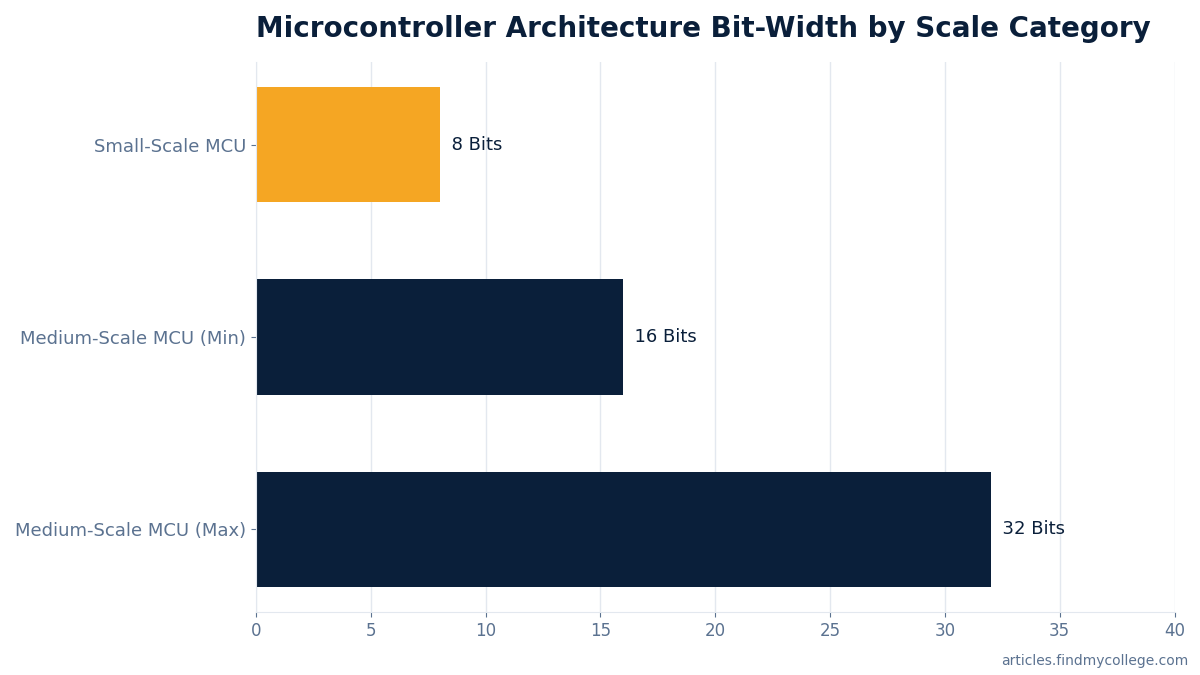
Small-scale embedded systems typically use an 8-bit microcontroller with simple software routines and low memory requirements. Medium-scale embedded systems utilize 16-bit to 32-bit microcontrollers, often linking multiple controllers together to handle moderate software complexity.
By functional capability, embedded systems are divided into four primary deployment categories: standalone, mobile, networked, and real-time systems.
| Category Type | Primary Operational Requirement | Real-World Examples |
|---|---|---|
| Standalone Systems | Functions independently without host reliance | Digital calculators, MP3 players, microwave oven controllers |
| Mobile Systems | Small, portable, low-power compact design | Smartphones, digital cameras, smart wearable devices |
| Networked Systems | Connected to communication networks for data output | Home security systems, Point-of-Sale (POS) terminals |
| Real-Time Systems | Provides output within defined strict time intervals | Automotive airbag controllers, traffic control systems, avionics |
Real-Time Embedded Systems: Hard vs Soft Real-Time Computing
Real-time embedded systems are defined by their strict operational requirement to generate correct outputs within defined time deadlines. These systems are classified into Hard Real-Time and Soft Real-Time computing environments based on the consequence of missing a timing deadline.
In Hard Real-Time systems, meeting precise execution deadlines is mandatory. In Soft Real-Time systems, deterministic timing is desired but missing a deadline degrades overall performance quality without causing total failure, such as buffer delays in video streaming or digital media playback.
Embedded Systems Syllabus and Subjects
The core curriculum of an embedded systems engineering program blends mathematical dynamic modeling, computer architecture, firmware design, and verification theory.
Key subjects cover mathematical modeling of physical-digital interactions. Continuous Dynamics covers Newtonian mechanics, actor models, and feedback control loops. Discrete Dynamics relies on Finite-State Machines (FSM), extended state machines, and non-determinism. Hybrid Systems combine discrete modal transitions with continuous physical dynamics. Software scheduling modules focus on Real-Time Operating Systems (RTOS) algorithms, including Rate Monotonic Scheduling (RMS) and Earliest Deadline First (EDF).
| Module Category | Core Engineering Subjects Covered | Focus Area |
|---|---|---|
| Modeling Dynamic Behaviors | Continuous Dynamics, Discrete Dynamics, Hybrid Systems, State Machines | Mathematical modeling of physical-digital interaction |
| Embedded Hardware Design | Sensors & Actuators, Embedded Processors, Memory Hierarchy, I/O Hardware | Hardware-software co-design and peripheral interfaces |
| System Execution & Software | Multitasking, Real-Time Scheduling (RMS, EDF), Concurrent Models | Managing timing constraints, threads, and deadlines |
| Analysis & Verification | Reachability Analysis, Model Checking, Execution Time (WCET), Security | Formal verification, timing correctness, and cryptography |
Embedded Software Architectures and Real-Time Operating Systems (RTOS)
Embedded software architecture determines how instruction code executes on hardware components.
Interrupt-controlled systems combine a primary execution loop with a secondary loop triggered by hardware or software interruptions for event-driven tasks. For mission-critical multi-threaded applications, Pre-emptive Multitasking utilizes a Real-Time Operating System (RTOS) to enforce task prioritization, manage context switches, and guarantee timing deadlines.
Key Hardware Technologies: MCU vs MPU vs SoC vs FPGA
Selecting the processing unit architecture is a pivotal decision in embedded engineering design.
A Microcontroller Unit (MCU) integrates the CPU, memory, and peripheral I/O ports onto a single silicon chip for low-power, dedicated control. Modern System-on-Chip (SoC) architectures utilize Heterogeneous Computing, integrating CPU cores, Digital Signal Processors (DSPs), and Neural Processing Units (NPUs) onto one die for mobile devices and IoT edge nodes. DSPs specialize in real-time processing of digital signals such as audio, video, noise cancellation, and radar. Field Programmable Gate Arrays (FPGAs) offer reconfigurable hardware gate arrays programmed using Hardware Description Languages (HDL) for custom logic acceleration.
Emerging Trends in Embedded Systems: Edge AI, Edge Computing, and Security
- Edge Computing: Processes data locally on embedded devices to reduce latency and cloud bandwidth dependence.
- SOM Platforms: System-on-Module (SOM) platforms like Tessolve MAGIK-II support processors from NXP, Qualcomm, TI, Mediatek, and Renesas running Linux, Android, or RTOS.
- Embedded Security: Incorporates cryptographic primitives, secure boot, network security protocols, and hardware security features.
Deploying AI models directly on local edge hardware minimizes latency and lowers cloud bandwidth requirements. Modern SOM platforms and integrated security features enable efficient, real-time embedded applications.
Embedded Systems Fees
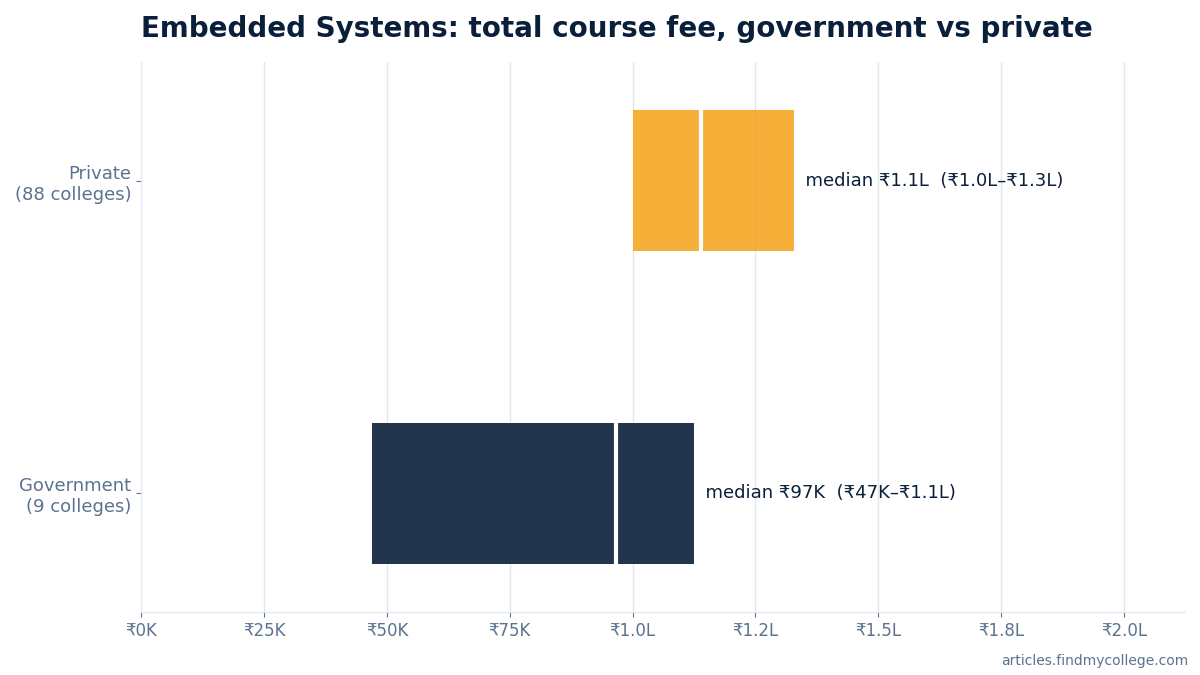
Course fees for embedded systems programs in India vary significantly between government institutions and private universities. For government colleges, the median total course fee is ₹96,660, with the middle half ranging between ₹46,900 and ₹1.12 lakh across institutes reporting fee data.
For private engineering colleges, the median total course fee is ₹1.14 lakh, with the middle half falling between ₹1.00 lakh and ₹1.33 lakh.
| College | City | Ownership | Total course fee |
|---|---|---|---|
| Government College of Engineering Kannur | Kannur | Government | ₹38,540 |
| Indian Institute of Technology Kharagpur | Kharagpur | Government | ₹43,800 |
| Gujarat Technological University | Ahmedabad | Government | ₹50,000 |
| JNTUH College of Engineering | Hyderabad | Government | ₹72,000 |
| Madras Institute of Technology | Chennai | Government | ₹96,660 |
| Universal College of Engineering and Technology Guntur | Guntur | Government | ₹1.00 lakh |
| Annamalai University | Chidambaram | Government | ₹1.03 lakh |
| Rajiv Gandhi Proudyogiki Vishwavidyalaya | Bhopal | Government | ₹1.22 lakh |
| National Institute of Electronics & Information Technology Calicut | Calicut | Government | ₹2.69 lakh |
| College | City | Ownership | Total course fee | NIRF rank |
|---|---|---|---|---|
| Manipal University Manipal | Manipal | — | ₹4.00 lakh | 3 (Overall, 2025) |
| Indian Institute of Technology Kharagpur | Kharagpur | Government | ₹43,800 | 6 (Overall, 2025) |
| Birla Institute of Technology and Science Pilani | Pilani | Private | ₹11.47 lakh | 7 (Overall, 2025) |
| Amrita Vishwa Vidyapeetham | Coimbatore | — | ₹1.80 lakh | 8 (Overall, 2025) |
| Vellore Institute of Technology Vellore | Vellore | — | ₹3.80 lakh | 14 (Overall, 2025) |
| Amity University Noida | Noida | — | ₹2.80 lakh | 22 (Overall, 2025) |
| SASTRA University | Thanjavur | — | ₹2.80 lakh | 29 (Overall, 2025) |
| University of Kashmir | Srinagar | — | ₹87,650 | 34 (Overall, 2025) |
| Graphic Era University | Dehradun | — | ₹11.10 lakh | 48 (Overall, 2025) |
| Sathyabama Institute of Science and Technology | Chennai | — | ₹2.60 lakh | 53 (Overall, 2025) |
| City | Colleges | Fee range | Well-known options |
|---|---|---|---|
| Hyderabad | 32 | ₹46,500 – ₹11.47 lakh | Jawaharlal Nehru Technological University Hyderabad, Anurag Group of Institutions |
| Chennai | 11 | ₹60,000 – ₹3.83 lakh | VIT University Chennai, Dhanalakshmi College of Engineering |
| Coimbatore | 10 | ₹60,000 – ₹1.80 lakh | Amrita Vishwa Vidyapeetham, P.S.G College of Technology |
| Bangalore | 7 | ₹96,250 – ₹4.59 lakh | Amrita Vishwa Vidyapeetham Bengaluru Campus, Dayananda Sagar University |
| East Godavari | 7 | ₹57,000 – ₹1.62 lakh | Aditya Engineering College East Godavari, Aditya College of Engineering and Technology East Godavari |
| Guntur | 5 | ₹60,000 – ₹1.00 lakh | St.Mary’s Group of Institutions, Universal College of Engineering and Technology Guntur |
| Dehradun | 5 | ₹1.86 lakh – ₹11.86 lakh | Graphic Era University, Maya Group of Colleges |
| Warangal | 4 | ₹56,000 – ₹2.02 lakh | National Institute of Technology Warangal, Jayamukhi Institute of Technological Sciences |
| College | City | Ownership | Total course fee | Average package |
|---|---|---|---|---|
| CVR College of Engineering, Ibrahimpatnam | Hyderabad | Private | ₹81,000 | 4.16 LPA |
| Annamacharya Institute of Technology & Sciences | Hyderabad | Private | — | 4 LPA |
| Vidya Jyothi Institute of Technology | Hyderabad | Private | ₹1.74 lakh | 3.7 LPA |
| Holy Mary Institute of Technology and Science | Hyderabad | Private | ₹1.23 lakh | 3.02 LPA |
| Kumaraguru College of Technology | Coimbatore | Private | ₹1.00 lakh | 3 LPA |
| GS Mandal’s Marathwada Institute of Technology | Aurangabad | Private | ₹70,000 | 3 LPA |
| Annamacharya Institute of Technology and Science | Kadapa | Private | ₹1.99 lakh | 2.77 LPA |
| Lingayas Institute of Management and Technology | Vijayawada | Private | ₹1.06 lakh | 1.5 LPA |
How to Apply for Embedded Systems Admission in 2026: Step by Step
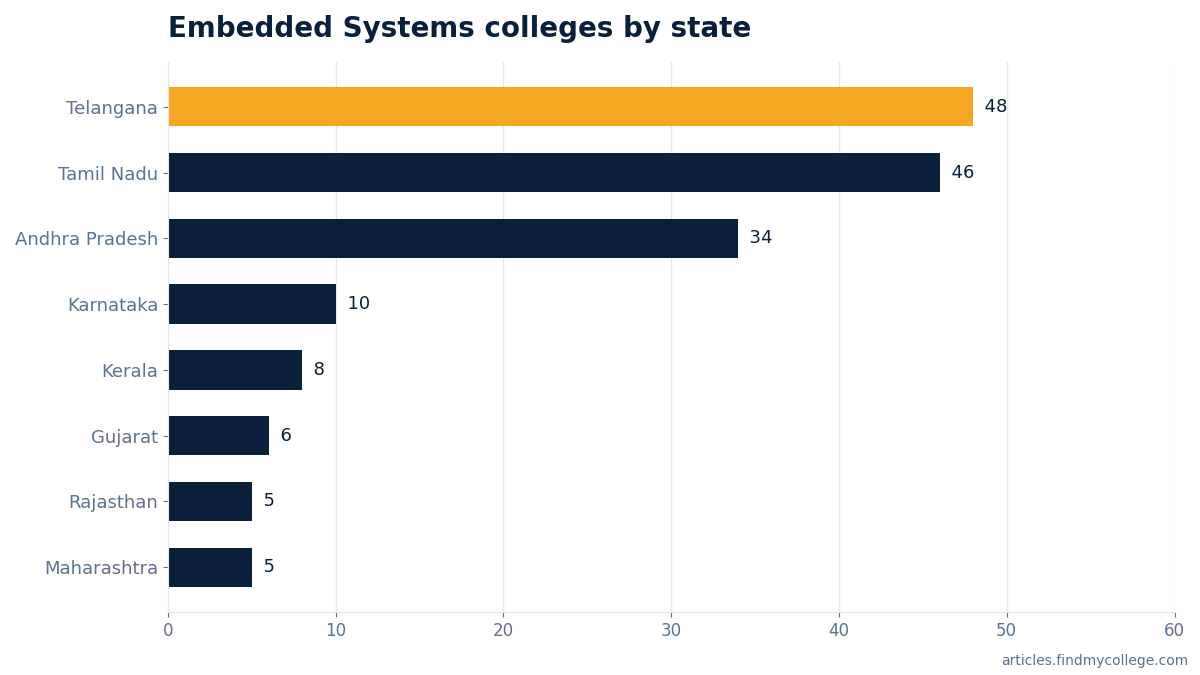
- Identify Eligible Institutions Across States: Explore at least 187 colleges offering Embedded Systems programs, including major state clusters in Telangana (48 colleges), Tamil Nadu (46 colleges), and Andhra Pradesh (34 colleges).
- Evaluate Top-Ranked NIRF Options: Target high-ranking institutions such as Manipal University Manipal (NIRF 3), Indian Institute of Technology Kharagpur (NIRF 6), and Birla Institute of Technology and Science Pilani (NIRF 7).
- Analyze Government vs. Private Fee Budgets: Compare total course fees across 12 government options (median ₹96,660) and 98 private colleges (median ₹1.14 lakh, middle half between ₹1.00 lakh and ₹1.33 lakh).
- Shortlist Low-Cost Government Options: Consider low-fee government options like Government College of Engineering Kannur (₹38,540), Indian Institute of Technology Kharagpur (₹43,800), or Gujarat Technological University (₹50,000).
- Filter Colleges by Key City Hubs: Select target cities such as Hyderabad (32 colleges, fee range ₹46,500 – ₹11.47 lakh), Chennai (11 colleges), and Coimbatore (10 colleges).
- Review Placement Outcomes: Assess expected salary returns across reporting institutions, where the median average placement package across 12 colleges stands at 3.36 LPA.
| What to do | Where | Link |
|---|---|---|
| Compare colleges, fees and cutoffs | Embedded Systems colleges in India | findmycollege.com |
At least 187 Indian colleges offer Embedded Systems courses, with government colleges having a median total fee of ₹96,660 and private colleges at ₹1.14 lakh. Prospective students should evaluate NIRF rankings, fee structures, and location options before applying.
FAQs
What are the different types of embedded systems?
Embedded systems are categorized by functional requirements into Standalone, Mobile, Networked, and Real-Time systems, and by scale into Small-scale (8-bit MCU or lower), Medium-scale (16-32-bit MCU), and Sophisticated-scale systems.
What are the parts of an embedded system?
An embedded system consists of hardware (microcontroller/microprocessor, memory, I/O ports), sensors, Analog-to-Digital (A-D) converters, processors/ASICs, Digital-to-Analog (D-A) converters, actuators, and software/firmware (application code and RTOS).
Which is better, VLSI or embedded?
Can AI replace an embedded engineer?
AI is becoming a key tool integrated into embedded engineering rather than replacing it. Embedded engineers now deploy Edge AI and machine learning models directly onto hardware SoCs to process data locally.
What is an embedded system GCSE?
What are the disadvantages of embedded systems?
Embedded systems are tightly constrained in design metrics, offering limited memory and processing power, and can be difficult to modify or re-program once embedded in dedicated hardware.