Executive MBA Degree: Program Structure, Scope and Career Growth
Nishit Kumar is a senior EdTech industry leader with over a decade of experience in building and scaling education platforms, shaping their product, content, and growth strategy. At…
- 30 May 2026DMS IIT Delhi Personal Interview Schedule
Personal interviews for Executive MBA candidates at IIT Delhi will be conducted on 30 May 2026. - 10 May 2026IIT Delhi EMBA Written Test Date Announced
Department of Management Studies (DMS), IIT Delhi schedules its Executive MBA written test for 10 May 2026.
An Executive MBA (EMBA) is a specialised graduate management degree designed for working professionals with 3 to 15 years of experience to develop executive leadership and strategic management skills without pausing their careers.
This complete guide outlines the eligibility criteria, admission schedules, core syllabus, fee distributions across top B-schools, and long-term career growth options for working executives.
| Parameter | Details |
|---|---|
| Program Duration | 1 to 2 years (18-month part-time options available) |
| Work Experience Required | 3 to 15 years (3+ years at IIT Delhi & SP Jain; 5-10 years for traditional EMBAs) |
| Academic Eligibility | Bachelor’s degree in any discipline with minimum 50% to 60% aggregate marks |
| Median Top B-School Offer (2026) | Rs 26 LPA |
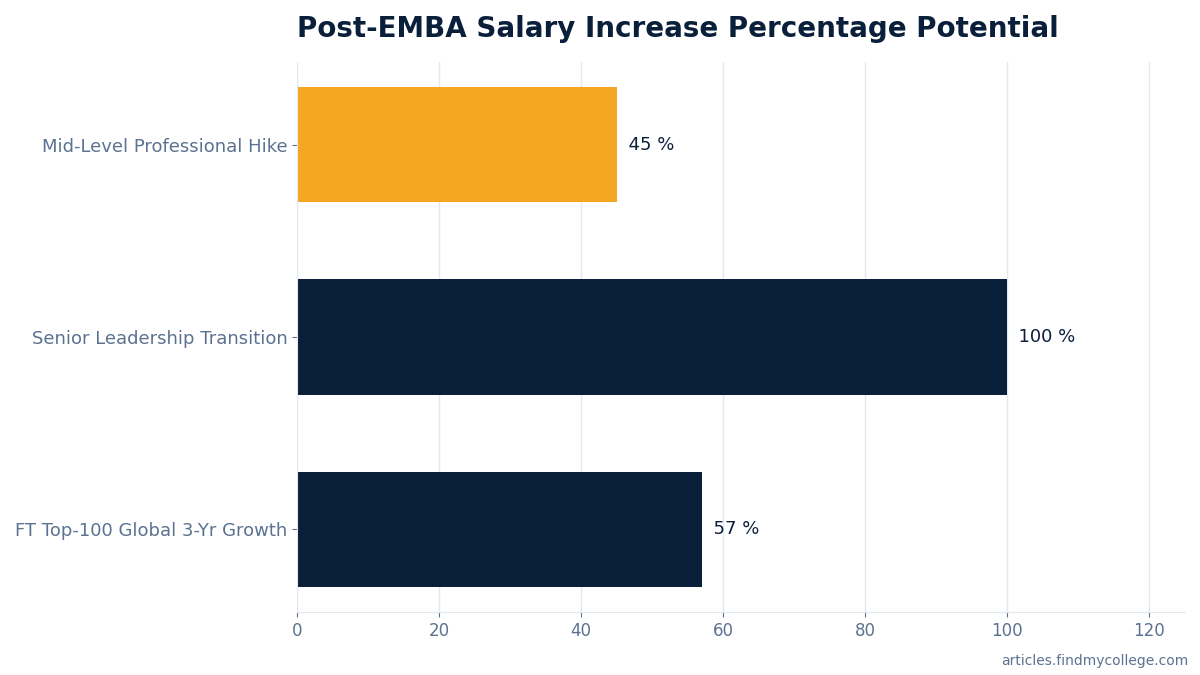
| Average Salary Hike Post-EMBA | 30% to 60% for mid-level professionals; up to 100%+ for senior leadership transitions |
| Learning Formats | Evening classes, weekend modules, hybrid, and 100% online (via ELO technology) |
What is Executive MBA
An Executive MBA is a professional master’s degree program structured for mid-career managers, corporate leaders, and business executives who wish to gain advanced strategic management knowledge while maintaining full-time employment. First introduced by the University of Chicago Booth School of Business in 1943, the format focuses heavily on high-level decision-making, corporate governance, cross-functional operations, and organizational strategy. According to GMAC data, executive management cohorts bring significant workplace experience to classroom discussions, with standard student profiles featuring professionals who are 31 years of age or older.
Unlike traditional management degrees designed for early-career graduates, the Executive MBA relies on peer-driven learning, case study analyses, and direct application of strategic concepts to active corporate challenges. Programs range from one year mba degree models to 2-year part-time tracks.
| Dimension | Executive MBA (EMBA) | Part-Time MBA | Executive Education |
|---|---|---|---|
| Qualification Awarded | Master’s Degree (EMBA) | Master’s Degree (MBA) | Certificate of Completion |
| Experience Level | Mid-to-senior (3–15 yrs) | Early-to-mid (2–5 yrs) | Any level seeking skill upskill |
| Curriculum Focus | Strategic leadership & C-suite focus | General managerial foundation | Targeted domain/skill training |
Types and Delivery Formats of Executive MBA Courses
Institutes offer diverse program delivery structures to accommodate full-time work schedules. Flexible formatting allows executives to balanced employment commitments alongside rigorous academic instruction.
- Weekend and Evening Executive MBA: Instruction occurs during Saturdays and Sundays or weekday evenings. Jamia Millia Islamia offers a 2-year, 4-semester part-time MBA (Executive) program divided into core papers and electives across Finance, Marketing, HR, Operations, and Entrepreneurship.
- Modular / Hybrid Executive MBA: Blends self-paced digital coursework with periodic on-campus immersion modules held every quarter.
- Online Executive MBA Courses: Delivered via virtual classroom technology. SP Jain Global offers an 18-month part-time Executive MBA awarding an Australian degree via Engaged Learning Online (ELO) technology. Online Executive MBA programs in India generally require 2 to 5 years of work experience and a recognized degree with 50% marks.
Executive MBA Eligibility
Admission criteria for executive management programs prioritize verified professional experience and demonstrated leadership potential alongside academic performance. Academic thresholds vary between government and private B-schools.
- Work Experience: Candidates must possess 3 to 15 years of full-time post-qualification work experience. Standard online executive MBA tracks require 2 to 5 years of work experience. For example, DMS IIT Delhi requires a minimum of 3 years of full-time work experience.
- Academic Qualifications: Applicants must hold a recognized Bachelor’s degree in any discipline with a minimum of 50% to 60% aggregate marks. DMS IIT Delhi mandates a Bachelor’s degree with 60% marks (55% for SC/ST/PH candidates).
Executive MBA Admission Process
- Written Test & Interview: Institutes such as DMS IIT Delhi require applicants to appear for a written test and personal interview.
- Candidate Evaluation: Selection gives weightage to professional background in terms of work experience and higher performance in qualifying degrees or diplomas.
Executive MBA admission evaluates academic qualifications and work background through written assessments and personal interviews. Selection frameworks award weightage for higher marks in qualifying degrees alongside relevant professional experience.
Executive MBA Syllabus and Subjects
The academic curriculum of an Executive MBA transitions from foundational functional management subjects to executive decision-making, global strategy, and corporate governance. Most curricula conclude with a practical capstone project or strategic business transformation study.
| Semester | Core Subjects Covered | Academic Focus |
|---|---|---|
| Semester I | Management Concepts & OB, Managerial Economics, Financial Accounting, Quantitative Methods, Business Communication, Marketing Management, HR Management, IT Applications | Foundational core management disciplines |
| Semester II | Organization Structure & Dynamics, Management Science, Economic Environment, Financial Management, Marketing Research, Operations Management, Accounting for Managerial Decision Making | Advanced functional managerial competencies |
| Semester III | Business Policy & Strategic Management, Methodology of Business Research, 6 Optional Elective Papers | Strategic alignment and industry specialisation |
| Semester IV | Business Ethics & Corporate Governance, Legal Environment of Business, International Business Environment, Project Study, 3 Optional Elective Papers | Governance, global business & capstone project |
Executive MBA Fees
At least 281 colleges offer Executive MBA degrees across India, including 18 government and 21 private institutions. Fee structures depend significantly on institutional ownership, campus infrastructure, global study immersions, and program delivery formats.
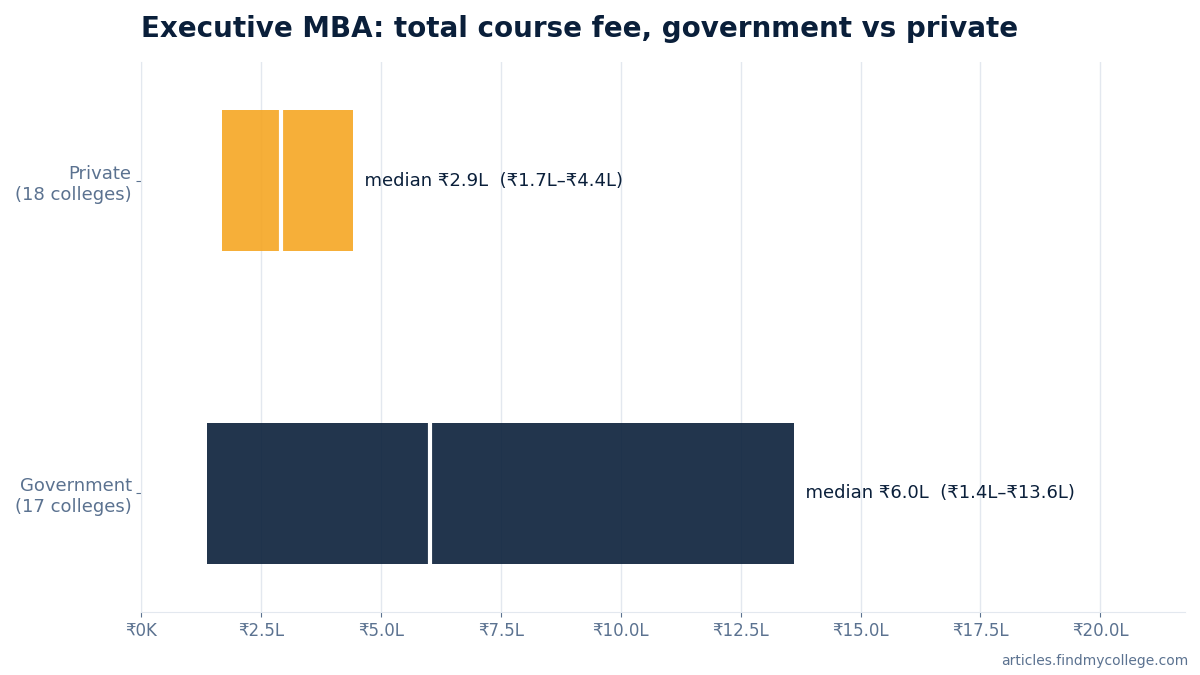
Across government colleges with fee data (17 institutions), the median total course fee stands at ₹6.02 lakh, with the middle half ranging between ₹1.37 lakh and ₹13.60 lakh. For private institutions (18 colleges with fee data), the median total course fee is ₹2.90 lakh, with the middle half falling between ₹1.68 lakh and ₹4.41 lakh. Internationally, global EMBA tuition averages US$82,000, ranging from US$40,000 at MIP Politecnico di Milano up to US$185,650 at HKUST-Kellogg.
| College | City | Ownership | Total course fee |
|---|---|---|---|
| Gujarat University | Ahmedabad | Government | ₹9,050 |
| Jamia Millia Islamia University | Delhi | Government | ₹61,855 |
| Kumaun University DSB Campus | Nainital | Government | ₹85,000 |
| Delhi University | Delhi | Government | ₹1.15 lakh |
| Magadh University | Gaya | Government | ₹1.60 lakh |
| University of Rajasthan | Jaipur | Government | ₹1.61 lakh |
| Panjab University | Chandigarh | Government | ₹2.66 lakh |
| Lalit Narayan Mishra Institute of Economic Development and Social Change | Patna | Government | ₹3.01 lakh |
| Delhi Technological University | Delhi | Government | ₹6.02 lakh |
| Indian Institute of Technology Kharagpur | Kharagpur | Government | ₹8.37 lakh |
Top Executive MBA Colleges
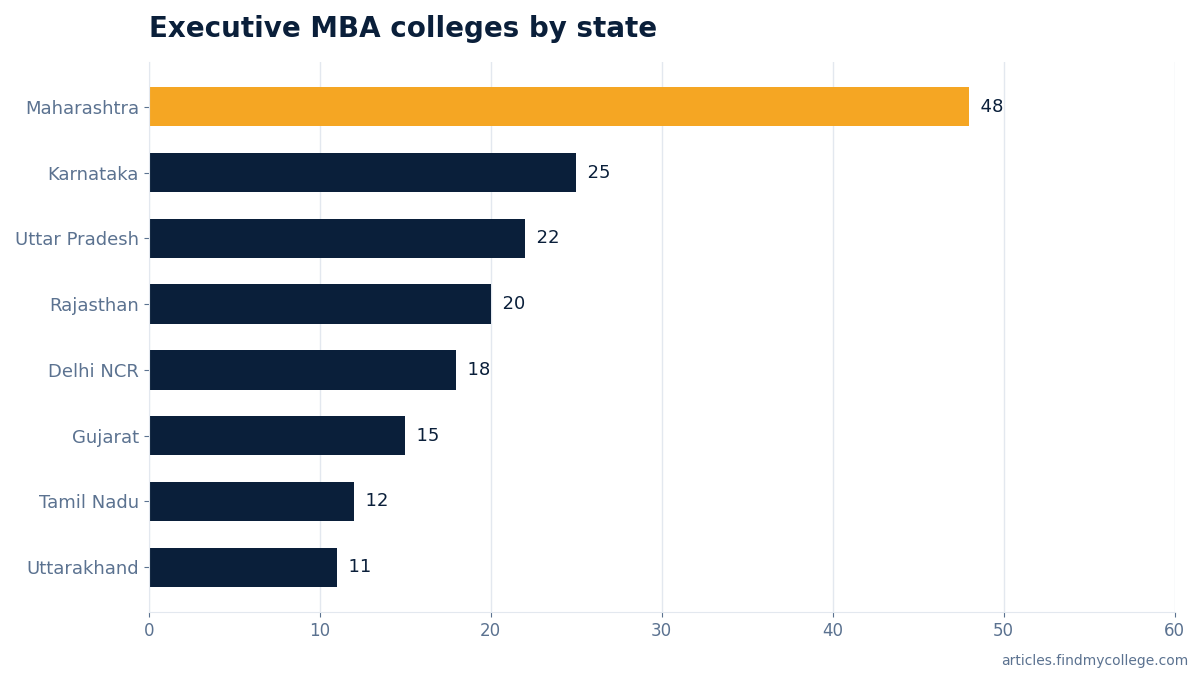
State-wise institutional distribution shows strong concentration in major commercial hubs: Maharashtra leads with 48 colleges, followed by Karnataka with 25, Uttar Pradesh with 22, Rajasthan with 20, Delhi NCR with 18, and Gujarat with 15. Premium public technical institutes and management B-schools top national rankings.
| College | City | Ownership | Total course fee | NIRF rank |
|---|---|---|---|---|
| Indian Institute of Technology Madras | Chennai | Government | ₹13.00 lakh | 1 (Overall, 2025) |
| Indian Institute of Technology Bombay | Mumbai | Government | ₹42.00 lakh | 3 (Overall, 2024) |
| Jamia Millia Islamia University | Delhi | Government | ₹61,855 | 4 (Overall, 2025) |
| Delhi University | Delhi | Government | ₹1.15 lakh | 5 (Overall, 2025) |
| Indian Institute of Technology Roorkee | Roorkee | — | ₹11.00 lakh | 6 (Overall, 2025) |
| Indian Institute of Technology Kharagpur | Kharagpur | Government | ₹8.37 lakh | 6 (Overall, 2025) |
| Indian Institute of Technology New Delhi | Delhi | Government | ₹18.86 lakh | 8 (Overall, 2025) |
| National Institute of Technology Rourkela | Rourkela | — | ₹6.35 lakh | 9 (Overall, 2025) |
| University of Hyderabad | Hyderabad | — | ₹5.00 lakh | 18 (Overall, 2025) |
| Amity University Noida | Noida | — | ₹2.20 lakh | 22 (Overall, 2025) |
Private universities and specialized management institutions also provide extensive executive education options across major cities, catering to regional corporate workforces.
| College | City | Ownership | Total course fee |
|---|---|---|---|
| Christ University | Bangalore | Private | ₹6.88 lakh |
| Uttaranchal University | Dehradun | Private | ₹4.10 lakh |
| Indian Institute of Technology Dhanbad | Dhanbad | Private | ₹6.00 lakh |
| NSHM Knowledge Campus Kolkata | Kolkata | Private | ₹4.17 lakh |
| Pacific University | Udaipur | Private | ₹4.88 lakh |
| Surana College | Bangalore | Private | ₹2.00 lakh |
| Roorkee College of Engineering | Roorkee | Private | ₹2.50 lakh |
| Pratap University | Jaipur | Private | ₹1.72 lakh |
| Kristu Jayanti College | Bangalore | Private | ₹10.00 lakh |
| Bengal Institute of Business Studies | Kolkata | Private | ₹3.62 lakh |
| City | Colleges | Fee range | Well-known options |
|---|---|---|---|
| Mumbai | 23 | ₹81,000 – ₹42.00 lakh | Indian Institute of Technology Bombay, S. P. Jain School of Global Management |
| Bangalore | 21 | ₹92,000 – ₹20.00 lakh | Christ University, Dayananda Sagar University |
| Delhi | 18 | ₹61,855 – ₹18.86 lakh | Jamia Millia Islamia University, Delhi University |
| Pune | 12 | ₹1.08 lakh – ₹7.03 lakh | Symbiosis International University Pune, Symbiosis Institute of Business Management Pune |
| Chennai | 11 | ₹1.60 lakh – ₹17.00 lakh | Indian Institute of Technology Madras, University of Madras |
| Hyderabad | 8 | ₹80,000 – ₹24.00 lakh | University of Hyderabad, Malla Reddy University |
| Jaipur | 8 | ₹1.61 lakh – ₹3.00 lakh | University of Rajasthan, Amity University Jaipur |
| Kolkata | 8 | ₹1.05 lakh – ₹31.00 lakh | Indian Institute of Management Kolkata, NSHM Knowledge Campus Kolkata |
Working executives seeking flexible distance education or digital learning environments can opt for accredited online programs across several major institutions.
| College | City | Ownership | Total course fee |
|---|---|---|---|
| St. Xavier’s University | Kolkata | — | ₹6.00 lakh |
| Amity Business School | Mumbai | — | ₹2.64 lakh |
| Indian Institute of Management Udaipur | Udaipur | Government | ₹14.21 lakh |
| Department of Business Administration, Tezpur University | Tezpur | — | ₹3.03 lakh |
| Shri Vile Parle Kelavani Mandal’s Narsee Monjee Institute of Management Studies (NMIMS) | Bangalore | — | ₹4.00 lakh |
| University of Madras | Chennai | — | ₹1.78 lakh |
| DY Patil International University | Pune | — | ₹3.65 lakh |
Executive MBA Career Scope and Salary
| Job Title / Role | Key Responsibility Area | Primary Hiring Sectors |
|---|---|---|
| General Manager | P&L ownership, regional operations, cross-functional leadership | Manufacturing, Infrastructure, Retail |
| Director of Strategy | Corporate growth initiatives, transformation, operational turnaround | Fintech, Consulting, Healthcare |
| Senior Consultant / Partner | Large-scale advisory, business transformation, strategy execution | Management Consulting, IT Services |
| C-Suite Executive (CEO/CFO/COO) | Overall strategic vision, corporate governance, organizational scale | Global Corporations, Tech, Scale-ups |
An EMBAC survey reports that 39 percent of Executive MBA students receive a career promotion after graduation. Graduates achieve break-even on tuition and opportunity costs within 2 to 4 years, while the median average placement package across 5 colleges is 9.4 LPA.
How to Choose the Right Executive MBA College
Selecting an executive management program requires careful evaluation of academic structure, peer network composition, and institutional support. Essential parameters include:
- Accreditation and Recognition: Ensure the degree or diploma awarded is recognized by national authorities or internationally accredited bodies.
- Global Exposure and Field Study: Look for programs offering international immersions. IIT Delhi provides Global Field Study (GFS) funding up to INR 1,50,000 for approved Executive MBA student projects.
- Peer Group Quality: Evaluate the cohort’s average years of work experience and sector representation to maximize networking value.
How to Apply for Executive MBA Admission in 2026: Step by Step
- Verify Work Experience and Academic Eligibility: Ensure you possess a recognised Bachelor’s degree (minimum 50-60% aggregate) and 3 to 15 years of full-time professional work experience.
- Submit Online Application Form: Fill out the institute application form uploading academic transcripts, employment proofs, resume, and Statement of Purpose.
- Obtain Employer No Objection Certificate (NOC): Obtain sponsorship or a No Objection Certificate from your employer confirming support for weekend/evening class attendance.
- Appear for Entrance Test / Written Examination: Appear for institute-specific entrance exams (e.g., DMS IIT Delhi Written Test scheduled for 10 May 2026).
- Attend Personal Interview Round: Participate in the personal interview process (e.g., IIT Delhi interview on 30 May 2026) evaluating managerial background and leadership intent.
- Confirm Admission and Pay Fees: Review final merit selection results (announced 3rd week of June 2026 for IITD) and complete program fee submission prior to class commencement.
| What to do | Where | Link |
|---|---|---|
| Compare colleges, fees and cutoffs | Executive MBA colleges in India | findmycollege.com |
FAQs
Is an executive MBA equal to a regular MBA?
Yes, an Executive MBA awards an equivalent Master’s degree in Business Administration, but it is structured specifically for working professionals with significant managerial work experience using part-time, evening, or weekend formats.
What are the eligibility requirements for an Executive MBA program in India?
Candidates require a Bachelor’s degree in any discipline with 50% to 60% aggregate marks and a minimum of 2 to 5 years of work experience (3+ years at IIT Delhi; 5-10 years for executive tracks).
Does an executive MBA increase salary?
Yes, mid-level professionals typically observe a 30% to 60% salary hike post-EMBA, while those transitioning into senior leadership or C-suite roles can experience salary increases up to 100%.
Which is better, MBA or Executive MBA?
Is 33 too old for an MBA?
Global management statistics show that a majority of EMBA students are 31 years of age or older, making peer cohorts experienced and senior.
What is an executive MBA salary in India?
Median MBA/EMBA offers at top 10 B-schools in India are projected at Rs 26 LPA in 2026.