How to Become a Judge in India: Qualification & Judicial Exams
Nishit Kumar is a senior EdTech industry leader with over a decade of experience in building and scaling education platforms, shaping their product, content, and growth strategy. At…
- 21 Aug 2026Supreme Court reduces mandatory practice rule to 1 year for judiciary exams
The Supreme Court reduced the mandatory advocate practice requirement for judiciary exam eligibility from 3 years to 1 year. Fresh law graduates remain eligible under a transition window until March 31, 2027, followed by 1 year of Judicial Academy training and 1 year of clerkship post-selection.
To become a judge in India, you must earn an LLB degree (3-year or 5-year integrated), enrol as an advocate with a State Bar Council, and clear your state’s Judicial Services Examination (PCS-J), which consists of Prelims, Mains, and an Interview. Entry-level Civil Judges (Junior Division) earn a starting basic salary of ₹77,840 per month (total gross emoluments around ₹1.2–1.5 lakh/month), while High Court judges receive ₹2,25,000 per month.
| Parameter | Details |
|---|---|
| Required Qualification | LLB degree (3-year or 5-year integrated BA/BBA/BCom/BSc LLB) |
| Primary Entrance Exam | State Judicial Services Examination / PCS (J) |
| Age Limit (Lower Judiciary) | 21 to 35 years (up to 40-42 years in states like Rajasthan and Haryana) |
| Starting Basic Pay (Civil Judge) | ₹77,840 per month (Total: ₹1.2–1.5 lakh per month) |
| High Court Judge Salary | ₹2,25,000 per month (Chief Justice: ₹2,50,000 per month) |
| Mandatory Practice Experience | 1 year active practice (Freshers eligible under transition window till March 31, 2027) |
| Supreme Court Elevation Eligibility | 5 years as High Court Judge or 10 years as High Court Advocate |
Eligibility to Become a Judge (career)
To sit for lower judicial service examinations in India, candidates must hold an LLB degree from a Bar Council of India (BCI) recognised university and be enrolled as an advocate under the Advocates Act, 1961.
Age limits for lower judiciary exams generally range between 21 and 35 years across most states. However, states like Rajasthan allow candidates up to 40 years, while Haryana sets the upper age limit at 42 years. Reserved categories receive age relaxations according to state regulations.
Courses to Become a Judge (career)
Students aiming for a judicial career can choose between two main educational pathways: a 5-year integrated law degree after Class 12 or a 3-year LLB program after completing graduation in any discipline.
Admission into top law universities offering BA LLB, BBA LLB, BCom LLB, or BSc LLB programs requires clearing national or state-level entrance examinations. Popular entrance tests include CLAT, AILET, LSAT, SLAT, and MHT CET. Completing a law degree from a BCI-recognised institute is mandatory to qualify for Bar enrolment and state judicial exams.
Skills Required
Aspiring judges need strong analytical ability and sound legal reasoning to interpret statutes and analyze complex factual evidence. Precise written communication is vital for drafting clear judgments and legal orders.
Judiciary candidates must also demonstrate language proficiency in the official regional language of the hiring state, such as Hindi, Marathi, or Bengali. Judicial temperament, ethical integrity, and objective decision-making are critical traits evaluated during the final interview and selection stages.
Judge (career) Salary
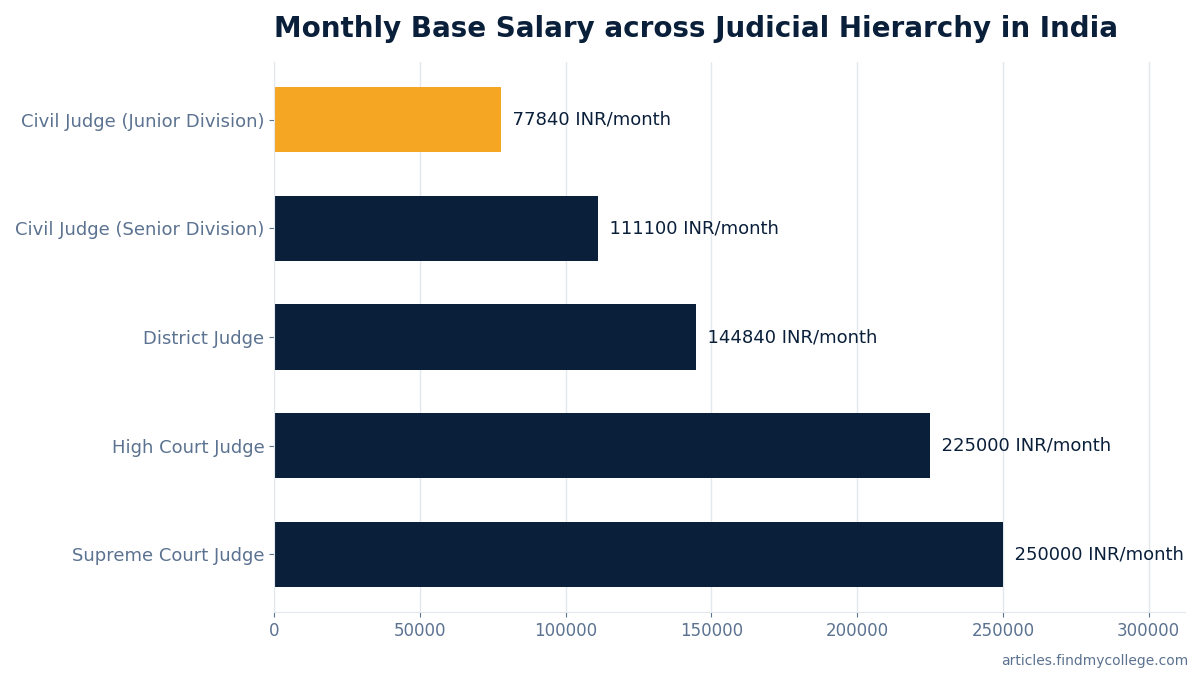
Judicial officers in India receive structured pay scales along with government allowances and perks. An entry-level Civil Judge (Junior Division) earns a starting basic salary of ₹77,840 per month, with total gross monthly emoluments ranging from ₹1.2 lakh to ₹1.5 lakh.
Constitutional court judges earn fixed monthly pay: High Court judges receive ₹2,25,000, while High Court Chief Justices and Supreme Court judges earn ₹2,50,000 per month. Subordinate judges also enjoy benefits including official housing rent allowances, electricity and water subsidies, travel allowances, children educational allowance, and pension benefits.
Eligibility Criteria for State Judicial Service Exams Across India
| State Judicial Service | Age Limit (General) | Educational Qualification | State Language & Other Criteria |
|---|---|---|---|
| Uttar Pradesh (UP PCS J) | 22 – 35 years | LLB from a university in UP or recognised Indian university | Proficiency in Hindi (Devanagari script) is essential |
| Delhi (DJS) | Upper limit 32 years | Law degree from a recognised University/Institute | Practising advocate or eligible to be enrolled under Advocates Act 1961 |
| Rajasthan (RJS) | 21 – 40 years | LLB or equivalent recognised under Advocates Act 1961 | – |
| Maharashtra | 21 – 35 years | LLB / LLM from recognised university | Proficiency in Marathi (speaking, reading, writing, and translation) |
| West Bengal | 23 – 35 years | Law degree and Bar Council enrolment | Ability to read, write, and speak Bengali (waived if Nepali is mother tongue) |
| Haryana | 21 – 42 years | LLB from Government/BCI-approved university | Enrolled Advocate entitled to practise in High Court |
Lower Judicial Services exam age limits generally span from 21 to 35 years, extending up to 40 years in Rajasthan and 42 in Haryana. Candidates must hold a BCI-recognised LLB degree and satisfy state language criteria where applicable.
Judicial Services Examination Pattern and Core Syllabus Structure
State Judicial Services Examinations (PCS-J) are conducted in three mandatory sequential stages: Preliminary Exam, Mains Exam, and Personal Interview. The syllabus covers substantive civil law, local state acts, procedural law, and recent legal updates.
Candidates must study updated criminal legislation, including the Bharatiya Nyaya Sanhita (BNS), Bharatiya Nagarik Suraksha Sanhita (BNSS), and Bharatiya Sakshya Adhiniyam (BSA). Language proficiency papers and judgment writing constitute a major part of the descriptive Mains examination.
| Exam Stage | Test Format | Key Subjects & Assessed Skills |
|---|---|---|
| Stage 1: Preliminary Exam | Objective MCQs (Screening round) | General Knowledge, Current Affairs, Basic Legal Aptitude, English |
| Stage 2: Mains Exam | Written Descriptive Papers | Civil Law, Criminal Law (BNS/BNSS/BSA), Constitution, Language & Judgment Writing |
| Stage 3: Interview / Viva Voce | Personal Interview by Selection Board | Legal Reasoning, Temperament, Communication & Judicial Aptitude |
Supreme Court 2026 Ruling on Advocate Practice & Transition Period Rules
Under the Supreme Court ruling dated August 21, 2026, the mandatory practice experience required for candidates appearing for lower judiciary exams was revised to 1 year of continuous active practice.
To prevent immediate hardship for ongoing judicial aspirants, the Supreme Court established a transition window ending March 31, 2027. Under this window, fresh law graduates can apply for state judiciary exams notified on or before March 31, 2027 without demonstrating prior active practice.
Candidates selected under this framework undergo 1 year of training at the State Judicial Academy, followed by 1 year of structured clerkship before assuming judicial duties.
How to Start a Career as Judge (career): Step by Step
- Earn an LLB Degree: Appear for law entrance exams like CLAT, AILET, LSAT, SLAT, or MHT CET and complete a 5-year integrated law course (BA/BBA/BCom/BSc LLB) after 12th or a 3-year LLB after graduation from a BCI-recognised university.
- Enrol with State Bar Council: Register as an Advocate with your respective State Bar Council under Section 24 of the Advocates Act, 1961 upon graduating.
- Fulfill Legal Practice Requirement: Gain 1 year of active legal practice as mandated by the Supreme Court framework, or apply as a fresh law graduate under the transition window available till March 31, 2027.
- Apply for State Judicial Services Exam (PCS-J): Submit your online application through the respective State Public Service Commission or High Court recruitment portal during the official notification window.
- Clear the Three Exam Stages: Qualify in Stage 1 Preliminary MCQ exam, score merit marks in Stage 2 Mains descriptive written papers (including judgment writing), and clear Stage 3 Personal Interview / Viva Voce.
- Undergo Judicial Training & Clerkship: Upon selection, complete 1 year of mandatory training at the State Judicial Academy followed by 1 year of structured clerkship before taking full judicial charge as a Civil Judge (Junior Division).
| What to do | Where | Link |
|---|---|---|
| Compare colleges, fees and cutoffs | Judge (career) colleges in India | findmycollege.com |
FAQs
How to become a judge after 12th in India?
Complete a 5-year integrated law degree (BA LLB, BBA LLB, BCom LLB, or BSc LLB) after 12th, enrol as an advocate with the State Bar Council, and clear your state’s Judicial Services Examination (PCS-J).
What is the age limit for judiciary exams in India?
For entry-level Civil Judge exams, the baseline age limit is generally 21 to 35 years. Some states set different limits, such as 21–40 years in Rajasthan and 21–42 years in Haryana, with relaxations for reserved categories.
How to become judge of High Court?
How to become Supreme Court judge?
What is the highest salary of a judge?
High Court Chief Justices and Supreme Court Judges receive a fixed monthly salary of ₹2,50,000, along with official accommodation, vehicle allowances, and post-retirement pension benefits.
What is the exam name to become a judge in India?
Entry-level judges are selected through the Judicial Services Examination, officially known as Provincial Civil Service (Judicial) or PCS (J), conducted individually by each state’s Public Service Commission or High Court.