

IGNOU PhD Admission 2026: Entrance Exam, Application and Dates
Nishit Kumar is a senior EdTech industry leader with over a decade of experience in building and scaling education platforms, shaping their product, content, and growth strategy. At…
PhD admissions in India are governed by UGC regulations requiring a Master’s degree with at least 55% aggregate (50% for reserved categories) or a qualifying four-year bachelor’s degree with research. Admission is granted based on national eligibility tests like UGC NET/CSIR NET or university entrance exams, followed by an interview and research proposal presentation.
At least 3561 colleges offer doctoral programmes across India, with government institutions having a median fee of ₹71,600. Below is a complete guide covering academic eligibility criteria, national entrance exams, application procedures, part-time guidelines, and research proposal requirements.
| Parameter | Details |
|---|---|
| Program Duration | 3 to 6 years |
| General Eligibility (Master’s) | Master’s degree with 55% aggregate (50% for SC/ST/reserved categories) |
| General Eligibility (4-Year UG) | 4-year bachelor’s degree with research under NEP framework |
| Age Limit | No upper age limit for PhD admission |
| Distance/Online PhD Permissibility | Not permitted under UGC regulations |
| Key Entrance Exams | UGC NET, CSIR NET, GATE, ICMR JRF, DBT JRF |
Ph.D. Eligibility
Candidates seeking admission to doctoral programmes must fulfill prescribed academic qualifications under UGC guidelines. A Master’s degree with at least 55% aggregate marks (50% aggregate for reserved categories) is required. Furthermore, under the National Education Policy framework, candidates completing a qualifying 4-year bachelor’s degree with research are eligible for direct PhD admission. There is no upper age limit restriction for applicants.
Ph.D. Entrance Exams
| Exam Name | Eligibility Criteria | Primary Disciplines |
|---|---|---|
| UGC NET JRF | Master’s degree with 55% marks (50% for reserved categories) | Humanities, Social Sciences, Commerce |
| CSIR NET | Master’s degree in Science/Engineering stream with 55% marks | Sciences |
| GATE | Bachelor’s or Master’s degree with minimum 55% marks | Engineering |
| DBT JRF | Postgraduate degree in Biotechnology (60% General/OBC, 55% SC/ST/PWD) | Biotechnology & Allied Areas |
National entrance examinations evaluate research aptitude and subject knowledge for PhD admissions across India. Candidates with a valid Junior Research Fellowship are commonly exempted from written university entrance tests.
Ph.D. Application Process
The selection process follows structured stages from initial eligibility checks to final supervisor allocation. Candidates must register online, clear either a national entrance examination or a university-specific test, and submit a detailed research proposal outlining their proposed research question, literature gap, and methodology.
| Stage | Description | Key Requirement |
|---|---|---|
| 1. Eligibility Verification | Check academic qualifications and minimum aggregate criteria | Master’s degree with 55% or 4-year UG with research |
| 2. Entrance Examination | Appear for national test (NET/GATE) or university test | Written test assessing research aptitude and subject knowledge |
| 3. Research Proposal Submission | Submit written research proposal detailing problem statement | Clear research question, literature gap, feasibility |
| 4. Interview & Presentation | Defend research proposal before faculty committee | Demonstrated domain knowledge and methodological understanding |
| 5. Allotment & Document Check | Supervisor allocation based on expertise and vacancy | NOC for working candidates, original certificates verification |
Top Ph.D. Colleges
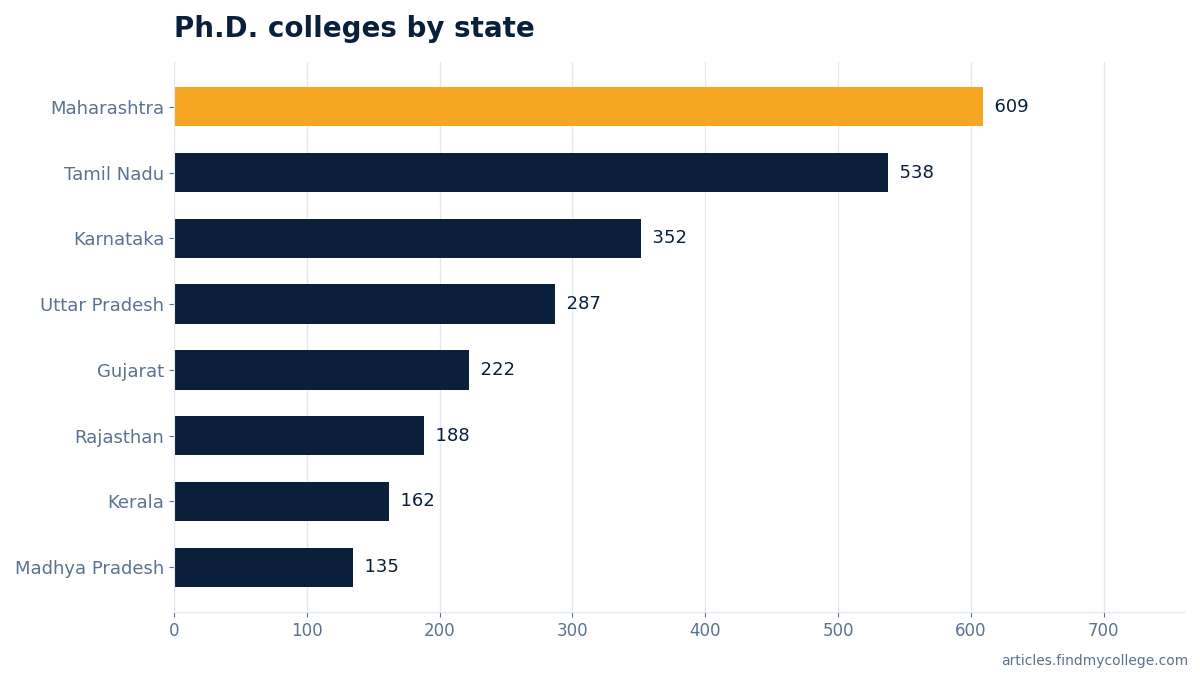
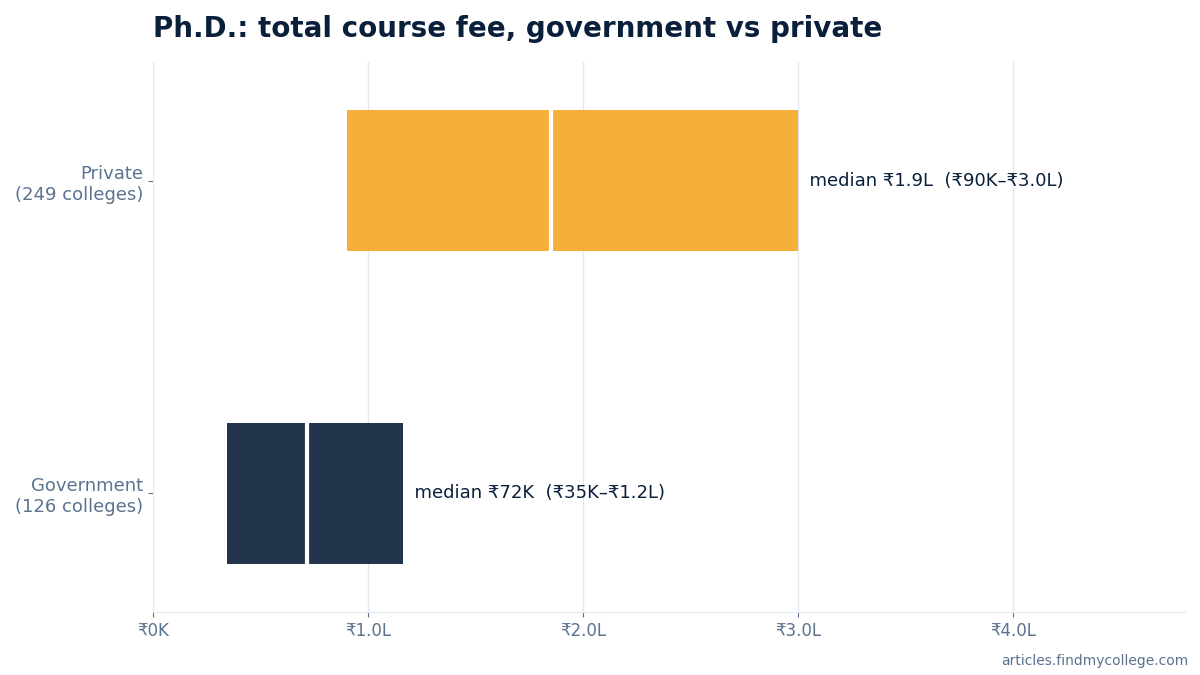
At least 3561 colleges offer Ph.D. programmes in India, including 287 government institutions and 1129 private institutions. For government colleges, the median total course fee stands at ₹71,600, with the middle half ranging between ₹34,582 and ₹1.16 lakh. Private institutions report a median total course fee of ₹1.85 lakh, with the middle half between ₹90,270 and ₹3.00 lakh. Geographically, Maharashtra has 609 colleges, followed by Tamil Nadu with 538, Karnataka with 352, Uttar Pradesh with 287, Gujarat with 222, and Rajasthan with 188. Across 9 institutions with placement data, the median average placement package is 6.47 LPA.
| College | City | Ownership | Total course fee | NIRF rank |
|---|---|---|---|---|
| Indian Institute of Science | Bangalore | — | ₹89,200 | 1 (Overall, 2025) |
| Indian Institute of Technology Madras | Chennai | Government | ₹30,850 | 1 (Overall, 2025) |
| Jawaharlal Nehru University | Delhi | Government | — | 2 (Overall, 2025) |
| Indian Institute of Technology Bombay | Mumbai | Government | ₹70,200 | 3 (Overall, 2024) |
| Manipal University Manipal | Manipal | — | ₹59,000 | 3 (Overall, 2025) |
| Punjab Agricultural University | Ludhiana | — | ₹1.76 lakh | 3 (Overall, 2025) |
| Jamia Millia Islamia University | Delhi | Government | ₹27,740 | 4 (Overall, 2025) |
| Indian Institute of Technology Kanpur | Kanpur | Government | ₹52,200 | 5 (Overall, 2025) |
| Delhi University | Delhi | Government | ₹7,130 | 5 (Overall, 2025) |
| Indian Institute of Technology Roorkee | Roorkee | — | ₹85,800 | 6 (Overall, 2025) |
| College | City | Ownership | Total course fee |
|---|---|---|---|
| Indian Institute of Foreign Trade Kolkata | Kolkata | Government | ₹5,000 |
| Bharathi Women’s College | Chennai | Government | ₹5,105 |
| All India Institute of Medical Sciences New Delhi | Delhi | Government | ₹5,215 |
| Gulbarga University | Gulbarga | Government | ₹6,545 |
| Govt. Raza Post Graduate College | Rampur | Government | ₹6,810 |
| Delhi University | Delhi | Government | ₹7,130 |
| Calicut University | Calicut | Government | ₹7,130 |
| Bastar University | Bastar | Government | ₹7,170 |
| Post Graduate Institute of Medical Education & Research | Chandigarh | Government | ₹7,410 |
| Government Thakur Ranmat Singh College | Rewa | Government | ₹7,777 |
| College | City | Ownership | Total course fee |
|---|---|---|---|
| Birla Institute of Technology and Science Pilani | Pilani | Private | ₹1.84 lakh |
| Chandigarh University | Chandigarh | Private | ₹3.60 lakh |
| VIT University Chennai | Chennai | Private | ₹1.33 lakh |
| Thapar Institute of Engineering and Technology | Patiala | Private | ₹69,000 |
| Chebrolu Hanumaiah Institute of Pharmaceutical Sciences | Guntur | Private | ₹1.05 lakh |
| Indian Institute of Technology Dhanbad | Dhanbad | Private | ₹50,400 |
| Uttaranchal University | Dehradun | Private | ₹3.59 lakh |
| Marwadi University | Rajkot | Private | ₹2.25 lakh |
| SVKM’s Narsee Monjee Institute of Management Studies Navi Mumbai | Navi Mumbai | Private | ₹3.00 lakh |
| Doon Business School | Dehradun | Private | ₹3.30 lakh |
| City | Colleges | Fee range | Well-known options |
|---|---|---|---|
| Bangalore | 179 | ₹50,000 – ₹8.75 lakh | Alliance University, Christ University |
| Pune | 173 | ₹52,785 – ₹5.16 lakh | Symbiosis Law School Pune, Armed Forces Medical College |
| Mumbai | 149 | ₹7,923 – ₹33.82 lakh | Indian Institute of Technology Bombay, Jamnalal Bajaj Institute of Management Studies |
| Chennai | 135 | ₹5,105 – ₹7.50 lakh | Indian Institute of Technology Madras, Saveetha Institute of Medical and Technical Sciences |
| Coimbatore | 114 | ₹36,500 – ₹9.34 lakh | Amrita Vishwa Vidyapeetham, P.S.G College of Technology |
| Delhi | 77 | ₹5,215 – ₹7.50 lakh | All India Institute of Medical Sciences New Delhi, Jamia Millia Islamia University |
| Jaipur | 76 | ₹30,970 – ₹45.00 lakh | Manipal University Jaipur, University of Rajasthan |
| Hyderabad | 69 | ₹35,000 – ₹5.20 lakh | University of Hyderabad, Indian Institute of Technology Hyderabad |
| College | City | Total course fee |
|---|---|---|
| IIHMR University | Jaipur | ₹4.00 lakh |
| Indian School of Business Management & Administration | Kolkata | ₹69,900 |
| Indian Institute of Business Management and Studies | Mumbai | ₹75,800 |
| Indian Institute of Information Technology Sri City | Sri City | ₹1.83 lakh |
| Shyam University | Dausa | ₹3.15 lakh |
| Birla Institute of Technology Mesra | Ranchi | ₹1.99 lakh |
How to Apply for Ph.D. Admission in 2026: Step by Step
- Eligibility Check: Verify academic qualifications such as a Master’s degree with minimum 55% aggregate (with relaxations for reserved categories) or a 4-year bachelor’s degree with research.
- Application & Registration: Apply for upcoming 2026 PhD entrance tests like UGC NET JRF 2026, CSIR NET 2026, or LPUNEST PhD 2026 by completing online or offline application forms and paying the requisite fee.
- Entrance Examination: Appear for written entrance tests assessing research aptitude and domain knowledge. Candidates holding a valid JRF are commonly exempted from written entrance exams.
- Research Proposal & Interview: Submit a written research proposal detailing a clear question, literature gap, and methodology, then defend it during a personal interview before a faculty committee.
- Final Admission & Document Verification: Complete supervisor allocation based on expertise and vacancy, verify original certificates, submit an employer NOC if working, and submit admission fees.
| What to do | Where | Link |
|---|---|---|
| application | Apex University PhD Portal | apexuniversity.edu.in |
| application | IIT Bombay IDC PhD Admission | idc.iitb.ac.in |
The research proposal presented during interviews determines admission outcomes significantly by evaluating question clarity, literature review, and methodology. Candidates with a valid Junior Research Fellowship are commonly exempted from written university entrance exams.
FAQs
Who can be eligible for PhD?
Candidates holding a Master’s degree with at least 55% aggregate (50% for reserved categories) or a 4-year bachelor’s degree with research under UGC regulations are eligible for PhD admission.
Can I do PhD at the age of 40?
Yes, there is no upper age limit for PhD admission under UGC regulations in India.
How many years is a PhD?
A PhD in India normally takes three to six years, including mandatory coursework during the first two semesters.
Can I do PhD without GATE?
Yes. PhD admission can be obtained through tests like UGC NET, CSIR NET, ICMR JRF, DBT JRF, or university-specific PhD entrance examinations.
What are the common PhD exams in India?
Common PhD entrance exams include UGC NET, CSIR NET, GATE, ICMR JRF, DBT JRF, and university-level entrance tests.
Can I pursue a PhD through distance learning mode?
No. Under UGC regulations, PhD programmes cannot be offered through distance or online mode, and any degree awarded via such modes is not recognised.