Integrated BSc MSc Courses 2026: Structure, Admissions, Top Colleges, Scope
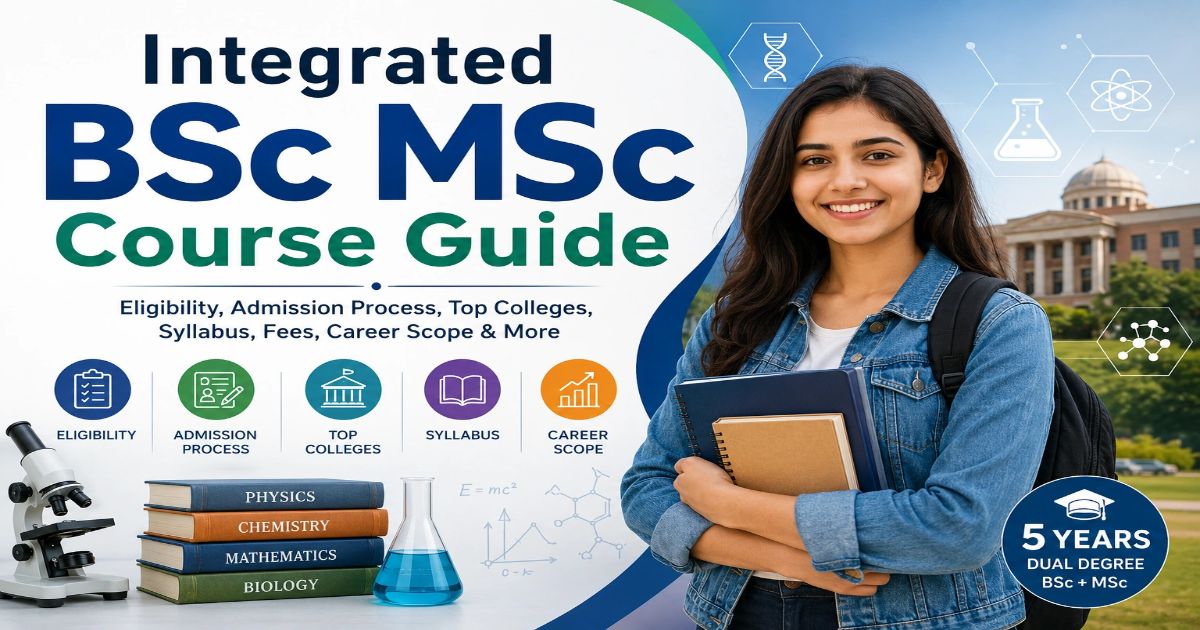
Integrated BSc MSc is a 5-year dual degree programme. Top colleges include IISER, NISER, University of Hyderabad, VIT, DTU and others. Fees can range from Rs. 1-10 lakhs for the whole course.
An integrated BSc MSc course provides an accelerated and comprehensive academic journey, allowing students to earn both undergraduate and postgraduate degrees in a single, continuous program. This dual degree typically spans 5 years with total fees ranging from Rs. 1.5 – 10 lakhs for the whole course. Top colleges offering integrated BSc and MSc courses include Indian Institutes of Science Education and Research, National Institute of Science Education and Research, University of Hyderabad, Vellore Institute of Technology and Delhi Technological University.
Students preparing for Integrated BSc MSc may have to appear for entrances like CUET, NPAT, IISER, NEST and others. This course offers job opportunities like Research Scientist, College Professors, Senior Laboratory Scientist, Food and Drugs Inspectors and Technical Consultant. This article delves into the structure, admission process, top colleges, and career prospects for integrated BSc MSc programs in 2026.
Integrated BSc MSc Dual Degree 2026: Full Form, Duration, Structure
This section covers Integrated BSc MSc Dual Degree 2026: Full Form, Duration, Structure with the key figures and details from the latest verified sources.
| Particular | Details |
| Course Name | Integrated B.Sc.-M.Sc. (Dual Degree) |
| Course Level | Undergraduate + Postgraduate |
| Course Duration | 5 Years (10 Semesters) |
| Eligibility | Class 12 (Science stream) from a recognised board |
| Admission Mode | Merit-based and/or entrance exam (CUET UG, IISER IAT, NEST, university-level tests) |
| Minimum Marks | Generally 50%–60% aggregate in Class 12 |
| Popular Specialisations | Physics, Chemistry, Mathematics, Biotechnology, Biological Sciences, Computer Science, Data Science, Environmental Science |
| Course Structure | Continuous curriculum combining undergraduate and postgraduate studies |
| Degree Awarded | B.Sc. + M.Sc. (or Integrated M.Sc./BS-MS, depending on the university) |
| Average Course Fees | ₹50,000–₹10 lakh (varies by institution) |
| Higher Education Options | Ph.D., M.Phil. (where applicable), Research Fellowships, International Master’s/Doctoral programmes |
| Career Areas | Research, Biotechnology, Healthcare, Data Science, Academia, Pharmaceuticals, IT, Environmental Science, Government Research Labs |
Integrated BSc MSc Eligibility Criteria and Admission Process
The admission process for bsc msc integrated courses in 2026 involves various criteria, including performance in 10+2 examinations and specific entrance tests.
| Eligibility Criteria | Details |
| Educational Qualification | Candidates must have passed Class 12 (10+2) or an equivalent examination from a recognised board. |
| Required Stream | Most programmes require a Science background. Students should have studied PCM, PCB, or PCMB depending on the chosen specialisation (e.g., Physics, Chemistry, Mathematics, Biology, Biotechnology, Computer Science). |
| Minimum Marks | Most universities require 50%–60% aggregate marks in Class 12. Reserved category candidates may receive relaxation as per institutional or government norms. |
| Admission Process | Candidates must fill out the application form on the respective university’s admission portal, appear for the required entrance exam (if applicable), participate in counselling or document verification, and complete fee payment after seat allotment.
Some universities also offer direct merit-based admission based on Class 12 marks. |
| Entrance Exams | Admission may be based on national or university-level entrance exams such as CUET UG, NEST, IISER Aptitude Test (IAT), JEE Main/Advanced, or institute-specific entrance tests. Some universities also offer merit-based admission. |
| Subject Requirements | Universities may specify compulsory subjects such as Physics, Chemistry, Mathematics, or Biology according to the selected Integrated BSc MSc specialisation. |
| Age Limit | Most universities do not prescribe a specific age limit, though candidates must satisfy the eligibility criteria of the respective institution or entrance examination. |
| Nationality | Indian nationals are generally eligible. Several universities also accept applications from NRIs, OCI, PIO, and foreign nationals under applicable admission guidelines. |
People Also Read

Entrance Exams for Integrated BSc MSc Admission
Several entrance exams, including CUET and NEST, are crucial for admission to various BSc and bsc msc integrated courses across central universities and specialized institutions.
| Entrance Exam | Details |
| CUET | Accepted by central universities such as the Delhi University (DU) and Banaras Hindu University (BHU). |
| NPAT | Conducted by NMIMS for admission into their BSc programs. |
| IISER | To get admission in the Indian Institutes of Science Education and Research. |
| NEST | Which is referred to as NEST by NISER and UM-DAE CEBS for integrated science education. |
| PUBDET | Conducted by Presidency University for admission into their BSc programs. |
| IPU CET | University-level test for UG courses, including B.Com Hons. |
| SET | Entrance exam for UG admissions to Symbiosis colleges in India. |
Top Integrated BSc MSc Colleges 2026: Rankings, Fees, Specializations
India boasts 209 integrated BSc-MSc colleges in 2026, providing diverse academic pathways. This section highlights leading institutions, their locations, fee structures, and the range of courses offered for a bsc msc integrated course.
| College | Location | Ownership | Approx. Fees (Total) | Popular Integrated Programmes |
| Indian Institutes of Science Education and Research | Pune, Kolkata, Mohali, Bhopal, Thiruvananthapuram, Tirupati, Berhampur | Central Government | ₹1.5–4 lakh | BS-MS (Biology, Chemistry, Mathematics, Physics, Earth & Environmental Sciences) |
| National Institute of Science Education and Research | Bhubaneswar, Odisha | Central Government | Fully funded + scholarship | Integrated B.Sc.-M.Sc. in Biological, Chemical, Mathematical and Physical Sciences |
| University of Hyderabad | Hyderabad, Telangana | Central University | ₹1–2 lakh | Integrated M.Sc. in Mathematics, Physics, Chemistry, Biology, Earth Sciences |
| Vellore Institute of Technology | Tamil Nadu | Deemed University | ₹7–10 lakh | Integrated M.Sc. Biotechnology, Chemistry, Mathematics, Physics, Data Science, Food Science |
| Delhi Technological University | New Delhi | State University | ₹6–8 lakh | Integrated B.Sc.-M.Sc. in Applied Mathematics, Physics, Chemistry, Biotechnology, Humanities |
| Amity University | Uttar Pradesh | Private | ₹6–10 lakh | Integrated B.Sc.-M.Sc. in Biotechnology, Physics, Chemistry, Mathematics |
| Savitribai Phule Pune University | Maharashtra | State University | ₹2–4 lakh | Integrated M.Sc. in Biotechnology, Bioinformatics and allied sciences |
| Institute of Bioinformatics and Biotechnology | Maharashtra | State University | ₹3–5 lakh | Integrated M.Sc. Biotechnology |
| Somaiya School of Basic and Applied Sciences | Mumbai, Maharashtra | Private | ₹8–10 lakh | Integrated BS-MS in Physics, Chemistry, Mathematics, Life Sciences |
| Mahatma Gandhi University | Kerala | State University | ₹1–2 lakh | Integrated M.Sc. in Physics, Chemistry, Computer Science, Life Sciences, Environmental Science |
| The IIS University | Jaipur, Rajasthan | Deemed University | ₹3.5–4.5 lakh | Integrated B.Sc.-M.Sc. Nanoscience & Technology |
| Gauhati University | Assam | State University | Varies by department | Five-Year Integrated B.Sc.-M.Sc. under FYIMP (NEP) |
Syllabus for Integrated BSc Msc Degree
A typical Integrated B.Sc.-M.Sc. syllabus progresses from science fundamentals in the initial semesters to advanced specialization, research, internships, and dissertation work in the final year. While subjects vary by specialization and university, the curriculum generally follows the structure below:
| Year | Topics Covered |
| Year 1 | Foundation subjects including Mathematics, Physics, Chemistry, Biology (depending on specialization), Computer Fundamentals, Communication Skills, Environmental Studies, and Practical Labs. |
| Year 2 | Core discipline subjects, Data Analysis, Programming/Laboratory Techniques, Statistics, Elective Courses, Research Fundamentals, and Mini Projects. |
| Year 3 | Advanced core subjects, Analytical Techniques, Domain-specific electives, Research Methodology, Skill Enhancement Courses, Practical Training, and Minor Project. |
| Year 4 | Postgraduate-level specialization papers, Advanced Laboratory Work, Seminar, Internship/Industrial Training, Interdisciplinary Electives, and Research Proposal. |
| Year 5 | Advanced specialization, Dissertation/Thesis, Major Research Project, Viva Voce, Scientific Writing, Publication/Presentation, and Comprehensive Examination. |
Integrated BSc MSc vs Separate Degrees: Pros and Cons 2026
Choosing between an integrated BSc MSc course and separate degrees involves weighing several factors. An integrated program typically saves one year in total duration and is generally more economical, offering a streamlined curriculum. This comparison highlights key differences to help prospective students decide.
| Feature | 5-Year Integrated Course | Separate Bachelors & Masters |
| Total Duration | 5 Years (Saves 1 year in many cases) | 5 to 6 Years (3+2 or 4+2) |
| Entrance Exams | One major exam after Class 12 | Two exams (UG entrance and PG entrance) |
| Curriculum | Streamlined and continuous | Broad UG foundation, specialized PG |
| Flexibility | Lower (committed to one field/college) | Higher (can change subjects/universities) |
| Cost | Generally more economical | Higher (separate admission/hostel fees) |
| Exit Options | Available under NEP (Bachelor’s exit) | Natural exit after 3 or 4 years |
Integrated BSc MSc Career Scope 2026: Job Roles, Salary, Future Prospects
An integrated BSc MSc course offers diverse career opportunities across various sectors, preparing graduates for leading roles. This section details potential job roles, average salaries, and specific opportunities in both government and private companies, highlighting the promising future prospects for this dual degree.
| Sector | Company | Job Designation | Salary |
| Government | Union public service | Research Scientist | INR 4 – 11 LPA |
| Government | T&M service consulting | College Professors | INR 2 – 9 LPA |
| Government | Lab technician | Senior Laboratory Scientist | INR 10 LPA |
| Government | Union public service commission | Food and Drugs Inspectors | INR 5 – 10 LPA |
| Private | TATA Group | Technical Consultant | INR 20 LPA |
| Private | The Godrej Group | Technical Sales Executive | INR 12 LPA |
| Private | Infosys | Software Developer | INR 11 LPA |
| Private | Wipro | Computer Engineer | INR 20 LPA |
VIT & DTU Integrated BSc MSc Programs Comparison 2026
This section compares integrated BSc MSc programs offered by VIT and DTU, highlighting their admission processes and program specifics. VIT offers various 5-year integrated M.Sc. programs for the 2026-27 academic year based on qualifying examination performance, while DTU’s integrated BSc & MSc programs for 2025-26 require a CUET-(UG) score.
| University | Program Name | Admission Year | Entrance Examination | Admission Basis |
| VIT Vellore | Integrated M.Sc. Data Science (5 year) | 2026-27 | NO ENTRANCE EXAMINATION | Performance in the qualifying examination (+2) |
| VIT Vellore | Integrated M.Sc. Food Science and Technology (5 year) | 2026-27 | NO ENTRANCE EXAMINATION | Performance in the qualifying examination (+2) |
| VIT Vellore | Integrated M.Sc. Biotechnology (5 year) | 2026-27 | NO ENTRANCE EXAMINATION | Performance in the qualifying examination (+2) |
| VIT Vellore | Integrated M.Sc. Physics (5 Year) | 2026-27 | NO ENTRANCE EXAMINATION | Performance in the qualifying examination (+2) |
| VIT Vellore | Integrated M.Sc. Chemistry (5 Year) | 2026-27 | NO ENTRANCE EXAMINATION | Performance in the qualifying examination (+2) |
| VIT Vellore | Integrated M.Sc. Mathematics (5 Year) | 2026-27 | NO ENTRANCE EXAMINATION | Performance in the qualifying examination (+2) |
| VIT Bhopal | Integrated M.Sc. Biotechnology | 2026-27 | NO ENTRANCE EXAMINATION | Performance in the qualifying examination (+2) |
| VIT Bhopal | Integrated M.Sc. Computational Statistics and Data Analytics | 2026-27 | NO ENTRANCE EXAMINATION | Performance in the qualifying examination (+2) |
| DTU | Integrated BSc & MSc in Biotechnology | 2025-26 | Common University Entrance Test: CUET-(UG)-2025 | Merit list prepared by CUET-(UG)-2025 score among registered students at the DTU portal |
| DTU | Integrated BSc & MSc in Chemistry | 2025-26 | Common University Entrance Test: CUET-(UG)-2025 | Merit list prepared by CUET-(UG)-2025 score among registered students at the DTU portal |
| DTU | Integrated BSc & MSc in Economics | 2025-26 | Common University Entrance Test: CUET-(UG)-2025 | Merit list prepared by CUET-(UG)-2025 score among registered students at the DTU portal |
| DTU | Integrated BSc & MSc in Mathematics | 2025-26 | Common University Entrance Test: CUET-(UG)-2025 | Merit list prepared by CUET-(UG)-2025 score among registered students at the DTU portal |
| DTU | Integrated BSc & MSc in Physics | 2025-26 | Common University Entrance Test: CUET-(UG)-2025 | Merit list prepared by CUET-(UG)-2025 score among registered students at the DTU portal |
Frequently Asked Questions
1. What is an Integrated BSc MSc course?
An Integrated BSc MSc course is a five-year dual-degree programme that combines undergraduate and postgraduate science education into one continuous curriculum, allowing students to earn both degrees without separate admissions.
2. What are the eligibility criteria for an Integrated BSc MSc course?
Candidates must have completed Class 12 with a Science stream from a recognised board. Most universities require 50–60% aggregate marks and may also conduct entrance examinations for admission.
3. Which entrance exams are accepted for Integrated BSc MSc admission?
Common entrance exams include CUET UG, NEST, IISER Aptitude Test (IAT), NPAT, and institute-level entrance tests. Some universities also grant admission based on Class 12 merit.
4. What is the average fee for an Integrated BSc MSc course in India?
The total course fee generally ranges from ₹50,000 to ₹10 lakh, depending on the institution. Government universities are more affordable, while private universities typically charge higher tuition fees.
5. What career opportunities are available after completing an Integrated BSc MSc degree?
Graduates can pursue careers as research scientists, laboratory scientists, professors, technical consultants, data scientists, and professionals in biotechnology, pharmaceuticals, healthcare, and government research organisations.
6. Is an Integrated BSc MSc better than pursuing separate BSc and MSc degrees?
An Integrated BSc MSc course saves time, offers a seamless curriculum, and can be more cost-effective. However, separate degrees provide greater flexibility to change universities or specialisations later.