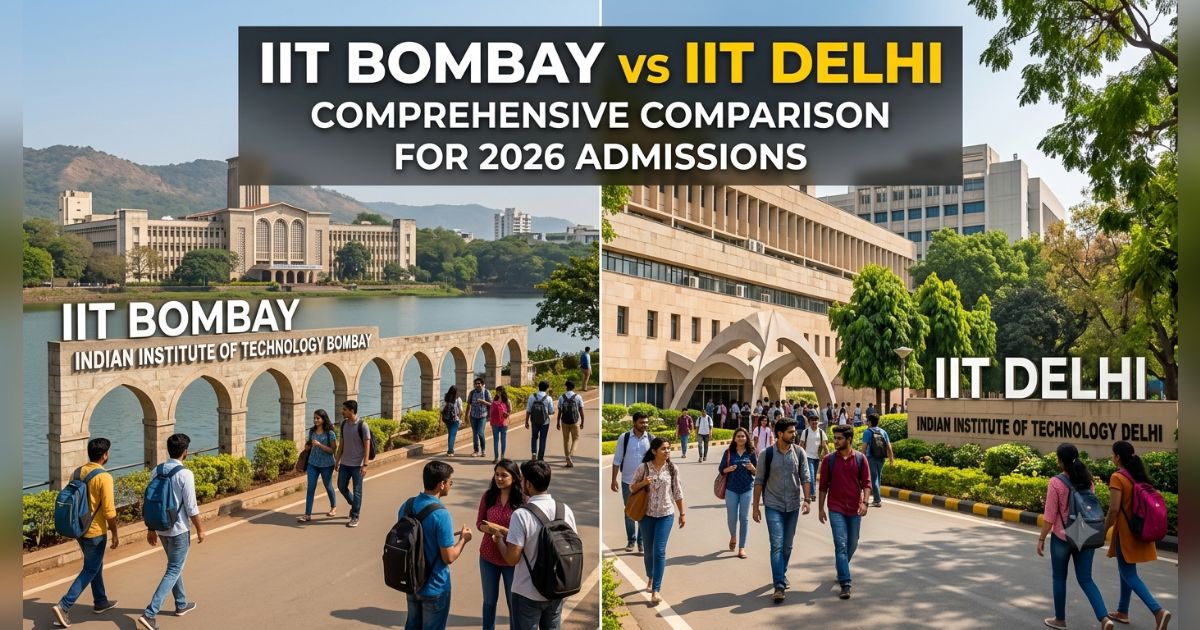
IIT Bombay vs IIT Delhi: Comprehensive Comparison for 2026 Admissions
The Joint Seat Allocation Authority (JoSAA) establishes the category-wise opening and closing ranks for IIT admissions, precisely determining which candidates secure a seat in premier institutions like IIT Bombay or IIT Delhi. These ranks, derived from JEE Advanced performance, define the admission benchmarks across General, OBC-NCL, EWS, SC, ST, and PwD categories. For instance, the IIT Delhi 2025 Entry Fee Document, processed via JoSAA, outlined ₹30,000 for Gen/OBC-NCL/EWS candidates and ₹15,000 for SC/ST/PwD. This rigorous allocation process contributes to IIT Bombay consistently attracting the highest concentration of top 100 rankers.
IIT Bombay vs IIT Delhi: Overall Rankings and Perception 2026
Aspirants frequently rank IIT Bombay and IIT Delhi among India’s best engineering colleges, with IIT Delhi retaining its position as India’s highest-ranked university in the QS World University Rankings 2027 Perception. This section details a comprehensive comparison.
| Parameter | IIT Bombay | IIT Delhi | IIT Madras |
| NIRF Ranking | #3 | #2 | #1 |
| Established | 1958 | 1961 | 1959 |
| Location | Powai, Mumbai, Maharashtra – 400076 | Hauz Khas, New Delhi, Delhi – 110016 | Chennai, Tamil Nadu – 600036 |
| Courses Offered | 141+ | 153+ | 132+ |
| Faculty Count | 700+ | 650+ | 600+ |
| B.Tech Fees | ₹2.2 L/yr | ₹2.2 L/yr | ₹2.3 L/yr |
| Hostel Fees | ₹25,000/semester | ₹20,000/semester | ₹20,000/semester |
| Average Package | ₹23.50 L | ₹25.82 L | ₹21.48 L |
| Highest Package | ₹1.0 Cr | ₹2.0 Cr | ₹4.3 Cr |
| Placement Rate | 98% | 95% | 94% |
| Overall Rating | 4.4/5 | 4.4/5 | 4.4/5 |
IIT Bombay CSE vs IIT Delhi CSE: Program & Placement Analysis 2026
IIT Bombay and IIT Delhi remain the two most sought-after CSE programmes in India, both delivering near 100 percent placement and exceptionally high packages, but the two institutes now show a notable shift in global rankings for 2026. IIT Bombay offers 110 seats with fees of about INR 1,13,000 per semester, while IIT Delhi has 93 seats at around INR 1,10,000 per semester.
| Parameter | IIT Bombay | IIT Delhi |
| NIRF 2025 Rank | 3rd overall, 3rd in Engineering | 4th overall, 2nd in Engineering |
| QS World Ranking 2026 | 129th globally | 123rd globally, ahead of IIT Bombay for the first time |
| CSE JEE Advanced closing rank, Open category | Roughly 60 to 80 | Roughly 80 to 100 |
| CSE average package, 2025-26 season | Approximately Rs. 38 to 45 LPA domestic | Approximately Rs. 30 to 45 LPA |
| CSE median package | Around Rs. 28 LPA | Around Rs. 24 to 28 LPA |
| CSE highest package | Rs. 2 to 2.4 Cr, including international offers | Rs. 1.5 to 2 Cr |
| Overall placement rate | Around 92 to 95 percent | Around 90 to 94 percent |
| Top recruiters | Google, Microsoft, Rubrik, DE Shaw, Jane Street, Citadel, Meta | Microsoft, Google, Goldman Sachs, Zomato, Amazon, McKinsey |
Ranking shift for 2026
The most important update this year is that IIT Delhi has overtaken IIT Bombay in the QS World University Rankings 2026, climbing 27 places to 123rd position, while IIT Bombay slipped slightly to 129th. This is IIT Delhi’s best-ever global ranking and marks the first time it has surpassed IIT Bombay in QS history, even though IIT Bombay still holds a stronger position in NIRF’s domestic Engineering category.
Placement performance
IIT Bombay continues to lead in extreme-value packages, largely due to strong quant trading and international tech recruitment, with average CSE packages around Rs. 38 to 45 LPA and top offers going beyond Rs. 2 crore from firms like Jane Street, Citadel, and Two Sigma. IIT Delhi remains extremely competitive, with CSE averages in a similar Rs. 30 to 45 LPA range, and it benefits from its Delhi NCR location, giving students easier access to corporate offices, internships, and networking opportunities in Gurugram and Delhi.
Both institutes report placement rates well above 90 percent, and both draw from a similar cluster of top-tier recruiters, including Microsoft, Google, and major finance and consulting firms. IIT Bombay generally reports a slightly higher share of international offers, which pushes its overall highest package figures marginally above IIT Delhi’s.
What this means for JEE aspirants
If your priority is the highest possible package ceiling and strongest international recruiter exposure, IIT Bombay CSE has consistently held a slight edge due to its quant finance and global tech pipeline. If you value the newly improved global academic ranking, location advantage, and equally strong average packages, IIT Delhi CSE is now an even more compelling choice than before, especially given its historic climb in the QS rankings.jeecounselling+3
In practical terms, the two institutes remain extremely close in placement outcomes, and the real differentiator for most students will come down to seat availability at your JEE Advanced rank, campus location preference, and specific research interests within CSE.
IIT Bombay vs IIT Delhi Placements: Highest CTC & Median Salary 2026
For 2026 aspirants, the 2025 season provides the most recent complete placement figures. IIT Delhi secured the highest international package of ₹2.5 crore for 2025-26, while IIT Bombay’s highest package reached ₹2.2 crore. This section details the placement performance of both institutions, focusing on MBA programs.
| Particulars | IIT Delhi (DMS) | IIT Mumbai (SJMSoM) |
| Highest CTC | INR 43,55,300 | INR 53,80,000 |
| Average CTC | INR 22,52,966 | INR 25,82,000 |
| Median CTC | INR 22,50,782 | INR 25,25,000 |
IIT Bombay vs IIT Delhi: Which has Better ROI?
Return on investment depends on total fees paid against realistic earning outcomes, not just headline packages, and the honest picture for both IITs looks quite different from what marketing figures suggest. For B.Tech CSE, total tuition fees at both institutes are nearly identical, at around Rs. 8 to 10 lakh for the full four-year programme, which means the real ROI differentiator comes down to placement consistency and median salary rather than fees.
| ROI Metric | IIT Bombay | IIT Delhi |
| Total B.Tech fees, 4 years | Approximately Rs. 8 to 10 lakh | Approximately Rs. 8 to 10 lakh |
| CSE seats | 198, per JoSAA seat matrix | 99, per JoSAA seat matrix |
| CSE JEE Advanced closing rank, 2026 Round 1, Open | AIR 65 | AIR 123 |
| Overall B.Tech median package, 2024-25 | Rs. 17.9 lakh | Rs. 20.0 lakh |
| Overall placement rate | Around 75 percent | Around 96 percent |
| CSE average package | Rs. 35 to 50 LPA | Rs. 30 to 45 LPA |
| CSE median package | Higher variance, strong outliers | Around Rs. 24 to 28 LPA, more consistent |
| Highest package | Rs. 2.2 crore, largely international | Rs. 1.5 to 2 crore |
| Location advantage | Strong startup and VC ecosystem in Mumbai, SINE incubator | Direct access to Gurugram-NCR tech and consulting corridor |
The real ROI picture
The most important correction to make here is that headline “highest package” numbers are misleading indicators of ROI. IIT Madras, for example, advertised a highest package of Rs. 4.3 crore in 2024-25, yet its actual B.Tech median was only Rs. 19.13 lakh, showing how far outlier offers can be from the typical outcome. The same pattern applies to IIT Bombay and IIT Delhi, where the real “typical” ROI outcome sits far closer to the median than the highest package figure suggests.
On overall placement consistency, IIT Delhi has a clear edge, with around 96 percent of B.Tech students placed compared to roughly 75 percent at IIT Bombay in the same reporting cycle, based on RTI-sourced data. This is a critical ROI factor, since a lower placement rate directly increases financial risk for students who do not land a job through campus recruitment.
Where IIT Bombay pulls ahead
Despite the placement percentage gap, IIT Bombay has historically delivered stronger extreme-value outcomes in CSE specifically, with average CSE packages estimated at Rs. 35 to 50 LPA against IIT Delhi’s Rs. 30 to 45 LPA, largely driven by international quant finance and top-tier tech offers. IIT Bombay also retains the tougher entry bar, with its CSE programme closing at AIR 65 in JoSAA 2026 Round 1 versus AIR 123 for IIT Delhi, reflecting continued high demand from top-ranking students.
Where IIT Delhi pulls ahead
IIT Delhi’s biggest ROI advantage is placement reliability combined with location. Its near 96 percent B.Tech placement rate is one of the strongest in the entire IIT system, and its Delhi-NCR location gives students direct access to Gurugram’s dense corporate and consulting ecosystem, adding recruiters like Zomato, Paytm, and Flipkart to its pool beyond the standard tech and finance names. For a large majority of students who will land median-range offers rather than outlier packages, IIT Delhi’s consistency makes it a statistically safer investment.
Verdict
If your goal is to maximise the ceiling, meaning the best possible chance at an extreme international package in CSE, IIT Bombay carries a marginal edge, largely due to its quant finance pipeline and slightly higher CSE closing demand. If your goal is to maximise the realistic, statistically likely ROI, meaning a strong median salary with a much higher chance of actually getting placed, IIT Delhi is the stronger choice, given its near 96 percent placement rate compared to IIT Bombay’s roughly 75 percent in the same reported cycle.
For most students, the practical verdict favours IIT Delhi on pure ROI grounds, because a guaranteed strong outcome for a much larger share of students outweighs a slightly higher ceiling that only a small fraction of graduates actually reach. IIT Bombay remains the better pick specifically for students confident about competing for the very top recruiter tier, since its brand and outlier outcomes in that segment remain unmatched.
Campus Life & Culture: IIT Bombay vs IIT Delhi Student Experience 2026
This section explores the distinct student experiences at IIT Bombay vs IIT Delhi, highlighting their unique campus environments, opportunities, and student preferences for the 2026 academic year. You will discover how each institution caters to different aspirations, from urban connectivity to a self-contained green township.
- IIT Bombay Campus Environment: Widely regarded as one of India’s most beautiful, with lake views and lush greenery.
- IIT Delhi Campus Environment: Compact, urban, green; offers easy access to Delhi’s restaurants, metro, and entertainment.
- IIT Bombay Opportunities: Better networking and internships due to proximity to Mumbai’s corporate and tech-finance ecosystem.
- IIT Delhi Opportunities: Strong proximity to government research, Gurugram tech startups, and cultural hubs.
- IIT Bombay Preference: Preferred by students desiring a larger, greener, isolated campus; also by most JEE toppers.
- IIT Delhi Preference: Preferred by students valuing urban access and Delhi’s vibrant culture.
These preferences highlight a clear divergence: students seeking a serene, self-contained academic haven often choose the former, while those prioritizing urban integration and capital city advantages gravitate towards the latter. Your choice depends on your desired lifestyle.
| Aspect | IIT Bombay | IIT Delhi |
| Campus Size | 550 acres | 325 acres |
| Campus Location | Powai, Mumbai — India’s financial capital | Hauz Khas, South Delhi — heart of the national capital |
The data clearly shows the size and strategic location differences, with one offering a significantly larger campus in the financial capital, and the other a more compact campus in the national capital’s heart.
IIT Bombay vs IIT Delhi: Fees, Courses, and GATE Accepted 2026
This section provides a detailed comparison of IIT Bombay vs IIT Delhi, highlighting key differences in their B.Tech fees, hostel charges, and the extensive range of courses each institution offers. Applicants gain admission through countrywide tests like GATE and JEE Advanced.
| Parameter | IIT Bombay | IIT Delhi |
| B.Tech Fees | ₹2.2 L/yr | ₹2.2 L/yr |
| Hostel Fees | ₹25,000/semester | ₹20,000/semester |
| Courses Offered | 141+ | 153+ |
Frequently Asked Questions
What are the JEE Advanced 2025 cutoff ranks for CSE at IIT Bombay and IIT Delhi?
For JEE Advanced 2025 CSE, IIT Bombay’s Round 3 cutoff ranks were 1-66, while IIT Delhi’s were 24-125.
Which has better CSE placements — IIT Bombay or IIT Delhi?
IIT Bombay and IIT Delhi consistently show slightly higher average placements than other IITs, making both top choices for CSE.
Which one is on top, IIT Bombay or IIT Delhi?
IIT Bombay is often rated higher when comparing factors like placements, cutoffs, and rankings against IIT Delhi.
What is IIT Bombay vs IIT Delhi?
IIT Bombay and IIT Delhi are premier institutions, both excelling in research and placements. IIT Bombay’s M.E./M.Tech median salary is ₹15 L – 17.92 L. They differ in campus location and specific academic strengths.
What are the eligibility requirements for IIT Bombay vs IIT Delhi?
Eligibility for both IIT Bombay and IIT Delhi admissions requires qualifying accepted exams, including JEE Main and two other specified tests.
How do I apply for IIT Bombay vs IIT Delhi?
Admission to IIT Bombay and IIT Delhi is primarily through JEE Advanced for undergraduate courses and GATE for M.E./M.Tech programs.